Custom Adventure Chinese & Japanese Calligraphy Wall Scroll
We have many options to create artwork with Adventure characters on a wall scroll or portrait...
...We could also help you create an Adventure Asian Tattoo.
Adventure
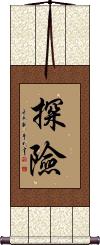
If you lead a life of adventure (like I do), a 探險 wall scroll is for you.
Alone, the first character can mean “to explore,” “to search out,” or “to scout.” The second character holds the meanings of “dangerous” and “rugged.” Together these two characters create the word that means “adventure” or “to explore.”
探険 is a modern Japanese Kanji version, but it more precisely means exploration or expedition rather than adventure. 探險 is the old/ancient Japanese version used before WWII. Let us know if you want the modern Japanese version instead.
See Also: Bon Voyage | Travel
Adventure
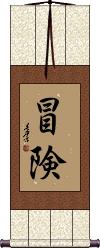
冒険 is a common Japanese way to say “Adventure.”
The first character can mean “to risk,” “to defy” or “to dare.” The second character means “inaccessible place” or “impregnable position.” Together, you get the idea of why these two characters mean adventure when put them together in Japanese.
Note: The second character is a morphed Japanese Kanji. The original Chinese version is also available and holds the same root meaning.
Adventure Lover
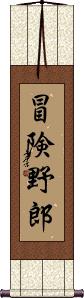
冒険野郎 is a Japanese title that means “adventure lover.”
This literally means something like “adventure wild man.”
This is a funny choice for a wall scroll, but it's a legitimate word in Japanese.
Adventure
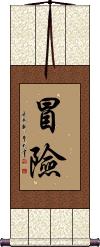
冒險 is another Chinese and Korean word for “Adventure.”
This is more of a “risk-taking” version of adventure.
The first character can mean “brave” and “bold.” The second character means “dangerous” and “rugged.” Together they can be defined as a word meaning “adventure” in Chinese and Korean.
Note: Some dictionaries translate these two characters as “take a risk.”
Journey / Travel
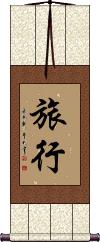
旅行 means journey or travels. It is sometimes used to refer to a vacation.
If you like a good adventure, maybe this is the word for you.
Fortuitous Meeting
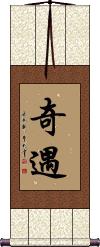
奇遇 can mean happy encounter, fortuitous meeting, adventure, unexpected meeting, or coincidence.
Smooth Sailing
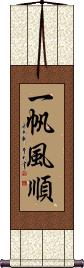
一帆風順 is just what you think it means. It suggests that you are on a trouble-free voyage through life, or literally on a sailing ship or sailboat. It is often used in China as a wish for good luck on a voyage or as you set out on a new quest or career in your life. Some may use this in place of “bon voyage.”
The literal meaning is “Once you raise your sail, you will get the wind you need, and it will take you where you want to go.” Another way to translate it is “Your sail and the wind follow your will.”
This is a great gift for a mariner, sailor, adventurer, or someone starting a new career.
Note: Can be understood in Korean Hanja but is rarely used.
See Also: Bon Voyage | Travel
Tiger
Year of the Tiger / Zodiac Sign
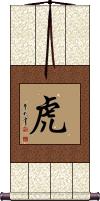
虎 is the character for tiger in Chinese, old Korean Hanja, and Japanese Kanji.
Since you already know what a tiger is, here's some trivia: If you look at the Japanese pronunciation, you might remember a movie called “Tora Tora Tora” which was the code word used to initiate the attack on Pearl Harbor. It simply means “Tiger Tiger Tiger.”
In Chinese culture, the tiger is considered to be the king of all animals (in much the way we see the lion in western culture).
From the Chinese Zodiac, if you were born in the year of the tiger, you . . .
Have a strong personality.
Are full of self-confidence.
Love adventure
Don't like to obey others.
See also our Chinese Zodiac or Tiger Calligraphy pages.
The following table may be helpful for those studying Chinese or Japanese...
| Title | Characters | Romaji (Romanized Japanese) | Various forms of Romanized Chinese | |
| Adventure | 探險 探险 / 探険 | tanken | tàn xiǎn / tan4 xian3 / tan xian / tanxian | t`an hsien / tanhsien / tan hsien |
| Adventure | 冒険 | bou ken / bo ken | ||
| Adventure Lover | 冒険野郎 | bou ken ya rou boukenyarou bo ken ya ro | ||
| Adventure | 冒險 冒险 | mào xiǎn / mao4 xian3 / mao xian / maoxian | mao hsien / maohsien | |
| Journey Travel | 旅行 | ryokou / ryoko | lǚ xíng / lv3 xing2 / lv xing / lvxing | lü hsing / lühsing |
| Fortuitous Meeting | 奇遇 | ki guu / kiguu / ki gu | qí yù / qi2 yu4 / qi yu / qiyu | ch`i yü / chiyü / chi yü |
| Smooth Sailing | 一帆風順 一帆风顺 | yī fán fēng shùn yi1 fan2 feng1 shun4 yi fan feng shun yifanfengshun | i fan feng shun ifanfengshun |
|
| Tiger | 虎 | tora | hǔ / hu3 / hu | |
| In some entries above you will see that characters have different versions above and below a line. In these cases, the characters above the line are Traditional Chinese, while the ones below are Simplified Chinese. | ||||



