There are thousands of
Buddhist terms and titles.
If what you want is not
here, please contact me,
and I'll help you get what
you need.
Chinese & Japanese Buddhism Calligraphy Wall Scrolls
You can choose from many custom options to create artwork with Buddhism characters on a wall scroll or portrait/
Start by clicking on a "Customize & Buy" button below...
Switched to secondary search mode due to lack of results using primary.
These secondary results may not be very accurate. Try a different but similar meaning word or phrase for better results. Or...
Look up in my Japanese Kanji & Chinese Character Dictionary(My dictionary is a different system then the calligraphy search you just tried)
If you want a special phrase, word, title, name, or proverb, feel free to contact me, and I will translate your custom calligraphy idea for you.
1. 1. Right Understanding / Right Perspective / Right View / Perfect View
3. 2. Right Resolve / Right Thought / Right Intention / Perfect Resolve
4. 3. Right Speech / Right Talk / Perfect Speech
5. 4. Right Action / Perfect Conduct
6. 5. Right Living / Right Livelihood / Perfect Livelihood
7. 6. Right Effort / Right Endeavor / Perfect Effort
8. 7. Right Mindfulness / Right Memory / Perfect Mindfulness
9. 8. Right Concentration / Perfect Concentration
10. In the Abyss of Infinite Bitterness - Turn to the Shore
12. Adapt Oneself
14. Kind Words
15. Sky / Void
16. Akemi
18. Sorry / Apologetic / Repent / Regret
19. Appreciation of Truth by Meditation
20. Ardent / Fierce
21. Ascend
22. Avatar
23. Awareness
24. Unmoved by the Eight Winds
27. Benzaiten
30. Ultimate Truth
31. Big Dream
32. Blue Lotus
33. Bodhi - Awakening Enlightenment
34. The Tree of Enlightenment / The Bodhi Tree
35. Bodhicitta: Enlightened Mind
36. Bodhidharma
38. Bodhidharma
39. The Bodhi Mind
40. Bodhisattva
41. Body / Karada
42. Body and Mind
44. Brahmavihara - The Four Immeasurables
45. Breath of Life
46. Brown
47. Wisdom and Insight of the Buddha
50. Triple Truth of Japanese Buddhism
51. Happy Buddha
52. Buddha Seeking
54. Buddha Heart / Mind of Buddha
55. Seeing one’s Nature and becoming a Buddha
56. The Buddha Realm / Buddhahood
59. Buddhism
60. Koan
61. No Trouble / Freedom from Problems
62. Buddha Way
63. The Principles of Buddhism
64. The Buddha is in Each Sentient Being
69. Compassionate Heart / Benevolent Heart
70. The True and Complete Enlightenment
71. Confidence / Faithful Heart
72. The Law of Creation and Destruction
73. Give Up Desire
74. Great Wisdom
75. Great Illumination of Wisdom
76. The Great Path has No Gate
77. Dana: Almsgiving and Generosity
78. Dark Sister
80. Demon Slayer
81. Devotion / Diligence / Vigorous / Energetic
82. Dew
83. Dharma / Buddhist Doctrine
84. Dharma / The Law
85. Dharma Gate
86. Stay Strong / Indestructible / Unbreakable
87. Diamond
88. Deities / Gods
89. Diligence
90. Divine Light
92. Divine Spirit
93. Dogen
94. Dojo / Martial Arts Studio
96. Dragon Spirit
97. Dynamic
98. Eighteen / 18
99. Amitabha Buddha
100. Enlightened Truth
1. Right Understanding / Right Perspective / Right View / Perfect View
Samyag Dristhi / Samyag Drsti / Samma Ditthi
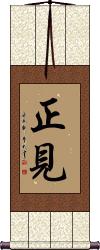
正見 is one of the Noble Eightfold Paths of Buddhism. Right View, along with the Right Thought, constitutes the path to Wisdom.
To get to the correct view of the world, you must first understand and follow Four Noble Truths.
Note: This term is exclusively used by devout Buddhists. It is not a common term, and is remains an unknown concept to most Japanese and Chinese people.
See Also: Enlightenment | Noble Eightfold Path
Ten perfect Mahayana rules
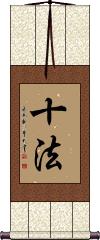
十法 is the title of the ten perfect or perfecting Mahāyāna rules.
The order of rules is as follows:
1. right belief.
2. right conduct.
3. right spirit.
4. the joy of the bodhi mind.
5. joy in the dharma.
6. joy in meditation.
7. pursuing the correct dharma.
8. obedience to, or accordance with dharma.
9. departing from pride, desire, etc.
10. comprehending the inner teaching of Buddha and taking no pleasure in attaining such knowledge or noting the ignorance of others.
This title is only used in the context of Buddhism. Japanese and Chinese people who are not familiar with Buddhism will not recognize this title.
2. Right Resolve / Right Thought / Right Intention / Perfect Resolve
Samyak Samkalpa / Samma Sankappa
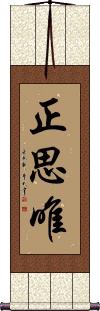
正思唯 is one of the Noble Eightfold Paths of Buddhism. Right Thought, along with the Right View, constitute the path to Wisdom.
In Buddhism, Right Thought, in simple terms, means to free yourself from having ill will towards anyone or anything. It also suggests that you remain harmless to other living creatures.
This can also be defined as “Resolve in favor of renunciation, goodwill, and non-harming of sentient beings.”
 There is an ancient/alternate version of the third character for this selection. You can see that alternation third character to the right. If you want your selection to use that older character, just click on the character to the right, instead of the button above.
Note: This term is exclusively used by devout Buddhists. It is not a common term, and is remains an unknown concept to most Japanese and Chinese people.
See Also: Enlightenment | Noble Eightfold Path
3. Right Speech / Right Talk / Perfect Speech
Samyag Vaca / Samma Vaca / Samma Vacha
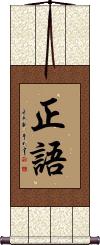
正語 is one of the Noble Eightfold Paths of Buddhism. Right Speech, along with Right Action and Right Living, constitute the path to Virtue.
Right Speech is abstaining from lying, abstaining from divisive speech, abstaining from abusive speech, abstaining from idle chatter, abstaining from slander, abstaining from gossip, or any form of harmful or wrong speech.
This term is exclusively used by devout Buddhists. It is not a common term, and is remains an unknown concept to most Japanese and Chinese people.
See Also: Enlightenment | Noble Eightfold Path
4. Right Action / Perfect Conduct
Samyak Karmanta / Samma Kammanta
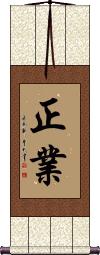
正業 is one of the Noble Eightfold Paths of Buddhism. Right Action, along with Right Speech and Right Living, constitute the path to Virtue.
The five precepts of Right Action are...
1. Refrain from destroying living beings (no murder or any form of taking a life).
2. Refrain from stealing.
3. Refrain from sexual misconduct (adultery, rape, etc.).
4. Refrain from false speech (lying or trickery).
5. Refrain from intoxicants that lead to heedlessness (no drugs or alcohol).
This concept can be summarized as “Avoidance of actions that conflict with moral discipline.”
Note: In Japanese, when read by a non-Buddhist, this will mean “the right job/vocation.”
This term is exclusively used by devout Buddhists. It is not a common term, and is remains an unknown concept to most Japanese and Chinese people.
See Also: Enlightenment | Noble Eightfold Path
5. Right Living / Right Livelihood / Perfect Livelihood
Samyag Ajiva / Samma Ajiva
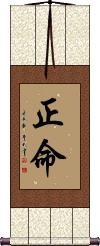
正命 (right living) is one of the Noble Eightfold Paths of Buddhism.
Right Living, along with Right Speech and Right Action, constitute the path to Virtue.
Right Living means that a Buddhist should only take a job or pursue a career in a field that does no harm. Buddhists should not work in the arms trade, as pimps or in the field of prostitution, as a butcher or in a shop that kills or sells meat, in a laboratory that does animal research, or in any other business that involves scheming or unethical behavior.
Another definition: Avoidance of professions that are harmful to sentient beings, such as slaughterer, hunter, dealer in weaponry or narcotics, etc.
This term is exclusively used by devout Buddhists. It is not a common term, and is remains an unknown concept to most Japanese and Chinese people.
See Also: Enlightenment | Noble Eightfold Path
6. Right Effort / Right Endeavor / Perfect Effort
Samyag Vyayama / Samma Vayama
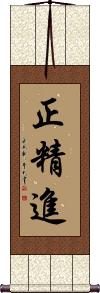
正精進 is one of the Noble Eightfold Paths of Buddhism. Right Effort, along with Right Mindfulness and Right Concentration, constitute the path to Concentration or Perfect Thought.
The proper effort is not the effort to make something particular happen. It is the effort to be aware and awake in each moment, the effort to overcome laziness and defilement, and the effort to make each activity of our daily meditation. This concept is about pursuing wholesome things that promote good karma.
Another definition: Cultivation of what is karmically wholesome and avoidance of what is karmically unwholesome.
This term is exclusively used by devout Buddhists. It is not a common term, and is remains an unknown concept to most Japanese and Chinese people.
See Also: Enlightenment | Noble Eightfold Path
7. Right Mindfulness / Right Memory / Perfect Mindfulness
Samyak Smriti / Samyak Smrti / Samma Sati
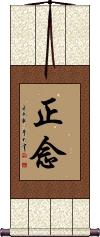
正念 is one of the Noble Eightfold Paths of Buddhism. Right Mindfulness, along with Right Effort and Right Concentration, constitute the path to Concentration or Perfect Thought.
Right Mindfulness is about remaining focused on one's body, feelings, mind, and mental qualities. It's also about being ardent, aware, and mindful, and supposes that you've already put aside worldly desire and aversion.
Monk Bhikkhu Bodhi described this as “The mind is deliberately kept at the level of bare attention, a detached observation of what is happening within us and around us in the present moment.” When practicing right mindfulness, the mind is trained to remain in the present, open, quiet, and alert, contemplating the present event.
Another definition: Ongoing mindfulness of body, feelings, thinking, and objects of thought.
This term is exclusively used by devout Buddhists. It is not a common term, and is remains an unknown concept to most Japanese and Chinese people.
See Also: Enlightenment | Noble Eightfold Path
8. Right Concentration / Perfect Concentration
Samyak Samadhi / Samma Samadhi
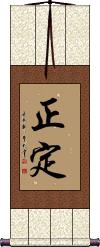
正定 is one of the Noble Eightfold Paths of Buddhism. Right Concentration, along with Right Effort and Right Mindfulness, constitute the path to Concentration or Perfect Thought.
Right Concentration has to do with leaving behind sensuality, unwholesome states, as well as pleasure and pain. 正定 is a complex idea, but once you have achieved the shedding of worldly sensation, you can truly concentrate and find a higher level of awareness.
Another definition: Concentration of mind that finds its high point in the four absorptions.
This term is exclusively used by devout Buddhists. It is not a common term, and is remains an unknown concept to most Japanese and Chinese people.
See Also: Enlightenment | Noble Eightfold Path
In the Abyss of Infinite Bitterness - Turn to the Shore
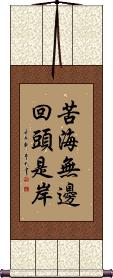
苦海無邊, 回頭是岸 can be translated almost directly as “The sea of bitterness has no bounds, turn your head to see the shore.”
Often this proverb refers to how Buddhist enlightenment can allow one to shed off the abyss of worldly suffering. But it can apply to other religions. If you find yourself trapped in the hardship of this worldly life, take a new turn, and seek a path to salvation.
Adamantine / King Kong
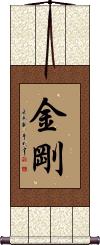
金剛 can translate as adamantine from Chinese, Japanese, and old Korean.
Other meanings and translations can include diamond, thunderbolt, Indra's indestructible weapon, a Buddhist symbol of the indestructible truth, Vajra (a mythical weapon), guardian deity, hardness, indestructibility, power, the least frangible of minerals.
The Chinese pronunciation of “Jīn Gāng” became the loanword used in English as “King Kong.” You can see King Kong as the indestructible ape guardian deity depending on how you read the story.
Adapt Oneself
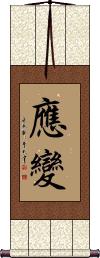
應變 means “to meet a contingency,” “to adapt oneself to changes,” or “to adapt to changes” in Chinese.
It's also used in Japanese but usually only in the context of Buddhism. 應變 is probably the shortest way to express the idea of adapting and overcoming whatever circumstances present themselves.
Adorable / Cute / Lovely
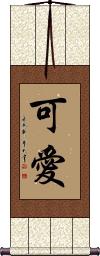
可愛 is a Chinese word that means adorable, cute, and lovely.
It also has a similar meaning in Japanese, but it's more often used as the given name Kawai.
In the Buddhist context, it can mean agreeable.
Kind Words
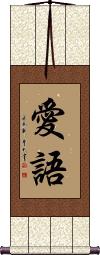
In the simplest terms, 愛語 means kind words.
In the Buddhist context, this is one of the four methods of approach to people which the bodhisattvas use to guide them to the way of the Buddha.
Other translations include loving speech or simply the words of a bodhisattva.
愛語 is also a common female name, Aigo, in Japanese.
Sky / Void
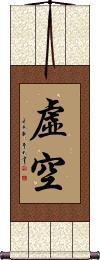
虛空 means void, hollow, empty, space, sky, atmosphere, heaven, or ether.
虛空 is the Chinese and Japanese version of the Sanskrit word ākāśa (or akasa / akash) which, beyond the sky or space meaning can be the immaterial universe behind all phenomena in the Buddhist context.
Akemi
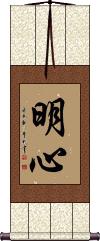
In Japanese, this is a female given name, Akemi (sometimes Meimi or Harumi).
In the Buddhist context, this title means enlightened heart.
Dharma Gate of Bliss
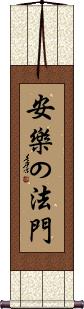
安樂の法門 represents that the Dharma Gate or the Door to Enlightenment leads to peace and happiness.
The Dharma Gate is the method of attaining or actualizing peace and happiness in Zen and other Buddhist traditions.
Sorry / Apologetic / Repent / Regret
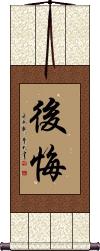
後悔 is the feeling of being or feeling repentant, apologetic, and regret.
後悔 is not sorrow.
This term is often used in the context of Buddhism and other religions.
Note: This is a strange thing to write on a wall scroll for Chinese, Japanese, and Korean people - but you can bend the rules if you want in the west.
Appreciation of Truth by Meditation
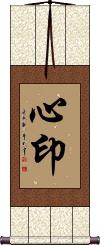
心印 is a Buddhist concept that simply stated is “appreciation of truth by meditation.”
It's a deep subject, but my understanding is that you can find truth through meditation, and once you've found the truth, you can learn to appreciate it more through further meditation. This title is not commonly used outside of the Buddhist community (your Asian friends may or may not understand it). The literal translation would be something like “the mind seal,” I've seen this term translated this way from Japanese Buddhist poetry. But apparently, the seal that is stamped deep in your mind is the truth. You just have to meditate to find it.
Soothill defines it this way: Mental impression, intuitive certainty; the mind is the Buddha-mind in all, which can seal or assure the truth; the term indicates the intuitive method of the Chan (Zen) school, which was independent of the spoken or written word.
Reference: Soothill-Hodous Dictionary of Chinese Buddhism
See Also: Zen
Ardent / Fierce
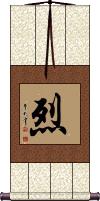
烈 is a Chinese word that means ardent; intense; fierce; stern; upright; to give one's life for a noble cause.
In another context, this character can refer to one's exploits or achievements.
In the Buddhist context, this is burning, fierce, virtuous, and/or heroic.
While technically, it had the same meaning in Japanese, it's usually a female given name, Retsu in Japanese these days.
Ascend
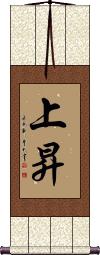
上昇 means to rise up, to go up, or to ascend in Chinese, Japanese Kanji, and old Korean Hanja.
If you are rising, ascending, or climbing, this is the word for you.
In the older Buddhist context, this means to ascend, with the implication that the destination is the heavenly realm.
Avatar
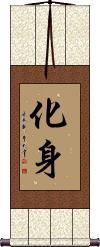
化身 is a way to say avatar in Chinese characters, Korean Hanja, and Japanese Kanji.
This is the original Buddhist idea of an avatar (not the movie). This can also mean: incarnation; reincarnation; embodiment; personification; impersonation.
化身 is the Chinese word used for the original Sanskrit, nirmāṇakāya. Alternates for nirmāṇakāya include 應身, 應化身, or 變化身. In the context of Buddhism, this is a Buddha's metamorphosic body, which has the power to assume any shape to propagate the Truth. This title, 化身, is used for the appearance of a Buddha's many forms.
Awareness
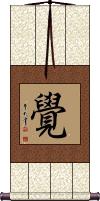
覺 can mean to feel; to figure out; thinking; awake; aware; bodhi; knowing; understanding; enlightenment; illumination; apprehend; perceive; realize.
覺 is a character that is impossible to define in a single word.
This term is often associated with Buddhism where it's understood to be: Illumination, enlightenment, or awakening in regard to the real in contrast to the seeming. However, it can also refer to enlightenment in regard to morality and evil.
Notes:
In Japanese, this can be the personal name Satoru.
In certain context, and only when pronounced as "jiao" in Chinese, it can refer to a nap, sleep or the state of sleeping. However, as a single character on a wall scroll, everyone will read this with the awareness or enlightenment context.
By no means is this the only way to write enlightenment. In fact, you should only choose this character if you are looking more for a word meaning awareness.
See Also: Enlightenment | Wisdom | Knowledge
Unmoved by the Eight Winds

八風吹不動 is an ancient Buddhist phrase from about 1000 years ago.
Literal meaning: “The Eight Winds cannot move [me].”
The original famous anecdote is from Song Dynasty China, involving the poet-official 蘇東坡 (Su Dongpo / Su Shi, 1037–1101) and Zen master 佛印 (Foyin).
Su Dongpo wrote 八風吹不動,一屁打過江
“The Eight Winds cannot move me; Yet one fart blows me across the river.”
Foyin’s irreverent reply exposed Su Dongpo’s ego, which is kind of a classic Zen/Chan teaching story.
利 gain
衰 loss
毀 disgrace
譽 praise
稱 honor
譏 ridicule
苦 suffering
樂 pleasure
“The Eight Winds cannot move [him / the mind].”
“Unmoved by the Eight Winds.”
“The Eight Winds do not move me.”
“Not moved by the Eight Winds.”
“Unshaken by the Eight Winds.”
“Unaffected by the Eight Winds.”
“Unmoved by worldly forces.”
“Steadfast against the Eight Winds.”
“Remaining unmoved amid the Eight Winds.”
There is a shorter Japanese Zen version, 八風不動, which drops the middle character. Often romanized as happū fudō. The romanization of 八風吹不動 is arguably happū fukedomo ugokazu or happū sui fudō.
Believe / Faith / Trust
śraddhā
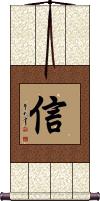
信 can mean to believe, truth, faith, fidelity, sincerity, trust, and confidence in Chinese, old Korean Hanja, and Japanese Kanji.
This single character is often part of other words with similar meanings.
It is one of the five basic tenets of Confucius.
In Chinese, it sometimes has the secondary meaning of a letter (as in the mail) depending on context but it will not be read that way when seen on a wall scroll.
In the Buddhist context, this is śraddhā (faith through hearing or being taught).
Kindness / Benevolence
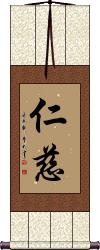
仁慈 word is used in Chinese, Korean, Japanese, and Asian Buddhism to relay the important idea of loving kindness.
仁慈 can also be defined as: benevolent; charitable; kind; merciful; kind-hearted; benevolence; kindness; humanity; mercy.
In Japanese, this can also be the given name Hitoji. This would also be a good Mandarin Chinese given name romanized as Jentzu (in Taiwan) or Renci (which sounds like ren-tsuh).
Benzaiten
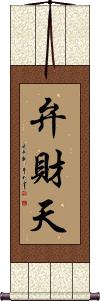
弁財天 is a Buddhist term that can be translated or transliterated as Benzaiten or Saraswati.
弁財天 is the Buddhist goddess of music, eloquence, wealth, and water.
This goddess of eloquence came into Buddhism from the Hindu goddess Saraswati. Benzaiten and Saraswati are considered by most to be one and the same. However, in Japanese culture, Benzaiten has been conflated with several other deities.
Beware of the Lawyers

提防律師 is a kind of Chinese joke about lawyers.
The first two characters mean “guard yourself against (an attack)” or “beware.”
The last two characters can be translated as lawyer, attorney, or solicitor.
Separately, those characters mean law/regulation/control and master/expert/teacher. Here, you can see the attorney meaning is pretty clear in the individual characters.
Please note this is Chinese only (it won't make sense in Japanese, and the last two characters are sometimes translated together as “Buddhist Priest” in Japanese).
Beyond / Exceed / Surpass
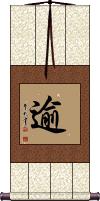
逾 means: to exceed; to go beyond; to transcend; to cross over; to jump over.
You'll see this character used in Buddhism (same meaning).
Technically, this single character is a Japanese word but is seldom used as a single Kanji in modern Japanese.
Ultimate Truth
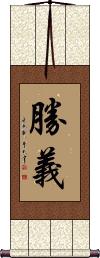
勝義 is a Buddhist term that can mean ultimate truth, beyond description, that which surpasses mere earthly ideas, superlative, or inscrutable.
In Japan, this can also be a given name romanized as Yoshitomo.
Big Dream
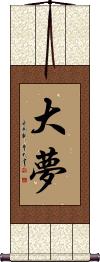
大夢 means “Big Dream” in Chinese and Japanese.
大夢 is primarily a Buddhist term referring to the great dream that represents a long and winding life that feels like a dream (since reality is an illusion anyway in Buddhism).
This can also be a female given name, Hiromu, or Oomu, in Japanese. Also, more rare unisex given names Daimu or Taimu.
Blue Lotus
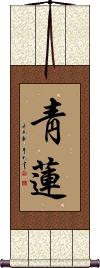
靑蓮 is a common title for Blue Lotus.
靑蓮 is often used in a Buddhist context for blue lotus from the Sanskrit “utpala.” This often refers to the clarity and purity of the lotus blue eyes possessed by a Living Buddha. It can also represent the purity of mind (without desire, suffering, fear, etc.).
Bodhi - Awakening Enlightenment
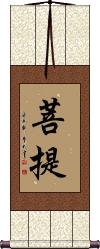
The Bodhi or 菩提 is the moment of completion in Buddhism.
It is when all things become known and you have completed your journey to enlightenment.
The reference is to the Bodhi tree where Siddhartha Gautama (the legendary man who established the Buddhist religion) achieved enlightenment. Sometimes this is referred to as “the tree of enlightenment,” but if you want the full version with the character for a tree at the end, please see the Bodhi Tree entry.
See Also: Buddha | Nirvana | Enlightenment
The Tree of Enlightenment / The Bodhi Tree
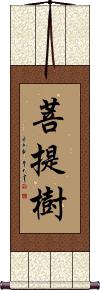
菩提樹 is the full title of the Bodhi tree (a fig tree) under which Siddhartha Gautama (the legendary man who established the Buddhist religion), achieved enlightenment.
Sometimes this is referred to as “the tree of enlightenment.” If you don't have a Bodhi tree to sit under, maybe you can achieve enlightenment under a wall scroll with this title.
Bodhicitta: Enlightened Mind
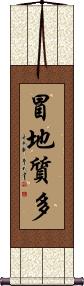
冒地質多 is a Chinese and Japanese way to write Bodhicitta.
冒地質多 is often translated as “the enlightened mind” or “enlightened heart.”
This title is strictly Buddhist and won't make sense to Chinese or Japanese people who do not have an expansive background in Buddhist terms, concepts, and scripture.
Bodhidharma
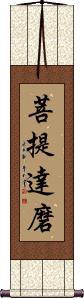
菩提達磨 is the title Bodhidharma in Chinese and Japanese.
Bodhidharma, commonly known as Damo, is reputed as the founder of the Chan (Zen) or Intuitional or Mystic School.
He likely came from south India and spread Mahayana Buddhism throughout China (even meeting the Emperor) and his disciples likely spread this all the way to Korea, Japan, and beyond in the 5th and 6th centuries.
Sometimes the last character varies in Chinese to 摩 instead of 磨 - let me know if you need a certain variation when you order.
Dharma / Damo / Daruma
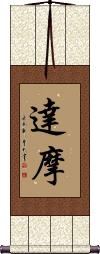
達摩 is the Chinese and Japanese title for Dharma (a short name for Bodhidharma).
He's known in Chinese as Damo and in Japanese as Daruma.
Note: In Japanese, they tend to write the last character as  versus
  . If you choose the Japanese master calligrapher, expect it to be written in the Japanese version.
Bodhidharma
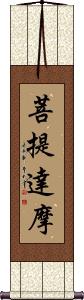
菩提達摩 is the Chinese Bodhidharma.
This refers to a man commonly known as Damo, reputed as the founder of Chan (Zen) Buddhism. His original name is believed to be Bodhitara (菩提多羅).
Note: Often, the last character is written as versus .
The Bodhi Mind
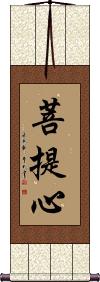
菩提心 means Bodhi-mind or Bodhi-heart.
This title represents the will to realize supreme enlightenment. The awakening of the Bodhi-mind is of utmost importance in Buddhist training.
Other definitions include the mind for or of bodhi, the awakened, enlightened mind, or having Buddha-nature.
Bodhisattva
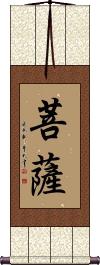
菩薩 is the title of a Buddhist deity that exists to help you reach enlightenment.
In Buddhist beliefs, a bodhisattva (bodhisatta) is dedicated to helping us achieve enlightenment. Bodhisattva means enlightenment truth which is bodhi sattva in Sanskrit.
This term is sometimes used to refer to a kindhearted person, one who will sacrifice himself/herself for others and lacks ego or desire but is instead devoted to the good and well-being of others.
See Also: Buddha | Namo Amitabha
Body / Karada
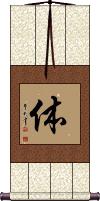
体 is used in Japanese to mean “body.”
体 can also refer to the form, style, corporeal existence, appearance, identity, or state of something or someone. 體 is also used in Buddhism in regard to the corporeal existence of someone (their earthy vessel). It's kind of a broad term that can be used in a lot of different ways.
As a single character, it's usually pronounced “karada” but it can also be pronounced “tai” or “te” (Japanese pronunciation borrowed from the original Chinese).
體 is not a common Kanji to use for a wall scroll. Only select this if you have a personal and meaningful reason to do so. Also, consider this version to be “Japanese only” - see below...
 In Chinese and old Korean Hanja, this character is written in the traditional form shown to the right. If you want this version, click on the character to the right instead of the button above.
Body and Mind
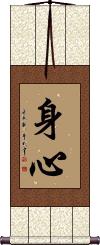
身心 means “body and mind” or “mental and physical” in Chinese and Japanese.
In the Buddhist context, body and mind encompass the five elements (skandha) of a sentient being.
The body is the physical material (rūpa) of life. The mind embraces the other four skandhas, which are consciousness, perception, action, and knowledge.
Body and Earth in Unity
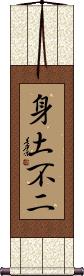
身土不二 (Shindofuni) is originally a Buddhist concept or proverb referring to the inseparability of body-mind and geographical circumstances.
This reads, “Body [and] earth [are] not two.”
Other translations or matching ideas include:
Body and land are one.
Body and earth can not be separated.
Body earth sensory curation.
You are what you eat.
Indivisibility of the body and the land (because the body is made from food and food is made from the land).
Going further, this speaks of our human bodies and the land from which we get our food being closely connected. This phrase is often used when talking about natural and organic vegetables coming directly from the farm to provide the healthiest foods in Japan.
Character notes: 身(shin) in this context does not just mean your physical body but a concept including both body and mind.
土 (do) refers to the soil, earth, clay, land, or in some cases, locality. It's not the proper name of Earth, the planet. However, it can refer to the land or realm we live in.
Japanese note: This has been used in Japan, on and off, since 1907 as a slogan for a governmental healthy eating campaign (usually pronounced as shindofuji instead of the original shindofuni in this context). It may have been hijacked from Buddhism for this propaganda purpose, but at least this is “healthy propaganda.”
Korean note: The phrase 身土不二 was in use by 1610 A.D. in Korea, where it can be found in an early medical journal.
In modern South Korea, it's written in Hangul as 신토불이. Korea used Chinese characters (same source as Japanese Kanji) as their only written standard form of the language until about a hundred years ago. Therefore, many Koreans will recognize this as a native phrase and concept.
See Also: Strength and Love in Unity
Brahmavihara - The Four Immeasurables
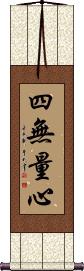
四無量心 is the cattāri brahmavihārā or catvāri apramāṇāni.
The four immeasurables, or infinite Buddha-states of mind. These four dhyānas include:
1. 慈無量心 boundless kindness, maitrī, or bestowing of joy or happiness.
2. 悲無量心 boundless pity, karuṇā, to save from suffering.
3. 喜無量心 boundless joy, muditā, on seeing others rescued from suffering.
4. 捨無量心 limitless indifference, upekṣā, i.e., rising above these emotions or giving up all things.
Breath of Life
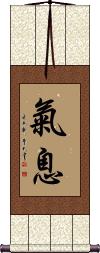
氣息 can mean breath of life or panting for want of breath in the Buddhist context.
In other contexts, it can mean breath, smell, odor, or flavor.
Brown
Single character for brown color
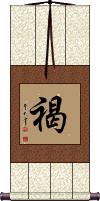
褐 is the most simple way to express brown in Chinese.
It also means brown in Japanese but this character is not often written alone in Japanese (they would tend to write 褐色 (brown color) to refer to brown or the color of tanned skin.
In some contexts, this can refer to gray or a dark color, or coarse hemp cloth.
In the Buddhist context, it can refer to a coarse serge (cheaply sewn clothing) hence poverty.
Note: In Taiwanese Mandarin, this is spoken with the 2nd or rising tone instead of the 4th or falling tone used in the mainland.
Wisdom and Insight of the Buddha
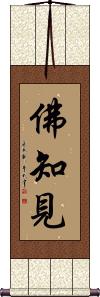
This title represents the wisdom and insight of the Buddha, or the penetrative power of Buddha's wisdom, or vision.
佛知見 is a term derived from the Lotus Sutra, perhaps up to 1900 years ago.
The Aura of Buddha
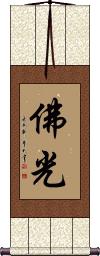
佛光 means Buddha's teachings, or Buddha's Light.
This often refers to the aura around the head of Buddha.
Alternate meanings include Spiritual Enlightenment (from Buddha), Buddha's Halo, Light of the Buddha, or Buddha's Glory.
The Eye of the Buddha
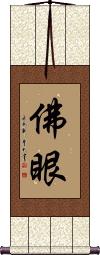
佛眼 is the “Eye of Buddha,” the enlightened one who sees all and is omniscient.
 In modern Japan, they also write the first Kanji as shown to the right. Both versions are correct but if you want the modern Japanese version, click on the Kanji to the right instead of the button above.
Triple Truth of Japanese Buddhism

人間性を再生するのは寛容な心親切な言葉奉仕と思いやりの精神 is known as the Triple Truth of Buddhism in Japanese.
The Buddha ordered that all should know this triple truth...
A generous heart, kind speech, and a life of service and compassion are the things that renew humanity.
That is the English translation most commonly used for this Japanese Buddhist phrase. You might have seen this on a coffee cup or tee shirt.
Note: Because this selection contains some special Japanese Hiragana characters, it should be written by a Japanese calligrapher.
Happy Buddha
Buddha of Joyful Light
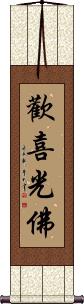
This title is Buddha of Joyful Light.
歡喜光佛 is Amitābha from Sanskrit but pronounced very differently in Chinese and Japanese.
Buddha Seeking
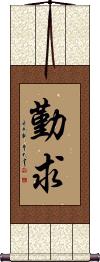
勤求 is a complex word that means inquiring in the Buddha way.
To put it another way, it is seeking something in the right way, at the right time, and diligently seeking only truth or the good.
Buddha Dharma Sangha
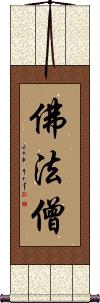
佛法僧 is the Buddha, Dharma, and Saṅgha.
These three characters are the “Triple Gem” of Buddhism or the Buddhist Trinity.
Buddha Heart / Mind of Buddha
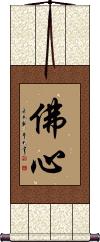
佛心 means the Buddha's mind, Buddha-heart, or the spiritually enlightened heart/mind.
The Buddha Heart is detached from good and evil and other such constructs. The Buddha Heart has mercy, compassion, and loving-kindness for all sentient life, the good, the wicked, and all in between.
The heart and mind (心) are the same concepts in the ancient Orient, so you can use heart and mind interchangeably in this context.
Seeing one’s Nature and becoming a Buddha
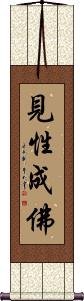
見性成佛 is a universal phrase that suggests that one may see one's nature and accomplish Buddhahood.
見性 suggests penetrating deep inside oneself to see one's “Original finally
Mind.”
成佛 refers to a sentient being who dispenses with illusions and delusions
through ascetic practice, is enlightened to the truth, and becomes a Buddha.
This is used by Mahayana, Chan, and Zen Buddhists in China, Korea, and Japan.
You will also see this with the last character written as 仏 in Japanese. In the religious context, 佛 is commonly used to mean Buddha. If you want the other version, see Kenshō Jōbutsu 見性成仏
The Buddha Realm / Buddhahood
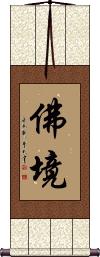
佛境 means the spiritual region of Buddhas, the state of the Buddha, or the Buddha realm.
佛境 is Bukkyō in Japanese and Fójìng in Mandarin Chinese.
If you are contemplating the Metaverse, in contrast, 佛境 is the Buddha-sphere or Buddhaverse.
Buddhism / Buddha
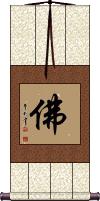
佛 is the essence of the Buddha or Buddhism.
Depending on the context, this word and character can be used to refer to the religion and lifestyle of Buddhism, or in some cases, the Buddha himself.
It is interesting to note that this word is separate from all others in the Chinese language. The sound of “fo” has only this meaning. 佛 is in contrast to many sounds in the Chinese language, which can have one of four tones, and more than 20 possible characters and meanings. This language anomaly shows how significantly Buddhism has affected China since ancient times.
More about Buddhism
佛 is also used with the same meaning in Korean Hanja.
It's used in the very religious context of Buddhism in Japan. It should be noted that there are two forms of this Kanji in use in Japan - this is the more formal/ancient version, but it's rarely seen outside of religious artwork and may not be recognized by all Japanese people.
It also acts as a suffix or first syllable for many Buddhist-related words in Chinese, Japanese, and Korean.
See our Buddhism & Zen page
See Also: Bodhisattva | Enlightenment
Buddha / Buddhism
Hotoke
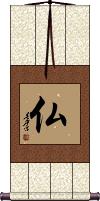
仏 is the single Japanese Kanji that can mean Buddha or Buddhism.
This Kanji was a shorthand way to write 佛 (Buddha) in Chinese (popular around the 13th century). Somehow, this became the version of this Chinese character that was absorbed into Japanese and thus became part of standard Kanji. Centuries later, this character is not recognized in China (except for those from China with a background in Chinese literature or language).
仏 is also a rare or derivative Korean Hanja form - but I doubt you will find any Korean that knows that.
Buddhism
(2 Kanji)
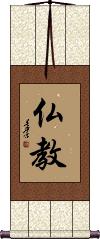
仏教 can mean Buddha or Buddhism in Japanese.
Depending on the context, this word can be used to refer to the religion and lifestyle of Buddhism or in some cases, the Buddha himself.
Note: Until the 5th century, Japan did not have a written language. At that time, Japan absorbed Chinese characters to form their written language (these characters are known as “Kanji” in Japanese). The first character of this Buddhism title was a shorthand way to write 佛 (Buddha) in Chinese (popular around the 13th century). Somehow, this became the version of this character that was absorbed into Japanese and thus became part of standard Kanji. Centuries later, this character is not recognized in China at all.
仏 is also a rare form of Buddha Korean Hanja - though seldom used even when the Korean Hanja writing system was more common 100 years ago.
Buddhism
(2 characters)
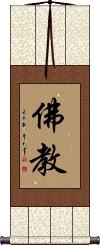
佛教 is the more exact way to express the religion or lifestyle of Buddhism.
It can also be read as “Buddha's Teachings.” 佛教 is Chinese only, as a different character is more commonly used in Japanese to express Buddhism. The same first character is used in Korea, but a slight variation exists in the second character in Korean Hanja. However, it would be fully recognized by any Korean person who can read Hanja.
Koan
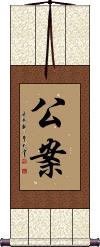
In the Buddhist context, 公案 is a Zen question for meditation.
From the Buddhist dictionary, this is:
Problems set by Zen masters, upon which thought is concentrated as a means to attain inner unity and illumination.
The secular meaning of this word can mean a judge's desk, a complex legal case, a contentious issue, a dossier, a case record, public laws, regulations, or case law.
No Trouble / Freedom from Problems
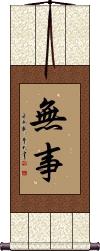
無事 is a Zen Buddhist term meaning no problem and no trouble.
無事 is the Zen state of perfect freedom from troubles and leaving secular affairs behind.
Sometimes this is used to describe the state of satori and complete tranquility of mind.
Written as 無事に with an extra Hiragana at the end, this becomes an adverb to describe something in the condition of safety, peace, quietness, and without troubles.
無事 (Buji) can also be a given name in Japan.
This has more meaning in the Japanese Zen Buddhist community than in China or Korea, where it can mean “be free” or “nothing to do or worry about.”
Buddha Way
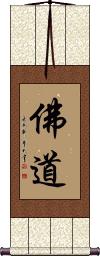
佛道 is “The way of Buddha, leading to Buddhahood” or the way to becoming a bodhi and enlightened.
Known in Japanese as Butsudō, in Mandarin Chinese as Fódào, and in Korean as Buldo or 불도.
The Principles of Buddhism
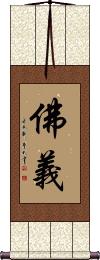
In short, 佛義 is the Principles of Buddhism, but there is more (especially for the second character):
佛 is the character for the Buddha and Buddhism.
義 has deeper meanings including justice, righteousness, morality, honour/honor, teachings, doctrine, right, proper, righteous, loyalty, purpose, or meaning. So the single word “principles” is often used to encompass all these ideas.
The Buddha is in Each Sentient Being
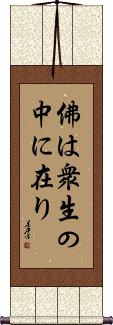
佛は衆生の中に在り is “Butsu wa shujo no naka ni ari” and means that the Buddha (potential for Buddhahood) exists in all beings in the universe.
So yes, your dog has the potential to be a Buddha (but only in a future reincarnation as a human). But all things, from the tiny cricket to the humpback whale have Buddha nature within them. If one takes the time to look and contemplate, one will see the Buddha in all things.
In Japan, sometimes the Buddha character is written 仏 instead of 佛, so you might see the whole phrase written as 仏は衆生の中に在り.
Note: Because this selection contains some special Japanese Hiragana characters, it should be written by a Japanese calligrapher.
Calm and Open Mind
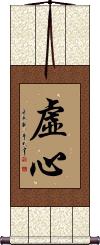
虛心 is a Buddhist term that speaks of being open-minded and/or having a calm and humble mind or heart.
Choice / Choose / Select
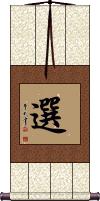
This single Chinese character, old Korean Hanja, and Japanese Kanji means: to choose; to pick; to select; to elect; selection; choice; choosing; picking; election.
In Japanese, it can also be the male given name Hitoshi.
In the Buddhist context, it means to choose, or a myriad.
Chop Wood, Carry Water
Before enlightenment or after, chores remain.
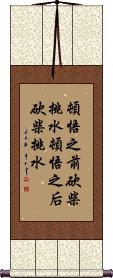
頓悟之前砍柴挑水; 頓悟之後砍柴挑水 means “Before enlightenment, chop wood, carry water; After enlightenment, chop wood, carry water.
This is a Chinese proverb that is attributed to 吴力 (Wú Lì) who lived between 1632 and 1718 - living part of his life as a devout Buddhist, and many years as a Catholic Jesuit Priest in China - what an interesting life!
This has been explained many times in many ways. I am a Buddhist, and here is my brief take on this proverb...
Before enlightenment, one may find daily chores mundane, tedious, and boring. However, upon reaching enlightenment one is not relieved of the details of daily life. An enlightened person will, however, see such chores as a joy, and do them mindfully.
There is another version floating around, which is 在你領悟之前砍柴、運水。在你領悟之後,砍柴、運水。
If you want this other version, just contact me. The meaning is the same, just different phrasing.
Mercy / Compassion / Love
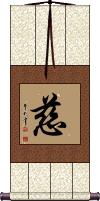
慈 is the simplest way to express the idea of compassion.
This can also mean love for your fellow humans, humanity, or living creatures. Sometimes this is extended to mean charity.
This term is often used in a Buddhist or Christian context. The concept was also spoken of by Laozi (Lao Tzu) in the Dao De Jing (Tao Te Ching).
慈 is considered the direct translation of the Sanskrit word मैत्री (maitrī) Pali word मेत्ता (mettā). In this context, it means benevolence, loving kindness, and goodwill.
This Chinese character is understood in Japanese but is usually used in compound words (not seen alone). Also used in old Korean Hanja, so it's very universal.
See Also: Mercy | Benevolence | Forgiveness | Kindness
Compassionate Heart / Benevolent Heart
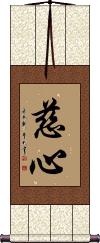
慈心 means “Compassionate Heart” or “Benevolent Heart.”
It's used in day-to-day speech to refer to someone who has the traits of benevolence, mercy, and compassion for their fellow humans.
This title is also used in Buddhism with the same profound meaning.
The True and Complete Enlightenment
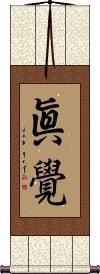
眞覺 means true and complete enlightenment.
This can refer to the perfect nirvana of the Buddha or the perception of ultimate truth or true awareness of all things (reality and unreality).
Confidence / Faithful Heart
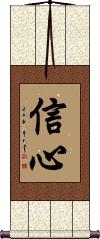
信心 is a Chinese, Japanese, and Korean word that means confidence, faith, or belief in somebody or something.
The first character means faith, and the second can mean heart or soul. Therefore, you could say this means “faithful heart” or “faithful soul.”
In Korean especially, this word has a religious connotation.
In the old Japanese Buddhist context, this was a word for citta-prasāda (clear or pure heart-mind).
In modern Japan (when read by non-Buddhists), this word is usually understood as “faith,” “belief,” or “devotion.”
See Also: Self-Confidence
The Law of Creation and Destruction
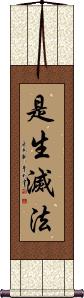
是生滅法 is a Buddhist term for “the law of arising and ceasing,” or, “the law of creation and destruction.”
Everything has a beginning and an end, birth and death, etc. All things follow this law.
Give Up Desire
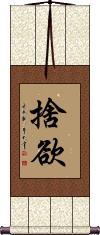
捨欲 is a Buddhist term that means to give up desire or the act of cutting off desire.
In Buddhism, our attachments, greed, and/or desires are the root of our suffering. Release them and live a happy life!
Great Wisdom
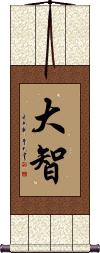
大智 is a Zen Buddhist title that means supreme wisdom, great wisdom, Buddha-wisdom, omniscience, or transcendental wisdom.
Great Illumination of Wisdom
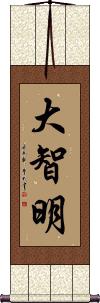
大智明 is a Zen Buddhist title that means the great illumination of wisdom.
This refers to wisdom so bright that it shines through obviously to all in its presence.
The Great Path has No Gate
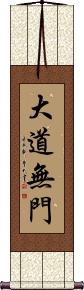
大道無門 is a Buddhist proverb that means “The Great Way has no entrance,” “The Great Way is gateless,” or “The Great Path lacks a gate.”
This can be translated in many other ways.
This concept was authored within a long sacred text by 無門慧開 (known as Wúmén Huìkāi in Chinese or Mumon Ekai in Japanese). He was a Chinese Chan Master (in Japanese, a Zen Master) who lived between 1183 and 1260 AD. His most famous work was a 48-koan collection titled “The Gateless Barrier” or “The Gateless Gate” (無門關 Wú Mén Guān in Chinese, or 無門関 Mu Mon Kan in Japanese). This calligraphy title is a notable line from this collection.
I like this reference to the source of this proverb: The Gateless Gate 無門關
Dana: Almsgiving and Generosity
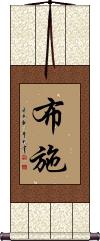
布施 is the Buddhist practice of giving known as Dāna or दान from Pali and Sanskrit.
Depending on the context, this can be alms-giving, acts of charity, or offerings (usually money) to a priest for reading sutras or teachings.
Some will put Dāna in these two categories:
1. The pure or unsullied charity, which looks for no reward here but only in the hereafter.
2. The sullied almsgiving whose object is personal benefit.
The first kind is, of course, the kind that a liberated or enlightened person will pursue.
Others will put Dāna in these categories:
1. Worldly or material gifts.
2. Unworldly or spiritual gifts.
You can also separate Dāna into these three kinds:
1. 財布施 Goods such as money, food, or material items.
2. 法布施 Dharma, as an act to teach or bestow the Buddhist doctrine onto others.
3. 無畏布施 Courage, as an act of facing fear to save someone or when standing up for someone or standing up for righteousness.
The philosophies and categorization of Dāna will vary among various monks, temples, and sects of Buddhism.
Breaking down the characters separately:
布 (sometimes written 佈) means to spread out or announce, but also means cloth. In ancient times, cloth or robs were given to the Buddhist monks annually as a gift of alms - I need to do more research, but I believe there is a relationship here.
施 means to grant, to give, to bestow, to act, to carry out, and by itself can mean Dāna as a single character.
Dāna can also be expressed as 檀那 (pronounced “tán nà” in Mandarin and dan-na or だんな in Japanese). 檀那 is a transliteration of Dāna. However, it has colloquially come to mean some unsavory or unrelated things in Japanese. So, I think 布施 is better for calligraphy on your wall to remind you to practice Dāna daily (or whenever possible).
Dark Sister
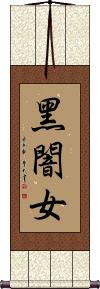
黑闇女 is a Buddhist title that means “dark sister,” “dark one,” or “dark woman.”
There are two sisters:
One is the deva, 功德女 (“merit” or “achieving”), who causes people to acquire wealth.
The other is the “dark one,” 黑闇女, which causes people to spend and waste.
These sisters always accompany each other.
Frightful Demon / Asura
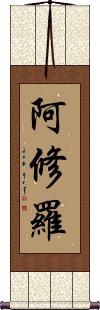
This demon title comes from the ancient Sanskrit word Asura.
阿修羅 is often used in Buddhism when describing various demons. Sometimes defined as “Fighting and battling a giant demon.”
In the context of Buddhism: This title originally meant a spirit, spirits, or even the gods (perhaps before 1700 years ago). It now generally indicates titanic demons, enemies of the gods, with whom, especially Indra, they wage constant war. They are defined as “not devas,” “ugly,” and “without wine.” There are four classes of asuras, separated according to their manner of rebirth. They can be egg-born, womb-born, transformation-born, and spawn- or water-born. Their abode is in the ocean, north of Sumeru but certain of the weaker dwell in a western mountain cave. They have realms, rulers, and palaces, as have the devas.
In terms of power, Asuras rank above humans but below most other deities. They live near the coastal foot of Mount Sumeru (on the northern side). Their domain is partially or wholly in the ocean.
Demon Slayer
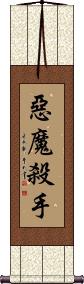
惡魔殺手 means Demon Slayer in Chinese.
The first word, 惡魔, means demon, fiend, evil māras, and can refer to the ancient demon enemies of Buddhism.
The second word, 殺手, means slayer, killer, murderer, hitman, or in the context of sports or video games, a formidable player.
Devotion / Diligence / Vigorous / Energetic
vīrya
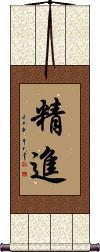
精進 is a wide-ranging word that is used in Chinese, Japanese, and Korean.
It can mean devotion, diligence, concentration, aggressive, enterprising, vigorous, energetic, purification, pushing, asceticism, assiduity, or virility. 精進 is deep, and these two characters can express ideas that take a full English phrase to describe, such as “concentration of mind,” “to forge ahead vigorously,” or “to dedicate oneself to progress.”
Used in the context of Buddhism, it means “making earnest efforts to cultivate virtue and get rid of evil” or “zeal in one's quest for enlightenment.”
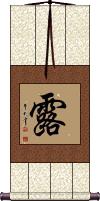
露 is the Chinese, Japanese Kanji, and old Korean Hanja for dew.
Depending on the context in which this character is used, it can also mean: tears; syrup; nectar; outdoors (not under cover); to show; to reveal; to betray; to expose; scanty; bare; unconcealed; naked; public.
露 can be a Chinese surname Lu. 露 can also be the Japanese surname Tsuyuzaki or Tsuyusaki, and the given names Tsuyu or Akira.
Oddly, 露 is sometimes used as an abbreviation for Russia.
In the Buddhist context, 露 also means dew, but can be a symbol of transience. Sometimes used as a metaphor to expose or disclose knowledge and truth.
Dharma / Buddhist Doctrine
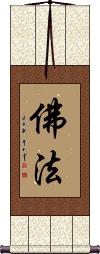
Dharma / The Law
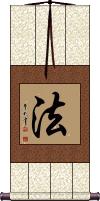
法 is the simple way to write “law” or in a Buddhist context “Dharma.”
This can also mean method, way, or Buddhist teaching. It's also an abbreviation for the country of France.
The Buddhist context exists in Chinese and Korean Hanja but I have not yet confirmed that this means more than “law” when used alone in Japanese.
Dharma Gate
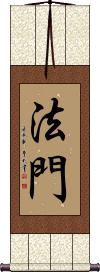
This is the Dharma Gate, The Gate to Enlightenment, or Dharmaparyāya.
The doctrines, or wisdom of Buddha is regarded as the door to enlightenment.
Stay Strong / Indestructible / Unbreakable
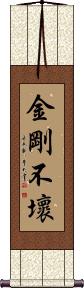
金剛不壞 is originally a Buddhist term for “The diamond indestructible.”
Sometimes, it's written 金剛不壞身, The diamond-indestructible body.
Outside that context, it still means firm and solid, sturdy and indestructible, unshakable, or adamantine (a mythological indestructible material).
 Note: If you order this from the Japanese master calligrapher, the last Kanji will look like the one shown to the right.
Diamond
金剛 is a common way to call diamonds in Chinese and Japanese.
Traditionally, there were not that many diamonds that made their way to Asia, so this word does not have the deep cultural significance that it does in the west (thanks mostly to De Beers' marketing). Therefore, this word was kind of borrowed from other uses.
This title can also refer to vajra (a Sanskrit word meaning both thunderbolt and diamond that originally refers to an indestructible substance); hard metal; pupa of certain insects; Vajrapani, Buddha's warrior attendant; King Kong; adamantine; Buddhist symbol of the indestructible truth.
Deities / Gods
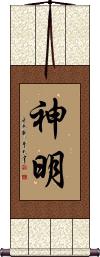
In Chinese, Japanese Kanji, and old Korean Hanja, 神明 title refers to deities or gods (can be the singular or plural form).
Depending on the context, this could also mean “divine.”
Specifically, in Japanese, this can refer to Amaterasu (as an enshrined deity).
In some Buddhist contexts, this also means deity but can also refer to “intelligence” (as in all-knowing).
Diligence
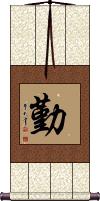
勤 is a single character that means diligence or “sense of duty” in Chinese and Korean (also understood in Japanese but not commonly seen as a stand-alone Kanji).
As a single character on a wall scroll, this will only be seen with this meaning. However, it can also mean industrious, hardworking, frequent, regular, constant, energy, zeal, fortitude, or virility.
In Buddhism, this can represent vīrya (viriya), the idea of energy, diligence, enthusiasm, or effort. It can be defined as an attitude of gladly engaging in wholesome activities, and it functions to cause one to accomplish wholesome or virtuous actions. Some Buddhists may even define this as “manliness” (a definition from a hundred years ago, before equality).
If you or someone you know is a hard worker (or needs a reminder to be diligent), then this is the wall scroll to have in your/their office.
Divine Light
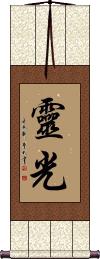
靈光 is a Chinese word that means “divine light.”
This can refer to the glow or halo around the Buddha. It can also be a miraculous column of light.
In slang, it can be like saying “jolly good!.”
Divine Protection
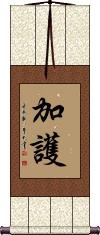
加護 is Japanese for “divine protection” or “the saving grace of God.”
Please consider this blessing to be Japanese only. This can have the same meaning in the context of Buddhism in Chinese, but it's also a nickname for “intensive care” at Chinese hospitals.
Note: My Japanese translator says this is not commonly used in Japanese. I added this because a customer asked for it. There is no better Japanese phrase to express this idea - so this is it if you want it.
Divine Spirit
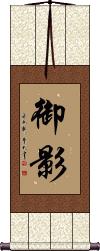
御影 is a Japanese word that means divine spirit or honorific language for “spirit of the dead.”
This can also refer to an image of a deity, buddha, royal, noble, etc.)
In the Buddhist context, it can mean (wooden) images of saints or deities.
御影 is also a Japanese name, Mikage.
Note: This is also a word in Chinese but not used very often in China (except perhaps by certain Buddhists).
Dogen
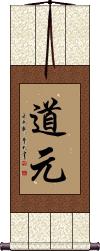
Usually, when people are looking for 道元 or “Dogen,” they are referring to the Japanese Zen monk by this name.
He lived from 1200-1253. This Dogen name or title literally means “The Way Origin” or “Beginning of the Path.” It is understood to mean “beginning of right doctrine or faith” in the context of his name and work to establish the Sōtō school of Zen in Japan.
To accomplish that task, this humble monk traveled from Japan and across China to find the more original or pure forms of Buddhism.
Dojo / Martial Arts Studio
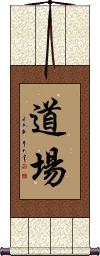
道場 is the Japanese term for a room or hall in which martial arts are taught.
道場 is often spelled “dojo” which has become a word in the English lexicon. However, the true Romaji is doujou or dōjō.
Please note: The Chinese definition of these characters is quite different. In Chinese, this is a place where Buddhist or Taoist mass is held. It could also be a place where spiritual or psychic events are performed.
Door of Great Wisdom

大智慧門 is the title for “The Great Wisdom Door,” or “The Gate to Great Wisdom.”
This refers to a portal to all wisdom and knowledge in Buddhism.
Dragon Spirit
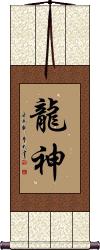
龍神 is a Chinese, Japanese Kanji, and old Korean Hanja title that can mean “dragon god,” “dragon king,” or “dragon spirit.”
In the context of Buddhism, this is one of eight kinds of spiritual beings found in Mahāyāna texts.
Dynamic
Moving / Motion / Ever-Changing
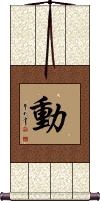
動 is the only Chinese/Japanese/Korean word that can encompass the idea of “dynamic” into one character.
動 can also mean:
to use; to act; to move; to change; motion; stir.
In the Buddhist context, it means: Movement arises from the nature of wind which is the cause of motion.
The key point of this word is that it represents motion or always moving. Some might say “lively” or certainly the opposite of something that is stagnant or dead.
Note: In Japanese, this can also be a female given name, Yurugi.
Eighteen / 18
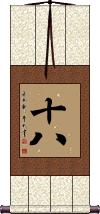
This means eighteen (18).
This can be pronounced seipai, toya, or jūhachi in Japanese. It can also be a Japanese personal name, Toya.
This would be the way to write the Buddhist Sanskrit word aṣṭādaśa (meaning 18) in Chinese, old Korean Hanja, and Japanese Kanji.
Amitabha Buddha
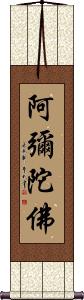
This title can mean the Buddha of the Western paradise.
But it's more a chant that means “May the lord Buddha preserve us!” or “Merciful Buddha!.”
阿彌陀佛 is also a translation to Chinese, Japanese, and Korean for “Amitâbha Buddha.”
Asian Buddhists will often greet and say goodbye to each other with this phrase/chant/title.
Enlightened Truth
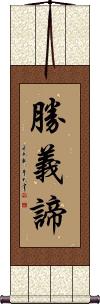
This Buddhist term means the superior truth or enlightened truth.
勝義諦 is a realm of understanding that is far beyond worldly truth.
Some will also define this as the ultimate truth.
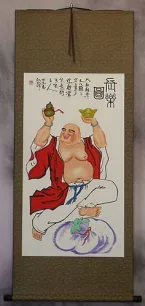
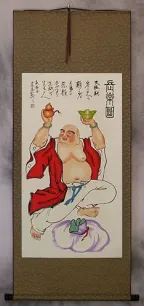
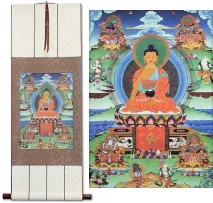
This in-stock artwork might be what you are looking for, and ships right away...

Gallery Price: $49.00
Your Price: $27.00





Gallery Price: $150.00
Your Price: $73.88

Gallery Price: $200.00
Your Price: $69.88

Gallery Price: $200.00
Your Price: $69.88
Gallery Price: $200.00
Your Price: $88.88



