Custom Christianity Chinese & Japanese Calligraphy Wall Scrolls
We can have your favorite verse from the Bible translated into Chinese and written on a wall scroll for you.
You must email your request siting the verse or verses you want (It would be an incredible amount of work to include every verse of the Bible in our Asian calligraphy database).
Here is an example: Joshua 24:15.
Seeking the word for Christ in Chinese or Japanese?
Want to tell the world that you are a Christian in ancient Chinese Characters?
Seeking other Christian-related words in Japanese or Chinese?
You've come to the right place...
1. Christian / Disciple of Christ
2. Christ
3. Jesus Christ
9. Christian
11. God of Zion / God of Abraham
13. Jesus
15. Jesus
17. Jesus is My Life
18. Jesus is Lord
19. Savior / Messiah
22. Yeshua
23. Jesus Saves
24. Hebrews 13:8
Christian / Disciple of Christ
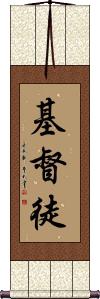
基督徒 is a very strong and direct word in Chinese for “Christian.”
The literal translation of the first two characters is “Christ.”
The last character means apprentice, follower, or disciple.
Altogether these three characters mean “Christ's Disciple” or “Christ's Apprentice.” 基督徒 is a pretty cool title to hang on your wall if you are a devout Christian.
Also used by Japanese Christians (but may be unfamiliar to non-Christian Japanese people).
See Also: Jesus Christ | God of Abraham
Christ
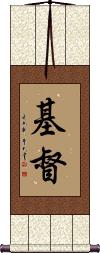
基督 is how to write “Christ” in Chinese characters, Korean Hanja, and Japanese Kanji.
This is the word used in the Chinese Union Bible (the only readily-available translation of the Bible into Chinese that I know of - published about 100 years ago). For Chinese Christians, this is the most common way to refer to Jesus Christ.
This is also the way that “Christ” is written in Japanese. But since the Japanese language is very flexible about the sounds that can be assigned to various Kanji, these characters have been assigned a pronunciation that sounds a lot like “Christ” or actually closer to the original “Christos.” In Japanese (if you don't know how the Romaji shown above in the gray box works), it sounds like “key ree sue toe” using English words/sounds. Say those four words fast, and you'll get it.
It should be noted that only Japanese Christians will be familiar with this word.
This is best defined, read, and understood with the characters together, but if you take this word for Christ apart, the first character means “fundamentals” or “foundation.” The second character can mean “leader” or “boss.”
Jesus Christ
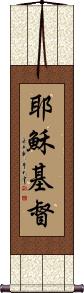
耶穌基督 is the full version, with the name “Jesus” being the first two characters and the meaning of “Christ” as the last two.
You can't get more specific than this when referring to the Messiah.
Disciple of Christianity
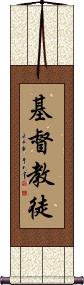
基督教徒 is the most verbose (longest) word for “Christian” in the Chinese and Japanese languages.
The literal translation of the first two characters is Christ.
The third Character means “Religion” or “Teaching.”
The last character means “apprentice” or “disciple.”
Altogether these three characters mean “Christ's Teaching Disciple” or “Christ's Religion Apprentice.”
Note: The last two characters are sometimes translated together as “follower (of a religion),” so you could also say it means “Follower of Christ.”
This four-character title makes it very clear what you are talking about in Chinese.
See Also: Jesus Christ | God of Abraham
Christianity / Christian
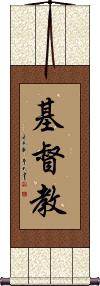
基督教 is the Chinese, Japanese and Korean word for “Christianity.”
Just as in English, this word is often used to mean “Protestant” but includes Catholics in the true definition.
It is the word used to refer to the whole “Christian religion” or “Christian Faith,” and therefore, it can be translated as “Christianity.” However, used as an adjective in regard to a person, it would translate as “Christian.” But more like saying, “His religion is Christianity,” rather than a noun form.
If you break it apart, the characters mean Base/Foundation Leading/Supervising Religion/Teaching. It makes more sense in Japanese, Chinese, and Korean. The first two characters together are translated as “Christ.” So you can also say this means “Christ's Religion” or “Christ's Teachings” when directly translated, or in reverse, “The Religion of Christ” or “The Teaching of Christ.”
Notes: The last character has a slight difference in one stroke - however, in calligraphic form, this will not be apparent. This entry can easily be read by any Korean person who knows Hanja characters (Chinese characters used in Korean).
See Also: Jesus Christ | God of Abraham
Jesus Christ is my Savior
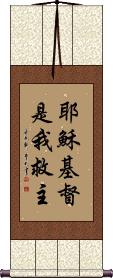
耶稣基督是我救主 is a Chinese phrase that reads “Jesus Christ is my savior.”
Jesus Christ is My Savior
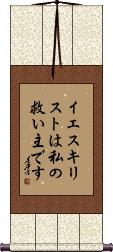
イエスキリストは私の救い主です is a Japanese phrase that means “Jesus Christ is my savior.”
Note: Because this selection contains some special Japanese Hiragana and Katakana characters, it should be written by a Japanese calligrapher.
Jesus Christ is Love
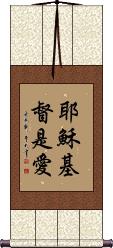
耶穌基督是愛 means Jesus Christ is Love in Mandarin Chinese.
耶稣 means Jesus, close to the original pronunciation of Yeshua.
基督 is the Chinese word that means Christ.
是 = is.
爱 = love.
Christian
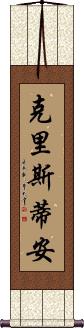
克里斯蒂安 is the transliteration to Mandarin Chinese for the given name Christian.
See Also: Christianity
Word of God / The Gospel
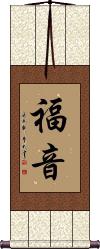
福音 is the Chinese, Korean and Japanese word for “Gospel” or “Word of God.”
福音 is a specifically Christian word in Asia (not used for any other religion).
The first character means blessing, good fortune, or good luck. This first character is a special character used throughout China to bring good tidings and fortune - especially during Chinese New Year. The second character means sound, noise, or news.
Together, these characters create a word that means “The Good News” or “The Sound of Good Fortune.”
When read by a Chinese or Japanese person, this word is always perceived as “The Christian Gospel,” “Word of God,” or even “The Voice of God.”
See Also: Christianity | Jesus Christ | God of Abraham
God of Zion / God of Abraham
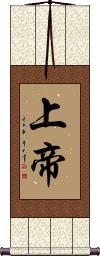
上帝 is how Chinese Christians and Jews refer to God, AKA The Judeo-Christian God.
There are Chinese Jews whose ancestry dates back to Jewish traders on the silk road. They are known as the Kaifeng Jews. Most have left China for Israel now.
There are also plenty of Christians in China of the Protestant and Catholic varieties. However, the churches are basically run by the government, and the Chinese Catholic church does not recognize the Pope.
Oddly, in my experience, I found the Chinese Protestant church to be much less political compared to Baptist and other Protestant churches that I have visited in America.
上帝 is also the typically-used title for God in Japanese.
While you may find this term in old Korean dictionaries, it is an obscure and rarely-used title for God in modern Korean.
See Also: Christianity | Jesus Christ
Holy Spirit / Holy Ghost
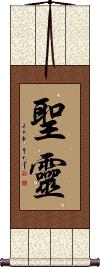
聖靈 is the title for the Holy Spirit or Holy Ghost as used by Jewish, Catholic, and Protestant (and other Christian) Chinese people.
And yes, Chinese Jews do exist, but there are not many of them.
The first character means Holy, Sacred, Saint, or Sage. The second means ghost, spirit, efficacious, or intelligence.
This is valid in Chinese characters and old Korean Hanja. This will be recognized in Japan but see the note below...
 In modern Japan, they now use a variant/simplified Kanji of the second character of Holy Spirit. If you want this Japanese version, click on the Kanji to the right instead of the button above.
Jesus
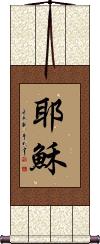
This is simply the name “Jesus” transliterated into Chinese. 耶穌 hold a pronunciation in Mandarin that is closer to the real and original Hebrew Yeshua, instead of the incorrect way we have always pronounced Jesus in English with a hard “J” sound. While this name sounds like the real “Jesus” in Chinese, Christians in China are more likely to say “Christ” (Jidu) which holds more meaning than just sound.
If you are Latino and have been given the name “Jesus,” this is also how to write your name in Chinese.
Jesus is my Savior
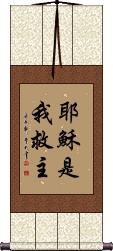
耶穌是我救主 is a Chinese phrase that reads, “Jesus is my savior.”
Jesus
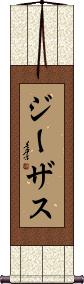
ジーザス is the name Jesus in Japanese.
This is a common version that approximates pronunciation in English. However, there are many variations for writing Jesus in Japanese, and it's hard to come up with an absolute answer (transliteration of names is more art than science).
Note: Because this title is entirely Japanese Katakana, it should be written by a Japanese calligrapher.
Jesus
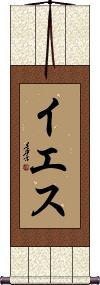
イエス is the name Jesus in Japanese.
This version is used most often when talking about Jesus the Christ.
Note: Because this title is entirely Japanese Katakana, it should be written by a Japanese calligrapher.
Jesus
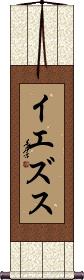
イエズス is the name Jesus in Japanese.
This is from the more Latin / Spanish pronunciation (without the hard “J” sound at the beginning).
Note: Because this title is entirely Japanese Katakana, it should be written by a Japanese calligrapher.
Jesus is my Savior
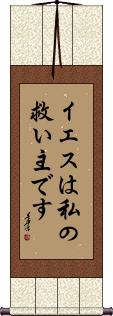
イエスは私の救い主です is a Japanese phrase that means “Jesus is my savior.”
Note: Because this selection contains some special Japanese Hiragana and Katakana characters, it should be written by a Japanese calligrapher.
Jesus is My Life
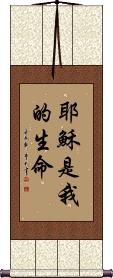
耶穌是我的生命 means Jesus is my life in Chinese.
The first two characters are a transliteration of the name Jesus into Mandarin Chinese.
The third character means, is.
The fourth and fifth mean my or mine.
The last two characters mean life, as in lifespan, or from birth to death.
This is not a common phrase for Chinese Christians, but this is the best way to translate this idea from English to Mandarin Chinese.
Jesus is Lord
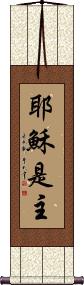
耶穌是主 means “Jesus is Lord” in Chinese.
Jesus is Lord
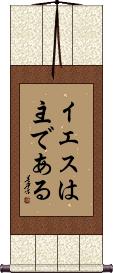
イエスは主である means “Jesus is Lord” in Jesus.
Note: Because this selection contains some special Japanese Hiragana and Katakana characters, it should be written by a Japanese calligrapher.
Savior / Messiah
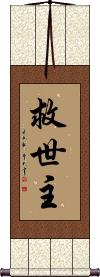
救世主 is Savior or Messiah (in Christianity) in Chinese, Japanese Kanji, and old Korean Hanja.
Resurrection / Re-Birth
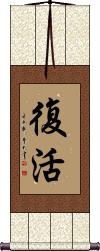
復活 is the Chinese, Japanese and Korean word for resurrection or rebirth.
復活 literally means “return to life.”
It is the term used in most Asian Bibles to refer to the resurrection of Christ. In Japanese, it is sometimes used to mean a Christian Revival. In some contexts, it can mean resuscitation.
See Also: Christianity | Jesus Christ | God of Abraham
Rehabilitation / Rebirth
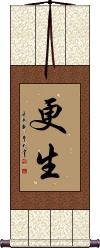
This is a Chinese, Korean and Japanese word that means rebirth or resurrection.
Other definitions include reinvigorated, rejuvenated, a new lease of life, rehabilitation, remaking one's life, starting life anew, regeneration, reorganization, rebuilding, recovery, restoration, remaking, coming back to life, revival, or resuscitation.
Yeshua
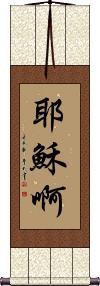
耶稣啊 is the name Yeshua in Chinese (Mandarin).
This is an approximation of the original Hebrew name for “Jesus” transliterated into Chinese.
Note: Christians in China are more likely to say “Christ” (Jidu) which holds more meaning than just sound.
This is very similar to the way Jesus (耶穌) is often written in Chinese, with the addition of 啊 which gives it the final “a” sound.
Jesus Saves
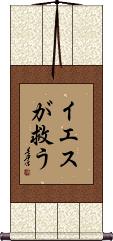
イエスが救う means “Jesus Saves” in Japanese.
Note: Because this selection contains some special Japanese Hiragana and Katakana characters, it should be written by a Japanese calligrapher.
Jesus Saves
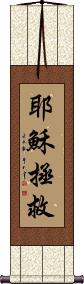
耶穌拯救 means “Jesus saves” in Mandarin Chinese.
Hebrews 13:8
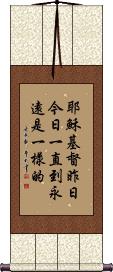
耶穌基督昨日今日一直到永遠是一樣的 is Hebrews 13:8 which reads, Jesus Christ the same yesterday, and today, and forever.
Live By The Sword Die By The Sword
Matthew 26:52
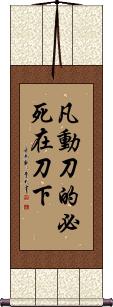
凡动刀的,必死在刀下 is the second part of Matthew 26:52 from the Chinese Union Bible where Jesus suggests that one who uses a sword will also die by it.
The following table may be helpful for those studying Chinese or Japanese...
| Title | Characters | Romaji (Romanized Japanese) | Various forms of Romanized Chinese | |
| Christian Disciple of Christ | 基督徒 | kirisuto | jī dū tú ji1 du1 tu2 ji du tu jidutu | chi tu t`u chitutu chi tu tu |
| Christ | 基督 | kirisuto | jī dū / ji1 du1 / ji du / jidu | chi tu / chitu |
| Jesus Christ | 耶穌基督 耶稣基督 | yē sū jī dū ye1 su1 ji1 du1 ye su ji du yesujidu | yeh su chi tu yehsuchitu |
|
| Disciple of Christianity | 基督教徒 | kirisutokyouto kirisutokyoto | jī dū jiào tú ji1 du1 jiao4 tu2 ji du jiao tu jidujiaotu | chi tu chiao t`u chituchiaotu chi tu chiao tu |
| Christianity Christian | 基督教 | kirisutokyou kirisutokyo | jī dū jiào ji1 du1 jiao4 ji du jiao jidujiao | chi tu chiao chituchiao |
| Jesus Christ is my Savior | 耶穌基督是我救主 耶稣基督是我救主 | yē sū jī dū shì wǒ jiù zhǔ ye1 su1 ji1 du1 shi4 wo3 jiu4 zhu3 ye su ji du shi wo jiu zhu yesujidushiwojiuzhu | yeh su chi tu shih wo chiu chu yehsuchitushihwochiuchu |
|
| Jesus Christ is My Savior | イエスキリストは私の救い主です | Iesu kirisuto wa watashi no sukuinushi desu | ||
| Jesus Christ is Love | 耶穌基督是愛 耶稣基督是爱 | yē sū jī dū shì ài ye1 su1 ji1 du1 shi4 ai4 ye su ji du shi ai yesujidushiai | yeh su chi tu shih ai yehsuchitushihai |
|
| Christian | 克里斯蒂安 | kè lǐ sī dì ān ke4 li3 si1 di4 an1 ke li si di an kelisidian | k`o li ssu ti an kolissutian ko li ssu ti an |
|
| Word of God The Gospel | 福音 | fukuin | fú yīn / fu2 yin1 / fu yin / fuyin | |
| God of Zion God of Abraham | 上帝 | joutei / jotei | shàng dì / shang4 di4 / shang di / shangdi | shang ti / shangti |
| Holy Spirit Holy Ghost | 聖靈 / 聖霊 圣灵 | sei rei / seirei | shèng líng sheng4 ling2 sheng ling shengling | |
| Jesus | 耶穌 耶稣 | yé sū / ye2 su1 / ye su / yesu | yeh su / yehsu | |
| Jesus is my Savior | 耶穌是我救主 耶稣是我救主 | yē sū shì wǒ jiù zhǔ ye1 su1 shi4 wo3 jiu4 zhu3 ye su shi wo jiu zhu yesushiwojiuzhu | yeh su shih wo chiu chu yehsushihwochiuchu |
|
| Jesus | ジーザス | jiizasu / jizasu | ||
| Jesus | イエス | iesu | ||
| Jesus | イエズス | iezusu | ||
| Jesus is my Savior | イエスは私の救い主です | iesu wa watashi no sukuinushi desu | ||
| Jesus is My Life | 耶穌是我的生命 耶稣是我的生命 | yē sū shì wǒ de shēng mìng ye1 su1 shi4 wo3 de sheng1 ming4 ye su shi wo de sheng ming yesushiwodeshengming | yeh su shih wo te sheng ming yehsushihwoteshengming |
|
| Jesus is Lord | 耶穌是主 耶稣是主 | yē sū shì zhǔ ye1 su1 shi4 zhu3 ye su shi zhu yesushizhu | yeh su shih chu yehsushihchu |
|
| Jesus is Lord | イエスは主である | Iesu wa omodearu Iesuwaomodearu | ||
| Savior Messiah | 救世主 | kyuuseishu / kyuseishu | jiù shì zhǔ jiu4 shi4 zhu3 jiu shi zhu jiushizhu | chiu shih chu chiushihchu |
| Resurrection Re-Birth | 復活 复活 | hukkatsu / hukatsu | fù huó / fu4 huo2 / fu huo / fuhuo | |
| Rehabilitation Rebirth | 更生 | kousei / kose kosei / kose | gēng shēng geng1 sheng1 geng sheng gengsheng | keng sheng kengsheng |
| Yeshua | 耶穌啊 耶稣啊 | yé sū a / ye2 su1 a / ye su a / yesua | yeh su a / yehsua | |
| Jesus Saves | イエスが救う | Iesu ga sukuu Iesugasukuu Iesu ga suku | ||
| Jesus Saves | 耶穌拯救 耶稣拯救 | yē sū zhěng jiù ye1 su1 zheng3 jiu4 ye su zheng jiu yesuzhengjiu | yeh su cheng chiu yehsuchengchiu |
|
| Hebrews 13:8 | 耶穌基督昨日今日一直到永遠是一樣的 耶稣基督昨日今日一直到永远是一样的 | yē sū jī dū zuó rì jīn rì yī zhí dào yǒng yuǎn shì yī yàng de ye1 su1 ji1 du1 zuo2 ri4 jin1 ri4 yi1 zhi2 dao4 yong3 yuan3 shi4 yi1 yang4 de ye su ji du zuo ri jin ri yi zhi dao yong yuan shi yi yang de | yeh su chi tu tso jih chin jih i chih tao yung yüan shih i yang te | |
| Live By The Sword Die By The Sword | 凡動刀的必死在刀下 凡动刀的必死在刀下 | fán dòng dāo de bì sǐ zài dāo xià fan2 dong4 dao1 de bi4 si3 zai4 dao1 xia4 fan dong dao de bi si zai dao xia | fan tung tao te pi ssu tsai tao hsia | |
| In some entries above you will see that characters have different versions above and below a line. In these cases, the characters above the line are Traditional Chinese, while the ones below are Simplified Chinese. | ||||



