Buy a Cooperation Chinese/Japanese Calligraphy Wall Scroll
We have many options to create artwork with Cooperation characters on a wall scroll or portrait.
1. Working Together as One / Cooperation
2. Cooperation / Collaboration
3. Cooperation
4. Collaboration / Cooperation / Synergy
5. Do not fear the task: Cooperation will lead to success
6. Flexibility
8. Energy Sword Body in Concert
9. Synergy / Cooperative Interaction
Working Together as One / Cooperation
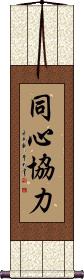
同心協力 is a Chinese proverb that means “to work with a common purpose,” “to make concerted efforts,” “to pull together,” or “to work as one.”
Cooperation / Collaboration
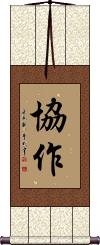
協作 is a Chinese, Japanese, and old Korean word that means cooperation or collaboration.
Cooperation is working together and sharing the load. When we cooperate, we join with others to do things that cannot be done alone. We are willing to follow the rules which keep everyone safe and happy. Together we can accomplish great things.
The first character means “united” or “to coordinate.” The second character means “to do,” “to make,” or “to compose.” Knowing this, you can understand why together, these characters create a word that can be defined as “cooperation” in Chinese, Japanese, and Korean.
It is implied that you are cooperating to create some project or product.
See Also: Partnership
Cooperation
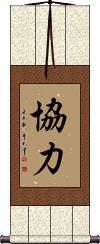
協力 is a Japanese word that means cooperation.
If you look at the second character, which means “strength” or “power,” and then you look at the first character, you will see that the first character seems to represent multiple “strengths” together. Thus, you can visually see the meaning of this word as “stronger when working together.” The combination of characters that form this word is commonly seen in Japanese Kanji and Korean Hanja but not used in China (however, a Chinese person could probably guess the meaning, and it can be pronounced in Chinese).
It is implied that you are cooperating to create some project or product.
This can also be translated as “joint effort.”
See Also: Partnership
Collaboration / Cooperation / Synergy
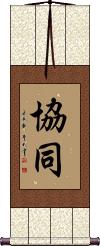
協同 is a Japanese, Chinese, and Korean word that means to cooperate, in coordination with, coordinated, collaborate, collaboration, collaborative, doing together (as equals).
Some will also use this as a short way to express the western idea of synergy (collaboration for a better result). There's a longer word, 協同作用, that adds “action” to this word and more directly means synergy.
Do not fear the task: Cooperation will lead to success
Do not fear strong winds waves; just be sure to row in unison
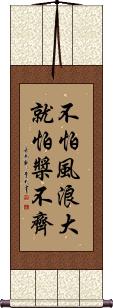
不怕风浪大就怕桨不齐 is a Chinese proverb that literally translates as: Do not fear strong winds [and] high waves; what [one should] worry about whether or not you're rowing in unison.
Figuratively, this means: However difficult the task, the key to success lies in making collective efforts.
I like to translate this as “Don't sweat the details, just get together and get it done.”
Flexibility
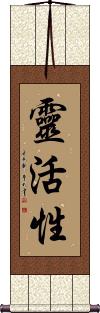
靈活性 is a Chinese and Korean word that means flexibility or being open to change.
You consider others' ideas and feelings and don't insist on your own way. Flexibility gives you creative new ways to get things done. Flexibility helps you to keep changing for the better. 靈活性 could also be defined as having a “flexible nature.”
Flexibility
Alternate / Japanese version
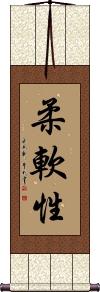
柔軟性 is the Chinese, Japanese Kanji, and Korean Hanja word that means “flexibility.”
It can also mean “compatibility,” “pliability,” “softness” and “elasticity.”
See Also: Flexibility
Guide / Help / Cooperate
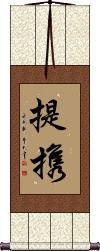
提携 varies a bit depending on which language you are reading it in.
提携 means to guide and help (younger people) in Chinese.
Cooperation or “working in concert” in Korean.
And cooperation, tie-up, joint business, and link-up in Japanese.
Energy Sword Body in Concert
Spirit, Sword & Body as One
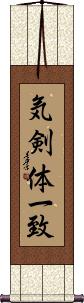
气剑体一致 often gets translated as “Mind Sword Body,” or “Spirit, Sword, and Body as One.” But I think these translations don't tell you enough about what this is really saying.
In this context, 気, which is the modern Japanese version of 氣, means spiritual and unseen energy or “life energy.” In some cases, 気 can be translated as spirit, feeling, or nature. If defined as the mind, it's more about the invisible or intangible parts of one's mind (or soul).
剣 is the Japanese version of 劍 meaning sword.
体 is the modern Japanese version of 體 meaning body.
The Kanji 一 means one, and in this case, suggests “all in one.”
The Kanji 到 means to send, deliver, or convey. But together, 一到 suggests all these things in agreement, union cooperation, or in concert.
Note: Arguments exist as to whether this should be romanized as Kikentaiitchi, Kikentaiicchi, or kikentaiichi. Technically, if you drop the last character, you get 気剣体一 and kikentaiichi (ki ken tai ichi), which is also a valid phrase.
Synergy / Cooperative Interaction
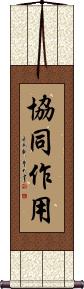
協同作用 is probably the best way to express “synergy” in Chinese and Japanese.
This is not a particularly common word in either language, so you might want to look at “cooperation.”
Unity / United / Solidarity / Cooperation
Join Forces / Rally Together
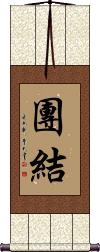
團結/糰結 means to join forces, unity, united, union, combination, cooperation, or solidarity.
Regarding solidarity, this was part of the Chinese title used for the Solidarity Workers Union in Poland. In some circumstances, this can mean “hold a rally.”
While there's not a perfect match to the English word “unity” in Chinese, this word is pretty close. It contains the idea of joining forces and working as one. It could even mean rallying together to achieve a goal or defeat a common enemy.
 There are several variations of these characters such as 团结, 団結, 團結, 糰結, etc. Modern Japanese will write it 団結. Just the first Kanji varies. Click on the image of that modern Japanese first Kanji to the right if you want this version instead of the traditional one.
Work Together with One Heart
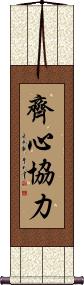
齊心協力 is a Chinese proverb that means “to work with a common purpose,” “to make concerted efforts,” “to pull together,” or “to work as one (or as if with one heart).”
The following table may be helpful for those studying Chinese or Japanese...
| Title | Characters | Romaji (Romanized Japanese) | Various forms of Romanized Chinese | |
| Working Together as One Cooperation | 同心協力 同心协力 | tóng xīn xié lì tong2 xin1 xie2 li4 tong xin xie li tongxinxieli | t`ung hsin hsieh li tunghsinhsiehli tung hsin hsieh li |
|
| Cooperation Collaboration | 協作 协作 | kyou saku / kyousaku / kyo saku | xié zuò / xie2 zuo4 / xie zuo / xiezuo | hsieh tso / hsiehtso |
| Cooperation | 協力 协力 | kyouryoku / kyoryoku | xié lì / xie2 li4 / xie li / xieli | hsieh li / hsiehli |
| Collaboration Cooperation Synergy | 協同 协同 | kyou dou / kyoudou / kyo do | xié tóng / xie2 tong2 / xie tong / xietong | hsieh t`ung / hsiehtung / hsieh tung |
| Do not fear the task: Cooperation will lead to success | 不怕風浪大就怕槳不齊 不怕风浪大就怕桨不齐 | bù pà fēng làng dà jiù pà jiǎng bù qí bu4 pa4 feng1 lang4 da4 jiu4 pa4 jiang3 bu4 qi2 bu pa feng lang da jiu pa jiang bu qi | pu p`a feng lang ta chiu p`a chiang pu ch`i pu pa feng lang ta chiu pa chiang pu chi |
|
| Flexibility | 靈活性 灵活性 | líng huó xìng ling2 huo2 xing4 ling huo xing linghuoxing | ling huo hsing linghuohsing |
|
| Flexibility | 柔軟性 柔软性 | junansei | róu ruǎn xìng rou2 ruan3 xing4 rou ruan xing rouruanxing | jou juan hsing joujuanhsing |
| Guide Help Cooperate | 提携 | tei kei / teikei | tí xié / ti2 xie2 / ti xie / tixie | t`i hsieh / tihsieh / ti hsieh |
| Energy Sword Body in Concert | 気剣体一致 / 氣劍體一致 气剑体一致 | ki ken tai icchi kikentaiicchi ki ken tai ichi | ||
| Synergy Cooperative Interaction | 協同作用 协同作用 | kyou dou sa you kyoudousayou kyo do sa yo | xié tóng zuò yòng xie2 tong2 zuo4 yong4 xie tong zuo yong xietongzuoyong | hsieh t`ung tso yung hsiehtungtsoyung hsieh tung tso yung |
| Unity United Solidarity Cooperation | 團結 / 糰結 团结 / 団结 | dan ketsu / danketsu | tuán jié / tuan2 jie2 / tuan jie / tuanjie | t`uan chieh / tuanchieh / tuan chieh |
| Work Together with One Heart | 齊心協力 齐心协力 | qí xīn xié lì qi2 xin1 xie2 li4 qi xin xie li qixinxieli | ch`i hsin hsieh li chihsinhsiehli chi hsin hsieh li |
|
| In some entries above you will see that characters have different versions above and below a line. In these cases, the characters above the line are Traditional Chinese, while the ones below are Simplified Chinese. | ||||



