Asian Art Outpost

Adventures in Asian Art


Family Wall Scroll

Family Chinese & Japanese Calligraphy Wall Scrolls

You can customize a beautiful family wall scroll here.
Start by clicking on the button next to your favorite family title below...

Quick links to words on this page...

  1. Family / Home
  2. Family / Household
  3. Forever Family
  4. One Family Under Heaven
  5. Any success can not compensate...
  6. Home is where the heart is
  7. Child
  8. No man knows what he owes to his parents...
  9. Brotherly and Sisterly Love
10. God Daughter
11. Mama / Mother / Mommy
12. Mother and Daughter
13. Loving Father
14. Loving Mother
15. Loving Grandfather
16. Loving Grandmother
17. Dear Grandfather
18. Dear Grandmother
19. Daddy / Father
20. Father and Son
21. Mother and Son
22. No one knows a son better than the father

Family / Home

jiā
ei / uchi / ke
家

This is the single-character that means family in Chinese and Japanese. It can also mean home or household depending on context.

Hanging this on your wall suggests that you put "family first".

Pronunciation varies in Japanese depending on context. When pronounced "uchi" in Japanese, it means home, but when pronounced "ke", it means family.

傢Note that there is an alternate form of this character. It has an additional radical on the left side, but no difference in meaning or pronunciation. The version shown above is the most universal, and is also ancient/traditional. The image shown to the right is only for reference.

Family / Household

jiā tíng
ka tei
가정
家
庭

This is a common way to express family, household, or home in Chinese, Japanese Kanji, and old Korean Hanja.

However, for a wall scroll, we recommend the single-character form (which is just the first character of this two character word). If you want that, just click here: Family Single-Character

The first character means "family" or "home". The second means "courtyard" or "garden". When combined, the meaning is a bit different, as it becomes "household" or "family". The home and/or property traditionally has a strong relationship with family in Asia. Some Chinese, Korean, and Japanese families have lived in the same house for 7 or more generations!

Forever Family

yǒng yuǎn de jiā
永
遠
的
家

This is a special phrase that we composed for a "family by adoption" or "adoptive family".

It's the dream of every orphan and foster child to be formally adopted and find their "forever family".

The first two characters mean forever, eternal, eternity, perpetuity, immortality, and/or permanence. The third character connects this idea with the last character which means "family" and/or "home".

One Family Under Heaven

tiān xià yī jiā
tenka ikka
천하일가
天
下
一
家

This phrase can also be translated as "The whole world is one family". It is used to mean that all humans are related under heaven.

The first two characters can be translated as "the world", "whole country", "descended from heaven", "earth under heaven", "the public" or "the ruling power".

The second two characters can mean "one family", "a household", "one's folks", "a house" or "a home". Usually this is read as "a family".

Note: This phrase can be understood in Japanese, though not commonly used.

Any success can not compensate
for failure in the home

suǒ yǒu de chéng gōng dōu wú fǎ bǔ cháng jiā tíng de shī bài
家
庭
的
失
敗
都
無
法
補
償
所
有
的
成
功

Characters shown
above are read
vertically, starting
from the right

This could also be translated in English as "No success can compensate for failure in the home".

Also, the word for "home" can be exchanged with "family".

Home is where the heart is

jiā yóu xīn shēng
가유심생
家
由
心
生

This old Chinese idiom is roughly equal to the English phrase "Home is where the heart is". If you know Chinese, you may recognize the first character as home and the third as heart.

Child

ér tóng
jidou
아동
兒
童

This is how to write "child" in Chinese. There are several ways to write child or offspring in Chinese, but this is the best form for calligraphy, or written (versus oral) form.

If children are important to you, this might be the scroll you want. Or if you are a child at heart, this also works.

児In Japanese, they use a slightly-morphed version of the original Chinese first character. If you want the special Japanese version, please click on the Kanji image shown to the right, instead of the button above. Note: Japanese people would still be able to understand the Chinese version and vice versa.

Back to the top of this page

No man knows what he owes to his parents
till he comes to have children of his own

ko wo motte shiru oya no on
知
る
親
の
恩
子
を
持
っ
て

Characters shown
above are read
vertically, starting
from the right

This Japanese phrase can be translated a few different ways:

No man knows what he owes to his parents till he comes to have children of his own.

One knows not what one owes to one's parents till one comes to have children of one's own.

Only after you have a baby, you will appreciate your parents or feel the way they do.

Only after becoming a parent yourself do you realize how much you owe [how indebted you are] to your own parents.

Brotherly and Sisterly Love

shǒu zú qíng
手
足
情

This is the love between siblings. When you love, protect, care for, and have a deep bond that only brothers or sisters can.

The actual translation is "Hand and Foot" but it is said the relationship between brothers or sisters is like that of hands and feet. They belong together, and complete the body. Even though this says "hand and foot", it will always be read with the brotherly and sisterly love meaning in Chinese.

Note: During the past 20 years, the "One child policy" in China is slowly making this term obsolete.

God Daughter

jiào nǚ
教
女

This is the title for a female child in which you have a sworn duty to raise, should the girl's parents die. The second character specifically designates that we are talking about a female child, thus the title God Daughter.

Back to the top of this page

Mama / Mother / Mommy


媽

This is the oral way that most Chinese people refer to their mothers. Often, they will put this together twice (two of the same character in a row) to create a word that sounds like "Mama". That's absolutely what little kids call their mothers in China. This Chinese "Mama" is the rough equivalent of "Mommy" in English. Beyond a certain age, Chinese will start to just say "Ma", which is like saying "Mom".

This entry is just here for a language lesson. This would make a strange wall scroll by Chinese standards. In Chinese, there are sometimes oral words that don't seem appropriate when written in calligraphy, and this is one of them. See our entry for "Loving Mother" for a better selection.

See Also...  Loving Mother

Mother and Daughter

mǔ nǚ
모녀
母
女

This simply means "mother and daughter" kind of as a unit, or as if mother and daughter are a whole together.

This is an unusual selection for a calligraphy wall scroll, and can be read many different ways. Your native Asian friends might wonder what you are trying to say. They might even read it as meaning "a mother and daughter without a dad".

This entry was added to our database for a customer's special request. It has the same meaning in Chinese Characters and Korean Hanja.

See Also...  Mother And Son

Loving Father

cí fù
jifu
자부
慈
父

These characters create the title of loving father, affectionate father, or merciful father. A great gift for your dad.

Back to the top of this page

Loving Mother

cí mǔ
ji bo
자모
慈
母

These characters create the title of loving mother, affectionate mother, or merciful mother. A great gift for your mom.

Loving Grandfather

Maternal (Northern China)

cí xiáng de lǎo ye
慈
祥
的
老
爺

This is what you would call your maternal grandfather (mother's father) in Northern China with the adjective/title "Dear" on the front.

Loving Grandfather

Maternal (Southern China)

cí xiáng de wài zǔ fù
外
祖
父
慈
祥
的

Characters shown
above are read
vertically, starting
from the right

This is "Loving Grandfather" in the formal way that people in Southern China usually call their mother's father (maternal grandfather).

Back to the top of this page

Loving Grandfather

Maternal (Southern China - Informal)

cí xiáng de wài gōng
慈
祥
的
外
公

This is "Loving Grandfather" using an informal way to call your maternal grandfather (mother's father) in Southern China.

Loving Grandfather

Paternal (Northern China)

cí xiáng de yé ye
慈
祥
的
爺
爺

This is "Loving Grandfather" using the most common way for people in Northern China to refer to their father's father (paternal grandfather).

Loving Grandfather

Paternal (Southern China)

cí xiáng de zǔ fù
慈
祥
的
祖
父

This is "Loving Grandfather" in the way people in Southern China call their father's father (paternal grandfather).

Back to the top of this page

Loving Grandmother

Maternal (Northern China)

cí xiáng de lǎo lao
慈
祥
的
姥
姥

This is "Loving Grandmother" in the common way to refer to your mother's mother (maternal grandmother) in Northern China.

Loving Grandmother

Maternal (Southern China)

cí xiáng de wài pó
慈
祥
的
外
婆

This is "Loving Grandmother" in a common way to refer to your mother's mother (maternal grandmother) in Southern China.

Loving Grandmother

Maternal (Southern China - formal)

cí xiáng de wài zǔ mǔ
外
祖
母
慈
祥
的

Characters shown
above are read
vertically, starting
from the right

This is "Loving Grandmother" in the formal way to refer to your mother's mother (maternal grandmother) in Southern China.

Back to the top of this page

Loving Grandmother

Paternal (Northern China)

cí xiáng de nǎi nai
慈
祥
的
奶
奶

This is "Loving Grandmother" in probably the most common way to refer to your father's mother (paternal grandmother) in northern China.

Loving Grandmother

Paternal (Southern China)

cí xiáng de zǔ mǔ
慈
祥
的
祖
母

This is "Loving Grandmother" in the most common way to refer to your father's mother (paternal grandmother) in Southern China.

Dear Grandfather

Maternal (Northern China)

qín ài de lǎo ye
親
愛
的
姥
爺

This is what you would call your maternal grandfather (mother's father) in Northern China with the adjective/title "Dear" on the front.

Back to the top of this page

Dear Grandfather

Maternal (Southern China)

qín ài de wài zǔ fù
外
祖
父
親
愛
的

Characters shown
above are read
vertically, starting
from the right

This is the formal way that people in Southern China usually call their mother's father (maternal grandfather) with the adjective/title "Dear" on the front.

Dear Grandfather

Maternal (Southern China - Informal)

qín ài de wài gōng
親
愛
的
外
公

This is an informal way to call your maternal grandfather (mother's father) in Southern China with the adjective/title "Dear" on the front.

Dear Grandfather

Paternal (Northern China)

qín ài de yé ye
親
愛
的
爺
爺

This is the most common way for people in Northern China to refer to their father's father (paternal grandfather) with the adjective/title "Dear" on the front.

Back to the top of this page

Dear Grandfather

Paternal (Southern China)

qín ài de zǔ fù
親
愛
的
祖
父

This is the how people in Southern China call their father's father (paternal grandfather) with the adjective/title "Dear" on the front.

Dear Grandmother

Maternal (Northern China)

qín ài de lǎo lao
親
愛
的
姥
姥

This is the common way to refer to your mother's mother (maternal grandmother) in Northern China with the adjective/title "Dear" on the front.

Dear Grandmother

Maternal (Southern China)

qín ài de wài pó
親
愛
的
外
婆

This is a common way to refer to your mother's mother (maternal grandmother) in Southern China with the adjective/title "Dear" on the front.

Back to the top of this page

Dear Grandmother

Maternal (Southern China - formal)

qín ài de wài zǔ mǔ
外
祖
母
親
愛
的

Characters shown
above are read
vertically, starting
from the right

The formal way to refer to your mother's mother (maternal grandmother) in Southern China with the adjective/title "Dear" on the front.

Dear Grandmother

Paternal (Northern China)

qín ài de nǎi nai
親
愛
的
奶
奶

This is probably the most common way to refer to your father's mother (paternal grandmother) in northern China with the adjective/title "Dear" on the front.

Dear Grandmother

Paternal (Southern China)

qín ài de zǔ mǔ
親
愛
的
祖
母

The most common way to refer to your father's mother (paternal grandmother) in Southern China with the adjective/title "Dear" on the front.

Back to the top of this page

Daddy / Father

bà ba
爸
爸

This is the colloquial way to say "Daddy" in Chinese. Sometimes Chinese people will refer to their father with just one of these characters, "Ba", which would be like "Dad". With both characters, "Baba", it's more like "Daddy".

This is really a weird selection for a wall scroll, so consider this entry to be for educational purposes only (don't order this).

Father and Son

fù yù zǐ
父
與
子

This is the simple term for "Father and Son". However, we like some of our other tribute phrases to fathers better than this one.

Mother and Son

mǔ zǐ
bo shi
모자
母
子

This simply means "mother and son", or the essence of the relationship and bond between mother and son.

This is really a single word that expresses this idea (showing how important or significant this bond is).

This is not the most common choice for a wall scroll, it is acceptable if you feel this term is important to you.

See Also...  Mother And Daughter

Back to the top of this page

No one knows a son better than the father

zhī zǐ mò ruò fù
知
子
莫
若
父

This can be translated as "No one knows a son better than his father".

This idiom is based on the idea that after spending many years together, family members know everything about each other. Better than anyone else, a father knows the qualities and shortcomings of his son.

If you are looking for something about "father and son", this is probably the best selection.

This is the original phrase (very old) but others have been composed about various combinations of mothers, sons, daughters, and fathers.


You should look at these ready-to-ship pieces of artwork:

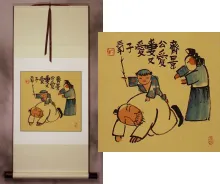
Family Snap Shot - Chinese Folk Art

Family Snap Shot
Chinese Folk Art

Here is a glimpse into traditional family life in China.


Compare: $50.00

Your Price: $29.95


More Info
The Mighty Army General & Family Man - Chinese Philosophy Art

The Mighty Army General & Family Man
Chinese Philosophy Art

The General has important duties, but when he comes home, he must remember that he is also a husband, father, and family man.


Compare: $50.00

Your Price: $24.95


More Info
Never Give Up - Chinese Proverb Calligraphy Wall Scroll

Never Give Up
Chinese Proverb Calligraphy Wall Scroll

Depending on how you want to read this, it is also a statement that you will never abandon your hopes, dreams, family or friends.


Compare: $100.00

Your Price: $49.88


More Info
The Good Life - Chinese Peasant Folk Art Painting

The Good Life
Chinese Peasant Folk Art Painting

The Chinese title of this painting means "Good Life", "Great Life" or "Happy Life". As you can see, they are able to provide plenty of food for the family, and have a healthy and happy son.


Compare: $50.00

Your Price: $29.95


More Info
The Mighty Army General - Ancient Chinese Philosophy Art

The Mighty Army General
Ancient Chinese Philosophy Art

He has important duties, but when he comes home, he must remember that he is also a husband, father, and family man.


Compare: $50.00

Your Price: $24.95


More Info
The Mighty Army General - Ancient Chinese Philosophy Wall Scroll

The Mighty Army General
Ancient Chinese Philosophy Wall Scroll

Price Reduced!!!
He has important duties, but when he comes home, he must remember that he is also a husband, father, and family man.


Compare: $50.00

Your Price: $29.88


More Info
Never Give Up - Chinese Proverb Calligraphy Wall Scroll

Never Give Up
Chinese Proverb Calligraphy Wall Scroll

Depending on how you want to read this, it is also a statement that you will never abandon your hopes, dreams, family or friends.


Compare: $142.00

Your Price: $78.88


More Info

A nice Chinese calligraphy wall scroll

The scroll that I am holding in this picture is a "medium size"
4-character wall scroll.
As you can see, it is a great size to hang on your wall.
(We also offer custom wall scrolls in larger sizes)

A professional Chinese Calligrapher

Professional calligraphers are getting to be hard to find these days.
Instead of drawing characters by hand, the new generation in China merely type roman letters into their computer keyboards and pick the character that they want from a list that pops up.

There is some fear that true Chinese calligraphy may become a lost art in the coming years. Many art institutes in China are now promoting calligraphy programs in hopes of keeping this unique form of art alive.

Trying to learn Chinese calligrapher - a futile effort

Even with the teachings of a top-ranked calligrapher in China, my calligraphy will never be good enough to sell. I will leave that to the experts.


A high-ranked Chinese master calligrapher that I met in Zhongwei

The same calligrapher who gave me those lessons also attracted a crowd of thousands and a TV crew as he created characters over 6-feet high. He happens to be ranked as one of the top 100 calligraphers in all of China. He is also one of very few that would actually attempt such a feat.


See: Our list of specifically Japanese Kanji Calligraphy Wall Scrolls. And, check out Our list of specifically old Korean Hanja Calligraphy Wall Scrolls.

The following table is only helpful for those studying Chinese (or Japanese), and perhaps helps search engines to find this page when someone enters Romanized Chinese or Japanese

Title
Characters 
Simplified
Traditional
Japanese Romaji
(Romanized Japanese)
Various forms of Romanized Chinese
Family / Home
家 / 傢
ei / uchi / ke
ei/uchi/ke
jiā
jia
chia
jia1
jia
Family / Household家庭
家庭 / 傢庭
ka tei
katei
jiā tíng
jia ting
chia t`ing
jia1 ting2
jiating
chiating
chia ting
Forever Family永远的家
永遠的家
n/ayǒng yuǎn de jiā
yong yuan de jia
yung yüan te chia
yong3 yuan3 de jia1
yongyuandejia
One Family Under Heaven天下一家
天下一家
tenka ikka
tenkaikka
tenka ika
tiān xià yī jiā
tian xia yi jia
t`ien hsia i chia
tian1 xia4 yi1 jia1
tianxiayijia
tienhsiaichia
tien hsia i chia
Any success can not compensate
for failure in the home
所有的成功都无法补偿家庭的失败
所有的成功都無法補償家庭的失敗
n/asuǒ yǒu de chéng gōng dōu wú fǎ bǔ cháng jiā tíng de shī bài
suo you de cheng gong dou wu fa bu chang jia ting de shi bai
so yu te ch`eng kung tou wu fa pu ch`ang chia t`ing te shih pai
suo3 you3 de cheng2 gong1 dou1 wu2 fa3 bu3 chang2 jia1 ting2 de shi1 bai4
so yu te cheng kung tou wu fa pu chang chia ting te shih pai
Home is where the heart is家由心生
家由心生
n/ajiā yóu xīn shēng
jia you xin sheng
chia yu hsin sheng
jia1 you2 xin1 sheng1
jiayouxinsheng
Child儿童
兒童
jidou
jido
ér tóng
er tong
erh t`ung
er2 tong2
ertong
erhtung
erh tung
No man knows what he owes to his parents
till he comes to have children of his own
子を持って知る親の恩
子を持って知る親の恩
ko wo motte shiru oya no on
kowomotteshiruoyanoon
n/a
Brotherly and Sisterly Love手足情
手足情
n/ashǒu zú qíng
shou zu qing
shou tsu ch`ing
shou3 zu2 qing2
shouzuqing
shoutsuching
shou tsu ching
God Daughter教女
教女
n/ajiào nǚ
jiao nv
chiao nü
jiao4 nv3
jiaonv
Mama / Mother / Mommy
n/a
ma
ma1
ma
Mother and Daughter母女
母女
n/amǔ nǚ
mu nv
mu nü
mu3 nv3
munv
Loving Father慈父
慈父
jifucí fù
ci fu
tz`u fu
ci2 fu4
cifu
tzufu
tzu fu
Loving Mother慈母
慈母
ji bo
jibo
cí mǔ
ci mu
tz`u mu
ci2 mu3
cimu
tzumu
tzu mu
Loving Grandfather慈祥的老爷
慈祥的老爺
n/ací xiáng de lǎo ye
ci xiang de lao ye
tz`u hsiang te lao yeh
ci2 xiang2 de lao3 ye
cixiangdelaoye
tzuhsiangtelaoyeh
tzu hsiang te lao yeh
Loving Grandfather慈祥的外祖父
慈祥的外祖父
n/ací xiáng de wài zǔ fù
ci xiang de wai zu fu
tz`u hsiang te wai tsu fu
ci2 xiang2 de wai4 zu3 fu4
cixiangdewaizufu
tzuhsiangtewaitsufu
tzu hsiang te wai tsu fu
Loving Grandfather慈祥的外公
慈祥的外公
n/ací xiáng de wài gōng
ci xiang de wai gong
tz`u hsiang te wai kung
ci2 xiang2 de wai4 gong1
cixiangdewaigong
tzuhsiangtewaikung
tzu hsiang te wai kung
Loving Grandfather慈祥的爷爷
慈祥的爺爺
n/ací xiáng de yé ye
ci xiang de ye ye
tz`u hsiang te yeh yeh
ci2 xiang2 de ye2 ye
cixiangdeyeye
tzuhsiangteyehyeh
tzu hsiang te yeh yeh
Loving Grandfather慈祥的祖父
慈祥的祖父
n/ací xiáng de zǔ fù
ci xiang de zu fu
tz`u hsiang te tsu fu
ci2 xiang2 de zu3 fu4
cixiangdezufu
tzuhsiangtetsufu
tzu hsiang te tsu fu
Loving Grandmother慈祥的姥姥
慈祥的姥姥
n/ací xiáng de lǎo lao
ci xiang de lao lao
tz`u hsiang te lao lao
ci2 xiang2 de lao3 lao
cixiangdelaolao
tzuhsiangtelaolao
tzu hsiang te lao lao
Loving Grandmother慈祥的外婆
慈祥的外婆
n/ací xiáng de wài pó
ci xiang de wai po
tz`u hsiang te wai p`o
ci2 xiang2 de wai4 po2
cixiangdewaipo
tzuhsiangtewaipo
tzu hsiang te wai po
Loving Grandmother慈祥的外祖母
慈祥的外祖母
n/ací xiáng de wài zǔ mǔ
ci xiang de wai zu mu
tz`u hsiang te wai tsu mu
ci2 xiang2 de wai4 zu3 mu3
cixiangdewaizumu
tzuhsiangtewaitsumu
tzu hsiang te wai tsu mu
Loving Grandmother慈祥的奶奶
慈祥的奶奶
n/ací xiáng de nǎi nai
ci xiang de nai nai
tz`u hsiang te nai nai
ci2 xiang2 de nai3 nai
cixiangdenainai
tzuhsiangtenainai
tzu hsiang te nai nai
Loving Grandmother慈祥的祖母
慈祥的祖母
n/ací xiáng de zǔ mǔ
ci xiang de zu mu
tz`u hsiang te tsu mu
ci2 xiang2 de zu3 mu3
cixiangdezumu
tzuhsiangtetsumu
tzu hsiang te tsu mu
Dear Grandfather亲爱的姥爷
親愛的姥爺
n/aqín ài de lǎo ye
qin ai de lao ye
ch`in ai te lao yeh
qin2 ai4 de lao3 ye
qinaidelaoye
chinaitelaoyeh
chin ai te lao yeh
Dear Grandfather亲爱的外祖父
親愛的外祖父
n/aqín ài de wài zǔ fù
qin ai de wai zu fu
ch`in ai te wai tsu fu
qin2 ai4 de wai4 zu3 fu4
qinaidewaizufu
chinaitewaitsufu
chin ai te wai tsu fu
Dear Grandfather亲爱的外公
親愛的外公
n/aqín ài de wài gōng
qin ai de wai gong
ch`in ai te wai kung
qin2 ai4 de wai4 gong1
qinaidewaigong
chinaitewaikung
chin ai te wai kung
Dear Grandfather亲爱的爷爷
親愛的爺爺
n/aqín ài de yé ye
qin ai de ye ye
ch`in ai te yeh yeh
qin2 ai4 de ye2 ye
qinaideyeye
chinaiteyehyeh
chin ai te yeh yeh
Dear Grandfather亲爱的祖父
親愛的祖父
n/aqín ài de zǔ fù
qin ai de zu fu
ch`in ai te tsu fu
qin2 ai4 de zu3 fu4
qinaidezufu
chinaitetsufu
chin ai te tsu fu
Dear Grandmother亲爱的姥姥
親愛的姥姥
n/aqín ài de lǎo lao
qin ai de lao lao
ch`in ai te lao lao
qin2 ai4 de lao3 lao
qinaidelaolao
chinaitelaolao
chin ai te lao lao
Dear Grandmother亲爱的外婆
親愛的外婆
n/aqín ài de wài pó
qin ai de wai po
ch`in ai te wai p`o
qin2 ai4 de wai4 po2
qinaidewaipo
chinaitewaipo
chin ai te wai po
Dear Grandmother亲爱的外祖母
親愛的外祖母
n/aqín ài de wài zǔ mǔ
qin ai de wai zu mu
ch`in ai te wai tsu mu
qin2 ai4 de wai4 zu3 mu3
qinaidewaizumu
chinaitewaitsumu
chin ai te wai tsu mu
Dear Grandmother亲爱的奶奶
親愛的奶奶
n/aqín ài de nǎi nai
qin ai de nai nai
ch`in ai te nai nai
qin2 ai4 de nai3 nai
qinaidenainai
chinaitenainai
chin ai te nai nai
Dear Grandmother亲爱的祖母
親愛的祖母
n/aqín ài de zǔ mǔ
qin ai de zu mu
ch`in ai te tsu mu
qin2 ai4 de zu3 mu3
qinaidezumu
chinaitetsumu
chin ai te tsu mu
Daddy / Father爸爸
爸爸
n/abà ba
ba ba
pa pa
ba4 ba
baba
Father and Son父与子
父與子
n/afù yù zǐ
fu yu zi
fu yü tzu
fu4 yu4 zi3
fuyuzi
Mother and Son母子
母子
bo shi
boshi
mǔ zǐ
mu zi
mu tzu
mu3 zi3
muzi
No one knows a son better than the father知子莫若父
知子莫若父
n/azhī zǐ mò ruò fù
zhi zi mo ruo fu
chih tzu mo jo fu
zhi1 zi3 mo4 ruo4 fu4
zhizimoruofu

If you have not set up your computer to display Chinese, the characters in this table probably look like empty boxes or random text garbage.
This is why I spent hundreds of hours making images so that you could view the characters in the "family" listings above.
If you want your Windows computer to be able to display Chinese characters you can either head to your Regional and Language options in your Win XP control panel, select the [Languages] tab and click on [Install files for East Asian Languages]. This task will ask for your Win XP CD to complete in most cases. If you don't have your Windows XP CD, or are running Windows 98, you can also download/run the simplified Chinese font package installer from Microsoft which works independently with Win 98, ME, 2000, and XP. It's a 2.5MB download, so if you are on dial up, start the download and go make a sandwich.

Some people may refer to this entry as Kanji, Characters, in Mandarin Chinese, Characters, in Chinese Writing, in Japanese Writing, in Asian Writing, Ideograms, Chinese symbols, Hieroglyphics, Glyphs, in Chinese Letters, Hanzi, in Japanese Kanji, Pictograms, in the Chinese Written-Language, or in the Japanese Written-Language.

Did you like this? Share it:


Copyright Oriental Outpost 2002-2012   -   All Rights Reserved
Image Use Policy Privacy Policy