Buy a Custom Fear Chinese or Japanese Calligraphy Wall Scroll
The good-meaning Asian words and phrases with "fear" in them tend to be about overcoming fear (rather than actual fear).
The character that means "fear" looks like this: 
This character is not appropriate alone for a wall scroll, so you will only find it within other selections below.
Switched to secondary search mode due to lack of results using primary.
These secondary results may not be very accurate. Try a different but similar meaning word or phrase for better results. Or...
Look up in my Japanese Kanji & Chinese Character Dictionary(My dictionary is a different system then the calligraphy search you just tried)
If you want a special phrase, word, title, name, or proverb, feel free to contact me, and I will translate your custom calligraphy idea for you.
1. Advance Bravely / Indomitable Spirit
2. 1000 good moves ruined by 1 bad
4. Blue Lotus
7. Confidence / Faithful Heart
8. The Confident Helmsman Inspires Confidence in the Passengers
10. Dana: Almsgiving and Generosity
11. Danger
12. Diligence
13. Do not fear the task: Cooperation will lead to success
14. Fear No Evil
15. Fear No Man / Fear Nothing
16. Fearghal
17. Fear God
19. Fearne
20. Fears
21. The one who retreats 50 paces mocks the one to retreats 100
23. Guan Yu
24. Indomitable / Persistence / Fortitude
27. Joshua 1:9
28. Know Your Enemy, Know Yourself, and Win 100 Battles
29. Never Give Up
30. Fear not long roads; Fear only short ambition
31. Do not fear poverty; Fear low ambitions
32. Do not fear being slow, fear standing still
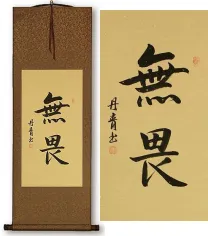
33. No Fear
34. No Mind / Mushin
35. Perseverance
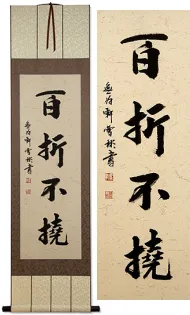
36. Undaunted After Repeated Setbacks
37. Preparation Yields No Fear or Worries
38. Preparation Yields No Regrets
40. One who is drenched in rain does not fear drops of dew
41. Respect out of fear is never genuine; Reverence out of respect is never false
43. Taekwondo Tenets / Spirit of Taekwon-do
46. Wolf
47. Zhang Fei
Advance Bravely / Indomitable Spirit
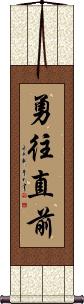
This proverb creates an image of a warrior bravely advancing against an enemy regardless of the odds.
This proverb can also be translated as “indomitable spirit” or “march fearlessly onward.”
See Also: Indomitable | Fortitude
1000 good moves ruined by 1 bad
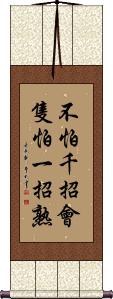
不怕千招会只怕一招熟 is a Chinese proverb that literally translates as: Do not worry about making a thousand clever moves; what [one has to] fear is one bad move.
Figuratively, this means: Even if you have made many clever moves before, one wrong move will ruin the whole game.
I compare this to the English saying, “It takes only one Aw-shit to wipe out a thousand Attaboys.”
Awesome / Awe-Inspiring
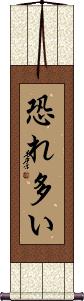
恐れ多い is a Japanese word for something awe-inspiring or awesome (in some odd context, it can refer to August).
恐れ多い is probably not appropriate for a calligraphy wall scroll unless you have a specific reason.
The word awesome is misused a lot in English or used too casually. This Japanese word is the real form of awesome, and it kind of means numerous fears and anxiety that you would feel in response to encountering something truly awesome (such as God, a tornado, a tsunami, etc.).
Note: Because this selection contains some special Japanese Hiragana characters, it should be written by a Japanese calligrapher.
Blue Lotus
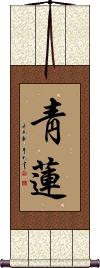
靑蓮 is a common title for Blue Lotus.
靑蓮 is often used in a Buddhist context for blue lotus from the Sanskrit “utpala.” This often refers to the clarity and purity of the lotus blue eyes possessed by a Living Buddha. It can also represent the purity of mind (without desire, suffering, fear, etc.).
The Brave Have No Fears
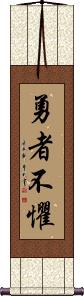
This proverb means “Brave people [are] without fear,” or “The brave are without fear.”
勇者不懼 is a proverb credited to Confucius. It's one of three phrases in a set of things he said.
This phrase is originally Chinese but has penetrated Japanese culture as well (many Confucian phrases have) back when Japan borrowed Chinese characters into their language.
This phrase has also been converted into modern Japanese grammar when written as 勇者は懼れず. If you want this version just click on those characters.
See Also: No Fear
Bravery / Courage
Courage in the face of Fear
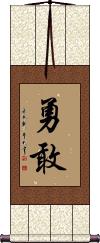
勇敢 is about courage or bravery in the face of fear.
You do the right thing even when it is hard or scary. When you are courageous, you don't give up. You try new things. You admit mistakes. This kind of courage is the willingness to take action in the face of danger and peril.
勇敢 can also be translated as braveness, valor, heroic, fearless, boldness, prowess, gallantry, audacity, daring, dauntless, and/or courage in Japanese, Chinese, and Korean. This version of bravery/courage can be an adjective or a noun. The first character means bravery and courage by itself. The second character means “daring” by itself. The second character emphasizes the meaning of the first but adds the idea that you are not afraid of taking a dare, and you are not afraid of danger.
勇敢 is more about brave behavior and not so much the mental state of being brave. You'd more likely use this to say, “He fought courageously in the battle,” rather than “He is very courageous.”
Bravery / Courage
Single Character for Courage
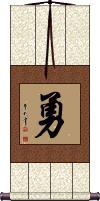
勇 can be translated as bravery, courage, valor, or fearless in Chinese, Japanese and Korean.
勇 is the simplest form to express courage or bravery, as there is also a two-character form that starts with this same character.
勇 can also be translated as brave, daring, fearless, plucky, or heroic.
This is also a virtue of the Samurai Warrior
See our page with just Code of the Samurai / Bushido here
Confidence / Faithful Heart
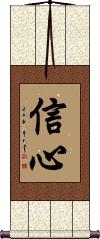
信心 is a Chinese, Japanese, and Korean word that means confidence, faith, or belief in somebody or something.
The first character means faith, and the second can mean heart or soul. Therefore, you could say this means “faithful heart” or “faithful soul.”
In Korean especially, this word has a religious connotation.
In the old Japanese Buddhist context, this was a word for citta-prasāda (clear or pure heart-mind).
In modern Japan (when read by non-Buddhists), this word is usually understood as “faith,” “belief,” or “devotion.”
See Also: Self-Confidence
The Confident Helmsman Inspires Confidence in the Passengers
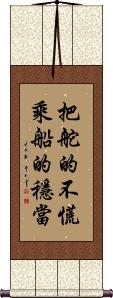
把舵的不慌乘船的稳当 is a Chinese proverb that literally translates as: [If the] helmsman is not nervous, the passengers [will feel] secure.
Figuratively, this means: If the leader appears confident, his/her followers will gain confidence also.
This is a great suggestion that a confident leader inspires confidence in his/her troops or followers. Of course, a nervous leader will create fear in troops or followers.
Bravery / Courage
Courageous Energy
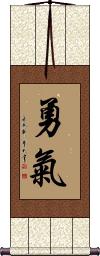
勇氣 is one of several ways to express bravery and courage in Chinese, Japanese, and Korean.
This version is the most spiritual. This is the essence of bravery from deep within your being. This is the mental state of being brave versus actual brave behavior. You'd more likely use this to say, “He is very courageous,” rather than “He fought courageously in the battle.”
The first character also means bravery or courage when it's seen alone. With the second character added, an element of energy or spirit is added. The second character is the same “chi” or “qi” energy that Kung Fu masters focus on when they strike. For this reason, you could say this means “spirit of courage” or “brave spirit.”
This is certainly a stronger word than just the first character alone.
Beyond bravery or courage, dictionaries also translate this word as valor/valour, nerve, audacity, daring, pluck, plucky, gallantry, guts, gutsy, and boldness.
This is also one of the 8 key concepts of tang soo do.
 While the version shown to the left is commonly used in Chinese and Korean Hanja (and ancient Japanese Kanji), please note that the second character is written with slightly fewer strokes in modern Japanese. If you want the modern Japanese version, please click on the character to the right. Both styles would be understood by native Chinese, Japanese, and many (but not all) Korean people. You should make your selection based on the intended audience for your calligraphy artwork. Or pick the single-character form of bravery/courage which is universal.
Dana: Almsgiving and Generosity
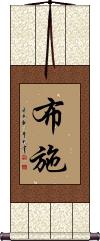
布施 is the Buddhist practice of giving known as Dāna or दान from Pali and Sanskrit.
Depending on the context, this can be alms-giving, acts of charity, or offerings (usually money) to a priest for reading sutras or teachings.
Some will put Dāna in these two categories:
1. The pure or unsullied charity, which looks for no reward here but only in the hereafter.
2. The sullied almsgiving whose object is personal benefit.
The first kind is, of course, the kind that a liberated or enlightened person will pursue.
Others will put Dāna in these categories:
1. Worldly or material gifts.
2. Unworldly or spiritual gifts.
You can also separate Dāna into these three kinds:
1. 財布施 Goods such as money, food, or material items.
2. 法布施 Dharma, as an act to teach or bestow the Buddhist doctrine onto others.
3. 無畏布施 Courage, as an act of facing fear to save someone or when standing up for someone or standing up for righteousness.
The philosophies and categorization of Dāna will vary among various monks, temples, and sects of Buddhism.
Breaking down the characters separately:
布 (sometimes written 佈) means to spread out or announce, but also means cloth. In ancient times, cloth or robs were given to the Buddhist monks annually as a gift of alms - I need to do more research, but I believe there is a relationship here.
施 means to grant, to give, to bestow, to act, to carry out, and by itself can mean Dāna as a single character.
Dāna can also be expressed as 檀那 (pronounced “tán nà” in Mandarin and dan-na or だんな in Japanese). 檀那 is a transliteration of Dāna. However, it has colloquially come to mean some unsavory or unrelated things in Japanese. So, I think 布施 is better for calligraphy on your wall to remind you to practice Dāna daily (or whenever possible).
Danger
A dangerous character in every way
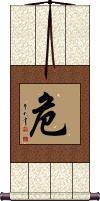
危 means danger, peril, or “to endanger” in Chinese, Japanese, and old Korean.
If you live a dangerous life or want to subtly warn others that you are a dangerous person, this may be the selection for you.
This also means “danger” and sometimes “fear” in Japanese and Korean but is seldom seen outside of compound words in those languages (as a single character, it's kind of like an abbreviation for danger in Japanese and Korean). 危 is also a rather odd selection for a wall scroll anyway. It's only here because people search for danger on our website.
Diligence
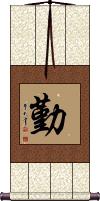
勤 is a single character that means diligence or “sense of duty” in Chinese and Korean (also understood in Japanese but not commonly seen as a stand-alone Kanji).
As a single character on a wall scroll, this will only be seen with this meaning. However, it can also mean industrious, hardworking, frequent, regular, constant, energy, zeal, fortitude, or virility.
In Buddhism, this can represent vīrya (viriya), the idea of energy, diligence, enthusiasm, or effort. It can be defined as an attitude of gladly engaging in wholesome activities, and it functions to cause one to accomplish wholesome or virtuous actions. Some Buddhists may even define this as “manliness” (a definition from a hundred years ago, before equality).
If you or someone you know is a hard worker (or needs a reminder to be diligent), then this is the wall scroll to have in your/their office.
Do not fear the task: Cooperation will lead to success
Do not fear strong winds waves; just be sure to row in unison
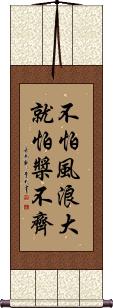
不怕风浪大就怕桨不齐 is a Chinese proverb that literally translates as: Do not fear strong winds [and] high waves; what [one should] worry about whether or not you're rowing in unison.
Figuratively, this means: However difficult the task, the key to success lies in making collective efforts.
I like to translate this as “Don't sweat the details, just get together and get it done.”
Fear No Evil
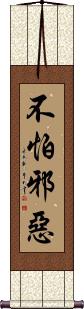
不怕邪惡 literally means “no fear of evil” in Chinese.
Chinese grammar and word order are a little different than English. 不怕邪惡 is the best way to write something that means “fear no evil” in Chinese.
The first character means “not,” “don't” or “no.”
The second means “fear.”
The last two mean “evil” but can also be translated as sinister, vicious, wickedness, or just “bad.”
Fear No Evil
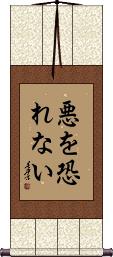
悪を恐れない is “Fear No Evil” in Japanese.
Japanese grammar and phrase construction is different than English, so this literally reads, “Evil Fear Not.”
The “evil” Kanji can also be translated as “wickedness.”
Note: Because this selection contains some special Japanese Hiragana characters, it should be written by a Japanese calligrapher.
Fear No Man / Fear Nothing
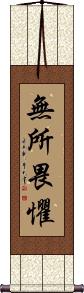
無所畏懼 means “fear nothing,” but it's the closest thing in Chinese to the phrase “fear no man” which many of you have requested.
This would also be the way to say “fear nobody” and can be translated simply as “undaunted.”
Fearghal
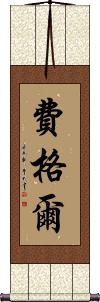
費格爾 is the name Fearghal in Chinese (Mandarin).
Fearghal
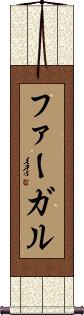
ファーガル is the name Fearghal in Japanese Katakana.
Note: Because this title is entirely Japanese Katakana, it should be written by a Japanese calligrapher.
Fear God
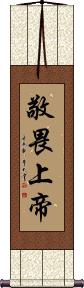
敬畏上帝 is probably the best way to translate the Christian English phrase “Fear God” into Chinese.
The first two characters mean to revere, be in awe of, or a general term of reverence. It can mean fear, but only in the context of respect or fear of authority.
Fearless / Daring
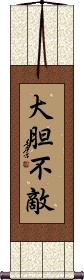
大胆不敵 is a Japanese word that can mean a few things depending on how you read it.
Popular translations include fearless, audacity (the attitude of a) daredevil, or daring.
The first two Kanji create a word that means: bold, fearless, or daring; audacious.
The last two Kanji create a word meaning: no match for, cannot beat, daring, fearless, intrepid, bold, or tough.
As with many Japanese words, the two similar-meaning words work together to multiply the meaning and intensity of the whole 4-Kanji word.
Fearne
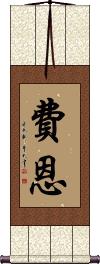
費恩 is the name Fearne in Chinese (Mandarin).
Fearne
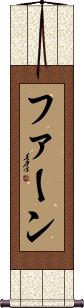
ファーン is the name Fearne in Japanese Katakana.
Note: Because this title is entirely Japanese Katakana, it should be written by a Japanese calligrapher.
Fears
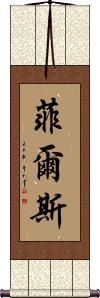
菲爾斯 is the name Fears in Chinese (Mandarin).
Fears

フィアーズ is the name Fears in Japanese Katakana.
Note: Because this title is entirely Japanese Katakana, it should be written by a Japanese calligrapher.
The one who retreats 50 paces mocks the one to retreats 100
The pot calls the kettle black
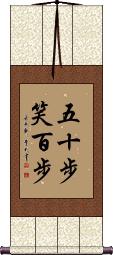
五十步笑百步 is a Chinese proverb that means the one who retreats 50 paces mocks the one who retreats 100 paces.
During the Warring States Period of what is now China (475 - 221 B.C.), the King of Wei was in love with war. He often fought with other kingdoms just for spite or fun.
One day, the King of Wei asked the philosopher Mencius, “I love my people, and all say I do the best for them. I move the people from famine-stricken areas to places of plenty and transport grains from rich areas to the poor. Nobody goes hungry in my kingdom, and I treat my people far better than other kings. But why does the population of my kingdom not increase, and why does the population of other kingdoms not decrease?”
Mencius answered, “Since you love war, I will make this example: When going to war, and the drums beat to start the attack, some soldiers flee for their lives in fear. Some run 100 paces in retreat, and others run 50 steps. Then the ones who retreated 50 paces laugh and taunt those who retreated 100 paces, calling them cowards mortally afraid of death. Do you think this is reasonable?
The King of Wei answered, “Of course not! Those who run 50 paces are just as timid as those who run 100 paces.”
Mencius then said, “You are a king who treats his subjects better than other kings treat their people, but you are so fond of war that your people suffer from great losses in battle. Therefore, your population does not grow. While other kings allow their people to starve to death, you send your people to die in war. Is there any difference?”
This famous conversation led to the six-character proverb shown here. It serves as a warning to avoid hypocrisy. It goes hand-in-hand with the western phrase, “The pot calls the kettle black,” or the Biblical phrase, “Before trying to remove a splinter from your neighbor's eye, first remove the plank from your own eye.”
Perseverance / Fortitude
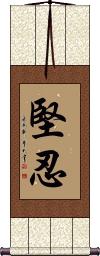
堅忍 means persistent, steadfast, fortitude, and/or perseverance.
The first character means strong, solid, firm, unyielding, or resolute.
The second character means to beat, endure, or tolerate.
Together they speak of the strength from within yourself. Some may also translate this as long-suffering in a more Biblical sense.
堅忍 is a common term in Chinese and Korean Hanja but a little less commonly used in modern Japanese Kanji. For that reason, this selection is best if your audience is Chinese or Korean.

 Note that when writing this as Kanji, Japanese will tend to write the second Kanji a little differently. If you select our Japanese master calligrapher, please expect the form where the little horizontal stroke crosses the vertical stroke. See differences in the images to the right. Technically, they are both the same character, and will be read the same in either language.
Guan Yu
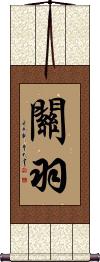
關羽 is the name Guan Yu, Army General for the Kingdom of Shu.
He is also known as Guan Gong (like saying Duke Guan or Sir Guan)
He was immortalized in the novel, “Romance of the Three Kingdoms.”
He was a fearsome fighter, also famous for his virtue and loyalty. He is worshiped by some modern-day soldiers and has the title “Warrior Saint” in China. Some believe he offers safety and protection for military servicemen.
Guan Yu lived until 219 A.D.
Indomitable / Persistence / Fortitude
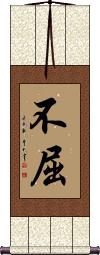
不屈 is the short form of a longer Chinese word and also a word used in Korean and Japanese to express the idea of being indomitable. It literally means “will not bend,” “will not crouch,” “will not yield,” “will not flinch,” or “will not submit.”
Note: Some will translate this as “indomitable spirit”; however, technically, there is no character to suggest the idea of “spirit” in this word.
Indomitable / Unyielding
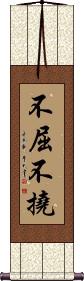
不屈不撓 means “Indomitable” or “Unyielding.”
不屈不撓 is a long word by Chinese standards. At least, it is often translated as a single word into English. It's actually a proverb in Chinese.
If you want to break it down, you can see that the first and third characters are the same. Both mean “not” (they work as a suffix to make a negative or opposite meaning to whatever character follows).
The second character means “bendable.”
The last means “scratched” or “bothered.”
So this really means “Won't be bent, can't be bothered.” I have also seen it written as “Will not crouch, will not submit.” This comes from the fact that the second character can mean “to crouch” and the last can mean “to submit” (as in “to give in” such as “submitting to the rule of someone else”). This may explain better why these four characters mean “indomitable.”
Notes:
Some will translate this as “indomitable spirit”; however, technically, there is no character to suggest the idea of “spirit” in this word.
Other translations include indefatigability, indomitableness, or unremitting tenacity.
The first two characters can be stand-alone words in Chinese.
In Japanese, this is considered two words (with very similar meanings). It's more common to see the word order flipped to 不撓不屈 in Japanese.
The same characters are used in old Korean Hanja. Just like in Japanese, the words are swapped to 不撓不屈 creating a word pronounced “불요불굴” in Korean.
See 不撓不屈
Indomitable Spirit
Korean Only
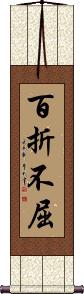
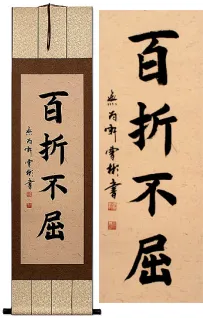
百折不屈 is a Korean proverb that means “indomitable spirit,” at least, that is the way it is commonly translated in martial arts circles (Taekwondo, Hapkido, etc.).
The literal translation is “[one] hundred [times] broken [still] don't succumb.”
Or more naturally translated, “Even if attacked/beaten one hundred times, still be undaunted/indomitable.”
Notes:
Some will say this is one long word rather than a proverb.
This is also a proverb/word in Chinese though rarely used in modern times.
Joshua 1:9
Do not be afraid, God is always with you
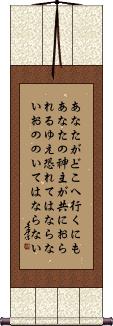
あなたがどこへ行くにもあなたの神主が共におられるゆえ恐れてはならないおののいてはならない is a Japanese translation of a large portion of Joshua 1:9.
The Japanese passage includes, “The Lord God is with you wherever you are; Therefore do not fear or be discouraged.”
Note: Because this selection contains some special Japanese Hiragana characters, it should be written by a Japanese calligrapher.
Know Your Enemy, Know Yourself, and Win 100 Battles
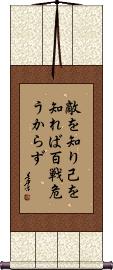
敵を知り己を知れば百戦危うからず is the longer/full Japanese version of this proverb. This means “Know your enemy, know yourself, and you will not fear a hundred battles.”
Others will translate this as “Know thy enemy, know thyself, yields victory in one hundred battles.”
Note: Because this selection contains some special Japanese Hiragana characters, it should be written by a Japanese calligrapher.
Never Give Up
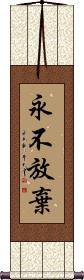
The first character means “eternal” or “forever,” and the second means “not” (together, they mean “never”). The last two characters mean “give up” or “abandon.” Altogether, you can translate this proverb as “never give up” or “never abandon.”
Depending on how you want to read this, 永不放棄 is also a statement that you will never abandon your hopes, dreams, family, or friends.
Fear not long roads; Fear only short ambition
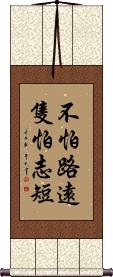
不怕路遠隻怕志短 is a Chinese proverb that literally translates as “Fear not long roads; fear only short ambition,” or “Don't fear that the road is long, only fear that your will/ambition/aspiration is short.”
Figuratively, this means: However difficult the goal is, one can achieve it as long as one is determined to do so.
Others may translate the meaning as “Don't let a lack of willpower stop you from pressing onward in your journey.”
Do not fear poverty; Fear low ambitions
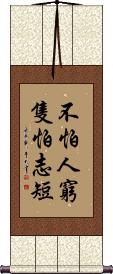
不怕人窮隻怕志短 is a Chinese proverb that literally translates as: It is not poverty that is to be feared; It is low ambition.
Figuratively, this means: It is not poverty but a lack of lofty aspiration that is to be regretted.
Do not fear being slow, fear standing still
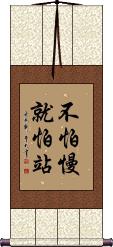
不怕慢就怕站 is a Chinese proverb that translates as: Don't worry about being slow; only worry about standing still.
Figuratively, this means: A slow progress holds some promise but to stand still promises failure.
No Fear
(2 characters)
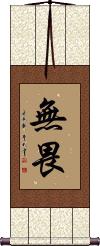
無畏 literally means “No Fear.” But perhaps not the most natural Chinese phrase (see our other “No Fear” phrase for a complete thought). However, this two-character version of “No Fear” seems to be a very popular way to translate this into Chinese when we checked Chinese Google.
Note: This also means “No Fear” in Japanese and Korean, but this character pair is not often used in Japan or Korea.
This term appears in various Chinese dictionaries with definitions like “without fear,” intrepidity, fearless, dauntless, and bold.
In the Buddhist context, this is a word derived from the word Abhaya, meaning: Fearless, dauntless, secure, nothing, and nobody to fear. Also, from vīra meaning: courageous, bold.
See Also: Never Give Up | No Worries | Undaunted | Bravery | Courage | Fear No Man
No Fear
(four-character version)
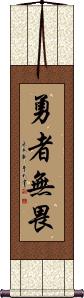
勇者無畏 is a complete sentence that means “Brave People Have No Fear” or “A Brave Person Has No Fear” (plural or singular is not implied).
We translated “No Fear” into the two variations that you will find on our website. Then we checked Chinese Google and found that others had translated “No Fear” in the exact same ways. Pick the one you like best. A great gift for your fearless friend.
See Also: Fear No Man
No Fear
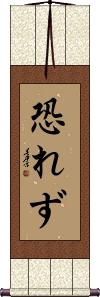
恐れず is probably the best way to express “No Fear” in Japanese.
The first Kanji and the following Hiragana character create a word that means: to fear, to be afraid of, frightened, or terrified.
The last Hiragana character serves to modify and negate the first word (put it in negative form). Basically, they carry a meaning like “without” or “keeping away.” 恐れず is almost like the English modifier “-less.”
Altogether, you get something like “Without Fear” or “Fearless.”
Here's an example of using this in a sentence: 彼女かのじょは思い切ったことを恐れずにやる。
Translation: She is not scared of taking big risks.
Note: Because this selection contains some special Japanese Hiragana characters, it should be written by a Japanese calligrapher.
No Mind / Mushin
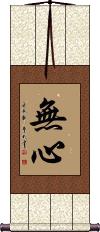
In Japanese, 無心 means innocent or without knowledge of good and evil. It literally means “without mind.”
無心 is one of the five spirits of the warrior (budo) and is often used as a Japanese martial arts tenet. Under that context, places such as the Budo Dojo define it this way: “No mind, a mind without ego. A mind like a mirror which reflects and dos not judge.” The original term was “mushin no shin,” meaning “mind of no mind.” It is a state of mind without fear, anger, or anxiety. Mushin is often described by the phrase “Mizu no Kokoro,” which means “mind like water.” The phrase is a metaphor describing the pond that clearly reflects its surroundings when calm but whose images are obscured once a pebble is dropped into its waters.
This has a good meaning in conjunction with Chan / Zen Buddhism in Japan. However, out of that context, it means mindlessness or absent-mindedness. To non-Buddhists in China, this is associated with doing something without thinking.
In Korean, this usually means indifference.
Use caution and know your audience before ordering this selection.
More info: Wikipedia: Mushin
Perseverance
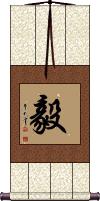
毅 is the simplest way to express perseverance in Chinese and Korean Hanja.
This single-character version leaves a bit of mystery about what kind of perseverance you might want to convey.
In Korean, this is usually associated with “strength of character.”
In Japanese, this character can be pronounced in a dozen different ways (so we have left out the Japanese pronunciation guide that normally appears above). In Japanese, this Kanji would usually be translated as “strong” (perhaps strong-willed).
Undaunted After Repeated Setbacks
Persistence to overcome all challenges
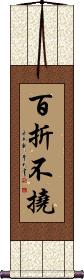
百折不撓 is a Chinese proverb that means “Be undaunted in the face of repeated setbacks.”
More directly translated, it reads, “[Overcome] a hundred setbacks, without flinching.” 百折不撓 is of Chinese origin but is commonly used in Japanese and somewhat in Korean (same characters, different pronunciation).
This proverb comes from a long, and occasionally tragic story of a man that lived sometime around 25-220 AD. His name was Qiao Xuan, and he never stooped to flattery but remained an upright person at all times. He fought to expose the corruption of higher-level government officials at great risk to himself.
Then when he was at a higher level in the Imperial Court, bandits were regularly capturing hostages and demanding ransoms. But when his own son was captured, he was so focused on his duty to the Emperor and the common good that he sent a platoon of soldiers to raid the bandits' hideout, and stop them once and for all even at the risk of his own son's life. While all of the bandits were arrested in the raid, they killed Qiao Xuan's son at first sight of the raiding soldiers.
Near the end of his career, a new Emperor came to power, and Qiao Xuan reported to him that one of his ministers was bullying the people and extorting money from them. The new Emperor refused to listen to Qiao Xuan and even promoted the corrupt Minister. Qiao Xuan was so disgusted that in protest, he resigned from his post as minister (something almost never done) and left for his home village.
His tombstone reads “Bai Zhe Bu Nao” which is now a proverb used in Chinese culture to describe a person of strong will who puts up stubborn resistance against great odds.
My Chinese-English dictionary defines these 4 characters as “keep on fighting despite all setbacks,” “be undaunted by repeated setbacks,” and “be indomitable.”
Our translator says it can mean “never give up” in modern Chinese.
Although the first two characters are translated correctly as “repeated setbacks,” the literal meaning is “100 setbacks” or “a rope that breaks 100 times.” The last two characters can mean “do not yield” or “do not give up.”
Most Chinese, Japanese, and Korean people will not take this absolutely literal meaning but will instead understand it as the title suggests above. If you want a single big word definition, it would be indefatigability, indomitableness, persistence, or unyielding.
See Also: Tenacity | Fortitude | Strength | Perseverance | Persistence
Preparation Yields No Fear or Worries
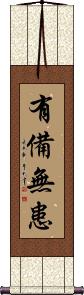
有備無患 means “When you are well-prepared, you have nothing to fear.”
Noting that the third character means “no” or “without” and modifies the last... The last character can mean misfortune, troubles, worries, or fears. It could even be stretched to mean sickness. Therefore you can translate this proverb in a few ways. I've also seen it translated as “Preparedness forestalls calamities.”
有備無患 is comparable to the English idiom, “Better safe than sorry,” but does not directly/literally mean this.
Preparation Yields No Regrets
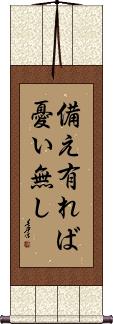
備え有れば憂い無し is as proverb that means “When you are well-prepared, you have nothing to regret” in Japanese.
Note: Because this selection contains some special Japanese Hiragana characters, it should be written by a Japanese calligrapher.
Qi Gong / Chi Kung
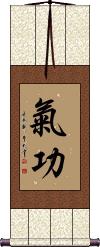
氣功 or Qigong is the title of a technique that is somewhere between medical practice, meditation, and in some cases, religion.
The definition is blurred depending on which school of Qigong you are following. In some cases, it is even incorporated with martial arts.
Some people (even Chinese people) mix this title with Tai Chi (Tai Qi) exercises.
Lately, in China, people will claim to practice Tai Chi rather than Qigong because the Qigong title was recently used as a cover for an illegal pseudo-religious movement in China with the initials F.G. or F.D. (I can not write those names here for fear of our website being banned in China).
You can learn those names and more here: Further info about Qigong
If you are wondering why I wrote “Qi Gong” and “Chi Kung” as the title of this calligraphy entry, I should teach you a little about the various ways in which Chinese can be Romanized. One form writes this as “Chi Kung” or “Chikung” (Taiwan). In the mainland and elsewhere, it is Romanized as “Qi Gong” or “Qigong.” The pronunciation is the same in Taiwan, mainland, and Singapore Mandarin. Neither Romanization is exactly like English. If you want to know how to say this with English rules, it would be something like “Chee Gong” (but the “gong” has a vowel sound like the “O” in “go”).
Romanization is a really confusing topic and has caused many Chinese words to be mispronounced in the west. One example is “Kung Pao Chicken,” which should actually be more like “Gong Bao” with the “O” sounding like “oh” for both characters. Neither the Romanization system in Taiwan nor the Mainland is perfect, in my opinion, and leads to many misunderstandings.
In modern Japan, you may see this written as 気功, but the original 氣功 is still recognized. If you need the Japanese version, please contact me.
One who is drenched in rain does not fear drops of dew
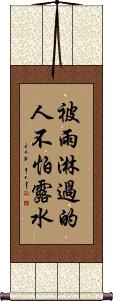
被雨淋過的人不怕露水 is a Chinese proverb that literally translates as “One who has been drenched by the rain is not afraid of dew drops.”
Figuratively, this means:
One who has gone through hardships is not afraid of (minor)setbacks.
Respect out of fear is never genuine; Reverence out of respect is never false
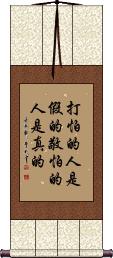
打怕的人是假的敬怕的人是真的 is a proverb that seems to be aimed at world leaders or others in power. Perhaps a suggestion to avoid the practice of “fear-mongering” opting instead for a policy of benevolence and justice.
An example: When the Bush administration told Pakistan they could either join America in the “war on terror,” or expect some bombs to be coming their way, Bush gained this kind of “less-than-genuine respect” from Pakistanis.
Leaders in places like North Korea and even Saudi Arabia reap the same bogus respect from their own citizens.
Note that calligraphers do not like to repeat the same characters in exactly the same way in the same piece of artwork. So expect the characters that are repeated to be written in different forms in the real artwork (unlike the way they are displayed to the left).
The Roar of the Lioness
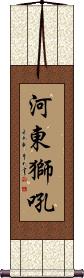
河東獅吼 is actually a proverb and joke about the plight and fear of a hen-pecked husband.
In ancient times, it was used to describe a wife who would berate her husband or go into jealous rages. However, this phrase currently brings about ideas of a husband that cowers in fear and cringes when his wife screams (or roars) at him.
Please only purchase this as a good-natured joke. If your wife or husband does not have a good sense of humor, it's probably not a good idea to hang this on your wall to irritate your mate.
Taekwondo Tenets / Spirit of Taekwon-do
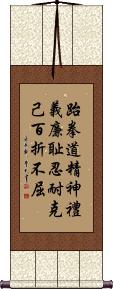
跆拳道精神禮義廉耻忍耐克己百折不屈 is General Choi's writing that is often called “The Tenets of Taekwon-do.”
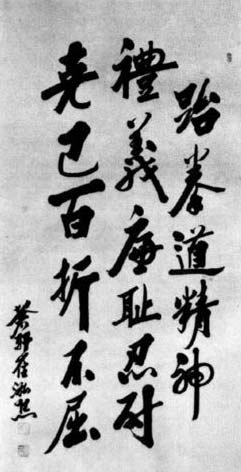
The actual title would be translated as “Taekwondo Spirit” or “The Spirit of Taekwondo.” It was originally written in Korean Hanja (Chinese characters used in Korea for about 1600 years).
General Choi's original calligraphy is shown to the right. Your custom calligraphy will be unique, and not an exact match, as each calligrapher has their own style.In modern times, the common form of written Korean is Hangul (a phonetic character set). The table below shows the text in Hangul and Hanja along with a pronunciation guide and a brief English translation:
| Traditional Korean Hanja | Modern Korean Hangul | Pronunciation | English |
| 跆拳道精神 | 태권도정신 | tae gweon do jeong sin | Taekwondo Spirit |
| 禮儀 | 예의 | ye yi | Courtesy / Etiquette / Propriety / Decorum / Formality |
| 廉耻 | 염치 | yeom ci | Integrity / Sense of Honor |
| 忍耐 | 인내 | in nae | Patience / Perseverance / Endurance |
| 克己 | 극기 | geug gi | Self-Control / Self-Denial / Self-Abnegation |
| 百折不屈 | 백절불굴 | baeg jeor bur gur | Indomitable Spirit (Undaunted even after repeated attacks from the opponent) |
| Note that the pronunciation is the official version now used in South Korea. However, it is different than what you may be used to. For instance, “Taekwon-do” is “tae gweon do.” This new romanization is supposed to be closer to actual Korean pronunciation. | |||
Tough / Unbeatable
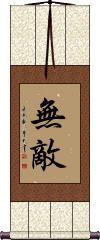
無敵 means tough or unbeatable in Chinese characters, Korean Hanja, and Japanese Kanji.
Other translations for this word include unequaled, without rival, a paragon, invincible, unrivaled/unrivalled, no match for, cannot beat, daring, fearless, intrepid, and/or bold.
In Japanese, this can also be the surname Muteki.
Carry On, Undaunted
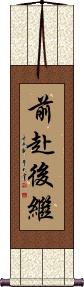
前赴後繼 is a Chinese proverb that figuratively means “to advance dauntlessly in wave upon wave.”
It suggests that you should or can carry on and have the strength to keep going.
While this proverb is a little bit militaristic, it suggests that despite a fallen comrade (or perhaps a loved one), you should keep going and work towards the goal they intended.
Wolf
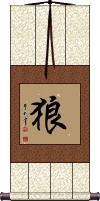
狼 is the character used to represent the elusive animal known as the wolf in both Chinese and Japanese.
If you are a fan of the wolf or the wolf means something special to you, this could make a great addition to your wall.
Do keep in mind, that much like our perception of wolves in the history of western culture, eastern cultures do not have a very positive view of wolves (save the scientific community and animal lovers). The wolf is clearly an animal that is misunderstood or feared the world over.
狼 is seldom used alone in Korean Hanja but is used in a compound word that means utter failure (as in a wolf getting into your chicken pen - or an otherwise ferocious failure). Not a good choice if your audience is Korean.
Zhang Fei
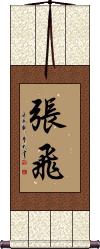
張飛 is the name of General Zhang Fei, of the Shu Kingdom. He was blood-brother of Liu Bei in the semi-historical novel “Romance of the Three Kingdoms.” Zhang Fei is famous for his heroic and fearsome fighting and his love of wine.
In Japanese, this can be the name Chouhi.
This in-stock artwork might be what you are looking for, and ships right away...
Gallery Price: $150.00
Your Price: $99.88
Gallery Price: $180.00
Your Price: $99.88
Gallery Price: $200.00
Your Price: $98.88


Gallery Price: $106.00
Your Price: $58.88
The following table may be helpful for those studying Chinese or Japanese...
| Title | Characters | Romaji (Romanized Japanese) | Various forms of Romanized Chinese | |
| Advance Bravely Indomitable Spirit | 勇往直前 | yǒng wǎng zhí qián yong3 wang3 zhi2 qian2 yong wang zhi qian yongwangzhiqian | yung wang chih ch`ien yungwangchihchien yung wang chih chien |
|
| 1000 good moves ruined by 1 bad | 不怕千招會隻怕一招熟 不怕千招会只怕一招熟 | bú pà qiān zhāo huì zhǐ pà yī zhāo shú bu2 pa4 qian1 zhao1 hui4 zhi3 pa4 yi1 zhao1 shu2 bu pa qian zhao hui zhi pa yi zhao shu | pu p`a ch`ien chao hui chih p`a i chao shu pu pa chien chao hui chih pa i chao shu |
|
| Awesome Awe-Inspiring | 恐れ多い | osore ooi / osoreooi / osore oi | ||
| Blue Lotus | 靑蓮 靑莲 | seiren | qing lián / qing lian2 / qing lian / qinglian | ch`ing lien / chinglien / ching lien |
| The Brave Have No Fears | 勇者不懼 勇者不惧 | yuu sha fu ku yuushafuku yu sha fu ku | yǒng zhě bú jù yong3 zhe3 bu2 ju4 yong zhe bu ju yongzhebuju | yung che pu chü yungchepuchü |
| Bravery Courage | 勇敢 | yuu kan / yuukan / yu kan | yǒng gǎn / yong3 gan3 / yong gan / yonggan | yung kan / yungkan |
| Bravery Courage | 勇 | isamu / yu- | yǒng / yong3 / yong | yung |
| Confidence Faithful Heart | 信心 | shin jin / shinjin | xìn xīn / xin4 xin1 / xin xin / xinxin | hsin hsin / hsinhsin |
| The Confident Helmsman Inspires Confidence in the Passengers | 把舵的不慌乘船的穩當 把舵的不慌乘船的稳当 | bǎ tuò de bù huāng chéng chuán de wěn dang ba3 tuo4 de bu4 huang1 cheng2 chuan2 de wen3 dang ba tuo de bu huang cheng chuan de wen dang | pa t`o te pu huang ch`eng ch`uan te wen tang pa to te pu huang cheng chuan te wen tang |
|
| Bravery Courage | 勇氣 勇气 / 勇気 | yuuki / yuki | yǒng qì / yong3 qi4 / yong qi / yongqi | yung ch`i / yungchi / yung chi |
| Dana: Almsgiving and Generosity | 布施 | fuse | bù shī / bu4 shi1 / bu shi / bushi | pu shih / pushih |
| Danger | 危 | ki | wēi / wei1 / wei | |
| Diligence | 勤 | kin | qín / qin2 / qin | ch`in / chin |
| Do not fear the task: Cooperation will lead to success | 不怕風浪大就怕槳不齊 不怕风浪大就怕桨不齐 | bù pà fēng làng dà jiù pà jiǎng bù qí bu4 pa4 feng1 lang4 da4 jiu4 pa4 jiang3 bu4 qi2 bu pa feng lang da jiu pa jiang bu qi | pu p`a feng lang ta chiu p`a chiang pu ch`i pu pa feng lang ta chiu pa chiang pu chi |
|
| Fear No Evil | 不怕邪惡 不怕邪恶 | bú pà xié è bu2 pa4 xie2 e4 bu pa xie e bupaxiee | pu p`a hsieh o pupahsieho pu pa hsieh o |
|
| Fear No Evil | 悪を恐れない | aku o osore nai akuoosorenai | ||
| Fear No Man Fear Nothing | 無所畏懼 无所畏惧 | wú suǒ wèi jù wu2 suo3 wei4 ju4 wu suo wei ju wusuoweiju | wu so wei chü wusoweichü |
|
| Fearghal | 費格爾 费格尔 | fèi gé ěr fei4 ge2 er3 fei ge er feigeer | fei ko erh feikoerh |
|
| Fearghal | ファーガル | faagaru / fagaru | ||
| Fear God | 敬畏上帝 | jìng wèi shàng dì jing4 wei4 shang4 di4 jing wei shang di jingweishangdi | ching wei shang ti chingweishangti |
|
| Fearless Daring | 大膽不敵 大胆不敵 | dai tan fu teki daitanfuteki | ||
| Fearne | 費恩 费恩 | fèi ēn / fei4 en1 / fei en / feien | ||
| Fearne | ファーン | faan / fan | ||
| Fears | 菲爾斯 菲尔斯 | fēi ěr sī fei1 er3 si1 fei er si feiersi | fei erh ssu feierhssu |
|
| Fears | フィアーズ | fiaazu / fiazu | ||
| The one who retreats 50 paces mocks the one to retreats 100 | 五十步笑百步 | wù shí bù xiào bǎi bù wu4 shi2 bu4 xiao4 bai3 bu4 wu shi bu xiao bai bu wushibuxiaobaibu | wu shih pu hsiao pai pu wushihpuhsiaopaipu |
|
| Perseverance Fortitude | 堅忍 坚忍 | ken nin / kennin | jiǎn rěn / jian3 ren3 / jian ren / jianren | chien jen / chienjen |
| Guan Yu | 關羽 关羽 | guān yǔ / guan1 yu3 / guan yu / guanyu | kuan yü / kuanyü | |
| Indomitable Persistence Fortitude | 不屈 | fukutsu | bù qū / bu4 qu1 / bu qu / buqu | pu ch`ü / puchü / pu chü |
| Indomitable Unyielding | 不屈不撓 不屈不挠 | fu kutsu fu tou fukutsufutou fu kutsu fu to | bù qū bù náo bu4 qu1 bu4 nao2 bu qu bu nao buqubunao | pu ch`ü pu nao puchüpunao pu chü pu nao |
| Indomitable Spirit | 百折不屈 | bǎi shé bù qū bai3 she2 bu4 qu1 bai she bu qu baishebuqu | pai she pu ch`ü paishepuchü pai she pu chü |
|
| Joshua 1:9 | あなたがどこへ行くにもあなたの神主が共におられるゆえ恐れてはならないおののいてはならない | anata ga doko e iku ni mo anata no kami omo ga tomoni ora reru yue osorete wa naranai ononoite wa naranai | ||
| Know Your Enemy, Know Yourself, and Win 100 Battles | 敵を知り己を知れば百戦危うからず | teki o shi ri o no o shi re ba hya ku sen aya u ka ra zu | ||
| Never Give Up | 永不放棄 永不放弃 | yǒng bù fàng qì yong3 bu4 fang4 qi4 yong bu fang qi yongbufangqi | yung pu fang ch`i yungpufangchi yung pu fang chi |
|
| Fear not long roads; Fear only short ambition | 不怕路遠隻怕志短 不怕路远只怕志短 | bú pà lù yuǎn zhǐ pà zhì duǎn bu2 pa4 lu4 yuan3 zhi3 pa4 zhi4 duan3 bu pa lu yuan zhi pa zhi duan bupaluyuanzhipazhiduan | pu p`a lu yüan chih p`a chih tuan pu pa lu yüan chih pa chih tuan |
|
| Do not fear poverty; Fear low ambitions | 不怕人窮隻怕志短 不怕人穷只怕志短 | bú pà rén qióng zhǐ pà zhì duǎn bu2 pa4 ren2 qiong2 zhi3 pa4 zhi4 duan3 bu pa ren qiong zhi pa zhi duan buparenqiongzhipazhiduan | pu p`a jen ch`iung chih p`a chih tuan pu pa jen chiung chih pa chih tuan |
|
| Do not fear being slow, fear standing still | 不怕慢就怕站 | bú pà màn jiù pà zhàn bu2 pa4 man4 jiu4 pa4 zhan4 bu pa man jiu pa zhan bupamanjiupazhan | pu p`a man chiu p`a chan pupamanchiupachan pu pa man chiu pa chan |
|
| No Fear | 無畏 无畏 | mui | wú wèi / wu2 wei4 / wu wei / wuwei | |
| No Fear | 勇者無畏 勇者无畏 | yǒng zhě wú wèi yong3 zhe3 wu2 wei4 yong zhe wu wei yongzhewuwei | yung che wu wei yungchewuwei |
|
| No Fear | 恐れず | oso re zu / osorezu | ||
| No Mind Mushin | 無心 无心 | mu shin / mushin | wú xīn / wu2 xin1 / wu xin / wuxin | wu hsin / wuhsin |
| Perseverance | 毅 | see note / seenote / se note | yì / yi4 / yi | i |
| Undaunted After Repeated Setbacks | 百折不撓 百折不挠 | hyaku setsu su tou hyakusetsusutou hyaku setsu su to | bǎi zhé bù náo bai3 zhe2 bu4 nao2 bai zhe bu nao baizhebunao | pai che pu nao paichepunao |
| Preparation Yields No Fear or Worries | 有備無患 有备无患 | yǒu bèi wú huàn you3 bei4 wu2 huan4 you bei wu huan youbeiwuhuan | yu pei wu huan yupeiwuhuan |
|
| Preparation Yields No Regrets | 備え有れば憂い無し | sona e a re ba ure i na shi sonaearebaureinashi | ||
| Qi Gong Chi Kung | 氣功 气功 | ki kou / kikou / ki ko | qì gōng / qi4 gong1 / qi gong / qigong | ch`i kung / chikung / chi kung |
| One who is drenched in rain does not fear drops of dew | 被雨淋過的人不怕露水 被雨淋过的人不怕露水 | bèi yǔ lín guò de rén bù pà lù shuǐ bei4 yu3 lin2 guo4 de ren2 bu4 pa4 lu4 shui3 bei yu lin guo de ren bu pa lu shui | pei yü lin kuo te jen pu p`a lu shui pei yü lin kuo te jen pu pa lu shui |
|
| Respect out of fear is never genuine; Reverence out of respect is never false | 打怕的人是假的敬怕的人是真的 | dǎ pà de rén shì jiǎ de jìng pà de rén shì zhēn de da3 pa4 de ren2 shi4 jia3 de jing4 pa4 de ren2 shi4 zhen1 de da pa de ren shi jia de jing pa de ren shi zhen de | ta p`a te jen shih chia te ching p`a te jen shih chen te ta pa te jen shih chia te ching pa te jen shih chen te |
|
| The Roar of the Lioness | 河東獅吼 河东狮吼 | hé dōng shī hǒu he2 dong1 shi1 hou3 he dong shi hou hedongshihou | ho tung shih hou hotungshihhou |
|
| Taekwondo Tenets Spirit of Taekwon-do | 跆拳道精神禮義廉耻忍耐克己百折不屈 跆拳道精神礼义廉耻忍耐克己百折不屈 | tái quán dào jīng shén lǐ yì lián chǐ rěn nài kè jǐ bǎi zhé bù qū tai2 quan2 dao4 jing1 shen2 li3 yi4 lian2 chi3 ren3 nai4 ke4 ji3 bai3 zhe2 bu4 qu1 tai quan dao jing shen li yi lian chi ren nai ke ji bai zhe bu qu | t`ai ch`üan tao ching shen li i lien ch`ih jen nai k`o chi pai che pu ch`ü tai chüan tao ching shen li i lien chih jen nai ko chi pai che pu chü |
|
| Tough Unbeatable | 無敵 无敌 | muteki | wú dí / wu2 di2 / wu di / wudi | wu ti / wuti |
| Carry On, Undaunted | 前赴後繼 前赴后继 | qián fù hòu jì qian2 fu4 hou4 ji4 qian fu hou ji qianfuhouji | ch`ien fu hou chi chienfuhouchi chien fu hou chi |
|
| Wolf | 狼 | okami | láng / lang2 / lang | |
| Zhang Fei | 張飛 张飞 | chou hi / chouhi / cho hi | zhāng fēi zhang1 fei1 zhang fei zhangfei | chang fei changfei |
| In some entries above you will see that characters have different versions above and below a line. In these cases, the characters above the line are Traditional Chinese, while the ones below are Simplified Chinese. | ||||



