Custom Karate Japanese Calligraphy Wall Scroll
You can choose from many options to create artwork with Karate characters on a wall scroll or portrait.
Start by clicking on the button next to your favorite Karate title below...
1. Karate-Do
5. Karate
6. Kempo Karate / Law of the Fist Empty Hand
7. Law of the Fist Karate / Kempo Karate
10. Shidokan
12. Shito-Ryu Ki-Me-Kan Karate-Do
15. Wado-Ryu Karate
16. Okinawa Karate
18. Kakuto Karate
19. Japanese Karate Association
24. Kenka Karate
26. Okinawa Goju Ryu Karate-Do
27. Goju Ryu
28. Tang Soo Do / Tang Hand Way
30. Tang Hand
31. Wado-Kai
32. Wado-Ryu
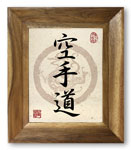
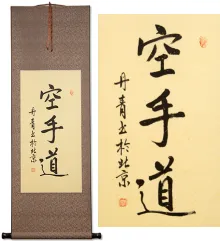
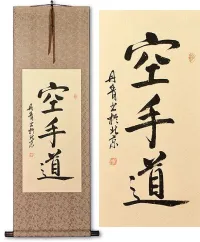
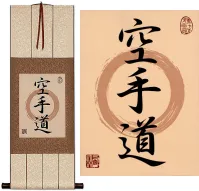
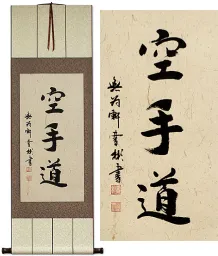
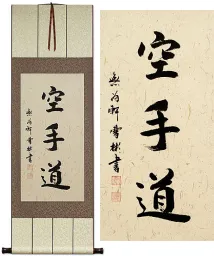
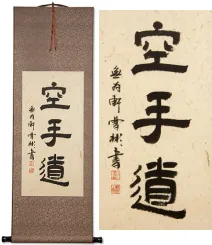
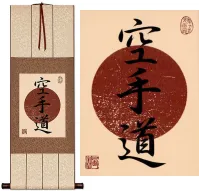
Karate-Do
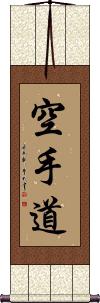
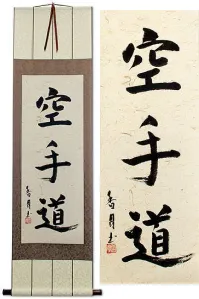
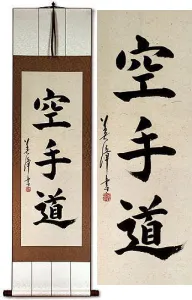
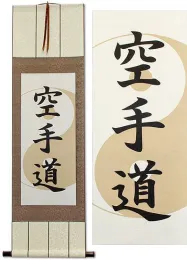
The literal meaning of 空手道 is “empty hand method” or “empty hand way.”
Credit is given that karate started in China but migrated and became refined and vastly popular in Japan.
Karate is a martial art that uses no blades or weapons other than the “natural weapons” God gave to humans (fists and feet). The last character somehow became optional, but the meaning of that character is “method” or “the way” as in Taoism / Daoism.
Karate-Do reached Korea, where it is known as 공수도 which can be romanized as “Kong Soo Do” or “Gong Su Do.”
Danketsu Karate-Do
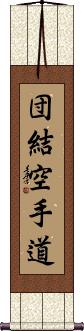
団結空手道 is the title for Danketsu Karate-Do, a dojo located in Stroudsburg, PA.
団結 (danketsu) means union, unity, or combination.
空手道 (karate-do) means “empty hand way.”
If you need you martial arts school/dojo/academy added to my database, just give me the info (actual Chinese/Japanese text if you have it).
Goju Ryu Karate-Do
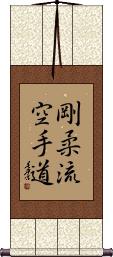
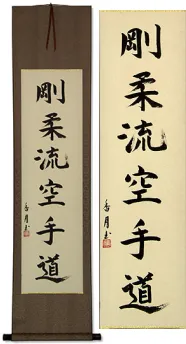
剛柔流空手道 is the title of the Goju-Ryu Karate-Do school of martial arts.
Isshin Ryu Karate Do
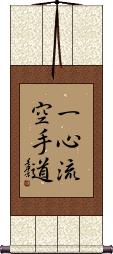
一心流空手道 is the full title for Isshin-Ryu Karate-Do.
The literal meaning is “one heart method empty hand way.”
There are other ways to translate this, but if you are looking for this title, you already know that.
This would make a great wall scroll for your dojo or private studio if you study this form of Japanese (technically from Okinawa) Karate.
Because this is a specifically-Japanese title, I strongly recommend that you select our Japanese Master Calligrapher to create this artwork.
Karate
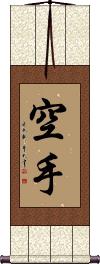
空手 is the short and widely-used-in-English version of karate-do without the “do” or “dao” at the end.
Literal meaning: Empty Hand.
Kempo Karate / Law of the Fist Empty Hand
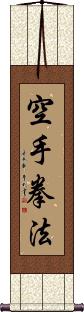
空手拳法 is the Kanji title for Kempo Karate.
The first two characters mean “karate” - technically they express “empty hand.”
The last two express “fist law” which is Romanized from Japanese as “Kenpo” or “Kempo.”
That “empty hand” translation can be understood better when you grasp the idea that karate is a martial art without weapons (other than the weapons organic to your body, such as your foot, hand, fist, etc). When you practice karate, you do so with empty hands (no weapons).
Note: There is also an antiquated way to write karate. It has the same pronunciation but a different first character which means “Tang” as in the Tang Dynasty. Some dojos use that form - let us know if you need that alternate form, and we'll add it.
Law of the Fist Karate / Kempo Karate
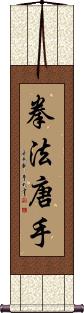
The first two characters mean “fist law” which is Romanized from Japanese as “Kenpo” or “Kempo.”
The last two are a secondary way to express “karate.”
Notes:
The more common way to express “karate” is literally “empty hand” (meaning “without weapons in your hand”). This version would be translated literally as “Tang hand” (as in the Tang Dynasty) or “China hand” (sometimes “Tang” means “China” in Japanese). Even though the character for “Tang” is used instead of “empty,” it's still pronounced “kara-te” in Japanese.
拳法唐手 is not commonly used in China - so please consider it to be a Japanese-only title.
Many Japanese people will say the last two Kanji are the old and antiquated way of saying Karate. This fact does not stop this title from existing, as these four characters are often seen in Kenpo / Kempo Dojos around the western world.
Matsubayashi-Ryu Karate-Do
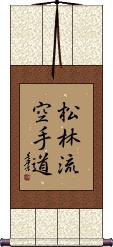
鬆林流空手道 is the Japanese title for the Matsubayashi-Ryu Karate-Do school of martial arts.
If directly translated, it means “Pine Forest Style Empty Hand Way.”
Notes:
1. 松林流 can be pronounced Matsubayashi-Ryū or Shōrin-Ryū. This can be confusing as Shōrin can also represent 少林 which refers to the Shaolin (little forest) style.
2. 松 can also be written in the traditional form of 鬆.
Nippon Karate-Do Genbu-Kai
Japanese Genbu Karate Club
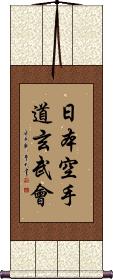
日本空手道玄武會 is the title for Nippon Karate-Do Genbu-Kai.
A Japanese karate association of the Genbu school.
Note that while this title does make perfect sense in Chinese, it is really a Japanese title. In fact, the first word is “Japanese/Japan.”
If you’d like your martial arts school, dojo or club added to our calligraphy database for easy ordering of a custom calligraphy wall scroll, just contact me.
Shidokan (Karate)
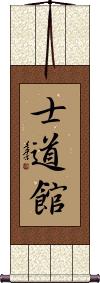
士道館 is the Japanese title for Shidōkan, a style of full-contact karate.
士道館 is a newer karate style founded in 1980 by Yoshiji Soeno.
Shidokan Karate-Do
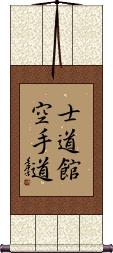
士道館空手道 is the full Japanese title for Shidōkan Karate-Do, a style of full-contact karate.
This is a newer karate style, founded in 1980 by Yoshiji Soeno.
Shito-Ryu Ki-Me-Kan Karate-Do
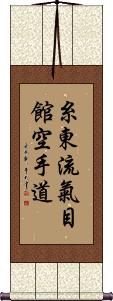
糸東流氣目館空手道 is the title for Shito-Ryu Ki-Me-Kan Karate-Do.
A school of Karate.
Note that while this title can be pronounced in Chinese, it only makes complete sense in Japanese.
Shotokan Karate-Do
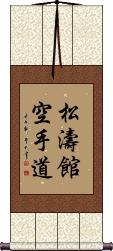
鬆濤館空手道 art the Japanese Kanji that make up the title for Shotokan Karate.
This should be considered a Japanese-only title. It does make sense and is pronounceable in Chinese and Korean but only as a title for a building (perhaps a martial arts hall) surrounded by pine trees - followed by the characters for “The empty hand method” (kong shou dao / Karate-do). Also, the first two characters were simplified in both Japanese and Chinese. The third character was simplified in Chinese but not Japanese.
Upon request, we can offer the fully traditional Chinese version but be sure you know what you are asking for.
Note: This would be understood in Chinese and Korean Hanja by a person from those cultures familiar with martial arts and various schools of Japanese karate.
Uechi-Ryu Karate-Do
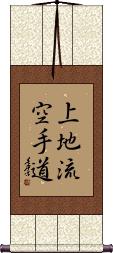
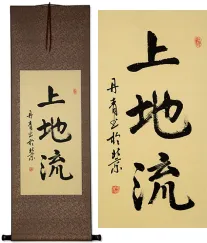
上地流空手道 is the title of the Uechi-Ryu Karate-Do school of Okinawan martial arts.
Uechi means “higher stages of practice” in a Buddhist context.
Wado-Ryu Karate
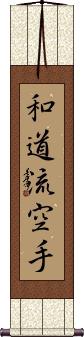
Okinawa Karate
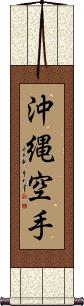
沖縄空手 is the title for Okinawa Karate.
Karate-Do Shinyo-Kai
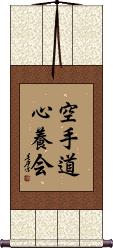
空手道心養会 is the Japanese Kanji for
Karate-Dō Shinyō-Kai.
Kakuto Karate
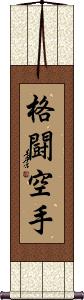
格闘空手 is Kakutō Karate and means Fighting Karate and/or Combat Karate.
Japanese Karate Association
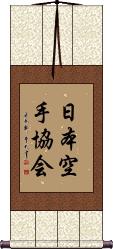
日本空手協会 is the Kanji for Nihon Karate Kyōkai or Japanese Karate Association.
Snow Leopard Karate-Do
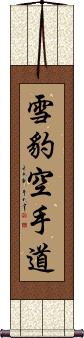
雪豹空手道 is the Japanese (and Chinese) title for Snow Leopard Karate-Do.
Karate Ni Sente Nashi
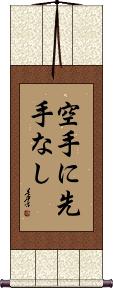
空手に先手なし means there is no first attack in Karate, or there is no first strike in Karate.
Note: Because this selection contains some special Japanese Hiragana characters, it should be written by a Japanese calligrapher.
White Crane Karate
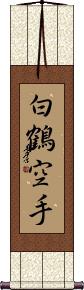
This is the title for White Crane Karate in Japanese Kanji.
Flying Dragon Karate-Do
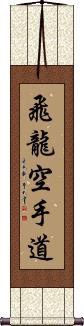
飛龍空手道 is the title Flying Dragon Karate-Do.
Kenka Karate
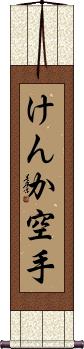
This is the title Kenka Karate in Japanese.
Note: Because this selection contains some special Japanese Hiragana characters, it should be written by a Japanese calligrapher.
Shito-Ryu Karate-Do
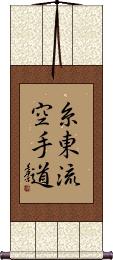
糸東流空手道 is the title for Shito-Ryu Karate-Do.
Okinawa Goju Ryu Karate-Do
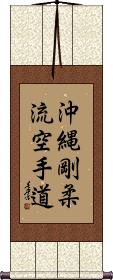
沖縄剛柔流空手道 is the title of the Okinawa Goju-Ryu Karate-Do school of martial arts.
Goju Ryu
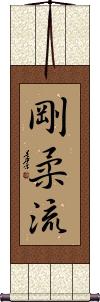
剛柔流 is the title of the Goju-Ryu or Gōjū-Ryū school/style of Karate or Japanese martial arts.
Sometimes romanized as Gojo-Ryu or Gojoryu, though technically, it should be Gōjū-Ryū (the accents indicating long vowel sounds like “gou juu ryuu”).
Tang Soo Do / Tang Hand Way
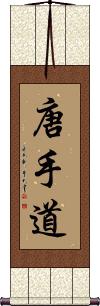
唐手道 is the alternate title for Karate-do.
This title uses a character, 唐, which represents the Tang Dynasty of China. Thus, this is often translated as the “Tang Hand Way” or incorrectly, “Tang Fist Way.”
I have also seen some call it “China Hand Way.”
Many in Korea refer to and romanize these characters as “Tang Soo Do” (당수도) where these characters refer to a kind of Korean style of Karate.
There is not a lot of information on this title but some believe that a simplified form of Kung Fu that started in China and ended up very popular in Japan used this title initially. It was later changed in Japan to a different Karate title which means “Empty Hand” (as in, without weapons).
Note: When used in Korean, this is pronounced 당수도. This title is often romanized as “Tang Soo Do,” “Tangsudo,” “Dang Su Do,” or “Dangsudo.” The last two romanizations on that list are the official Korean government romanization, though martial arts schools tend to use other non-standard versions.
Shorinji Kempo / Kenpo
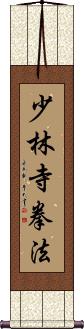
少林寺拳法 is a specific type of martial art in Japan that claims origins in the Kung Fu practiced in the original Shaolin Monastery of China.
The first three characters mean “Shaolin Monastery,” and you might notice the Japanese is pronounced in a very similar way. The reason is, many words were “borrowed” from the original Chinese when Japan did not have a written language and simply absorbed Chinese characters into their language around the 5th century. When a Japanese word did not exist, the Chinese pronunciation was often absorbed as well as the written form.
The last two characters mean “fist law” or “method of the fist.” It has long been argued as to whether the Japanese for these characters should be Romanized as “kempo” or “kenpo.” The official method should be “kenpou” but it's common to drop the “u” that comes after the “o.”
I imagine if you are looking for this title, you already know what it means, so the above is simply extra information that a student of Shorinji Kempo might want to know.
Tang Hand
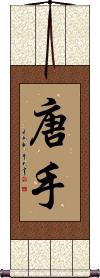
唐手 is a very seldom-used title for Karate.
This title uses a character that represents the Tang Dynasty of China. Thus, this is often translated as the “Tang Hand” or, incorrectly, “Tang Fist.”
I have also seen some call it “China Hand.”
There is not a lot of information on this title but some believe that a simplified form of Kung Fu that started in China, and ended up very popular in Japan used this title initially. It was later changed in Japan to a different Karate title which means "Empty Hand" (as in, without weapons).
I am sure that some will suggest a different history or argue a different origin. I think that nobody can be sure.
Note: Just like the more conventional Karate title, this one can have the "way" or "method" character added to the end, as in Karate-Do.
Wado-Kai
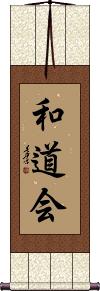
Wado-Kai is used as a title for styles of Karate and Aikido.
Breaking down the characters into the proper Japanese Romaji, you have “wa dou kai” or “wa dō kai.” The meaning is roughly-translated as “Harmony Way Club” or “Peace Method Association.” The first Kanji should probably be read as harmony, rather than peace in this case.
See Also: Wado-Ryu
Wado-Ryu
Style of Karate or Jujitsu
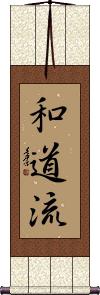
和道流 or Wado-Ryu is a style of Karate or Jujutsu (Jujitsu).
Note: Many will argue whether this is a style of Karate or Jujutsu.
While some find Wado-Ryu similar to Shotokan Karate, enough differences exist in perspective and technique that it stands by itself.
Breaking down the characters into the proper Japanese Romaji, you have “wa dou ryuu” or “wa dō ryū.” The meaning is roughly-translated as “Harmony Way Style” or “Peace Method Style.” The first Kanji should probably be read as harmony rather than peace in this case.
See Also: Wado-Kai
This in-stock artwork might be what you are looking for, and ships right away...
Gallery Price: $90.00
Your Price: $49.88
Gallery Price: $90.00
Your Price: $49.88
Gallery Price: $200.00
Your Price: $118.88
Gallery Price: $340.00
Your Price: $188.77
Gallery Price: $180.00
Your Price: $99.88
Gallery Price: $103.00
Your Price: $56.88
The following table may be helpful for those studying Chinese or Japanese...
| Title | Characters | Romaji (Romanized Japanese) | Various forms of Romanized Chinese | |
| Karate-Do | 空手道 | kara te dou karatedou kara te do | kōng shǒu dào kong1 shou3 dao4 kong shou dao kongshoudao | k`ung shou tao kungshoutao kung shou tao |
| Danketsu Karate-Do | 団結空手道 | dan ketsu kara te dou danketsukaratedou dan ketsu kara te do | ||
| Goju Ryu Karate-Do | 剛柔流空手道 刚柔流空手道 | gou juu ryuu kara te dou goujuuryuukaratedou go ju ryu kara te do | ||
| Isshin Ryu Karate Do | 一心流空手道 | i sshin ryuu kara te dou isshinryuukaratedou i shin ryu kara te do | ||
| Karate | 空手 | kara te / karate | kōng shǒu kong1 shou3 kong shou kongshou | k`ung shou kungshou kung shou |
| Kempo Karate Law of the Fist Empty Hand | 空手拳法 | kara te ken pou karatekenpou kara te ken po | kōng shǒu quán fǎ kong1 shou3 quan2 fa3 kong shou quan fa kongshouquanfa | k`ung shou ch`üan fa kungshouchüanfa kung shou chüan fa |
| Law of the Fist Karate Kempo Karate | 拳法唐手 | ken pou kara te kenpoukarate ken po kara te | quán fǎ táng shǒu quan2 fa3 tang2 shou3 quan fa tang shou quanfatangshou | ch`üan fa t`ang shou chüanfatangshou chüan fa tang shou |
| Matsubayashi-Ryu Karate-Do | 松林流空手道 | matsu bayashi ryuu kara te dou matsu bayashi ryu kara te do | ||
| Nippon Karate-Do Genbu-Kai | 日本空手道玄武會 日本空手道玄武会 | ni ppon kara te dou gen bu kai nipponkaratedougenbukai ni pon kara te do gen bu kai | rì běn kōng shǒu dào xuán wǔ huì ri4 ben3 kong1 shou3 dao4 xuan2 wu3 hui4 ri ben kong shou dao xuan wu hui | jih pen k`ung shou tao hsüan wu hui jih pen kung shou tao hsüan wu hui |
| Shidokan (Karate) | 士道館 | shi dou kan shidoukan shi do kan | ||
| Shidokan Karate-Do | 士道館空手道 | shi dou kan kara te dou shidoukankaratedou shi do kan kara te do | ||
| Shito-Ryu Ki-Me-Kan Karate-Do | 糸東流氣目館空手道 糸东流気目馆空手道 | shito-ryu ki-me-kan karate-dou shito-ryu ki-me-kan karate-do | mì dōng liú qì mù guǎn kōng shǒu dào mi4 dong1 liu2 qi4 mu4 guan3 kong1 shou3 dao4 mi dong liu qi mu guan kong shou dao | mi tung liu ch`i mu kuan k`ung shou tao mi tung liu chi mu kuan kung shou tao |
| Shotokan Karate-Do | 鬆濤館空手道 松涛館空手道 | shou tou kan kara te dou shoutoukankaratedou sho to kan kara te do | sōng tāo guǎn kōng shǒu dào song1 tao1 guan3 kong1 shou3 dao4 song tao guan kong shou dao songtaoguankongshoudao | sung t`ao kuan k`ung shou tao sungtaokuankungshoutao sung tao kuan kung shou tao |
| Uechi-Ryu Karate-Do | 上地流空手道 | ue chi ryuu kara te dou uechiryuukaratedou ue chi ryu kara te do | ||
| Wado-Ryu Karate | 和道流空手 | wa dou ryuu kara te wadouryuukarate wa do ryu kara te | ||
| Okinawa Karate | 沖縄空手 | oki nawa kara te okinawakarate | chōng shéng kōng shǒu chong1 sheng2 kong1 shou3 chong sheng kong shou chongshengkongshou | ch`ung sheng k`ung shou chungshengkungshou chung sheng kung shou |
| Karate-Do Shinyo-Kai | 空手道心養会 | kara te dou shin you kai karatedoushinyoukai kara te do shin yo kai | ||
| Kakuto Karate | 格闘空手 | kaku tou kara te kakutoukarate kaku to kara te | ||
| Japanese Karate Association | 日本空手協會 日本空手協会 | ni hon kara te kyou kai nihonkaratekyoukai ni hon kara te kyo kai | rì běn kōng shǒu xié huì ri4 ben3 kong1 shou3 xie2 hui4 ri ben kong shou xie hui ribenkongshouxiehui | jih pen k`ung shou hsieh hui jihpenkungshouhsiehhui jih pen kung shou hsieh hui |
| Snow Leopard Karate-Do | 雪豹空手道 | yukihyou karate yukihyoukarate yukihyo karate | xuě bào kōng shǒu dào xue3 bao4 kong1 shou3 dao4 xue bao kong shou dao xuebaokongshoudao | hsüeh pao k`ung shou tao hsüehpaokungshoutao hsüeh pao kung shou tao |
| Karate Ni Sente Nashi | 空手に先手なし | karate ni sente nashi karatenisentenashi | ||
| White Crane Karate | 白鶴空手 | shiro tsuru kara te shirotsurukarate | ||
| Flying Dragon Karate-Do | 飛龍空手道 飞龙空手道 | hi ryuu kara te dou hiryuukaratedou hi ryu kara te do | fēi lóng kòng shǒu dào fei1 long2 kong4 shou3 dao4 fei long kong shou dao feilongkongshoudao | fei lung k`ung shou tao feilungkungshoutao fei lung kung shou tao |
| Kenka Karate | けんか空手 | kanka karate kankakarate | ||
| Shito-Ryu Karate-Do | 糸東流空手道 糸东流空手道 | shii tou ryuu kara te dou shiitouryuukaratedou shi to ryu kara te do | ||
| Okinawa Goju Ryu Karate-Do | 沖縄剛柔流空手道 沖縄刚柔流空手道 | oki nawa gou juu ryuu kara te dou oki nawa go ju ryu kara te do | ||
| Goju Ryu | 剛柔流 刚柔流 | gou juu ryuu goujuuryuu go ju ryu | ||
| Tang Soo Do Tang Hand Way | 唐手道 | kara te do / karatedo | táng shǒu dào tang2 shou3 dao4 tang shou dao tangshoudao | t`ang shou tao tangshoutao tang shou tao |
| Shorinji Kempo Kenpo | 少林寺拳法 | shourinji kenpou shourinjikenpou shorinji kenpo | shào lín sì quán fǎ shao4 lin2 si4 quan2 fa3 shao lin si quan fa shaolinsiquanfa | shao lin ssu ch`üan fa shaolinssuchüanfa shao lin ssu chüan fa |
| Tang Hand | 唐手 | kara te / karate | táng shǒu tang2 shou3 tang shou tangshou | t`ang shou tangshou tang shou |
| Wado-Kai | 和道會 和道会 | wa dou kai / wadoukai / wa do kai | ||
| Wado-Ryu | 和道流 | wa dou ryuu wadouryuu wa do ryu | ||
| In some entries above you will see that characters have different versions above and below a line. In these cases, the characters above the line are Traditional Chinese, while the ones below are Simplified Chinese. | ||||




