Asian Art Outpost

Adventures in Asian Art


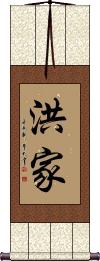
Custom Kung Fu Chinese & Japanese Calligraphy Wall Scroll

We have many options to create artwork with Kung Fu characters on a wall scroll or portrait...
...We could also help you create an Kung Fu Asian Tattoo.

Quick links to words on this page...

  1. Kung Fu / Gong Fu
  2. Martial Arts / Wu Shu
  3. Drunken Monkey Kung Fu
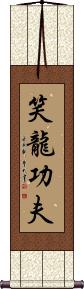
  4. Laughing Dragon Kung Fu
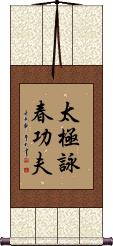
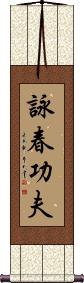
  5. Wing Chun Kung Fu
  6. Bruce Lee
  7. Bravery / Courage
  8. Crouching Tiger Hidden Dragon
  9. Dragon Snake Tiger...
10. Drunken Monkey
11. Drunken Fist
12. Inner Strength
13. Karate
14. Old Karate / Tang Hand Way / Tang Soo Do
15. Kenpo / Kempo / Quan Fa / Chuan Fa
16. Monkey Fist
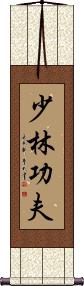
17. Shaolin
18. Shaolin Chuan / Shao Lin Quan
19. Shorinji Kempo / Kenpo
20. Shorin-Ryu
21. Strong bones come from hard knocks
22. Sword
23. Warrior Essence / Warrior Spirit / Martial

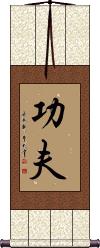
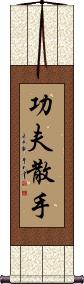
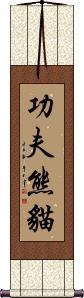
Kung Fu / Gong Fu

gōng fu
kan fu / ku fu
功
夫

One of the most famous types of martial arts in the world - and not just because of Bruce Lee.

Some translate the meaning as "Accomplishment by Great Effort". I think this is partially true, but directly translated it literally means "Merit/Achievement/Accomplishment Man". The word "fu" can sometimes mean "husband" or "porter", but in this case, it can only mean "man". However, few in China will think "man" when they hear the word "Gong Fu" spoken.

This term is also used for things other than martial arts. In fact, it's used to refer to a person with excellent skills in crafts that require a great deal of effort such as cooking, tea ceremonies, and calligraphy.

What a lot of people don't know is that the spelling of "Kung Fu" was actually taken from the old Wade Giles form of Romanization. Using this method, the sounds of the English "G" and "K" were both written as "K" and an apostrophe after the "K" told you it was supposed to sound like a "G". Nobody in the west knew this rule, so most people pronounce it with a "K-sound". And so Gong Fu will always be Kung Fu for most westerners.

Also, just to educate you a little more, the "O" in "Gong" has a sound like the English word "oh".

The popular Chinese dish "Kung Pao Chicken" suffers from the same problem. It should actually be "Gong Bao Chicken".

Historical note: Many will claim that Kung Fu was invented by the monks of the Shaolin monastery. This fact is argued in both directions by scholars of Chinese history. Perhaps it is more accurate to say that the Shaolin Monks brought the original fame to Kung Fu many generations ago.

Japanese note: While Japanese martial artists will recognize these characters, Katakana is more often used to approximate the pronunciation of "Kung Fu" with "カンフー". Some will argue as to whether this should be considered a Japanese word at all.

Martial Arts / Wu Shu

Chinese / Korean

wǔ shù
bujutsu
무술
武
術

This is the very Chinese way to express "Martial Arts". Some even use this word to directly describe Kung Fu. But this is a label that fits all disciplines from Karate to Kung Fu to Taekwondo.

Note: This also means Martial Arts with the same appearance in old Korean Hanja characters and is pronounced "musul" or "musur" in Korean.

While this is best if your audience is Chinese or Korean, this also means "martial arts" in Japanese.

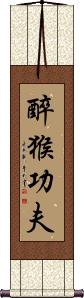
Drunken Monkey Kung Fu

zuì hóu gōng fu
醉
猴
功
夫

This is the title for Drunken Monkey Kung Fu (Gong Fu). The martial arts style inspired by the novel, "Journey to the West".

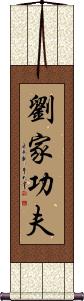
Laughing Dragon Kung Fu

xiào lóng gōng fu
소룡공부
笑
龍
功
夫

This is the title for a Martial Arts studio (custom-made at by request of the owner of the studio).

Wing Chun Kung Fu

yǒng chūn gōng fu
wing cheun gung fu
詠
春
功
夫

The first two characters literally mean "Singing Spring" (as in springtime).

The last two are "Kung Fu".

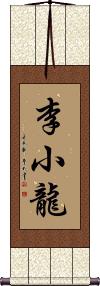
Bruce Lee

lǐ xiǎo lóng
bu ruu su ri
이소룡
李
小
龍

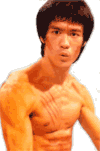
Bruce LeeMany people have no idea that Bruce Lee had a "real" Chinese name. In mainland China and Hong Kong he is known as "Li Xiao-Long". He kept his family name pronunciation (Li = Lee). This is a common family name that also means "plum".

His given name "Xiao-Long" literally means "little dragon". This is why you often see the character for dragon associated with Bruce Lee on various posters etc.

For a pronunciation lesson, the "X" in Romanized Chinese is pronounced like a "sh" sound but with your tongue at the bottom of your mouth. The vowel sound in "Long" is like the English "oh", not like the "ah" sound in the English word "long".

If you are a big Bruce Lee fan, you should know this information, and you should have this wall scroll hanging in your room or martial arts studio.

Note: Japanese use these same exact Chinese characters / Kanji to write Bruce Lee's real name (with different pronunciation - which is a bit like how the name "Bruce Lee" sounds in English).

See Also...  Marital Arts

Bravery / Courage

Courageous Energy

yǒng qì
yuuki
용기
勇
氣

There are several ways to express bravery and courage in Chinese, Japanese, and Korean. This version is the most spiritual. This is the essence of bravery from deep within your being. This is the mental state of being brave versus actual brave behavior. You'd more likely use this to say, "He is very courageous", rather than "He fought courageously in the battle".

The first character also means bravery or courage when it's seen alone. With the second character added, an element of energy or spirit is added. The second character is the same "chi" or "qi" energy that Kung Fu masters focus when they strike. For this reason, you could say this means "spirit of courage" or "brave spirit".

This is certainly a stronger word than just the first character alone.

Beyond bravery or courage, dictionaries also translate this word as valour, valor, nerve, audacity, daring, pluck, plucky, gallantry, guts, gutsy and boldness.

Japanese 気While the version shown to the left is commonly used in Chinese and Korean Hanja (and ancient Japanese Kanji), please note that the second character is written with slightly fewer strokes in modern Japanese. If you want the modern Japanese version, please click on the character to the right. Both styles would be understood by native Chinese, Japanese, and many (but not all) Korean people. You should choose character based on the intended audience for your calligraphy artwork. Or pick the single-character form of bravery/courage which is universal.

See Also...  Warrior

Back to the top of this page

Crouching Tiger Hidden Dragon

wò hǔ cáng lóng
와호장룡
臥
虎
藏
龍

This is the movie title of the Kung Fu epic that was very popular in the west a few years back. The title is actually a re-ordering of an ancient Chinese idiom that refers to undiscovered talents.

The movie was one of the most popular Chinese foreign films to ever debut in the USA, but received a lukewarm reception in China.

Note: This can be pronounced in Korean, but it's not a commonly-used term.

Dragon Snake Tiger
Leopard Crane

lóng shé hǔ bào hè
ryuu hebi tora hyou tsuru
룡사호표학
龍
蛇
虎
豹
鶴

This is a list of the Chinese characters for the five animals of Shaolin Kung Fu in a comfortable order (meaning that they are in the proper order and will simply "feel right" to a Chinese person who views this arrangement).

Drunken Monkey

zuì hóu
醉
猴

This is the short title for Drunken Monkey (often used as a title for a style of martial arts or kung fu which mimics the movements of a drunk monkey). This martial arts style was inspired by the novel, "Journey to the West".

Back to the top of this page

Drunken Fist

(A legitimate style of Kung Fu)

zuì quán
suiken
취권
醉
拳

Drunken Fist is a traditional Chinese martial art / technique of Kung Fu.

It is a northern style of martial art that imitates a drunk person in its movements. Many staggering movements serve to deceive the opponent and keep them off-balance.

Some consider Drunken Fist to be among the harder styles of martial arts due to the need for powerful joints and fingers.

See Also...  Drunken Monkey

Inner Strength

(short version)

nèi lì
nai ryoku
내력
內
力

This is the shorter version of inner-strength (can also be translated as "internal force"). The first character holds the meaning of "inner" or "internal". The second character means "power", "force" or "strength".

This is kind of a Kung Fu way of talking about an inner power or strength from within. This is sort of a way to express "inner-chi". This is clearly something that you might hear in a real Chinese Kung Fu movie.

While understood in both Chinese and Japanese, this can have a secondary meaning of "inner stress" in Japanese.

Karate

táng shǒu
kara te
唐
手

This is a very seldom-used title for Karate. This title uses a character which represents the Tang Dynasty of China. Thus, this is often translated as the "Tang Hand" or incorrectly, "Tang Fist". I have also seen some call it "China Hand".

There is not a lot of information on this title, but some believe that a simplified form of Kung Fu that started in China, and ended up very popular in Japan used this title initially. It was later changed in Japan to a different Karate title which means "Empty Hand" (as in, without weapons).

I am sure that some will suggest a different history or argue a different origin. I think that nobody can be sure.

Note: Just like the more conventional Karate title, this one can have the "way" or "method" character added to the end, as in Karate-Do.

Back to the top of this page

Old Karate / Tang Hand Way / Tang Soo Do

táng shǒu dào
kara te do
당수도
唐
手
道

This is a very seldom-used title for Karate-do. This title uses a character which represents the Tang Dynasty of China. Thus, this is often translated as the "Tang Hand Way" or incorrectly, "Tang Fist Way". I have also seen some call it "China Hand Way".

There is not a lot of information on this title, but some believe that a simplified form of Kung Fu that started in China, and ended up very popular in Japan used this title initially. It was later changed in Japan to a different Karate title which means "Empty Hand" (as in, without weapons).

In Korean, this title represents a certain style of martial arts. From Korean, this is often romanized as "Tang Soo Do", "Tangsudo", "Dang Su Do", or "Dangsudo". The last two romanizations on that list are the official Korean government romanization, though martial arts schools tend to use other non-standard versions.

Kenpo / Kempo / Quan Fa / Chuan Fa

quán fǎ
kenpou
권법
拳
法

This form of martial arts can be translated in several ways. Some will call it "fist principles" or "the way of the fist", or even "law of the fist". The first character literally means fist. The second can mean law, method, way, principle or Buddhist teaching.

Kempo is really a potluck of martial arts. Often a combination of Chinese martial arts such as Shaolin Kung Fu with Japanese martial arts such as Karate, Jujutsu (Jujitsu), Aikido, and others. You may see the term "Kempo Karate" which basically means Karate with other disciplines added. In this way, Kempo becomes an adjective rather than a title or school of martial arts.

These facts will long be argued by various masters and students of Kempo. Even the argument as to whether it should be spelled "kenpo" or "Kempo" ensues at dojos around the world (the correct Romaji should actually be "kenpou" if you precisely follow the rules).

The benefit of Kempo is that the techniques are easier to learn and master compared to pure Kung Fu (wu shu). Students are often taught basic Karate moves, kicks, and punches before augmenting the basic skills with complex Kung Fu techniques. This allows students of Kempo achieve a level where they can defend themselves or fight in a relatively short amount of time (a few years rather than a decade or more).

Because the definition of this word is so fluid, I should make some notes here:

1. Purists in Okinawa will claim that "Okinawa Kenpo" or "Ryukyu Hon Kenpo" is the original and true version of this martial art from the old kingdom. There is actually little or no connection between Okinawa Kenpo and the way the word is used elsewhere.

2. In Chinese, where these characters are pronounced "quan fa" (sometimes Romanized as "chuan fa" because the Chinese-pinyin "q" actually sounds like an English "ch" sound), these characters do not hold the connotation of being a mixed martial art. It is simply defined as "the law of the fist".

3. In my Japanese dictionary, it oddly defines Kenpo as "Chinese art of self-defense". I personally don't feel this is the most common way that people perceive the word, but just something you should know.

Monkey Fist

hóu quán
후권
猴
拳

This literally means what you think, it's the "Monkey Fist" school of Kung Fu. A style that mimics the punches and movements of monkeys and apes.

Becoming popular during the Qing Dynasty, this style can trace its origins back to as early as the Song Dynasty. Some of the romance and popularity of this style comes from the novel "Journey to the West" which features the Monkey King and his fighting skills.

This novel and martial arts style has spawned a stream of Hong Kong movies featuring the Monkey King, and other Kung Fu style variations such as "Drunken Monkey" and "Monkey Stealing Peaches" (a technique of disabling your opponent by grabbing and yanking on his testicles).

Note: This kind of makes sense in Korean Hanja and Japanese Kanji, but probably unknown by all Koreans and Japanese except those who have an interest in this form of Kung Fu.

Back to the top of this page

Shaolin

Little Forest

shǎo lín
sho rin
소림
少
林

The Shaolin monks of China have been practicing the art of Kung Fu for thousands of years. While there are many schools of Kung Fu in China, Shaolin are one of the more religiously devout and disciplined.

The title of Shaolin actually refers to a specific Buddhist monastery. It should be noted that the Shaolin were famous in China long before the Kung Fu TV show. Their fame in China is due to the monks' heroic and swift rescue an emperor during the Tang Dynasty. Most Chinese people are not keenly aware of the Kung Fu TV show, and have no idea who David Carradine is or anything about his character, Kwai Chang Caine.

Note: The literal meaning of these two characters is "little forest".

The fame of the Shaolin has spread all over Asia, as even though this is a Chinese title, the same characters are used in Japanese with the same meaning.

Shaolin Chuan / Shao Lin Quan

shǎo lín quán
소림권
少
林
拳

This is the title of the martial art (style of Kung Fu) that is taught to the monks and students in the Shaolin Buddhist Monastery. The addition of Chuan or Quan which means fist is what signifies that you are talking about this school or form of martial arts.

Shorinji Kempo / Kenpo

shào lín sì quán fǎ
shourinji kenpou
少
林
寺
拳
法

This is a specific type of martial arts in Japan that claims origins in the Kung Fu practiced in the original Shaolin Monastery of China.

The first three characters mean "Shaolin Monastery" and you might notice the Japanese is pronounced in a very similar way. This is because many words were "borrowed" from the original Chinese when Japan did not have a written language and simply absorbed Chinese characters into their language around the 5th century. When a Japanese word did not exist, the Chinese pronunciation was often absorbed as well as the written form.

The last two characters mean "fist law" or "method of the fist". It has long been argued as to whether the Japanese for these characters should be Romanized as "kempo" or "kenpo". The official method should be "kenpou" but it's common to drop the "u" that comes after the "o".

I imagine if you are looking for this title, you already know what it means, so the above is simply extra information that a student of Shorinji Kempo might want to know.

Back to the top of this page

Shorin-Ryu (Japanese)

Little Forest Style

shào lín liú
shou rin ryu
少
林
流

This is a specific type of martial arts (Karate) from Okinawa, Japan.

The first two characters mean "Little Forest". This happens to be the exact title of Shaolin (the famous place in China that many believe to be the birthplace of Kung Fu).

The last character can mean a flow or movement, but in the context of martial arts, refers to a style, method, or in the extended meaning, a school.

Note: This title can be pronounced in Chinese, but would only be used or well-known by Chinese people who practice this Japanese martial art (rare). In most cases, consider this to be a "Japanese only" title.

小Note: This title is sometimes written with a different first character. It can be written with a character that means "little/small" (see first character to the right).

松But it can also be written with a first character which means "pine" (see second character to the right).

Click on the character above (instead of the button above) of your choice if you want one of these alternate forms.

Strong bones come from hard knocks

bù kē bù pèng bù yìng
骨
頭
不
硬
不
磕
不
碰

Characters shown
above are read
vertically, starting
from the right

This literally translates as: Without being knocked around a bit, [one's] bones won't become hard.

Figuratively, this means: One can't become strong without first being tempered by "hard knocks".

While true for everyone, this sounds like the "Iron Body" form of Kung Fu, where practitioners bodies are beaten (and often bone fractured) in order to become stronger.
For the rest of us, this is just about how we can be tempered and build character through the hardships in our lives.

Sword

jiàn
ken / tsurugi
劍

This Character is pronounced "jian" in Chinese. When you say it, imagine that you are making the sound of a sword as it clashes with a metal shield. This might get you closer to the correct pronunciation in Chinese.

I actually wonder if this word came from the metallic ringing sounds of a sword in battle - but such knowledge is lost in history.

The sword is a symbol of a warrior. The one thing that a soldier in ancient China lived and died by. A warrior with his skills and sword proves himself of great value. A warrior who losses his sword instantly becomes worthless.

This is an excellent scroll for someone in the military (especially officers of all services - as well as enlisted NCO Marines since they still carry swords even if mainly for ceremonial purposes). Or perhaps someone who practices variations of kung fu or tai chi that involve weapons.

Please note that while this character is understood with the sword meaning in Japanese, you might be looking for the word "katana" which also means sword in Japanese, but means "knife" in Chinese.

There are other ways to write sword, and here are a few...
Common Japanese and rare Chinese traditional form of sword Typical traditional form of sword in Chinese Old/Alternative way to write sword in Chinese Old/Alternative way to write sword in Chinese Old/Alternative way to write sword in Chinese This one kind of means Typical traditional form of sword in Chinese Common Japanese and rare Chinese traditional form of sword Old/Alternative way to write sword in Chinese Old/Alternative way to write sword in Chinese Old/Alternative way to write sword in Chinese This one kind of means Typical traditional form of sword in Chinese Typical traditional form of sword in Chinese Common Japanese and rare Chinese traditional form of sword Old/Alternative way to write sword in Chinese Old/Alternative way to write sword in Chinese Old/Alternative way to write sword in Chinese This one kind of means Typical traditional form of sword in Chinese Common Japanese and rare Chinese traditional form of sword Old/Alternative way to write sword in Chinese Old/Alternative way to write sword in Chinese Old/Alternative way to write sword in Chinese This one kind of means Typical traditional form of sword in Chinese Common Japanese and rare Chinese traditional form of sword Old/Alternative way to write sword in Chinese Old/Alternative way to write sword in Chinese Old/Alternative way to write sword in Chinese This one kind of means
If you are particular about the version you receive, please let me know when you place your order (Note: Special styles are only available from one of our master calligraphers).

We have a forum entry that addresses the many ways to write sword. You can find that here: 100 Ways to Write Sword - Deciphering Ancient Seal Script

Back to the top of this page

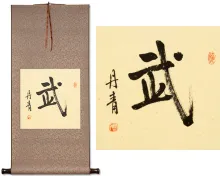
Warrior Essence / Warrior Spirit / Martial


bu
武

This character is the essence or spirit of a warrior. This character is part of the word "wu shu" which is sometimes translated as "martial arts" or "kung fu".

In more modern speech and other context, this can mean military, martial, warlike, fierce, and perhaps violent, but usually as a prefix for a longer word or phrase.


You should look at these ready-to-ship pieces of artwork:

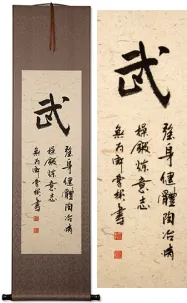
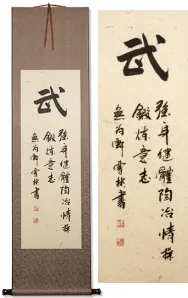
Kung Fu - Chinese Calligraphy Wall Scroll

Kung Fu
Chinese Calligraphy Wall Scroll

If you practice the ancient art of Chinese martial arts and have the "skill" level known as Kung Fu (or Gong Fu) this is the wall scroll for you.


Compare: $200.00

Your Price: $78.88


More Info
Kung Fu - Chinese Calligraphy Wall Scroll

Kung Fu
Chinese Calligraphy Wall Scroll

If you practice the ancient art of Chinese martial arts and have the "skill" level known as Kung Fu (or Gong Fu) this is the wall scroll for you.


Compare: $200.00

Your Price: $78.88


More Info
Kung Fu - Chinese Calligraphy Wall Scroll

Kung Fu
Chinese Calligraphy Wall Scroll

If you practice the ancient art of Chinese martial arts and have the "skill" level known as Kung Fu (or Gong Fu) this is the wall scroll for you.


Compare: $200.00

Your Price: $78.88


More Info
Kung Fu - Chinese Calligraphy Wall Scroll

Kung Fu
Chinese Calligraphy Wall Scroll

If you practice the ancient art of Chinese martial arts and have the "skill" level known as Kung Fu (or Gong Fu) this is the wall scroll for you.


Compare: $200.00

Your Price: $78.88


More Info
WARRIOR SPIRIT Chinese Character / Japanese Kanji Wall Scroll

WARRIOR SPIRIT Chinese Character / Japanese Kanji Wall Scroll

This character is often associated with Kung Fu and other Asian Martial Arts.


Compare: $142.00

Your Price: $78.88


More Info

A nice Chinese calligraphy wall scroll

The scroll that I am holding in this picture is a "medium size"
4-character wall scroll.
As you can see, it is a great size to hang on your wall.
(We also offer custom wall scrolls in larger sizes)

A professional Chinese Calligrapher

Professional calligraphers are getting to be hard to find these days.
Instead of drawing characters by hand, the new generation in China merely type roman letters into their computer keyboards and pick the character that they want from a list that pops up.

There is some fear that true Chinese calligraphy may become a lost art in the coming years. Many art institutes in China are now promoting calligraphy programs in hopes of keeping this unique form of art alive.

Trying to learn Chinese calligrapher - a futile effort

Even with the teachings of a top-ranked calligrapher in China, my calligraphy will never be good enough to sell. I will leave that to the experts.


A high-ranked Chinese master calligrapher that I met in Zhongwei

The same calligrapher who gave me those lessons also attracted a crowd of thousands and a TV crew as he created characters over 6-feet high. He happens to be ranked as one of the top 100 calligraphers in all of China. He is also one of very few that would actually attempt such a feat.


See: Our list of specifically Japanese Kanji Calligraphy Wall Scrolls. And, check out Our list of specifically old Korean Hanja Calligraphy Wall Scrolls.

The following table is only helpful for those studying Chinese (or Japanese), and perhaps helps search engines to find this page when someone enters Romanized Chinese or Japanese

Title
Characters 
Simplified
Traditional
Japanese Romaji
(Romanized Japanese)
Various forms of Romanized Chinese
Kung Fu / Gong Fu功夫
功夫
kan fu / ku fu
kanfu/kufu
gōng fu
gong fu
kung fu
gong1 fu
gongfu
Martial Arts / Wu Shu武术
武術
bujutsuwǔ shù
wu shu
wu3 shu4
wushu
Drunken Monkey Kung Fu醉猴功夫
醉猴功夫 / 醉猴功伕
n/azuì hóu gōng fu
zui hou gong fu
tsui hou kung fu
zui4 hou2 gong1 fu
zuihougongfu
Laughing Dragon Kung Fu笑龙功夫
笑龍功夫
n/axiào lóng gōng fu
xiao long gong fu
hsiao lung kung fu
xiao4 long2 gong1 fu
xiaolonggongfu
Wing Chun Kung Fu咏春功夫
詠春功夫
n/ayǒng chūn gōng fu
yong chun gong fu
yung ch`un kung fu
yong3 chun1 gong1 fu
yongchungongfu
yungchunkungfu
yung chun kung fu
Bruce Lee李小龙
李小龍
bu ruu su ri
buruusuri
bu ru su ri
lǐ xiǎo lóng
li xiao long
li hsiao lung
li3 xiao3 long2
lixiaolong
Bravery / Courage勇气 / 勇気
勇氣
yuuki
yuki
yǒng qì
yong qi
yung ch`i
yong3 qi4
yongqi
yungchi
yung chi
Crouching Tiger Hidden Dragon卧虎藏龙
臥虎藏龍
n/awò hǔ cáng lóng
wo hu cang long
wo hu ts`ang lung
wo4 hu3 cang2 long2
wohucanglong
wohutsanglung
wo hu tsang lung
Dragon Snake Tiger
Leopard Crane
龙蛇虎豹鹤
龍蛇虎豹鶴
ryuu hebi tora hyou tsuru
ryuuhebitorahyoutsuru
ryu hebi tora hyo tsuru
lóng shé hǔ bào hè
long she hu bao he
lung she hu pao ho
long2 she2 hu3 bao4 he4
longshehubaohe
Drunken Monkey醉猴
醉猴
n/azuì hóu
zui hou
tsui hou
zui4 hou2
zuihou
Drunken Fist醉拳
醉拳
suikenzuì quán
zui quan
tsui ch`üan
zui4 quan2
zuiquan
tsuichüan
tsui chüan
Inner Strength内力
內力
nai ryoku
nairyoku
nèi lì
nei li
nei4 li4
neili
Karate唐手
唐手
kara te
karate
táng shǒu
tang shou
t`ang shou
tang2 shou3
tangshou
tangshou
tang shou
Old Karate / Tang Hand Way / Tang Soo Do唐手道
唐手道
kara te do
karatedo
táng shǒu dào
tang shou dao
t`ang shou tao
tang2 shou3 dao4
tangshoudao
tangshoutao
tang shou tao
Kenpo / Kempo / Quan Fa / Chuan Fa拳法
拳法
kenpou
kenpo
quán fǎ
quan fa
ch`üan fa
quan2 fa3
quanfa
chüanfa
chüan fa
Monkey Fist猴拳
猴拳
n/ahóu quán
hou quan
hou ch`üan
hou2 quan2
houquan
houchüan
hou chüan
Shaolin少林
少林
sho rin
shorin
shǎo lín
shao lin
shao3 lin2
shaolin
Shaolin Chuan / Shao Lin Quan少林拳
少林拳
n/ashǎo lín quán
shao lin quan
shao lin ch`üan
shao3 lin2 quan2
shaolinquan
shaolinchüan
shao lin chüan
Shorinji Kempo / Kenpo少林寺拳法
少林寺拳法
shourinji kenpou
shourinjikenpou
shorinji kenpo
shào lín sì quán fǎ
shao lin si quan fa
shao lin ssu ch`üan fa
shao4 lin2 si4 quan2 fa3
shaolinsiquanfa
shaolinssuchüanfa
shao lin ssu chüan fa
Shorin-Ryu (Japanese)少林流
少林流
shou rin ryu
shourinryu
sho rin ryu
shào lín liú
shao lin liu
shao4 lin2 liu2
shaolinliu
Strong bones come from hard knocks不磕不碰骨头不硬
不磕不碰骨頭不硬
n/abù kē bù pèng bù yìng
bu ke bu peng gutou bu ying
pu k`o pu p`eng pu ying
bu4 ke1 bu4 peng4 gu3tou bu4 ying4
bukebupenggutoubuying
pukopupengpuying
pu ko pu peng pu ying
Sword
ken / tsurugi
ken/tsurugi
jiàn
jian
chien
jian4
jian
Warrior Essence / Warrior Spirit / Martial
bu
wu
wu3
wu

If you have not set up your computer to display Chinese, the characters in this table probably look like empty boxes or random text garbage.
This is why I spent hundreds of hours making images so that you could view the characters in the "kung fu" listings above.
If you want your Windows computer to be able to display Chinese characters you can either head to your Regional and Language options in your Win XP control panel, select the [Languages] tab and click on [Install files for East Asian Languages]. This task will ask for your Win XP CD to complete in most cases. If you don't have your Windows XP CD, or are running Windows 98, you can also download/run the simplified Chinese font package installer from Microsoft which works independently with Win 98, ME, 2000, and XP. It's a 2.5MB download, so if you are on dial up, start the download and go make a sandwich.

Some people may refer to this entry as Kanji, Characters, in Mandarin Chinese, Characters, in Chinese Writing, in Japanese Writing, in Asian Writing, Ideograms, Chinese symbols, Hieroglyphics, Glyphs, in Chinese Letters, Hanzi, in Japanese Kanji, Pictograms, in the Chinese Written-Language, or in the Japanese Written-Language.

Did you like this? Share it:


Copyright Oriental Outpost 2002-2012   -   All Rights Reserved
Image Use Policy Privacy Policy