Asian Art Outpost

Adventures in Asian Art


Custom Leadership / Initiative Chinese or Japanese Calligraphy Wall Scroll

We have many options for Leadership-related words or phrases on a wall scroll or portrait in Chinese or Japanese calligraphy.
If you want to create a cool Leadership Asian character tattoo, you can purchase that on our Chinese and Japanese Tattoo Image Service page and we'll help you select from many forms of ancient Asian symbols that express the idea of Leadership.

Quick links to words on this page...

  1. Leadership
  2. Initiative / Leadership
  3. Leadership / Ability to Lead
  4. Art of War: 5 Points of Analysis
  5. Initiative / Proactive
  6. Shogun / Japanese General
  7. Chinese or Korean Army General
  8. Art of War
  9. Sun Tzu - Art of War
10. Banzai / Wansui
11. Banzai
12. Boys be Ambitious
13. The Confident Helmsman...
14. Corinthians 13:4
15. Destiny / Fate
16. Drunken Monkey
17. Drunken Monkey Kung Fu
18. Empress
19. Destiny Determined by Heaven
20. The one who retreats 50 paces...
21. Begging Forgiveness
22. Forgiveness
23. Furinkazan
24. Grace from Heaven / Grace from God
25. Glory and Honor
26. A Deliberate Inaction...
27. John 14:15
28. John 14:18
29. John 3:16
30. Katana
31. Know Thy Enemy, Know Thyself
32. Know Your Enemy, Know Yourself,...
33. Hunt Foxes with Stealth, Hunt Wolves in the Open
34. Listen to Both Sides and be Enlightened,...
35. Maintain An Army For 1000 Days,...
36. Marine
37. Master / Sifu / Shi Fu / Shifu
38. Monkey Fist
39. Mountain Travels Poem by Dumu
40. Better Late Than Never
41. Appreciation & Love...
42. Past experience is the teacher for the future.
43. Undaunted After Repeated Setbacks
44. Phoenix
45. Queen
46. Queen / Empress
47. Respect out of fear is never genuine...
48. Samurai
49. Consciousness of Self
50. Shaolin
51. A sly rabbit has three openings to its den
52. Sun Tzu: Regard Your Soldiers as Children
53. The More We Sweat in Training,...
54. Tiger Rumor
55. Unselfish: Perfectly Impartial
56. United States Marine Corps
57. Work Unselfishly for the Common Good
58. Five Ancestors Fist
59. Tiger
60. Dragon
61. Drunken Monkey
62. Yellow
63. Animal Kingdom
64. Dragon / Emperor Symbol
65. Emperor
66. King
67. Army / Military

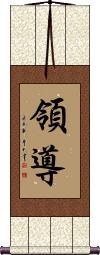
Leadership

lǐng dǎo
영도
領
導

This is the Chinese word for "Leadership". It contains the ideas of "to lead", "to direct", "to conduct" and "to guide". Putting a wall scroll with this word on your wall suggests that you are honing your leadership skills or hold a position of leadership.

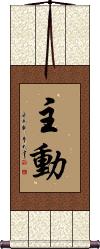
Initiative / Leadership

jī jí
shudou
주동
主
動

In Chinese, this word means "to take the initiative".

In Japanese and Korean, the meaning varies slightly to a meaning that leans more toward "leadership" (as in one who is leading a group or organization).

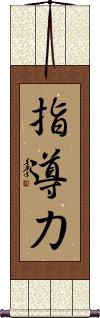
Leadership / Ability to Lead (Japanese Only)

shidouryoku
지도력
指
導
力

This is the Japanese word for "Leadership". This refers to the ability to lead (or with certain adjectives added, the lack of ability to lead).

Art of War: 5 Points of Analysis
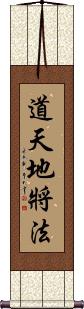
dào tiān dì jiàng fǎ
dou ten chi shou hou
도천지장법
道
天
地
將
法

The first chapter of Sun Tzu's Art of War lists five key points to analyzing your situation. Sun Tzu says that to sharpen your skills, you must plan. To plan well, you must know your situation. Therefore, you must consider and discuss the following:

1. Philosophy and Politics: Make sure your way or your policy is agreeable among all of your troops (and the citizens of your kingdom as well). For when your soldiers believe in you and your way, they will follow you to their deaths without hesitation, and will not question your orders.

2. Heaven/Sky: Consider climate / weather. This can also mean to consider whether God is smiling on you. In the modern military, this could be waiting for clear skies so that you can have air support for an amphibious landing.

3. Ground/Earth: Consider the terrain in which the battle will take place. This includes analyzing defensible positions, exit routes, and using varying elevation to your advantage. When you plan an ambush, you must know your terrain, and the best location from which to stage that ambush. This knowledge will also help you avoid being ambushed, as you will know where the likely places in which to expect an ambush from your enemy.

4. Leadership: This applies to you as the general, and also to your lieutenants. A leader should be smart and be able to develop good strategies. Leaders should keep their word, and if they break a promise, they should punish themselves as harshly as they would punish subordinates. Leaders should be benevolent to their troops, with almost a fatherly love for them. Leaders must have the ability to make brave and fast decisions. Leaders must have steadfast principles.

5. [Military] Methods: This can also mean laws, rules, principles, model, or system. You must have an efficient organization in place to manage both your troops and supplies. In the modern military, this would be a combination of how your unit is organized, and your SOP (Standard Operating Procedure).

Notes: This is a simplistic translation and explanation. Much more is suggested in the actual text of the Art of War (Bing Fa). It would take a lot of study to master all of these aspects. In fact, these five characters can be compared to the modern military acronyms such as BAMCIS or SMEAC.

CJK notes: I have included the Japanese and Korean pronunciations, but in Chinese, Korean and Japanese, this does not make a typical phrase (with subject, verb and object) it is a list that only someone familiar with Sun Tzu's writings would understand.

Initiative / Proactive

jī jí
sekkyoku
적극
積
極

This word closely matches the way initiative is often used in English. This word can also mean active, energetic, vigorous, positive (outlook), or proactive in Chinese.

The meaning also includes positive and progressive in Japanese and Korean.

Shogun / Japanese General

jiāng jūn
shougun
장군
将
軍

In the west, when someone mentions "Shogun" we may be filled with thoughts of gallant warriors. Some might even think of the TV mini-series with Richard Chamberlain. Often westerners use the words Samurai and Shogun interchangeably. So I will clear it up really quickly...

Shogun in the simplest definition is a General. You could also use words such as commander, lord, overlord, highest ranking, or commanding officer, since "Shogun" has held some slightly ambiguous meanings at times in Japanese history.

Sometimes a Shogun was a general, other times he was the leader of a military government in Japan.

Variants of the same characters are used in China for the rank and title of a General of the People's Liberation Army (and the same term and characters have been used for the last 2200 years since the Qin Dynasty).

Chinese or Korean Army General (Shogun)

jiāng jūn
shougun
장군
將
軍

There is a slight variation in the way the first character is written. This is the more Chinese and Korean Hanja version. So if you want to specifically refer to a Chinese or Korean General, this is the way. Japanese people would still easily identify this as "shogun".

Note: This term is also used for Admiral in Korean in certain context (if you need a better title for Admiral, just let me know).

Back to the top of this page

Art of War

bīng fǎ
hyou hou
병법
兵
法

This means "Art of War". It also part of the title of a famous book of tactics by Sun Tzu. These characters could also be translated as "military strategy and tactics", "military skills" or "army procedures". If you are a military tactician, this is the wall scroll for you.

See Also...  Military

Sun Tzu - Art of War

military strategy, tactics, and procedure

sūn zǐ bīng fǎ
son shi hyou hou
손자병법
孫
子
兵
法

This is the full title of the most famous book about warfare in the history of the world. The English title is "Sun Tzu's The Art of War".

The last two characters have come to be known in the west as "The Art of War", but a better translation would be, "military strategy and tactics", "military skills" or "army procedures".

Note: Sometimes the author's name is Romanized as "Sun Zi" or "Sunzi".

It's written the same in Chinese, Japanese Kanji and Korean Hanja.

See Also...  Military | Warrior

Banzai / Wansui

Old Japanese / Traditional Chinese & Korean

wàn suì
banzai / manzai
만세
萬
歲

We've made two almost identical entries for this word. This is the traditional Chinese, Korean Hanja, and ancient Japanese way to write banzai. In modern times, the first character was simplified in Japan and China. So you might want to select the other entry for more universal readability.

While it has become a popular if not an odd thing to scream as you jump out of an airplane (preferably with a parachute attached), banzai is actually a very old Asian way to say "hooray". The Japanese word "banzai" comes from the Chinese word "wan sui" which means "The age of 10,000 years". It is actually a wish that the Emperor or the Empire live that long.

Imagine long ago as the Emperor made a rare public appearance. This is what all of the people would yell to their leader in respect.

So if you like is as a hooray, or you want to wish someone that they live for 10,000 years, this is the calligraphy for you.

Other translations include: Cheers! (not the drinking kind), hurrah!, long live [name]!, congratulations!

To other things with banzai in their names; I am still waiting for the promised sequel to Buckaroo Banzai.

Notes: Sometimes people confuse banzai with bonsai. A bonsai is a miniature tree. They have nothing to do with each other. Further, bonzai is not a word at all - although it would make a great name for a calcium supplement for older people.

Back to the top of this page

Banzai (Modern Japanese Version)

wàn suì
banzai
만세
万
歲

We've made two almost identical entries for this word. This is the modern Japanese way to write banzai. In the last century, the first character was simplified in Japan and China. The new generation will expect it to be written this way, but the old generation can still read the more traditional form. You must make your own determination as to what version is best for you. If your audience is mostly Japanese, I suggest this form.

While it has become a popular if not an odd thing to scream as you jump out of an airplane (preferably with a parachute attached), banzai is actually a very old Asian way to say "hooray". The Japanese word "banzai" comes from the Chinese word "wan sui" which means "The age of 10,000 years". It is actually a wish that the Emperor or the Empire live that long.

Imagine long ago as the Emperor made a rare public appearance. This is what all of the people would yell to their leader in respect.

So if you like is as a hooray, or you want to wish someone that they live for 10,000 years, this is the calligraphy for you.

To other things with banzai in their names; I am still waiting for the promised sequel to Buckaroo Banzai.

Other translations: hurrah, long life, congratulations, cheers, live long.

Notes: Sometimes people confuse banzai with bonsai. A bonsai is a miniature tree. They have nothing to do with each other. Further, bonzai is not a word at all - although it would make a great name for a calcium supplement for older people.

Boys be Ambitious

Qoute from William S. Clark in Japan

shou nen yo tai shi o ida ke
志
を
抱
け
少
年
よ
大

Characters shown
above are read
vertically, starting
from the right

This was a sort of motto invoked by William S. Clark, after being hired by the Emperor of Japan in 1876 to establish a university in Hokkaido, Japan.

This phrase is famous across all generations of Japan since that time.

The Confident Helmsman
Inspires Confidence in the Passengers

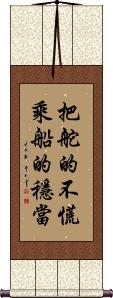
bǎ tuò de bù huāng chéng chuán de wěn dang
乘
船
的
穩
當
把
舵
的
不
慌

Characters shown
above are read
vertically, starting
from the right

This literally translates as: [If the] helmsman is not nervous, the passengers [will feel] secure.

Figuratively, this means: If the leader appears confident, his/her followers will gain confidence also.

This is a great suggestion that a confident leader inspires confidence in his/her troops or followers. Of course, a nervous leader will create fear in troops or followers.

Back to the top of this page

Corinthians 13:4

All you need to know about LOVE


ài shì héng jiǔ rěn nài yòu yǒu én cí ài shì bú jì dù ài shì bú zì kuā bù zhāng kuáng
不
嫉
妒
愛
是
不
自
誇
不
張
狂
愛
是
恆
久
忍
耐
又
有
恩
慈
愛
是

Characters shown
above are read
vertically, starting
from the right

This is First Corinthians 13:4 written in Chinese.

Chinese Corinthians 13:4 Love

Shown with large "love" character in master calligrapher Xing An-Ping's "Personal Lishu" style.

In English, this reads:

1st Corinthians 13:4 (KJV) Charity suffereth long, and is kind; charity envieth not; charity vaunteth not itself, is not puffed up...

1st Corinthians 13:4 (NIV) Love is patient, love is kind. It does not envy, it does not boast, it is not proud.

1st Corinthians 13:4 (Basic English) Love is never tired of waiting; love is kind; love has no envy; love has no high opinion of itself, love has no pride.

The Chinese translation follows the love meaning, rather than the King James use of "charity". I was a little confused when writing this description with the significant differences between the NIV vs. KJV translations. After speaking to a Greek scholar about this, it would seem that the KJV has an almost errant translation with the use of "charity" in place of "love".

We used the most popular Christian Chinese Bible, which is the Chinese Union Version (CUV). The CUV was first published in 1919. We use this so that the Chinese translation would be as accurate and standard as possible. Any Chinese Christian worth their salt will easily be able to identify this verse when they see these characters.

If you want a big "love" character written above the verse on your artwork, just make a note in the "special instructions" tab when you are customizing your artwork. There is no extra charge for that service on this special verse.

Destiny / Fate

(single character)

mìng yùn
inochi / mei
命

This character is often translated as "destiny". Sometimes this character is simply translated as "life", but more in terms of one's lot in life. In certain context, this can mean command or decree (generally from a king or emperor). Of course, such a decree are part of fate and lead you to fulfill your destiny.

In Chinese this word leans toward the fate or destiny definition.
In Korean, it is usually read simply as "life".
In Japanese, it can mean all definitions shown above, depending on context.

See Also...  Good Fortune

Drunken Monkey

zuì hóu
醉
猴

This is the short title for Drunken Monkey (often used as a title for a style of martial arts or kung fu which mimics the movements of a drunk monkey). This martial arts style was inspired by the novel, "Journey to the West".

Back to the top of this page

Drunken Monkey Kung Fu

zuì hóu gōng fu
醉
猴
功
夫

This is the title for Drunken Monkey Kung Fu (Gong Fu). The martial arts style inspired by the novel, "Journey to the West".

Empress

huáng hòu
kou gou
황후
皇
后

This is the title of empress or emperess, the female form of emperor. This is used in Chinese, Japanese Kanji, and old Korean Hanja.

While the emperor's reign was for life, if he died, his wife would hold his power. In this case, a woman was the ultimate ruler of the greater part of East Asia (what is now China) until her death and the succession of the emperor's first born son to lead the empire. Numerous times in various Chinese dynasties, an empress took power in this way.

The first character means emperor by itself.

The second character alone can mean "wife of an emperor or king" (the first character clarifies that we are talking about an empress, and not a queen). It can also mean sovereign or last offspring, depending on context.

Note: In some books, this word is translated as queen. While only incorrect if you get technical (because an empress is theoretically a higher level than a queen), the meaning is very similar.

This is sometimes used for the title of queen, but more technically, this is the wife of the emperor (a higher level than a queen).

See Also...  Emperor | King | Queen | Phoenix

Destiny Determined by Heaven

tiān yì
teni
천의
天
意

This is a way to express destiny in a slightly religious way. Literally this means "Heaven's Wish" or "Heaven's Desire" with the idea of fate and destiny being derived as well. It suggests that your destiny comes from God / Heaven and that your path has already been chosen by a higher power.

My Japanese dictionary defines this word as "divine will" or "providence" but it also holds the meaning of "the will of the emperor". Therefore I don't suggest this phrase if your audience is Japanese - it feels a little strange in Japanese anyway.

Back to the top of this page

The one who retreats 50 paces
mocks the one to retreats 100

The pot calls the kettle black

wù shí bù xiào bǎi bù
五
十
步
笑
百
步

During the Warring States Period of what is now China (475 - 221 B.C.), the King of Wei was in love with war. He often fought with other kingdoms just for spite or fun.

One day, the King of Wei asked the philosopher Mencius, "I love my people, and all say I do the best for them. I move the people from famine-stricken areas to places of plenty, and transport grains from rich areas to the poor. Nobody goes hungry in my kingdom, and I treat my people far better than other kings. But why does the population of my kingdom not increase, and why does the population of other kingdoms not decrease?"

Mencius answered, "Since you love war, I will make this example: When going to war, and the drums beat to start the attack, some soldiers flee for their lives in fear. Some run 100 paces in retreat, and others run 50 steps. Then the ones who retreated 50 paces laugh and taunt those who retreated 100 paces, calling them cowards mortally afraid of death. Do you think this is reasonable?

The King of Wei answered, "Of course not! Those who run 50 paces are just as timid as those who run 100 paces."

Mencius then said, "You are a king who treats his subjects better than other kings treat their people, but you are so fond of war, that your people suffer from great losses in battle. Therefore your population does not grow. While other kings allow their people to starve to death, you send your people to die in war. Is there really any difference?"

This famous conversation lead to the six-character proverb shown here. It serves as a warning to avoid hypocrisy. It goes hand-in-hand with the western phrase, "The pot calls the kettle black", or the Biblical phrase, "Before trying to remove a splinter from your neighbor's eye, first remove the plank from your own eye".

Begging Forgiveness

ráo shù
饒
恕

This Chinese word is a kind of forgiveness that you would beg for like a servant begging a master. This can also be the forgiveness that a person would beg from the king or God.

This word suggests that this is forgiveness for something really bad (a terrible crime or sin).

Forgiveness (from the top down)

róng shè
you sha
용사
容
赦

This is the kind of forgiveness that a king might give to his subjects for crimes or wrong-doings. This is a rather high-level forgiveness. Meaning that it goes from a higher level to lower (not the reverse).

Alone, first character can mean "to bear", "to allow" and/or "to tolerate", and the second can mean "to forgive", "to pardon" and/or "to excuse".

See Also...  Benevolence

Back to the top of this page

Furinkazan

military strategy

fēng lín huǒ shān
fuu rin ka zan
風
林
火
山

This is the battle strategy and motto of Japanese feudal lord Takeda Shingen (1521–1573 A.D.). This came from the Art of War by Chinese strategist and tactician Sun Tzu (Sunzi).

You can think of this as a sort of abbreviation to remind officers and troops how to conduct battle.

This is literally a word list: Wind, Forest, Fire, Mountain.

The more expanded meaning is supposed to be...

"Swift as wind, quiet as forest, fierce as fire, and immovable as a mountain"

"As fast as the wind, as quiet as the forest, as daring as fire, and immovable as the mountain"

"Move as swift as a wind, stay as silent as forest, attack as fierce as fire, undefeatable defense like a mountain"

"Move swiftly like the wind, stay silent like the forest, attack fiercely like fire, take tactical position on the mountain"

See Also...  Art Of War

Grace from Heaven / Grace from God

tiān ēn
ten on
天
恩

This is the deepest way to say "Heaven's Grace" or "God's Grace" in Chinese.

The first character means Heaven or sky (referring in this case to the domain of God).
The second character means grace, blessings, benevolence, favor / favour, acts of kindness, merits, or beneficial influence.

This title can also be defined as:
Blessings of Heaven, Favor of the Emperor, Divination's luckiest day, or blessings of nature. Note: When you see "Emperor" above, keep in mind that the Emperor, like the Pope is theoretically chosen by God, or seen as an emissary or conduit of God in ancient Asian culture. It would only be read that way in certain context such as, "The Emperor, in his mercy, bestowed upon him Heaven's Grace and the prisoner was set free".

Note: Technically, this is a Japanese word too, but it's rarely-used in Japan anymore. Therefore this title is best if your audience is Chinese.

Glory and Honor

róng
ei
榮

This character relates to giving someone a tribute or praise. It's a little odd as a gift, so this may not be the best selection for a wall scroll.

I've made this entry just because this character is often misused as "honorable" or "keeping your honor". It's not quite the same meaning, as this usually refers to a tribute or giving an honor to someone.

This is often found in tattoo books incorrectly listed as the western idea of personal honor or being honorable. Check with us before you get a tattoo that does not match the meaning you are really looking for. As a tattoo, this suggests that you either have a lot of pride in yourself or that you have a wish for prosperity for you and/or your family.

栄In modern Japanese Kanji, glory and honor looks like the image to the right.

There is a lot of confusion about this character, so here are some alternate translations for this character: prosperous, flourishing, blooming (like a flower), glorious beauty, proud, praise, rich, or it can be the family name "Rong". The context in which the character is used can change the meaning between these various ideas.

In the old days, this could be an honor paid to someone by the Emperor (basically a designation by the Emperor that a person has high standing).

To sum it up: This character has a positive meaning, however, it's a different flavor than the idea of being honorable and having integrity.

Back to the top of this page

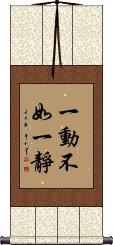
A Deliberate Inaction
Is Better Than A Blind Action

yí dòng bù rú yí jìng
일동불여일정
如
一
靜
一
動
不

Characters shown
above are read
vertically, starting
from the right

Sometimes this is translated by others as "Look before you leap", but the more accurate and direct translation is the one I used in the title.

While somewhat military in its origin, this phrase can apply to any situation where a decision needs to be made, but perhaps there are still some "unknowns".

This suggests that in our "action based" world, sometimes the "smarter move" is "no move at all".

John 14:15

nǐ mén ruò ài wǒ jiù bì zūn shǒu wǒ de mìng lìng
守
我
的
命
令
我
就
必
遵
你
們
若
愛

Characters shown
above are read
vertically, starting
from the right

This is the translation of John 14:15 into Chinese.

This translation comes from the Chinese Union Bible which comes from a revised version of the King James. This Chinese Bible was originally translated and printed in 1919 (several revisions since then).

Because of the origin being the KJV, I'll say that in English, this would be, "If ye love me, keep my commandments.".

In basic English, this would be, "If you have love for me, you will keep my laws."

John 14:18

wǒ bù piě xià nǐ mén wéi gū ér wǒ bì dào nǐ mén zhè lǐ lái
你
們
這
裡
來
為
孤
兒
我
必
到
我
不
撇
下
你
們

Characters shown
above are read
vertically, starting
from the right

This is the translation of John 14:18 into Chinese.

This translation comes from the Chinese Union Bible which comes from a revised version of the King James. This Chinese Bible was originally translated and printed in 1919 (several revisions since then).

Because of the origin being the KJV, I'll say that in English, this would be, "I will not leave you comfortless: I will come to you.".

In basic English, this would be, "I will not let you be without a friend: I am coming to you."

Back to the top of this page

John 3:16


shén ài shì rén shèn zhì jiāng tā de dú shēng zǐ cì gè tā mén jiào yí qiè xìn tā de bú zhì miè wáng fǎn dé yǒng shēng
他
的
不
至
滅
亡
反
得
永
生
生
子
賜
給
他
們
叫
一
切
信
神
愛
世
人
甚
至
將
他
的
獨

Characters shown
above are read
vertically, starting
from the right

This is the full translation of John 3:16 into Chinese.

This translation comes from the Chinese Union Bible which comes from a revised version of the King James. This Chinese Bible was originally translated and printed in 1919 (several revisions since then).

Because of the origin being the KJV, I'll say that in English, this would be, "For God so loved the world, that he gave his only begotten Son, that whosoever believeth in him should not perish, but have everlasting life".

As with any translation, there are interesting cultural and linguistic issues. For instance, the word used for "world" in Chinese can also mean "common people". So you could say that it means "For God so loved the common people..."
This does not take away from the text, as it will be understood with the same meaning and connotation.

There is no direct Greek to Chinese translation in print (that I know of), so this is the best available. Of course, you can ask any Greek person of faith, and they will claim that a bit is lost from the original Greek of the New Testament to any of the English versions of the Bible in print.

Katana

Japanese Samurai Sword

dāo
katana
刀

This is the Japanese Kanji for "sword". This refers to the style of sword carried by warriors, samurai, and shogun of ancient Japan.

With the pacification of Japan, such swords are now only used for ceremony and decoration. The true art of sword-smithing is all but lost in Japan with new sword production dedicated to making inexpensive replicas for the tourist and foreign market.

For those of you that want to ask whether I can get you a real antique sword. Let me tell you that most real Asian swords were melted down after WWII in Japan, and during the Great Leap Forward in China. Any remaining swords are family heirlooms that nobody will part with.

Please carefully note that the Japanese kanji character shown above is only for a Japanese audience. In China, this character means "knife". See our other entry for "sword" in Chinese.
Note: This can mean knife, sword, or blade in Korean, depending on context.

See Also...  Sword

Know Thy Enemy, Know Thyself

zhí bǐ zhí jī
知
彼
知
己

This is from Sun Tzu's (Sunzi's) Art of War. It means that if you know and understand the enemy, you also know yourself. There is a secondary four characters that come after this in the Art of War (not included here) which suggest you cannot lose a battle when you follow this philosophy.

In a very literal and somewhat-boring way, this can also be translated as, "Estimate correctly one's strength as well as that of one's opponent".

Back to the top of this page

Know Your Enemy, Know Yourself,
and You Cannot Lose

zhí bǐ zhí jī bǎi zhàn bú dài
百
戰
不
殆
知
彼
知
己

Characters shown
above are read
vertically, starting
from the right

This is from Sun Tzu's (Sunzi's) Art of War. It means that if you know and understand the enemy, you also know yourself, and thus with this complete understanding, you cannot lose.

This phrase is often somewhat-directly translated as, "Know the enemy and know yourself, and you can fight a hundred battles without defeat".

It can also be translated as, "If you know both yourself and your enemy, you can come out of hundreds of battles without danger", or "Know your enemy, know yourself, and your victory will not be threatened".

Hunt Foxes with Stealth, Hunt Wolves in the Open

àn dǎ hú li míng dǎ láng
明
打
狼
闇
打
狐
狸

Characters shown
above are read
vertically, starting
from the right

This literally translates as: Hunt foxes stealthily, [and] hunt wolves openly [just as they themselves do].

Figuratively, this means:
Different opponents require different appropriate strategies.

This is a suggestion that you should know your enemy, and know that each enemy is different, that therefore requires a specialized approach (attack).

See Also...  Art Of War

Listen to Both Sides and be Enlightened,
Listen to One Side and be in the Dark

jiān tīng zé míng, piān tīng zé àn
겸청칙명편청칙암
兼
聽
則
明
偏
聽
則
暗

A man named Wei Zheng lived between 580-643 AD. He was a noble and wise historian and minister in the court of the early Tang Dynasty.

The emperor once asked him, "What should an emperor do to understand the real-world situation and what makes an emperor out-of-touch with reality?"

Wei Zheng replied, "Listen to both sides and you will be enlightened; listen to only one side and you will be left in the dark."

Then Wei Zheng went on to site examples of leaders in history that were victorious after heeding both sides of the story, and other leaders that met their doom because they believed one-sided stories which often came from flattering lips.

Please note that there is an unwritten rule when the same character appears twice in the same phrase, the calligrapher will alter the appearance so that no two characters are exactly alike in the same piece. This calligraphy has two repeating characters that will be written differently than they appear here.


Back to the top of this page

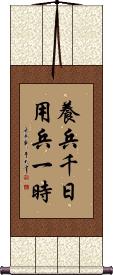
Maintain An Army For 1000 Days,
Use It For An Hour

yǎng bīng qiān rì, yàng bīng yì shí
양병천일용병일시
用
兵
一
時
養
兵
千
日

Characters shown
above are read
vertically, starting
from the right

Nothing could be more true. When I was in the Marine Corps, we trained for years for combat that often lasts only hours.

This phrase also reminds me of a common phrase used in the military to describe combat: "Weeks of total boredom, punctuated with five minutes of shear terror".

This may have some roots in Sun Tzu's The Art of War. Though I can not find this passage in his writings.

On the subject of the Art of War, if you have a favorite passage, we can create a custom calligraphy scroll with that phrase.

Marine

Amphibious Warrior (Chinese)

hǎi jūn lù zhàn duì yuán
海
軍
陸
戰
隊
員

This is the Chinese way to express "Marine". (as in a member of the Marine Corps). It is not country-specific, so it could be the Royal Marines, U.S. Marines, Chinese Marines, etc.
In Australian English, they would translate this as "Naval Infantryman".

Breaking down each character, this means:
"ocean/sea military/arms shore/land fighting/war/battle corps/team/group person/member". Note that the first two characters presented together, but outside of this phrase mean "navy" (sea military).

See Also...  Warrior | Military | Navy | Art Of War

Master / Sifu / Shi Fu / Shifu

Martial Arts Teacher

shī fu
si fu
사부
師
傅

This means master in Chinese (occasionally used in Korean Hanja as well). In the context of Martial Arts, this is the master and teacher who instructs students.

In other contexts, this can simply mean "skilled worker".

Historically, this term has been used for a lot of things, such as, "The tutor of a king or emperor". But now it's more commonly used to mean, master worker, or qualified worker.

Currently, within the field of skilled labor, a master (shifu) is higher than a journeyman, and is considered to be one worthy to teach others.

Note: In the 1970's and 1980's this term was used as a common form of polite address between people. You might say, "master, do you know were Tian'anmen Square is?" to just a person on the street at that time. This usage has almost passed, however, for some reason, people still often refer to taxi cab drivers as "master" in China (though I think/hope this is fading).

Language notes: I've often seen this romanized as "sifu", this is actually the Cantonese romanization. In Mandarin Chinese, it's "shifu". The pronunciation in Mandarin is actually like "sure foo" (using typical English pronunciation). There's an "R-sound" in there, which is not obvious from the romanization. Many martial arts studios incorrectly pronounce this like "she foo". In Cantonese, it sounds like "Sea foo" (almost like "sea food", minus the "d" on the end).

This is kind of a weird selection for a calligraphy wall scroll, this entry is more for educational purposes. But you are welcome to buy it if you feel it's appropriate for your circumstances.

Back to the top of this page

Monkey Fist

hóu quán
후권
猴
拳

This literally means what you think, it's the "Monkey Fist" school of Kung Fu. A style that mimics the punches and movements of monkeys and apes.

Becoming popular during the Qing Dynasty, this style can trace its origins back to as early as the Song Dynasty. Some of the romance and popularity of this style comes from the novel "Journey to the West" which features the Monkey King and his fighting skills.

This novel and martial arts style has spawned a stream of Hong Kong movies featuring the Monkey King, and other Kung Fu style variations such as "Drunken Monkey" and "Monkey Stealing Peaches" (a technique of disabling your opponent by grabbing and yanking on his testicles).

Note: This kind of makes sense in Korean Hanja and Japanese Kanji, but probably unknown by all Koreans and Japanese except those who have an interest in this form of Kung Fu.

Mountain Travels Poem by Dumu


yuǎn shàng hán shān shí jìng xiá bái yún shēng chù yǒu rén jiā tíng chē zuò ài fēng lín wǎn shuàng yè hóng yú èr yuè huā
遠
上
寒
山
石
徑
斜
白
雲
生
處
有
人
家
停
車
坐
愛
楓
林
晚
霜
葉
紅
於
二
月
花

This poem was written almost 1200 years ago during the Tang dynasty. It depicts traveling up a place known as Cold Mountain, where some hearty people have built their homes. The traveler is overwhelmed by the beauty of the turning leaves of the maple forest that surrounds him just as night overtakes the day, and darkness prevails. His heart implores him to stop, and take in all of the beauty around him.

First before you get to the full translation, I must tell you that Chinese poetry is a lot different than what we have in the west. Chinese words simply don't rhyme in the same way that English, or other western languages do. Chinese poetry depends on rhythm and a certain beat of repeated numbers of characters.

I have done my best to translate this poem keeping a certain feel of the original poet. But some of the original beauty of the poem in it's original Chinese will be lost in translation.

Far away on Cold Mountain, a stone path leads upwards.
Among white clouds peoples homes reside.
Stopping my carriage I must, as to admire the maple forest at nights fall.
In awe of autumn leaves showing more red than even flowers of early spring.

Hopefully, this poem will remind you to stop, and "take it all in" as you travel through life.
The poet's name is "Du Mu" in Chinese that is: 杜牧.
The title of the poem, "Mountain Travels" is: 山行
You can have the title, poet's name, and even Tang Dynasty written as an inscription on your custom wall scroll if you like.

More about the poet:

Dumu lived from 803-852 AD and was a leading Chinese poet during the later part of the Tang dynasty.
He was born in Chang'an, a city of central China and former capital of the ancient Chinese empire in 221-206 BC. In present day China, his birthplace is currently known as Xi'an, the home of the Terracotta Soldiers.

He was awarded his Jinshi degree (an exam administered by the emperor's court which leads to becoming an official of the court) at the age of 25, and went on to hold many official positions over the years. However, he never achieved a high rank, apparently because of some disputes between various factions, and his family's criticism of the government. His last post in the court was his appointment to the office of Secretariat Drafter.

During his life, he wrote scores of narrative poems, as well as a commentary on the Art of War and many letters of advice to high officials.

His poems were often very realistic, and often depicted every day life. He wrote poems about everything, from drinking beer in a tavern to weepy poems about lost love.

The thing that strikes you most is the fact even after 1200 years, not much has changed about the beauty of nature, toils and troubles of love and beer drinking.

Better Late Than Never

It's Never Too Late Too Mend

wáng yáng bǔ láo yóu wèi wéi wǎn
망양보뢰유미위만
亡
羊
補
牢
猶
未
為
晚

Long ago in what is now China, there were many kingdoms throughout the land. This time period is known as "The Warring States Period" by historians because these kingdoms often did not get along with each other.

Some time around 279 B.C. the Kingdom of Chu was a large, but not particularly powerful kingdom. Part of the reason it lacked power was the fact that the King was surrounded by "yes men" who told him only what he wanted to hear. Many of the King\’s court officials were corrupt and incompetent which did not help the situation.

The King was not blameless himself, as he started spending much of his time being entertained by his many concubines.

One of the King\’s ministers, Zhuang Xin, saw problems on the horizon for the Kingdom, and warned the King, "Your Majesty, you are surrounded by people who tell you what you want to hear. They tell you things to make you happy, and cause you to ignore important state affairs. If this is allowed to continue, the Kingdom of Chu will surely perish, and fall into ruins".

This enraged the King who scolded Zhuang Xin for insulting the country and accused him of trying to create resentment among the people. Zhuang Xin explained, "I dare not curse the Kingdom of Chu, but I feel that we face great danger in the future because of the current situation". The King was simply not impressed with Zhuang Xin\’s words.
Seeing the King\’s displeasure with him and the King\’s fondness for his court of corrupt officials, Zhuang Xin asked permission of the King that he may take leave of the Kingdom of Chu, and travel to the State of Zhao to live. The King agreed, and Zhuang Xin left the Kingdom of Chu, perhaps forever.

Five months later, troops from the neighboring Kingdom of Qin invaded Chu, taking a huge tract of land. The King of Chu went into exile, and it appeared that soon, the Kingdom of Chu would no longer exist.

The King of Chu remembered the words of Zhuang Xin, and sent some of his men to find him. Immediately, Zhuang Xin returned to meet the King. The first question asked by the King was, "What can I do now?"

Zhuang Xin told the King this story:

A shepherd woke one morning to find a sheep missing. Looking at the pen saw a hole in the fence where a wolf had come through to steal one of his sheep. His friends told him that he had best fix the hole at once. But the Shepherd thought since the sheep is already gone, there is no use fixing the hole.
The next morning, another sheep was missing. And the Shepherd realized that he must mend the fence at once. Zhuang Xin then went on to make suggestions about what could be done to reclaim the land lost to the Kingdom of Qin, and reclaim the former glory and integrity in the Kingdom of Chu.

The Chinese idiom shown above came from this reply from Zhuang Xin to the King of Chu almost 2,300 years ago.
It translates roughly into English as...
"Even if you have lost some sheep, it\’s never too late to mend the fence".

This phrase is often used in modern China when suggesting in a hopeful way that someone change their ways, or fix something in their life. It might be used to suggest fixing a marriage, quit smoking, or getting back on track after taking an unfortunate path in life among other things one might fix in their life.

I suppose in the same way that we might say, "Today is the first day of the rest of your life" in our western cultures to suggest that you can always start anew.

Note: This does have Korean pronunciation, but is not a well-known phrase in Korean (only Koreans familiar with ancient Chinese history would know it). Best if your audience is Chinese.

Back to the top of this page

Appreciation & Love
for Your Parents

shuí yán cùn cǎo xīn bào dé sān chūn huī
誰
言
寸
草
心
報
得
三
春
暉

This is the last line of a famous poem. It is perceived as a tribute or ode to your parent's or mother from a child or children that have left home.

The poem was written by Meng Jiao during the Tang Dynasty (about 1200 years ago). The Chinese title is "You Zi Yin" which means "The Traveler's Recite".

The last line as shown here speaks of the generous and warm spring sun light which gives the grass far beyond what the little grass can could ever give back (except perhaps by showing its lovely green leaves and flourishing). The metaphor is that the sun is your mother or parents, and you are the grass. Your parents raise you and give you all the love and care you need to prepare you for the world. A debt which you can never repay, nor is repayment expected.

The first part of the poem (not written in the characters to the left) suggests that the thread in a loving mother's hands is the shirt of her traveling offspring. Vigorously sewing while wishing them to come back sooner than they left.
...This part is really hard to translate into English that makes any sense, but maybe you get the idea. We are talking about a poem that is so old that many Chinese people would have trouble reading it (as if it was the King James Version of Chinese).

Past experience is the teacher for the future.

Past events not forgotten serve as teachers for later events.

qián shì bú wàng hòu shí zhī shī
前
事
不
忘
后
事
之
師

The most literal translation to English of this ancient Chinese proverb is:
"Past events not forgotten serve as teachers for later events".

However, it's been translated several ways:
Past experience, if not forgotten, is a guide for the future.
Past calamity is my teacher.
A good memory for the past is a teacher for the future.
The remembrance of the past is the teacher of the future.
If one remembers the lessons of the past; They will serve as a guide to avoid mistakes in the future.

The origin:
This proverb comes from the 5th century B.C. just before the Warring States Period in the territory now known as China.
The head of the State of Jin, Zhi Bo, seized power in a coup. He did this with help from the armies of the State of Han and Wei. Instead of being grateful for the help from Han and Wei, he treacherously took the land of Han and Wei. Never satisfied, Zhi Bo employed the armies of Han and Wei to attack and seize the State of Zhao.

The king of Zhao took advice from his minister Zhang Mengtan and secretly contacted the Han and Wei armies to reverse their plans and attack the army of Zhi Bo instead. The plan was successful, and the State of Zhao was not only saved, but was set to become a powerful kingdom in the region.

Zhang Mengtan immediately submitted his resignation to a confused king of Zhao. When asked why, Zhang Mengtan said, "I've done my duty to save my kingdom, but looking back at past experience, I know sovereign kings are never satisfied with the power or land at hand. They will join others and fight for more power and more land. I must learn from past experiences, as those experiences are the teachers of future events".
The king could not dispute the logic in that statement and accepted Zhang Mengtan's resignation.

For generations, the State of Zhao continued to fight for power and land until finally being defeated and decimated by the State of Qin (which lead to the birth of the Qin Dynasty in 221 B.C.).

Undaunted After Repeated Setbacks

Persistence to overcome all challenges

bǎi zhé bù náo
hyaku setsu su tou
백절불요
百
折
不
撓

This phrase means "Be undaunted in the face of repeated setbacks". It's of Chinese origin, but is commonly used in Japanese, and somewhat in Korean (same characters, different pronunciation).

This phrase comes from a long, and occasionally tragic story of a man that lived sometime around 25-220 AD. His name was Qiao Xuan and he never stooped to flattery, but remained an upright person at all times. He fought to expose corruption of higher-level government officials at great risk to himself.

Then when he was at a higher level in the Imperial Court, bandits were regularly capturing hostages and demanding ransoms. But when his own son was captured, he was so focused on his duty to the Emperor and common good that he sent a platoon of soldiers to raid the bandits' hideout, and stop them once and for all even at the risk of his own son's life. While all of the bandits were arrested in the raid, they killed Qiao Xuan's son at first sight of the raiding soldiers.

Near the end of his career a new Emperor came to power, and Qiao Xuan reported to him that one of his ministers was bullying the people and extorting money from them. The new Emperor refused to listen to Qiao Xuan and even promoted the corrupt Minister. Qiao Xuan was so disgusted that in protest he resigned his post as minister (something almost never done) and left for his home village.

His tombstone reads "Bai Zhe Bu Nao" which is now a phrase used in Chinese culture to describe a person of strong will who puts up stubborn resistance against great odds.

My Chinese-English dictionary defines these 4 characters as, "keep on fighting in spite of all setbacks", "be undaunted by repeated setbacks" and "be indomitable".

Our translator says it can mean, "never give up" in modern Chinese.

Although the first two characters are translated correctly as "repeated setbacks", the literal meaning is "100 setbacks" or "a rope that breaks 100 times". The last two characters can mean "do not yield" or "do not give up".
Most Chinese, Japanese, and Korean people will not take this absolutely literal meaning, but will instead understand it as the title suggests above. If you want a single big word definition, it would be indefatigability or indomitableness.

See Also...  Tenacity | Fortitude | Strength | Perseverance

Back to the top of this page

Phoenix (female)

huáng
ou
凰

This is another simple way to write "Phoenix" in Chinese. This is the specifically female element of phoenix, so this is how you write "female phoenix". This character is sometimes used to represent the female empress (many times in history, China was ruled by a woman, in much the same way queens came to power in Europe).

Note that the emperor is always represented as a dragon (not the male version of phoenix).

If you see yourself as a strong woman, this might be scroll for you to express "woman power" or "powerful woman" in a cool way.

Queen

nǚ wáng
jo ou
여왕
女
王

This is one way to write queen in Chinese, Japanese Kanji, and old Korean Hanja.

This is not the same thing as an empress.

The first character means "woman" or "female", and the second means "king". So this is literally, "woman king".

See Also...  Empress | Goddess | King | Emperor

Queen / Empress

Wife of the King

wáng hòu
ou kou
왕후
王
后

This is another way to write queen in Chinese, Japanese Kanji, and old Korean Hanja.

This is sometimes used for the title of empress.

The first character means "king" and the second means "wife", or a short form to say "wife of the king / emperor". So this is literally, "king's wife" or "emperor's wife". Some will translate this as "queen consort".

See Also...  Queen | Goddess | King | Emperor

Back to the top of this page

Respect out of fear is never genuine
Reverence out of respect is never false

dǎ pà de rén shì jiǎ de jìng pà de rén shì zhēn de
人
是
真
的
假
的
敬
怕
的
打
怕
的
人
是

Characters shown
above are read
vertically, starting
from the right

This is a proverb that seems to be aimed at world leaders or others in power. Perhaps a suggestion to avoid the practice of "fear mongering" opting instead for a policy of benevolence and justice.

An example: When the Bush administration told Pakistan they could either join America in the "war on terror", or expect some bombs to be coming their way, Bush gained this kind of "less-than-genuine respect" from Pakistanis.
Leaders in places like North Korea and even Saudi Arabia reap the same bogus respect from their own citizens.

Note that calligraphers do not like to repeat the same characters in exactly the same way in the same piece of artwork. So expect the characters that are repeated to be written in different forms in the real artwork (unlike the way they are displayed to the left).

Samurai

shì
samurai
侍

In Japanese, this character represents the warriors that attempted to hold peace when there was no Emperor in Japan. Be cautious though, as it is an old way to express "servant" or "waiter" in Chinese and Korean. Of course, if you are a samurai, you are a servant to your Shogun-ate, Lord, or the people (which is the root meaning).

See Also...  Warrior

Consciousness of Self

zì jué
jikaku
자각
自
覺

This is the idea of being conscious, self-aware and sometimes "on one's own initiative".

覚After WWII, they started using a simplified form of the second Kanji for this word in Japan. That version is shown to the right, and you can click on that Kanji if you want the modern Japanese form. Otherwise, the characters shown in the upper left are the correct ones for ancient/old/traditional Chinese, Japanese, and Korean.

Back to the top of this page

Shaolin

Little Forest

shǎo lín
sho rin
소림
少
林

The Shaolin monks of China have been practicing the art of Kung Fu for thousands of years. While there are many schools of Kung Fu in China, Shaolin are one of the more religiously devout and disciplined.

The title of Shaolin actually refers to a specific Buddhist monastery. It should be noted that the Shaolin were famous in China long before the Kung Fu TV show. Their fame in China is due to the monks' heroic and swift rescue an emperor during the Tang Dynasty. Most Chinese people are not keenly aware of the Kung Fu TV show, and have no idea who David Carradine is or anything about his character, Kwai Chang Caine.

Note: The literal meaning of these two characters is "little forest".

The fame of the Shaolin has spread all over Asia, as even though this is a Chinese title, the same characters are used in Japanese with the same meaning.

A sly rabbit has three openings to its den

-or- The crafty rabbit has three different entrances to its lair

jiǎo tù sān kū
狡
兔
三
窟

This speaks to the cunning character of a sly rabbit. Such a rabbit will not have just one hole, but rather a few entrances and exits from his liar.

About 2,250 years ago a very rich man told his assistant to go and buy something wonderful that he did not yet posses. He was a man that already had everything, so the assistant went to a local village that owed a great deal of money to the rich man. The assistant told the village elders that all debts were forgiven. All the villagers rejoiced and praised the rich man's name. The assistant returned to the rich man and told him he had purchased "benevolence" for him. The rich man was mildly amused, but perhaps a bit confused by the action.

Some time later, the rich man fell from the favor of the Emperor, and was wiped out without a penny to his name. One day he was walking aimlessly and stumbled into the village in which the debts had been forgiven. The villagers recognized the man and welcomed him with open arms, clothed, fed, and gave him a place to live.

Without trying, the man had become like the sly and cunning rabbit. When his exit was blocked, he had another hole to emerge from - and was reborn. This story and idiom comes from a book titled "The Amendment" - it's unclear whether this man actually existed or not. But the book did propel this idiom into common use in China.

Still today this idiom about the rabbit is used in China when suggesting "backup plans" alternate methods, and anyone with a good escape plan.

Sun Tzu: Regard Your Soldiers as Children

Coming Soon
愛
子
故
可
與
之
俱
死
與
之
赴
深
溪
視
卒
如
視
卒
如
嬰
兒
故
可
以

Characters shown
above are read
vertically, starting
from the right

This is an entry from the 10th section within the Earth/Terrain chapter of Sun Tzu's Art of War.

This is often translated as, "Regard your soldiers as your children, and they will follow you into the deepest valleys. Look upon them as your own beloved sons, and they will stand by you even unto death".

Back to the top of this page

The More We Sweat in Training,
The Less We Bleed in Battle

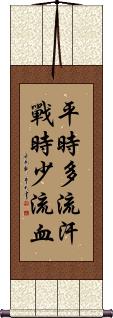
píng shí duō liú hàn zhàn shí shǎo liú xuè
戰
時
少
流
血
平
時
多
流
汗

Characters shown
above are read
vertically, starting
from the right

There is more than one way to translate this ancient Chinese military proverb. Here are a few interpretations:

A drop of sweat spent in a drill is a drop of blood saved in war.

More practice will give one a better chance of success in real situation.

The more you sweat in training, the less you bleed in battle.

I heard this many times when I was a U.S. Marine, but I had no idea at the time that it was actually an old Chinese proverb.

Tiger Rumor

sān rén chéng hǔ
삼인성호
三
人
成
虎

These four characters together relay the meaning that can be expressed in English as, "When three people say there's a tiger running in the street, you believe it".

Of course, there is an ancient story behind this phrase...

This is actually an idiom that resulted from a conversation that occurred around 300 B.C.

The conversation was between the king of the Wei kingdom and one of the king's ministers named Pang Cong.

It was near the end of one of many wars, this time with the Zhao kingdom. Pang Cong was to be sent by the king to the Zhao kingdom with the king's son who was to be held hostage. It was common at the time for a king to make his son a hostage to secure stable peace between warring kingdoms.

Before minister Pang Cong departed, he asked his king, "If one person told you there was a tiger running in the street, would you believe it?".

"No", the king said.

The minister continued, "What if two people told you?"

The king replied, "Well, I would have my doubts, but I might believe it".

The minister continued, "So, what if three people told you that there is a tiger running in the streets?"

The king replied, "Yes, I would believe it, it must be true if three people say it".

The minister then reminded the king, "Your son and I are now traveling far away to live in the distant Zhao kingdom - much farther from your palace than the street. Rumors may fly about me in my absence, so I hope your majesty will weight such rumors appropriately".

The king replied, "I have every trust in you, do not worry"

While the minister was gone, the king's enemies gossiped about minister Pang Cong on many occasions. At first, the king thought nothing of these comments and rumors. But slowly as the rumors mounted, the king began to suspect ill of his minister.

Some time later when peace was well-established, the minister and prince were freed and returned to the kingdom of Wei. The king received his son, BUT DID NOT EVEN SUMMON MINISTER PANG CONG TO THE PALACE!

Hopefully this story will help you see how dangerous words can be when used to promote rumors, or create ill will. And perhaps will inspire you to not believe everything you hear.

There is also a secondary suggestion in this idiom that gossip is as ferocious as a tiger. Some Chinese people who don't know the ancient story above may believe that this scroll means that rumors are as vicious as three tigers.

Note: This phrase appears in my Korean dictionary, but is not well-known in Korea.

Unselfish: Perfectly Impartial

dà gōng wú sī
대공무사
大
公
無
私

This is comes from an old story from some time before 476 BC. About a man named Qi Huangyang, who was commissioned by the king to select the best person for a certain job in the Imperial Court.

Qi Huangyang selected his enemy for the job. The king was very confused by the selection, but Qi Huangyang explained that he was asked to find the best person for the job, not necessarily someone that he personally liked or had a friendship with.

Later, Confucius commented on how unselfish and impartial Qi Huangyang was by saying "Da Gong Wu Si" which if you look it up in a Chinese dictionary, is generally translated as "Unselfish" or "Just and Fair".

If you translate each character, you'd have something like,

"Big/Deep Justice Without Self".

Direct translations like this leave out a lot of what the Chinese characters really say. Use your imagination, and suddenly you realize that "without self" means "without thinking about yourself in the decision" - together, these two words mean "unselfish". The first two characters serve to really drive the point home that we are talking about a concept that is similar to "blind justice".

One of my Chinese-English dictionaries translates this simply as "just and fair". So that is the short and simple version.

Note: This can be pronounced in Korean, but it's not a commonly-used term.

See Also...  Selflessness | Work Unselfishly For The Common Good | Altruism

Back to the top of this page

United States Marine Corps

Japanese Only

bei kai hei tai
미해병대
米
海
兵
隊

This is the Japanese way to write "United States Marine Corps" or simply "U.S. Marines".

Breaking down each Kanji, this means:
"rice (American) ocean/sea soldiers/army/military corps/regiment/group".

This title will only make sense in Japanese, it is not the same in Chinese! Make sure you know your audience before ordering a custom wall scroll.

If you are wondering about the rice, America is known as "rice country" or "rice kingdom" when literally translated. The Kanji for rice is often used as an abbreviation in front of words (like a sub-adjective) to make something "American". Americans say "rice-burner" for a Japanese car, and "rice-rocket" for a Japanese motorcycle. If you did the same in Japanese, it would be exactly the opposite meaning.

Note: I have not verified this, but I've found this title used for U.S. Marines in Korean articles, so it's most likely a normal Korean term as well (but only in Korean Hanja).

See Also...  Marine Corps | Navy | Army | Art Of War | Warrior

Work Unselfishly for the Common Good

kè jǐ fèng gōng
극기봉공
克
己
奉
公

This can also mean: "Place Strict Standards on Oneself in Public Service".
This Chinese phrase is often used to express how one should act as a government official. Most of us wish our public officials would hold themselves to higher standards. I wish I could send this scroll, along with the meaning to every member of Congress, and the President (or if I was from the UK, all the members of Parliament, and the PM)

The story behind this ancient Chinese idiom:
A man named Cai Zun was born in China a little over 2000 years ago. In 24 AD, he joined an uprising led by Liu Xiu who later became the emperor of the Eastern Han Dynasty.

Later, the new emperor put Cai Zun in charge of the military court. Cai Zun exercised his power in strict accordance with military law, regardless of the offender's rank or background. He even ordered the execution of one of the emperor's close servants after the servant committed a serious crime.

Cai Zun led a simple life, but put great demands on himself to do all things in an honorable way. The emperor rewarded him for his honest character and honorable nature by promoting him to the rank of General and granting him the title of Marquis.

Whenever Cai Zun would receive an award, he would give credit to his men and share the reward with them.
Cai Zun was always praised by historians who found many examples of his selfless acts that served the public interest.
Sometime, long ago in history, people began to refer to Cai Zun as "ke ji feng gong".

See Also...  Unselfish | Selflessness | Altruism

Five Ancestors Fist

wǔ zǔ quán
五
祖
拳

This is a martial arts concept (some would say "school") known as Five Ancestors' Fist.

The first character means five.
The second means ancestor, forefather, or grandparents.
The third means fist.


The ancestors referred to by this title and whose attributes contribute to this style are as follows:
1. Grace of the White Crane.
2. Agility of the Monkey.
3. Precision and skill of Emperor Taizu (mythical great ancestor).
4. Power of Luohan (Buddist arhat).
5. Breath of Damo (founder of Buddhism, or the first Buddha).

Back to the top of this page

Tiger

Year of the Tiger / Zodiac Sign


tora
虎

This is the character for tiger in Chinese, old Korean Hanja, and Japanese Kanji.

Since you already know what a tiger is, here's some trivia: If you look at the Japanese pronunciation, you might remember a movie called "Tora Tora Tora" which was the code word used to initiate the attack on Pearl Harbor. It simply means "Tiger Tiger Tiger".

In Chinese culture, the tiger is considered to be the king of all animals (in much the way we see the lion in western culture).

From the Chinese Zodiac, if you were born in the year of the tiger, you . . .

Have a strong personality.
Are full of self-confidence.
Love adventure
Don't like to obey others.

See also our Chinese Zodiac or Tiger Calligraphy pages.

Dragon

Year of the Dragon / Zodiac Sign

lóng
ryuu / tatsu
龍

This is the character for dragon in Chinese, old Korean Hanja, and Japanese Kanji.

The dragon is the creature of myth and legend that dominates Chinese, Japanese, and even European folklore. In China, the dragon is the symbol of the Emperor, strength and power, and the Chinese dragon is known as the god of water.

From the Chinese Zodiac, if you were born in the year of the Dragon, you . . .

Have a strong body and spirit.
Are full of energy.
Have vast goals.
Have a deep level of self-awareness.
Will do whatever you can to "save face".

See also our Chinese Zodiac or Dragon Calligraphy pages.

Drunken Monkey

Japanese Only

yo i saru
酔
い
猿

This is the Japanese title for Drunken Monkey.

Back to the top of this page

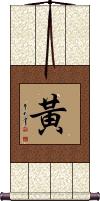
Yellow

Yellow Color

huáng
hon / kou
黃

This is the single character for the color yellow in Chinese.

In China, yellow is traditionally the color of the emperor. In fact, there was a time when only the emperor could wear yellow clothing, or own yellow pet fish. Note: Goldfish were breed originally in China for the emperor. When the perfect yellow fish was breed, all but the emperor were banned from owning any. Thus a more orange-colored goldfish dominated the market.

This character is not a common selection for a wall scroll. Even if your Chinese surname is Huang (Yellow) or your Korean surname is Hwang (yellow), it's still probably not appropriate.

黄This character is written with a slight variation in Simplified Chinese and modern Japanese. Click on the image to the right if you want this alternate version.

Animal Kingdom

dòng wù wáng guó
doubutsu oukoku
동물왕국
動
物
王
國

This is literally what it says.

There is even a TV show in China that is similar to Wild Kingdom or what you would currently see on the Discovery Channel that has this same title.

For your information: In the Chinese way of thinking, the Tiger is the king of the animal kingdom (lions are not native to China, so the tiger took the role that we have given to the lion in our western way of thinking).

The Japanese version has a slight variation on the last character. Let me know if your audience is Japanese, and we will have it written in that form for you.

Dragon / Emperor Symbol

lóng
ryuu / tatsu
竜

This is an alternate form of dragon. Still pronounced the same in Chinese, Japanese, and Korean.

This particular Kanji is often associated as an imperial symbol as well as representing the mythical Asian dragon. You may have seen it on the chest or flag of the emperor in old Japanese and Chinese movies.

Note: I would rate this as a non-universal alternate form. The other dragon character is by far more common, and universally understood.

We strongly recommend symbol of dragon if you are looking for the symbol of dragon.

See Also...  Phoenix | Emperor | King

Back to the top of this page

Emperor

huáng
kou
皇

This is the simple, single-character way to write emperor in Chinese and Japanese.

See Also...  Empress | King | Queen

Emperor

huáng dì
koutei
황제
皇
帝

From times of old, the emperors of Asia ruled under the authority of God himself. In fact, one definition of an emperor is a ruler put in power by God. This definition separates emperors from the various kings in Chinese history (although defining who is a king versus an emperor gets vague sometimes).

Occasionally, the emperor's wife was widowed, and she took the role of empress until her death (see our entry for empress if that is what you are looking for).

See Also...  Empress | King | Queen

King

wáng
wong
ou
王

This is wang which means king. It is not pronounced the way you think in Chinese. It is more like English-speakers would want to pronounce wong. It has roughly the same vowel sound as tong, song, or long in English.

Note that this means king only, not emperor. An emperor is higher than a king, and theoretically is chosen by God, according to ancient Chinese culture. However, the definition is often blurred at various points in Asian history.

This word can also be defined as ruler, sovereign, monarch or magnate. It is also can refer to a game piece in the chess-like Japanese strategic game of shoji.

Note: This can also be a family name in Chinese, Korean and Vietnamese (in Vietnamese it's Vương).

See Also...  Queen

Back to the top of this page

Army / Military

jūn
gun
軍

This character means army, military, or arms.

This is also a character used in the compound word that means "army general". It's the "gun" in the well-known Japanese title "Shogun" which means general.

See Also...  Shogun | Navy | Marine | Military


You should look at these ready-to-ship pieces of artwork:

Emperor Ancestor - Partial-Print Wall Scroll

Emperor Ancestor
Partial-Print Wall Scroll

This kind of artwork is often called an "ancestor painting". Though it's only your ancestor if you are a descendant of the Emperor.


Compare: $200.00

Your Price: $68.88


More Info
Monkey King - Warrior Wall Scroll

Monkey King
Warrior Wall Scroll

If you love the novel, or the numerous movies that depict "The Journey to the West", then you know this frisky fellow.


Compare: $200.00

Your Price: $78.88


More Info
Zhao Jun - The Distinguished Beauty of China Wall Scroll

Zhao Jun
The Distinguished Beauty of China Wall Scroll

In 48 B.C. the Emperor sent out servants to find the most beautiful woman in all of China. They found this woman, but that's just the beginning of the story...


Compare: $88.00

Your Price: $48.88


More Info
Zhao Jun - The Distinguished Beauty of China Wall Scroll

Zhao Jun
The Distinguished Beauty of China Wall Scroll

In 48 B.C. the Emperor sent out servants to find the most beautiful woman in all of China. They found this woman, but that's just the beginning of the story...


Compare: $88.00

Your Price: $48.88


More Info
Zhao Jun - The Distinguished Beauty of China Wall Scroll

Zhao Jun
The Distinguished Beauty of China Wall Scroll

In 48 B.C. the Emperor sent out servants to find the most beautiful woman in all of China. They found this woman, but that's just the beginning of the story...


Compare: $180.00

Your Price: $68.88


More Info
Zhao Jun - The Distinguished Beauty of China Wall Scroll

Zhao Jun
The Distinguished Beauty of China Wall Scroll

In 48 B.C. the Emperor sent out servants to find the most beautiful woman in all of China. They found this woman, but that's just the beginning of the story...


Compare: $88.00

Your Price: $48.88


More Info
Zhao Jun - The Distinguished Beauty of China Wall Scroll

Zhao Jun
The Distinguished Beauty of China Wall Scroll

In 48 B.C. the Emperor sent out servants to find the most beautiful woman in all of China. They found this woman, but that's just the beginning of the story...


Compare: $180.00

Your Price: $68.88


More Info
Zhao Jun - The Distinguished Beauty of China Wall Scroll

Zhao Jun
The Distinguished Beauty of China Wall Scroll

In 48 B.C. the Emperor sent out servants to find the most beautiful woman in all of China. They found this woman, but that's just the beginning of the story...


Compare: $180.00

Your Price: $68.88


More Info
DRAGON Chinese Calligraphy Portrait

DRAGON Chinese Calligraphy Portrait

The Chinese character for "dragon". Also the Emperor's symbol, and sometimes used as a symbol for a warrior.


Compare: $40.00

Your Price: $16.88


More Info
TIGER - Chinese / Japanese / Korean Symbol Portrait

TIGER
Chinese / Japanese / Korean Symbol Portrait

The king of the animal kingdom according to Chinese traditional culture


Compare: $40.00

Your Price: $16.88


More Info
DRAGON Chinese Calligraphy Portrait

DRAGON Chinese Calligraphy Portrait

The Chinese character for "dragon". Also the Emperor's symbol, and sometimes used as a symbol for a warrior.


Compare: $40.00

Your Price: $16.88


More Info
TIGER - Chinese Character / Japanese Kanji Wall Scroll

TIGER
Chinese Character / Japanese Kanji Wall Scroll

If you like tigers, why not show your dedication to the king of animals according to Chinese culture?


Compare: $65.00

Your Price: $28.88


More Info
DRAGON Chinese / Japanese Calligraphy Wall Scroll

DRAGON Chinese / Japanese Calligraphy Wall Scroll

The symbol of the Emperor with the heart of a warrior.


Compare: $65.00

Your Price: $27.88


More Info

A nice Chinese calligraphy wall scroll

The scroll that I am holding in this picture is a "medium size"
4-character wall scroll.
As you can see, it is a great size to hang on your wall.
(We also offer custom wall scrolls in larger sizes)

A professional Chinese Calligrapher

Professional calligraphers are getting to be hard to find these days.
Instead of drawing characters by hand, the new generation in China merely type roman letters into their computer keyboards and pick the character that they want from a list that pops up.

There is some fear that true Chinese calligraphy may become a lost art in the coming years. Many art institutes in China are now promoting calligraphy programs in hopes of keeping this unique form of art alive.

Trying to learn Chinese calligrapher - a futile effort

Even with the teachings of a top-ranked calligrapher in China, my calligraphy will never be good enough to sell. I will leave that to the experts.


A high-ranked Chinese master calligrapher that I met in Zhongwei

The same calligrapher who gave me those lessons also attracted a crowd of thousands and a TV crew as he created characters over 6-feet high. He happens to be ranked as one of the top 100 calligraphers in all of China. He is also one of very few that would actually attempt such a feat.


See: Our list of specifically Japanese Kanji Calligraphy Wall Scrolls. And, check out Our list of specifically old Korean Hanja Calligraphy Wall Scrolls.

The following table is only helpful for those studying Chinese (or Japanese), and perhaps helps search engines to find this page when someone enters Romanized Chinese or Japanese

Title
Characters 
Simplified
Traditional
Japanese Romaji
(Romanized Japanese)
Various forms of Romanized Chinese
Leadership领导
領導
n/alǐng dǎo
ling dao
ling tao
ling3 dao3
lingdao
Initiative / Leadership主动
主動
shudou
shudo
jī jí
ji ji
chi chi
ji1 ji2
jiji
Leadership / Ability to Lead (Japanese Only)指导力
指導力
shidouryoku
shidoryoku
n/a
Art of War: 5 Points of Analysis道天地将法
道天地將法
dou ten chi shou hou
doutenchishouhou
do ten chi sho ho
dào tiān dì jiàng fǎ
dao tian di jiang fa
tao t`ien ti chiang fa
dao4 tian1 di4 jiang4 fa3
daotiandijiangfa
taotientichiangfa
tao tien ti chiang fa
Initiative / Proactive积极
積極
sekkyoku
sekyoku
jī jí
ji ji
chi chi
ji1 ji2
jiji
Shogun / Japanese General将军
將軍
shougun
shogun
jiāng jūn
jiang jun
chiang chün
jiang1 jun1
jiangjun
Chinese or Korean Army General (Shogun)将军
將軍
shougun
shogun
jiāng jūn
jiang jun
chiang chün
jiang1 jun1
jiangjun
Art of War兵法
兵法
hyou hou
hyouhou
hyo ho
bīng fǎ
bing fa
ping fa
bing1 fa3
bingfa
Sun Tzu - Art of War孙子兵法
孫子兵法
son shi hyou hou
sonshihyouhou
son shi hyo ho
sūn zǐ bīng fǎ
sun zi bing fa
sun tzu ping fa
sun1 zi3 bing1 fa3
sunzibingfa
Banzai / Wansui万岁
萬歲
banzai / manzai
banzai/manzai
wàn suì
wan sui
wan4 sui4
wansui
Banzai (Modern Japanese Version)万岁
萬歲
banzaiwàn suì
wan sui
wan4 sui4
wansui
Boys be Ambitious少年よ大志を抱け
shou nen yo tai shi o ida ke
shounenyotaishioidake
sho nen yo tai shi o ida ke
n/a
The Confident Helmsman
Inspires Confidence in the Passengers
把舵的不慌乘船的稳当
把舵的不慌乘船的穩當
n/abǎ tuò de bù huāng chéng chuán de wěn dang
ba tuo de bu huang cheng chuan de wen dang
pa t`o te pu huang ch`eng ch`uan te wen tang
ba3 tuo4 de bu4 huang1 cheng2 chuan2 de wen3 dang
pa to te pu huang cheng chuan te wen tang
Corinthians 13:4愛是恆久忍耐又有恩慈愛是不嫉妒愛是不自誇不張狂
愛是恆久忍耐又有恩慈愛是不嫉妒愛是不自誇不張狂
n/aài shì héng jiǔ rěn nài yòu yǒu én cí ài shì bú jì dù ài shì bú zì kuā bù zhāng kuáng
ai shi heng jiu ren nai you you en ci ai shi bu ji du ai shi bu zi kua bu zhang kuang
ai shih heng chiu jen nai yu yu en tz`u ai shih pu chi tu ai shih pu tzu k`ua pu chang k`uang
ai4 shi4 heng2 jiu3 ren3 nai4 you4 you3 en2 ci2 ai4 shi4 bu2 ji4 du4 ai4 shi4 bu2 zi4 kua1 bu4 zhang1 kuang2
ai shih heng chiu jen nai yu yu en tzu ai shih pu chi tu ai shih pu tzu kua pu chang kuang
Destiny / Fate
inochi / mei
inochi/mei
mìng yùn
ming
ming4
ming
Drunken Monkey醉猴
醉猴
n/azuì hóu
zui hou
tsui hou
zui4 hou2
zuihou
Drunken Monkey Kung Fu醉猴功夫
醉猴功夫 / 醉猴功伕
n/azuì hóu gōng fu
zui hou gong fu
tsui hou kung fu
zui4 hou2 gong1 fu
zuihougongfu
Empress皇后
皇后
kou gou
kougou
ko go
huáng hòu
huang hou
huang2 hou4
huanghou
Destiny Determined by Heaven天意
天意
tenitiān yì
tian yi
t`ien i
tian1 yi4
tianyi
tieni
tien i
The one who retreats 50 paces
mocks the one to retreats 100
五十步笑百步
五十步笑百步
n/awù shí bù xiào bǎi bù
wu shi bu xiao bai bu
wu shih pu hsiao pai pu
wu4 shi2 bu4 xiao4 bai3 bu4
wushibuxiaobaibu
Begging Forgiveness饶恕
饒恕
n/aráo shù
rao shu
jao shu
rao2 shu4
raoshu
Forgiveness (from the top down)容赦
容赦
you sha
yousha
yo sha
róng shè
rong she
jung she
rong2 she4
rongshe
Furinkazan风林火山
風林火山
fuu rin ka zan
fuurinkazan
fu rin ka zan
fēng lín huǒ shān
feng lin huo shan
feng1 lin2 huo3 shan1
fenglinhuoshan
Grace from Heaven / Grace from God天恩
天恩
ten on
tenon
tiān ēn
tian en
t`ien en
tian1 en1
tianen
tienen
tien en
Glory and Honor荣 / 栄
eiróng
rong
jung
rong2
rong
A Deliberate Inaction
Is Better Than A Blind Action
一动不如一静
一動不如一靜
n/ayí dòng bù rú yí jìng
yi dong bu ru yi jing
i tung pu ju i ching
yi2 dong4 bu4 ru2 yi2 jing4
yidongburuyijing
John 14:15你们若爱我就必遵守我的命令
你們若愛我就必遵守我的命令
n/anǐ mén ruò ài wǒ jiù bì zūn shǒu wǒ de mìng lìng
ni men ruo ai wo jiu bi zun shou wo de ming ling
ni men jo ai wo chiu pi tsun shou wo te ming ling
ni3 men2 ruo4 ai4 wo3 jiu4 bi4 zun1 shou3 wo3 de ming4 ling4
John 14:18我不撇下你们为孤儿我必到你们这里来
我不撇下你們為孤兒我必到你們這裡來
n/awǒ bù piě xià nǐ mén wéi gū ér wǒ bì dào nǐ mén zhè lǐ lái
wo bu pie xia ni men wei gu er wo bi dao ni men zhe li lai
wo pu p`ieh hsia ni men wei ku erh wo pi tao ni men che li lai
wo3 bu4 pie3 xia4 ni3 men2 wei2 gu1 er2 wo3 bi4 dao4 ni3 men2 zhe4 li3 lai2
wo pu pieh hsia ni men wei ku erh wo pi tao ni men che li lai
John 3:16神爱世人甚至将他的独生子赐给他们叫一切信他的不至灭亡反得永生
神愛世人甚至將他的獨生子賜給他們叫一切信他的不至滅亡反得永生
n/ashén ài shì rén shèn zhì jiāng tā de dú shēng zǐ cì gè tā mén jiào yí qiè xìn tā de bú zhì miè wáng fǎn dé yǒng shēng
shen ai shi ren shen zhi jiang ta de du sheng zi ci gei ta men jiao yi qie xin ta de bu zhi mie wang fan de yong sheng
shen ai shih jen shen chih chiang t`a te tu sheng tzu tz`u t`a men chiao i ch`ieh hsin t`a te pu chih mieh wang fan te yung sheng
shen2 ai4 shi4 ren2 shen4 zhi4 jiang1 ta1 de du2 sheng1 zi3 ci4 gei3 ta1 men2 jiao4 yi2 qie4 xin4 ta1 de bu2 zhi4 mie4 wang2 fan3 de2 yong3 sheng1
shen ai shih jen shen chih chiang ta te tu sheng tzu tzu ta men chiao i chieh hsin ta te pu chih mieh wang fan te yung sheng
Katana
katanadāo
dao
tao
dao1
dao
Know Thy Enemy, Know Thyself知彼知己
知彼知己
n/azhí bǐ zhí jī
zhi bi zhi ji
chih pi chih chi
zhi2 bi3 zhi2 ji1
zhibizhiji
Know Your Enemy, Know Yourself, and You Cannot Lose知彼知己百战不殆
知彼知己百戰不殆
n/azhí bǐ zhí jī bǎi zhàn bú dài
zhi bi zhi ji bai zhan bu dai
chih pi chih chi pai chan pu tai
zhi2 bi3 zhi2 ji1 bai3 zhan4 bu2 dai4
zhibizhijibaizhanbudai
Hunt Foxes with Stealth, Hunt Wolves in the Open暗打狐狸明打狼
闇打狐狸明打狼
n/aàn dǎ hú li míng dǎ láng
an da hu li ming da lang
an ta hu li ming ta lang
an4 da3 hu2 li ming2 da3 lang2
andahulimingdalang
Listen to Both Sides and be Enlightened, Listen to One Side and be in the Dark兼听则明偏听则暗
兼聽則明偏聽則暗
n/ajiān tīng zé míng, piān tīng zé àn
jian ting ze ming, pian ting ze an
chien t`ing tse p`ien t`ing tse an
jian1 ting1 ze2 ming2, pian1 ting1 ze2 an4
chien ting tse pien ting tse an
Maintain An Army For 1000 Days, Use It For An Hour养兵千日用兵一时
養兵千日用兵一時
n/ayǎng bīng qiān rì, yàng bīng yì shí
yang bing qian ri yang bing yi shi
yang ping ch`ien jih yang ping i shih
yang3 bing1 qian1 ri4 yang4 bing1 yi4 shi2
yang ping chien jih yang ping i shih
Marine海军陆战队员
海軍陸戰隊員
n/ahǎi jūn lù zhàn duì yuán
hai jun lu zhan dui yuan
hai chün lu chan tui yüan
hai3 jun1 lu4 zhan4 dui4 yuan2
haijunluzhanduiyuan
Master / Sifu / Shi Fu / Shifu师傅
師傅
n/ashī fu
shi fu
shih fu
shi1 fu
shifu
Monkey Fist猴拳
猴拳
n/ahóu quán
hou quan
hou ch`üan
hou2 quan2
houquan
houchüan
hou chüan
Mountain Travels Poem by Dumu远上寒山石径斜白云生处有人家停车坐爱枫林晚霜叶红于二月花
遠上寒山石徑斜白雲生處有人家停車坐愛楓林晚霜葉紅於二月花
n/ayuǎn shàng hán shān shí jìng xiá bái yún shēng chù yǒu rén jiā tíng chē zuò ài fēng lín wǎn shuàng yè hóng yú èr yuè huā
yuan shang han shan shi jing xia bai yun sheng chu you ren jia ting che zuo ai feng lin wan shuang ye hong yu er yue hua
yüan shang han shan shih ching hsia pai yün sheng ch`u yu jen chia t`ing ch`e tso ai feng lin wan shuang yeh hung yü erh yüeh hua
yuan3 shang4 han2 shan1 shi2 jing4 xia2 bai2 yun2 sheng1 chu4 you3 ren2 jia1 ting2 che1 zuo4 ai4 feng1 lin2 wan3 shuang4 ye4 hong2 yu2 er4 yue4 hua1
yüan shang han shan shih ching hsia pai yün sheng chu yu jen chia ting che tso ai feng lin wan shuang yeh hung yü erh yüeh hua
Better Late Than Never亡羊补牢犹未为晚
亡羊補牢猶未為晚
n/awáng yáng bǔ láo yóu wèi wéi wǎn
wang yang bu lao you wei wei wan
wang yang pu lao yu wei wei wan
wang2 yang2 bu3 lao2 you2 wei4 wei2 wan3
Appreciation & Love
for Your Parents
谁言寸草心报得三春晖
誰言寸草心報得三春暉
n/ashuí yán cùn cǎo xīn bào dé sān chūn huī
shui yan cun cao xin bao de san chun hui
shui yen ts`un ts`ao hsin pao te san ch`un hui
shui2 yan2 cun4 cao3 xin1 bao4 de2 san1 chun1 hui1
shui yen tsun tsao hsin pao te san chun hui
Past experience is the teacher for the future.前事不忘后事之师
前事不忘后事之師
n/aqián shì bú wàng hòu shí zhī shī
qian shi bu wang hou shi zhi shi
ch`ien shih pu wang hou shih chih shih
qian2 shi4 bu2 wang4 hou4 shi2 zhi1 shi1
chien shih pu wang hou shih chih shih
Undaunted After Repeated Setbacks百折不挠
百折不撓
hyaku setsu su tou
hyakusetsusutou
hyaku setsu su to
bǎi zhé bù náo
bai zhe bu nao
pai che pu nao
bai3 zhe2 bu4 nao2
baizhebunao
Phoenix (female)
ou
o
huáng
huang
huang2
huang
Queen女王
女王
jo ou
joou
jo o
nǚ wáng
nv wang
nü wang
nv3 wang2
nvwang
Queen / Empress王后
王后
ou kou
oukou
o ko
wáng hòu
wang hou
wang2 hou4
wanghou
Respect out of fear is never genuine
Reverence out of respect is never false
打怕的人是假的敬怕的人是真的
打怕的人是假的敬怕的人是真的
n/adǎ pà de rén shì jiǎ de jìng pà de rén shì zhēn de
da pa de ren shi jia de jing pa de ren shi zhen de
ta p`a te jen shih chia te ching p`a te jen shih chen te
da3 pa4 de ren2 shi4 jia3 de jing4 pa4 de ren2 shi4 zhen1 de
ta pa te jen shih chia te ching pa te jen shih chen te
Samurai
samuraishì
shi
shih
shi4
shi
Consciousness of Self自觉 / 自覚
自覺
jikakuzì jué
zi jue
tzu chüeh
zi4 jue2
zijue
Shaolin少林
少林
sho rin
shorin
shǎo lín
shao lin
shao3 lin2
shaolin
A sly rabbit has three openings to its den狡兔三窟
狡兔三窟
n/ajiǎo tù sān kū
jiao tu san ku
chiao t`u san k`u
jiao3 tu4 san1 ku1
jiaotusanku
chiaotusanku
chiao tu san ku
Sun Tzu: Regard Your Soldiers as Children视卒如婴儿故可以与之赴深溪视卒如爱子故可与之俱死
視卒如嬰兒故可以與之赴深溪視卒如愛子故可與之俱死
n/aComing Soon
Coming Soon
Coming Soon
ComingSoon
The More We Sweat in Training, The Less We Bleed in Battle平时多流汗战时少流血
平時多流汗戰時少流血
n/apíng shí duō liú hàn zhàn shí shǎo liú xuè
ping shi duo liu han
zhan shi shao liu xue
p`ing shih to liu shih shao liu hsüeh
ping2 shi2 duo1 liu2 han4
zhan4 shi2 shao3 liu2 xue4
ping shih to liu shih shao liu hsüeh
Tiger Rumor三人成虎
三人成虎
n/asān rén chéng hǔ
san ren cheng hu
san jen ch`eng hu
san1 ren2 cheng2 hu3
sanrenchenghu
sanjenchenghu
san jen cheng hu
Unselfish: Perfectly Impartial大公无私
大公無私
n/adà gōng wú sī
da gong wu si
ta kung wu ssu
da4 gong1 wu2 si1
dagongwusi
United States Marine Corps米海兵隊
米海兵隊
bei kai hei tai
beikaiheitai
n/a
Work Unselfishly for the Common Good克己奉公
克己奉公
n/akè jǐ fèng gōng
ke ji feng gong
k`o chi feng kung
ke4 ji3 feng4 gong1
kejifenggong
kochifengkung
ko chi feng kung
Five Ancestors Fist五祖拳
五祖拳
n/awǔ zǔ quán
wu zu quan
wu tsu ch`üan
wu3 zu3 quan2
wuzuquan
wutsuchüan
wu tsu chüan
Tiger
tora
hu
hu3
hu
Dragon
ryuu / tatsu
ryuu/tatsu
ryu / tatsu
lóng
long
lung
long2
long
Drunken Monkey酔い猿
酔い猿
yo i saru
yoisaru
n/a
Yellow
hon / kou
hon/kou
hon / ko
huáng
huang
huang2
huang
Animal Kingdom动物王国
動物王國
doubutsu oukoku
doubutsuoukoku
dobutsu okoku
dòng wù wáng guó
dong wu wang guo
tung wu wang kuo
dong4 wu4 wang2 guo2
dongwuwangguo
Dragon / Emperor Symbol
ryuu / tatsu
ryuu/tatsu
ryu / tatsu
lóng
long
lung
long2
long
Emperor
kou
ko
huáng
huang
huang2
huang
Emperor皇帝
皇帝
koutei
kotei
huáng dì
huang di
huang ti
huang2 di4
huangdi
King
ou
o
wáng
wang
wang2
wang
Army / Military
gunjūn
jun
chün
jun1
jun

If you have not set up your computer to display Chinese, the characters in this table probably look like empty boxes or random text garbage.
This is why I spent hundreds of hours making images so that you could view the characters in the "leadership" listings above.
If you want your Windows computer to be able to display Chinese characters you can either head to your Regional and Language options in your Win XP control panel, select the [Languages] tab and click on [Install files for East Asian Languages]. This task will ask for your Win XP CD to complete in most cases. If you don't have your Windows XP CD, or are running Windows 98, you can also download/run the simplified Chinese font package installer from Microsoft which works independently with Win 98, ME, 2000, and XP. It's a 2.5MB download, so if you are on dial up, start the download and go make a sandwich.

Some people may refer to this entry as Kanji, Characters, in Mandarin Chinese, Characters, in Chinese Writing, in Japanese Writing, in Asian Writing, Ideograms, Chinese symbols, Hieroglyphics, Glyphs, in Chinese Letters, Hanzi, in Japanese Kanji, Pictograms, in the Chinese Written-Language, or in the Japanese Written-Language.

Did you like this? Share it:


Copyright Oriental Outpost 2002-2012   -   All Rights Reserved
Image Use Policy Privacy Policy