Buy a wall scroll with Mark in Chinese or Japanese.
Learn how the name Mark is written in Chinese and Japanese. Decorate your home with a cool wall scroll that says Mark.
1. Angel
2. Mark the boat to find the lost sword / Ignoring the changing circumstances of the world
3. 50th Golden Wedding Anniversary
4. Inspiration
5. Mark
6. Mark-Anthony
7. Mark
8. Mark-Anthony
9. One
10. Remember
Angel
(Name Version 1)
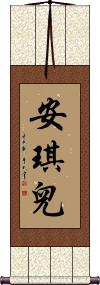
安琪兒 is the most common transliteration to Mandarin Chinese for the name Angel.
It is supposed to sound like Angel but to be honest, this one misses the mark.
I would go with the meaning of Angel if I were you.
Angel
(Name - Version 2)
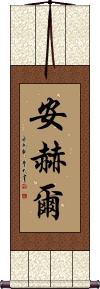
安赫爾 is another common transliteration to Mandarin Chinese for the name Angel.
This one misses the mark too - It uses a hard “H” sound to simulate the “J” sound of the “G” in this name. I don't know who transliterated these first and how it became the standard.
Again, I recommend using the meaning of Angel above.
If anything, this is the more masculine form of Angel. This is also the form commonly used for the masculine Latin name Ángel.
Mark the boat to find the lost sword / Ignoring the changing circumstances of the world
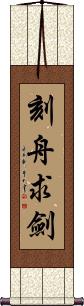
刻舟求劍 is an originally-Chinese proverb that serves as a warning to people that things are always in a state of change.
Thus, you must consider that and not depend on the old ways or a way that may have worked in the past but is no longer valid.
This idiom/proverb comes from the following story:
A man was traveling in a ferry boat across a river. With him, he carried a treasured sword. Along the way, the man became overwhelmed and intoxicated by the beautiful view and accidentally dropped his prized sword into the river. Thinking quickly, he pulled out a knife and marked on the rail of the boat where exactly he had lost his sword.
When the boat arrived on the other side of the river, the man jumped out of the boat and searched for his sword right under where he'd made the mark. Of course, the boat had moved a great distance since he made the mark, and thus, he could not find the sword.
While this man may seem foolhardy, we must take a great lesson from this parable: Circumstances change, so one should use methods to handle the change. In modern China, this is used in business to mean that one should not depend on old business models for a changing market.
50th Golden Wedding Anniversary
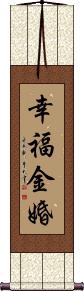
幸福金婚 means “Happy Golden Anniversary” and is a great gift for a couple who is celebrating 50 years together.
The first two characters mean happy, blessed, or happiness.
The last two characters mean “couple's golden anniversary.” It means “golden wedding” or “golden marriage,” but this is only used for the 50-year-mark of a marriage (the same way we use gold to represent 50 years in the west).
幸福金婚 is a nice title to use with an inscription. You could request something like, “Happy 50th Anniversary, Mr. and Mrs. Smith,” to be written down the side of this title in smaller Chinese characters.
Inspiration
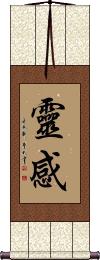
靈感 is the Chinese word closest to hitting the mark for the English word inspiration.
In a more extended context, I have even seen this translated as “brain wave.”
The first character means alert, departed soul, efficacious, quick, effective, or intelligent.
The second character means to feel, to move, to touch, or to affect.
The combined meaning of these two characters changes a bit, but I think it's nice to know the individual meanings to give you a better understanding of where a word comes from.
You could describe this word as “the thought that pops into your head just before you patent the greatest widget ever invented that everyone in the world will want.”
At least, that's the idea.
This term can also mean “intelligent thought” if you translate it directly from each character. If you are looking for inspiration or need to be inspired, this is the word for you.
Mark
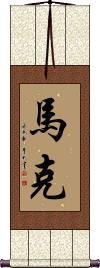
馬克 is the name Mark in Chinese (Mandarin).
Mark-Anthony
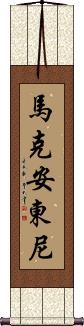
馬克安東尼 is the name Mark-Anthony in Chinese (Mandarin).
Mark
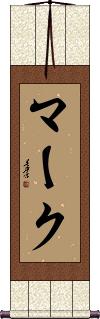
This is the most commonly used version of the name Mark in Japanese.
Note: Because this title is entirely Japanese Katakana, it should be written by a Japanese calligrapher.
Mark
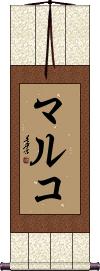
マルコ is another way to write Mark in Katakana (phonetic Japanese).
This is often the way the book of Mark is written when referring to the Japanese Bible. This version is also sometimes used for the name Marco.
Note: Because this title is entirely Japanese Katakana, it should be written by a Japanese calligrapher.
Mark-Anthony
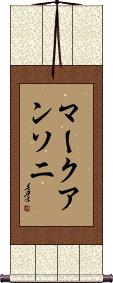
This is the compound name Mark-Anthony in Japanese.
Note: Because this title is entirely Japanese Katakana, it should be written by a Japanese calligrapher.
One
The number one
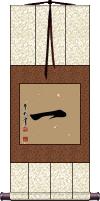
一 is “one” or “1” in Chinese, Japanese Kanji, and old Korean Hanja.
People keep searching for “one” but I'm not sure what you want. This would be a strange selection for a wall scroll, so please don't order it. Post a request on our forum if you want a phrase with “one” in it that you can't find on our site.
The “one” character is really simple, it's just one stroke. Two is two strokes and three is three strokes, from four and above, the characters get more complicated.
In some ways, the “one” character is too simple, it could be a stray mark, or added to a banking document. Therefore, the following banking anti-fraud character for “one” has developed over the last 1500 years in China and Japan:


Remember
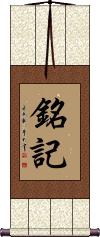
銘記 means to keep in mind, to take note of, or simply to remember, in Chinese characters and Japanese Kanji.
The first character means to engrave, inscribe, or carve an inscription.
The second character means to remember, note, mark, sign, record, history, chronicle, or annals.
When used in the context of a person, this means to engrave on the heart or to inscribe a memory in one's mind. In short, it's the idea of deeply remembering something, some event, or someone forever.
Tai Chi Chuan / Tai Ji Quan
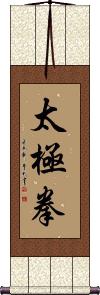
太極拳 is the famous Taoist meditation and martial art exercise. The direct translation of these characters would be something like “grand ultimate fist,” but that does not quite hit the mark for what this title really means.
An early-morning walk through any city in China near a park or an open area will yield a view of Chinese people practicing this ancient technique.
A typical scene is an old man of no less than 80 years on this earth, with a wispy white beard and perhaps a sword in one hand. He makes slow moves that are impossibly smooth. He is steady-footed and always in balance. For him, time is meaningless and proper form, and technique is far more important than speed.
For the younger generation, faster moves may look impressive and seem smooth to the casual observer. But more discipline and mental strength are needed to create perfectly smooth moves in virtual slow motion.
Note: There are two ways to Romanize these Chinese characters, as seen in the title above. The pronunciation and actual characters are the same in Chinese. If you really used English sounds/words to pronounce this, it would be something like “tie jee chew-on” (make the “chew-on” one flowing syllable).
The two most important days in your life...
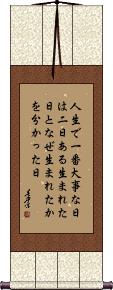
人生で一番大事な日は二日ある。生まれた日と、なぜ生まれたかを分かった日 is Mark Twain's quote, “The two most important days in your life are the day you are born and the day you find out why” in Japanese.
Note: Because this selection contains some special Japanese Hiragana characters, it should be written by a Japanese calligrapher.
This in-stock artwork might be what you are looking for, and ships right away...
Gallery Price: $51.00
Your Price: $28.00
Gallery Price: $58.00
Your Price: $32.00
Gallery Price: $45.00
Your Price: $25.00
The following table may be helpful for those studying Chinese or Japanese...
| Title | Characters | Romaji (Romanized Japanese) | Various forms of Romanized Chinese | |
| Angel | 安琪兒 安琪儿 | ān qí ér an1 qi2 er2 an qi er anqier | an ch`i erh anchierh an chi erh |
|
| Angel | 安赫爾 安赫尔 | ān hè ěr an1 he4 er3 an he er anheer | an ho erh anhoerh |
|
| Mark the boat to find the lost sword Ignoring the changing circumstances of the world | 刻舟求劍 刻舟求剑 | kokushuukyuuken kokushukyuken | kè zhōu qiú jiàn ke4 zhou1 qiu2 jian4 ke zhou qiu jian kezhouqiujian | k`o chou ch`iu chien kochouchiuchien ko chou chiu chien |
| 50th Golden Wedding Anniversary | 幸福金婚 / 倖福金婚 幸福金婚 | kou fuku kin kon koufukukinkon ko fuku kin kon | xìng fú jīn hūn xing4 fu2 jin1 hun1 xing fu jin hun xingfujinhun | hsing fu chin hun hsingfuchinhun |
| Inspiration | 靈感 灵感 | reikan | líng gǎn / ling2 gan3 / ling gan / linggan | ling kan / lingkan |
| Mark | 馬克 马克 | mǎ kè / ma3 ke4 / ma ke / make | ma k`o / mako / ma ko | |
| Mark-Anthony | 馬克安東尼 马克安东尼 | mǎ kè ān dōng ní ma3 ke4 an1 dong1 ni1 ma ke an dong ni makeandongni | ma k`o an tung ni makoantungni ma ko an tung ni |
|
| Mark | マーク | maaku / maku | ||
| Mark | マルコ | maruko | ||
| Mark-Anthony | マーク アンソニ | maaku ansoni maakuansoni maku ansoni | ||
| One | 一 | ichi | yī / yi1 / yi | i |
| Remember | 銘記 | mei ki / meiki | míng jì / ming2 ji4 / ming ji / mingji | ming chi / mingchi |
| Tai Chi Chuan Tai Ji Quan | 太極拳 太极拳 | tai kyoku ken taikyokuken | tài jí quán tai4 ji2 quan2 tai ji quan taijiquan | t`ai chi ch`üan taichichüan tai chi chüan |
| The two most important days in your life... | 人生で一番大事な日は二日ある生まれた日となぜ生まれたかを分かった日 | Jinsei de ichiban daijina hi wa futsuka aru. Umaretahi to, naze umareta ka o wakatta hi | ||
| In some entries above you will see that characters have different versions above and below a line. In these cases, the characters above the line are Traditional Chinese, while the ones below are Simplified Chinese. | ||||




