Custom Mercy Chinese & Japanese Calligraphy Wall Scroll
We have many options to create artwork with Mercy characters on a wall scroll or portrait.
If you want to create a cool Mercy wall scroll, this is the place. Below you will find a few Asian symbols that express the idea of mercy.
2. Mercy / Compassion / Buddhist Loving Kindness
3. Fire and Water Have No Mercy
4. Goddess of Mercy and Compassion
5. No Mercy
6. Benevolence
8. Buddha Heart / Mind of Buddha
9. Charity
10. Compassionate Heart / Benevolent Heart
11. Forgiveness
13. Grace from Heaven / Grace from God
14. Guan Shi Yin: Protector Of Life
15. Kindness and Forgiving Nature
16. Loving-Kindness Conquers All
17. Namu Amida Butsu
Mercy / Compassion / Love
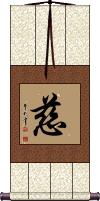
慈 is the simplest way to express the idea of compassion.
This can also mean love for your fellow humans, humanity, or living creatures. Sometimes this is extended to mean charity.
This term is often used in a Buddhist or Christian context. The concept was also spoken of by Laozi (Lao Tzu) in the Dao De Jing (Tao Te Ching).
慈 is considered the direct translation of the Sanskrit word मैत्री (maitrī) Pali word मेत्ता (mettā). In this context, it means benevolence, loving kindness, and goodwill.
This Chinese character is understood in Japanese but is usually used in compound words (not seen alone). Also used in old Korean Hanja, so it's very universal.
See Also: Benevolence | Forgiveness | Kindness
Mercy / Compassion / Buddhist Loving Kindness
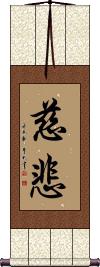
Besides the title above, 慈悲 can also be defined as clemency or lenience and sometimes the act of giving charity.
In the Buddhist context, it can be defined as “benevolence,” “loving-kindness and compassion,” or “mercy and compassion.”
This Buddhist virtue is perhaps the most important to employ in your life. All sentient beings that you encounter should be given your loving kindness. And trust me, however much you can give, it comes back. Make your life and the world a better place!
This Chinese/Japanese Buddhist term is the equivalent of Metta Karuna from Pali or Maitri Karuna from Sanskrit.
慈 can mean loving-kindness by itself.
悲 adds a component of sorrow, empathy, compassion, and sympathy for others.
See Also: Benevolence
Fire and Water Have No Mercy
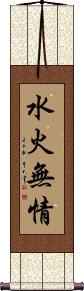
水火無情 is a Chinese proverb that means “fire [and] water have-not mercy.”
This serves to remind us that the forces of nature are beyond human control.
Some may also translate this as “implacable fate.”
Goddess of Mercy and Compassion
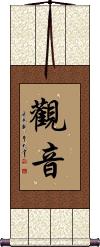
觀音/観音 is the Buddhist deity known as the Goddess of Mercy or Bodhisattva of Compassion.
In Chinese, the proper name of this being is Guan Yin. There is some debate as to whether Guan Yin is female. The argument comes from some scripture that suggests Buddhist deities take on the male form. Others say that Guan Yin has no sex. And still, others are okay with the female representation of Guan Yin.
This bodhisattva is also known or Romanized in the following ways:
Mandarin Chinese: Guan Yin, Kuan Yin, Kwan Yin.
Japanese: Kannon, Kwannon.
Sanskrit: Bodhisattva Avalokitesvara.
Korean: Gwan-eum.
Vietnamese: Quan Âm.
Thai: Kuan Eim.
English: Bodhisattva of Mercy and Salvation, Goddess of Compassion, Buddha of Mercy, et al.
Note: The first character has a slight variation in Japanese. If your audience is specifically Japanese, you may want to select that version.
See Also: Buddhism | Goddess | Namo Amitabha | Bodhisattva
Goddess of Mercy and Compassion
This is the long or more formal version of this title
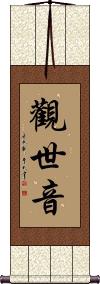
觀世音 is the longer and perhaps more formal title for the Buddhist deity known as the Goddess of Mercy or Bodhisattva of Compassion.
The longer title of this bodhisattva is Romanized in the following ways:
Mandarin Chinese: Guanshi Yin, Kuan-shih Yin.
Japanese: Kanzeon.
Sanskrit: Bodhisattva Avalokitesvara.
Korean: Gwan-se-eum.
Vietnamese: Quan Thế Âm.
Thai: Prah Mae Kuan Eim.
English: Bodhisattva of Mercy and Salvation, Goddess of Compassion, Buddha of Mercy, et al.
Please view our more common and shorter version, “Guan Yin” before you make a decision. Also, note that the first character has a slight variation in Japanese. If your audience is specifically Japanese, you may want to select that version.
No Mercy
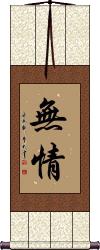
無情 is a terrible phrase for a calligraphy wall scroll. I'm not even sure any of my calligraphers will write this. It's just that many people have searched my website for “no mercy.”
This word means pitiless, ruthless, merciless, heartless, heartlessness, hardness, cruelty, or ruthless.
In the context of Buddhism, this is used to describe something or someone that is non-sentient (inhuman or without feeling).
Benevolence
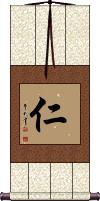
Beyond benevolence, 仁 can also be defined as “charity” or “mercy” depending on context.
The deeper meaning suggests that one should pay alms to the poor, care for those in trouble, and take care of his fellow man (or woman).
仁 is one of the five tenets of Confucius. In fact, it is a subject that Confucius spent a great deal of time explaining to his disciples.
I have also seen this benevolent-related word translated as perfect virtue, selflessness, love for humanity, humaneness, goodness, goodwill, or simply “love” in the non-romantic form.
This is also a virtue of the Samurai Warrior
See our page with just Code of the Samurai / Bushido here
Kindness / Benevolence
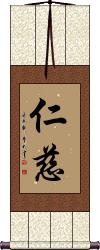
仁慈 word is used in Chinese, Korean, Japanese, and Asian Buddhism to relay the important idea of loving kindness.
仁慈 can also be defined as: benevolent; charitable; kind; merciful; kind-hearted; benevolence; kindness; humanity; mercy.
In Japanese, this can also be the given name Hitoji. This would also be a good Mandarin Chinese given name romanized as Jentzu (in Taiwan) or Renci (which sounds like ren-tsuh).
Buddha Heart / Mind of Buddha
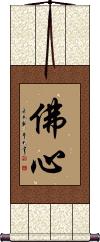
佛心 means the Buddha's mind, Buddha-heart, or the spiritually enlightened heart/mind.
The Buddha Heart is detached from good and evil and other such constructs. The Buddha Heart has mercy, compassion, and loving-kindness for all sentient life, the good, the wicked, and all in between.
The heart and mind (心) are the same concepts in the ancient Orient, so you can use heart and mind interchangeably in this context.
Charity
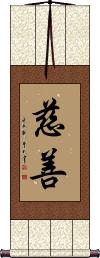
There are a few different words used to express charity in Chinese characters, Japanese Kanji and old Korean Hanja but 慈善 is the most common.
Some of the other words describe acts such as “giving alms” etc.
Note: Sometimes this is translated as benevolence or benevolent.
Also, this considered to be one of the Seven Heavenly Virtues.
If you need a different meaning, just contact me.
See Also: Benevolence | Altruism
Compassionate Heart / Benevolent Heart
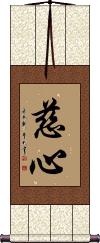
慈心 means “Compassionate Heart” or “Benevolent Heart.”
It's used in day-to-day speech to refer to someone who has the traits of benevolence, mercy, and compassion for their fellow humans.
This title is also used in Buddhism with the same profound meaning.
Forgiveness (from the top down)
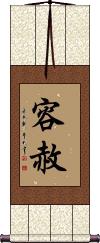
容赦 is the kind of forgiveness that a king might give to his subjects for crimes or wrong-doings.
容赦 is a rather high-level forgiveness. Meaning that it goes from a higher level to a lower (not the reverse).
Alone, the first character can mean “to bear,” “to allow,” and/or “to tolerate,” and the second can mean “to forgive,” “to pardon,” and/or “to excuse.”
When you put both characters together, you get forgiveness, pardon, mercy, leniency, or going easy (on someone).
See Also: Benevolence
Forgiveness
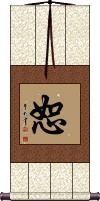
恕 means to forgive, show mercy, absolve, or excuse in Chinese and Korean Hanja (though mostly used in compound words in Korean).
恕 incorporates the pictogram of a heart at the bottom, and a woman and a mouth at the top. The heart portion has the most significance, as it is suggested that it is the heart's nature to forgive.
In Asian culture, as with most other cultures, forgiveness is an act of benevolence and altruism. In forgiving, you put yourself in someone else's shoes and show them the kindness that you would want them to show you. Confucius referred to this quality as “human-heartedness.”
Goddess of Compassion
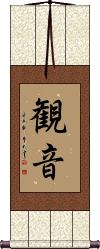
観音 is the specifically Japanese version of Bodhisattva of Compassion or Guan Yin.
In Japanese, this is pronounced Kannon and occasionally spelled Kwannon. The Chinese version is a bit more commonly seen in Asia. However, in Japanese, there is a slight variation with the first character.
Some time ago, a camera company in Japan named their company after this Buddhist deity. That camera company is still known as Canon (they chose a “C” instead of a “K” when they Romanized this name).
Goddess of Compassion
Long or more formal Japanese version of this title
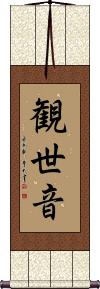
観世音 is the more extended and more formal Japanese version of Bodhisattva of Compassion or Guan Yin.
In Japanese, this is pronounced Kanzeon. The Chinese version is a bit more common in Asia, but in Japanese, they use a slight variation of the first character. Choose this version only if your intended audience is specifically Japanese.
Grace from Heaven / Grace from God
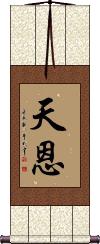
天恩 is the deepest way to say “Heaven's Grace” or “God's Grace” in Chinese.
The first character means Heaven or sky (referring, in this case, to the domain of God).
The second character means grace, blessings, benevolence, favor/favour, acts of kindness, merits, or beneficial influence.
This title can also be defined as:
Blessings of Heaven, Favor of the Emperor, Divination's luckiest day, or blessings of nature. Note: When you see “Emperor” above, remember that the Emperor, like the Pope, is theoretically chosen by God or seen as an emissary or conduit of God in ancient Asian culture. It would only be read that way in a certain context, such as “The Emperor, in his mercy, bestowed upon him Heaven's Grace, and the prisoner was set free.”
Note: Technically, this is a Japanese word too (pronounced "ten-on") but it’s rarely used in Japan anymore. Therefore, this title is best if your audience is Chinese.
Guan Shi Yin: Protector Of Life
觀世音 is an alternate title for Guanyin, the Bodhisattva of Compassion or Goddess of Mercy.
觀世音 is the Buddhist bestower of children, the protector of life and all in distress (especially of those at sea).
Kindness and Forgiving Nature
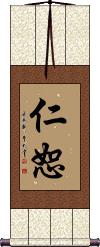
仁恕 is a word in Chinese and Japanese that means something like benevolence with magnanimity or kindness with a forgiving nature.
If this describes you, then you are the type of person that I would like to call my friend.
This may not be the most common word in daily use, but it's old enough that it transcended cultures from China to Japan in the 5th century when Japan lacked a written language and absorbed Chinese characters and words into their language.
Note: 仁恕 is not commonly used in Korean.
Loving-Kindness Conquers All
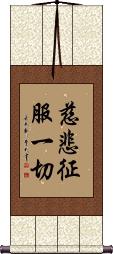
慈悲征服一切 is a way to express the idea that mercy, compassion, and loving-kindness can overcome all things.
This phrase is composed of 3 Chinese words:
慈悲 = loving-kindness; mercy; compassion; benevolence. It's used in Buddhism a lot to express the idea of how one should treat everyone else and all living beings.
征服 = to conquer; to subdue; to vanquish; to overcome.
一切 = all; everything; the whole; lock, stock, and barrel; without exception.
Namu Amida Butsu
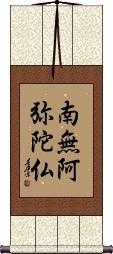
南無阿弥陀仏 is the modern Japanese version of “Namu Amida Butsu” or “The Compassionate Amitabha Buddha.”
Some will translate this as “I sincerely believe in Amitabha; Lord have mercy on me.”
This phrase especially applies to Japanese Pure Land Buddhists.
There is a universal version using ancient characters (with more strokes) for the 4th and last characters. That version is also used in Chinese, Korean, and occasionally Vietnamese.
This is used to pay homage to Amitabha Buddha.
See Also: Bodhisattva | Buddhism | Nirvana
Merciful Heart / The Light from a Buddha Mind
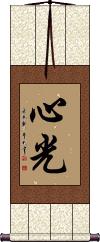
心光 can mean the light from a Buddha's mind or “merciful heart.”
This would especially be the light emanating from Amitābha.
Note that the character 心 can mean mind or heart. 光 means light or brightness - but in this context can suggest a glow of mercy or compassion.
This can also be a Japanese surname that is romanized as Shinkou or Shinko.
This in-stock artwork might be what you are looking for, and ships right away...
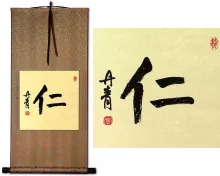
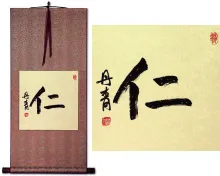
The following table may be helpful for those studying Chinese or Japanese...
| Title | Characters | Romaji (Romanized Japanese) | Various forms of Romanized Chinese | |
| Mercy Compassion Love | 慈 | ji | cí / ci2 / ci | tz`u / tzu |
| Mercy Compassion Buddhist Loving Kindness | 慈悲 | ji hi / jihi | cí bēi / ci2 bei1 / ci bei / cibei | tz`u pei / tzupei / tzu pei |
| Fire and Water Have No Mercy | 水火無情 水火无情 | shuǐ huǒ wú qíng shui3 huo3 wu2 qing2 shui huo wu qing shuihuowuqing | shui huo wu ch`ing shuihuowuching shui huo wu ching |
|
| Goddess of Mercy and Compassion | 觀音 / 観音 观音 | kan non / kannon | guān yīn / guan1 yin1 / guan yin / guanyin | kuan yin / kuanyin |
| Goddess of Mercy and Compassion | 觀世音 观世音 | guān shì yīn guan1 shi4 yin1 guan shi yin guanshiyin | kuan shih yin kuanshihyin |
|
| No Mercy | 無情 无情 | mujou / mujo | wú qíng / wu2 qing2 / wu qing / wuqing | wu ch`ing / wuching / wu ching |
| Benevolence | 仁 | jin | rén / ren2 / ren | jen |
| Kindness Benevolence | 仁慈 | jin ji / jinji | rén cí / ren2 ci2 / ren ci / renci | jen tz`u / jentzu / jen tzu |
| Buddha Heart Mind of Buddha | 佛心 | busshin / bushin | fó xīn / fo2 xin1 / fo xin / foxin | fo hsin / fohsin |
| Charity | 慈善 | ji zen / jizen | cí shàn / ci2 shan4 / ci shan / cishan | tz`u shan / tzushan / tzu shan |
| Compassionate Heart Benevolent Heart | 慈心 | jishin | cí xīn / ci2 xin1 / ci xin / cixin | tz`u hsin / tzuhsin / tzu hsin |
| Forgiveness (from the top down) | 容赦 | you sha / yousha / yo sha | róng shè / rong2 she4 / rong she / rongshe | jung she / jungshe |
| Forgiveness | 恕 | shù / shu4 / shu | ||
| Goddess of Compassion | 観音 | kan non / kannon | guān yīn / guan1 yin1 / guan yin / guanyin | kuan yin / kuanyin |
| Goddess of Compassion | 観世音 | kan ze on / kanzeon | guān shì yīn guan1 shi4 yin1 guan shi yin guanshiyin | kuan shih yin kuanshihyin |
| Grace from Heaven Grace from God | 天恩 | tiān ēn / tian1 en1 / tian en / tianen | t`ien en / tienen / tien en | |
| Guan Shi Yin: Protector Of Life | 觀世音 观世音 | kanzeon | guān shì yīn guan1 shi4 yin1 guan shi yin guanshiyin | kuan shih yin kuanshihyin |
| Kindness and Forgiving Nature | 仁恕 | jinjo | rén shù / ren2 shu4 / ren shu / renshu | jen shu / jenshu |
| Loving-Kindness Conquers All | 慈悲征服一切 | cí bēi zhēng fú yī qiè ci2 bei1 zheng1 fu2 yi1 qie4 ci bei zheng fu yi qie cibeizhengfuyiqie | tz`u pei cheng fu i ch`ieh tzupeichengfuichieh tzu pei cheng fu i chieh |
|
| Namu Amida Butsu | 南無阿弥陀仏 | namu amida butsu namuamidabutsu | ||
| Merciful Heart The Light from a Buddha Mind | 心光 | shin kou / shinkou / shin ko | xīn guāng xin1 guang1 xin guang xinguang | hsin kuang hsinkuang |
| In some entries above you will see that characters have different versions above and below a line. In these cases, the characters above the line are Traditional Chinese, while the ones below are Simplified Chinese. | ||||




