Buy a Mind Chinese/Japanese Calligraphy Wall Scroll
We have many options to create artwork with the Chinese characters / Asian symbols / Japanese Kanji for Mind on a wall scroll or portrait.
See also: Heart, Spirit and/or Soul.
1. Beautiful Heart / Beautiful Mind
4. Bodhicitta: Enlightened Mind
8. Buddha Heart / Mind of Buddha
11. Heijoshin / Presence of Mind
12. Immovable Mind
13. Seeking Mind
14. The Nature of Enlightenment in One's Mind
15. Resolute Mind
16. Lingering Mind
18. Be Master of Mind, Not Mastered by Mind
19. Merciful Heart / The Light from a Buddha Mind
20. Mind Body Spirit
21. Mind Over Matter
23. Mind’s Eye
24. Mind Like Water
25. Morality of Mind
26. No Mind / Mushin
27. One Heart / One Mind / Heart and Soul
28. One Mind / Unity
30. Open Mind
31. An Open Book Benefits Your Mind
33. Patience Brings Peace of Mind
34. Patience Yields Peace of Mind
35. Peace of Mind
36. Peaceful Heart / Peace of Mind / Calm Mind
38. Presence of Mind
39. Prideful Mind / Self-Respecting Heart
40. Purity of Mind
44. Truth Flashed Through The Mind
45. Tsuki no Kokoro / Mind like the Moon
46. A Wise Man Changes His Mind
47. Work Together with One Mind
48. Alert / On Guard / Lingering Mind
50. Immovable Mind Way / Fudoshin Way
51. Immovable Mind Hall / Fudoshin Dojo
52. Beautiful Heart / Beautiful Spirit
53. Good Heart
54. To a Willing Heart, All Things Are Possible
55. Determination
57. Exercise
58. Inner Peace
59. Martial Morality / Martial Arts Ethics / Virtue
60. Energy Sword Body in Concert
61. Morality of Deed
62. Spirit
Beautiful Heart / Beautiful Mind
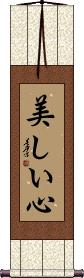
美しい心 means “beautiful heart” or “beautiful mind,” in Japanese.
The word for “heart” also means “mind” and sometimes “soul” in ancient Asia.
Note: Because this selection contains some special Japanese Hiragana characters, it should be written by a Japanese calligrapher.
Beautiful Mind
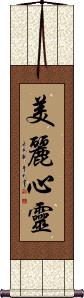
美麗心靈 means “Beautiful Mind” in Chinese.
美麗心靈 is also the Chinese title of the 2001 movie of the same name.
Mind of the Beginner
Shoshin
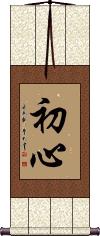
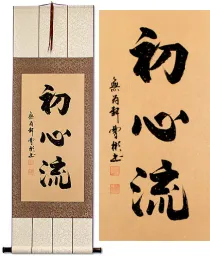
初心 is often translated in Japanese as “beginner's mind” or “beginner's spirit.”
In Chinese, the dictionary definition is “one's original intention.”
The first character means first, initial, primary, junior, beginning, or basic.
The second character means heart, mind, soul, or essence.
初心 is one of the five spirits of the warrior (budo) and is often used as a Japanese martial arts tenet. Under that context, places such as the Budo Dojo define it this way: The state of shoshin is that of a beginners mind. It is a state of awareness that always remains fully conscious, aware, and prepared to see things for the first time. The attitude of shoshin is essential to continued learning.
Bodhicitta: Enlightened Mind
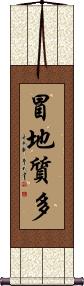
冒地質多 is a Chinese and Japanese way to write Bodhicitta.
冒地質多 is often translated as “the enlightened mind” or “enlightened heart.”
This title is strictly Buddhist and won't make sense to Chinese or Japanese people who do not have an expansive background in Buddhist terms, concepts, and scripture.
The Bodhi Mind
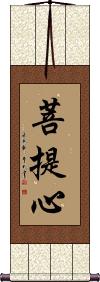
菩提心 means Bodhi-mind or Bodhi-heart.
This title represents the will to realize supreme enlightenment. The awakening of the Bodhi-mind is of utmost importance in Buddhist training.
Other definitions include the mind for or of bodhi, the awakened, enlightened mind, or having Buddha-nature.
Body and Mind
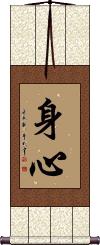
身心 means “body and mind” or “mental and physical” in Chinese and Japanese.
In the Buddhist context, body and mind encompass the five elements (skandha) of a sentient being.
The body is the physical material (rūpa) of life. The mind embraces the other four skandhas, which are consciousness, perception, action, and knowledge.
Body Mind Spirit
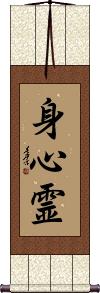
身心霊 means “body mind spirit” in Japanese.
This refers to your physical, mental, and spiritual presence.
This can also be translated as “body heart spirit” as 心 can mean mind or heart.
Note that this is a "word list" and not a proper phrase (with a subject, verb, and object) nor a typical title in Japanese. So it's not too commonly seen in Japan. However, the term 身心霊整合性医療 that refers to holistic medicine is gaining popularity.
Buddha Heart / Mind of Buddha
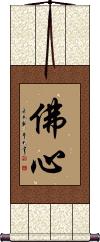
佛心 means the Buddha's mind, Buddha-heart, or the spiritually enlightened heart/mind.
The Buddha Heart is detached from good and evil and other such constructs. The Buddha Heart has mercy, compassion, and loving-kindness for all sentient life, the good, the wicked, and all in between.
The heart and mind (心) are the same concepts in the ancient Orient, so you can use heart and mind interchangeably in this context.
Calm and Open Mind
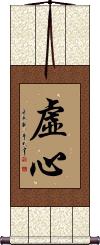
虛心 is a Buddhist term that speaks of being open-minded and/or having a calm and humble mind or heart.
Heart / Mind / Spirit
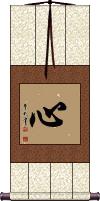
心 would often be translated as “heart.”
However, because it was believed in Chinese culture for thousands of years that your consciousness and thoughts came from the big red organ in the middle of your chest, it also means “mind” or “spirit” and sometimes even “soul.”
In Korean, beyond heart, mind, and spirit, this character can mean moral, nature, mind, affections, intentions, core, and center. In fact, it is used in Chinese to mean “center” as well but only with another character in front of it. For instance, “medical center” or even “shopping center.” Separately and alone, it will not be read with that “center” meaning unless thought of as “the center of your soul.”
Heijoshin / Presence of Mind
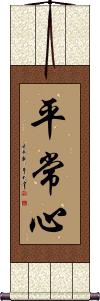
平常心 is the title Heijoshin, as associated with Kendo and Aikido schools of Japanese martial arts.
平常心 is also a word in Japanese that can be translated as “one's self-possession” or “presence of mind.”
In Chinese and Korean, this means “simplicity heart,” “composure,” “calmness,” or a “sense of orderliness.” In Chinese and Korean, this implies that you enjoy what you have, keep your heart in balance, and have no over-blown ambitions.
Immovable Mind
fudoshin
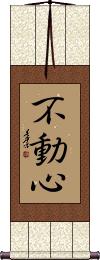
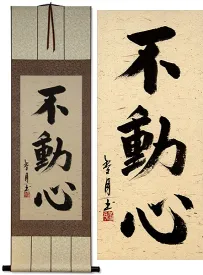
不動心 is one of the five spirits of the warrior (budo) and is often used as a Japanese martial arts tenet.
Under that context, places such as the Budo Dojo define it this way: An unshakable mind and an immovable spirit is the state of fudoshin. It is courage and stability displayed both mentally and physically. Rather than indicating rigidity and inflexibility, fudoshin describes a condition that is not easily upset by internal thoughts or external forces. It is capable of receiving a strong attack while retaining composure and balance. It receives and yields lightly, grounds to the earth, and reflects aggression back to the source.
Other translations of this title include unwavering mind, immovable mind, unwavering composure, imperturbability, steadfastness, keeping a cool head in an emergency, or keeping one's calm (during a fight).
The first two Kanji alone mean immobility, firmness, fixed, steadfastness, motionless, and idle.
The last Kanji means heart, mind, soul, or essence.
Together, these three Kanji create a title defined as “immovable mind” within the context of Japanese martial arts. However, in Chinese, it would mean “motionless heart,” and in Korean Hanja, “wafting heart” or “floating heart.”
Seeking Mind
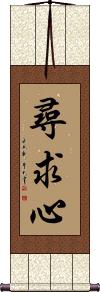
尋求心 means seeking mind or discursive thought in the context of Buddhism.
The first two characters are a word that means “to seek” or “to look for.” The last character means mind (or heart).
The Nature of Enlightenment in One's Mind
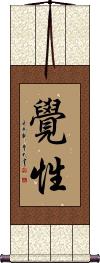
覺性 represents “The enlightened mind free from all illusion,” “The nature of enlightenment in one's mind,” or “The Buddha-nature.”
To reach this “enlightened nature,” one must form their mind into and utilize their mind as the agent of knowledge, or enlightenment.
Resolute Mind
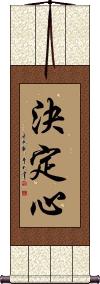
決定心 means the mind of certainty, resolute mind, imperturbable mind, firm determination, firm resolution, or stable commitment.
In the context of Buddhism, this is the deep resolution needed to attain enlightenment.
If you go to a deeper meaning, this is a condition of settling into the thought that occurs in the process of perception subsequent to the “seeking mind” or “尋求心.”
Lingering Mind
Zanshin
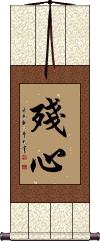
First off, 殘心 should only be used in the context of Japanese martial arts. In Chinese, it's a rather sad title (like a broken heart). In Chinese, the first character alone means destroyed, spoiled, ruined, injured, cruel, oppressive, savage, incomplete, or disabled. However, in Japanese, it's remainder, leftover, balance, or lingering.
The second character means heart, mind, soul, or essence in both languages.
殘心 is one of the five spirits of the warrior (budo) and is often used as a Japanese martial arts tenet. Under that context, places such as the Budo Dojo define it this way: The spirit of zanshin is the state of the remaining or lingering spirit. It is often described as a sustained and heightened state of awareness and mental follow-through. However, true zanshin is a state of focus or concentration before, during, and after the execution of a technique, where a link or connection between uke and nage is preserved. Zanshin is the state of mind that allows us to stay spiritually connected, not only to a single attacker but to multiple attackers and even an entire context; a space, a time, an event.
 In modern Japan (and Simplified Chinese), they use a different version of the first character, as seen to the right. Click on this character to the right instead of the button above if you want this modern Japanese version of lingering mind / zanshin.
Listen with Open Mind
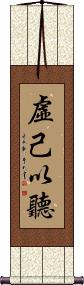
虛己以聽 is a Chinese proverb that means to listen to the ideas of others with an open mind.
Be Master of Mind, Not Mastered by Mind
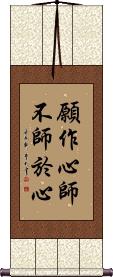
願作心師不師於心 means, “Be master of mind, rather than mastered by mind,” in Chinese.
This is not an ancient Chinese phrase but rather something we added at the request of a customer.
Merciful Heart / The Light from a Buddha Mind
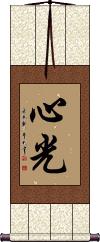
心光 can mean the light from a Buddha's mind or “merciful heart.”
This would especially be the light emanating from Amitābha.
Note that the character 心 can mean mind or heart. 光 means light or brightness - but in this context can suggest a glow of mercy or compassion.
This can also be a Japanese surname that is romanized as Shinkou or Shinko.
Mind Body Spirit
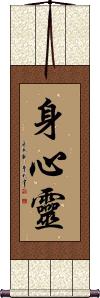
身心靈 is probably the best way to express the idea of “Body, Mind, and Spirit” in Chinese and old Korean Hanja. We are actually using the word “heart” here because, for thousands of years, the heart was thought to be the place where your thoughts, feelings, and emotions came from. We do something similar in the west when we say “warm-hearted” or “I love you with all of my heart.” In this context, heart = mind in Asian language and culture.
The very literal translation of these three characters is “body, heart & spirit,” which could also be interpreted as “body, mind & soul.”
We have arranged these characters in this order because it simply “feels” like the proper order in the Chinese language. Word lists like this are not so common for calligraphy artwork, so we must be careful to put them in the most natural order. It should be noted that this is not a common title in Asia, nor is it considered an actual phrase (as it lacks a clear subject, verb, and object).
 In Japanese Kanji, they use an alternate form of the character for soul or spirit. If you want this using the Japanese alternate, please click on the Kanji shown to the right instead of the button above.
Japanese disclaimer: This is not a natural phrase/list in Japanese. While not totally-natural in Chinese, this word list is best if your audience is Chinese.
Mind Over Matter
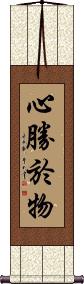
心勝於物 is how to write, “mind over matter” in Chinese.
Mind Over Matter
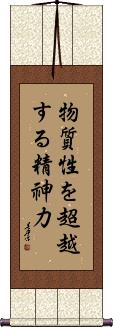
物質性を超越する精神力 means “mind over matter,” in Japanese.
If you get really technical, you get a translation like, “mental strength transcends materiality.”
Note: Because this selection contains some special Japanese Hiragana characters, it should be written by a Japanese calligrapher.
Mind Your Own Business
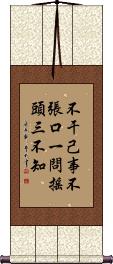
不干己事不张口一问摇头三不知 literally translates as [About] matters [that] don't concern [you], do not open [your] mouth, [and] when questioned, always shake [your] head “No.”
Figuratively, this means: It is best to remain reticent about other people's affairs and to refuse to make any comment on matters that don't concern you.
Mind Your Own Business
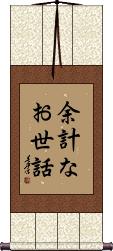
余計なお世話 suggests that you do not give unwanted help or advice to someone.
The Japanese characters break down this way:
余計 (yokei) too much, unnecessary, extraneous, abundance, surplus, excess, superfluity.
な (na) connecting article.
お世話 (osewa) help, aid, assistance.
Note: Because this selection contains some special Japanese Hiragana characters, it should be written by a Japanese calligrapher.
Mind’s Eye
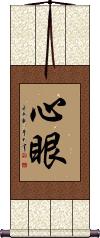
This means mind's eye.
Other definitions include: intention; conscience; consideration; the eye of the mind; mental vision.
Mind Like Water
Mizu No Kokoro
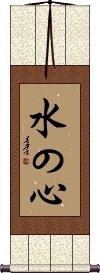
水の心 is the Japanese Buddhist and martial arts phrase, “Mizu no Kokoro,” which means “mind like water” or “heart of water.”
The phrase is a metaphor describing the pond that clearly reflects its surroundings when calm but whose images are obscured once a pebble is dropped into its waters.
Morality of Mind
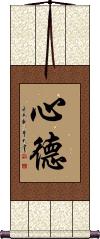
The idea of 心德 or “morality of mind” goes along with 行德 or “wu de” (martial morality or virtues of the warrior).
Here, the first character is a representation of your heart or mind.
The second character refers to morality or virtue.
This can also be translated as “morality of heart,” “virtue of heart,” or “virtue of the mind.”
Since ancient times in Asia, the idea of your mind (where your soul resides and your thought originates) has been associated with the heart. Just as in western culture, where we say “it comes from the heart” or “heartfelt emotions,” there is a belief that your heart and mind are one and the same (medical science now begs to differ).
See Also: Morality of Deed | Martial Morality
No Mind / Mushin
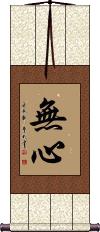
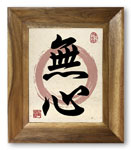
In Japanese, 無心 means innocent or without knowledge of good and evil. It literally means “without mind.”
無心 is one of the five spirits of the warrior (budo) and is often used as a Japanese martial arts tenet. Under that context, places such as the Budo Dojo define it this way: “No mind, a mind without ego. A mind like a mirror which reflects and dos not judge.” The original term was “mushin no shin,” meaning “mind of no mind.” It is a state of mind without fear, anger, or anxiety. Mushin is often described by the phrase “Mizu no Kokoro,” which means “mind like water.” The phrase is a metaphor describing the pond that clearly reflects its surroundings when calm but whose images are obscured once a pebble is dropped into its waters.
This has a good meaning in conjunction with Chan / Zen Buddhism in Japan. However, out of that context, it means mindlessness or absent-mindedness. To non-Buddhists in China, this is associated with doing something without thinking.
In Korean, this usually means indifference.
Use caution and know your audience before ordering this selection.
More info: Wikipedia: Mushin
One Heart / One Mind / Heart and Soul
Isshin
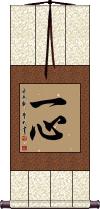
一心 can be translated as “one mind,” “single-minded focus,” or “wholehearted devotion,” from Chinese, Japanese Kanji, and old Korean Hanja.
Colloquially or figuratively, it means: wholeheartedly; heart and soul; of one mind; single-mindedness, wholeheartedness; one's whole heart; with the whole mind or heart; one mind in heart.
I'm not kidding, all of those came right from the dictionary for this one title.
In martial arts usage, this term emphasizes total commitment, where intent, attention, and action are unified without distraction.
In Japanese budō, it often conveys wholehearted dedication to practice or principle, whereas in Chinese usage it tends toward inner mental cultivation.
In Buddhism, this can refer to the bhūtatathatā, or the whole of things; the universe as one mind, or a spiritual unity.
In Japanese, this can be the female given name, Hitomi.
One Mind / Unity
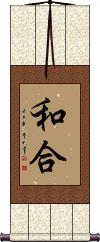
和合 means to blend, unite, or be of one mind.
和合 is usually used as a Buddhist term. It can also be defined as harmony, concord, agreement, unity, union, and harmonize/harmonization.
Open and Calm Mind
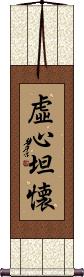
虛心坦懐 is a Japanese proverb that means “with an open and calm mind,” “with no preconceived notions,” or “without reservations.”
In some contexts, it can mean frank or candid.
If you want to remind yourself to approach each situation with no preconceptions, this is a good title for you. This can also refer to the ideas of being candid, frank, and straightforward.
Open Mind
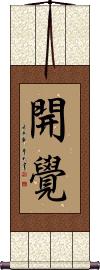
開覺 is a Buddhist term meaning “open mind.”
The more full definition as used in Buddhism is, “To arouse, awaken; to allow the original Buddha-nature to open and enlighten the mind.”
An Open Book Benefits Your Mind
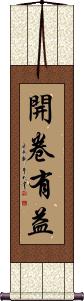
There are several ways to translate this ancient proverb. Translated literally and directly, it says, “Open roll has/yields benefit.”
To understand that, you must know a few things...
First, Chinese characters and language have deeper meanings that often are not spoken but are understood - especially with ancient texts like this. Example: It's understood that the “benefit” referred to in this proverb is to the reader's mind. Just the last character expresses that whole idea.
Second, Chinese proverbs are supposed to make you think and leave a bit of mystery to figure out.
Third, for this proverb, it should be noted that roll = book. When this proverb came about (about two thousand years ago), books were rolls of bamboo slips strung together. The first bound books like the ones we use today did not come about until about a thousand years after this proverb when they invented paper in China.
開卷有益 is a great gift for a bookworm who loves to read and increase their knowledge. Or for any friend that is or wants to be well-read.
Some other translations of this phrase:
Opening a book is profitable
The benefits of education.
The Original Mind
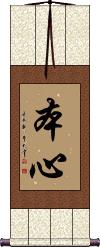
In Zen Buddhism, 本心 means “original mind” or “original heart,” which refers to one's Buddha-nature present from birth.
This can also be translated as true feelings, real intention, one's own heart, one's right mind, one's senses, one's conscience, or fundamental mind.
Note: 心 can mean heart or mind - thought in ancient Asia to be the same organ.
Patience Brings Peace of Mind
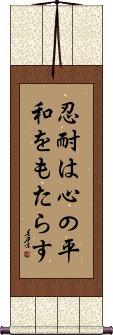
忍耐は心の平和をもたらす means “patience brings peace of mind,” in Japanese.
Note: Because this selection contains some special Japanese Hiragana characters, it should be written by a Japanese calligrapher.
Patience Yields Peace of Mind
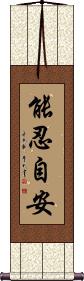
This ancient Chinese proverb can be translated as “Patience brings peace of mind,” “One who has patience finds peace,” and a few other ways.
Peace of Mind
(five-character version)
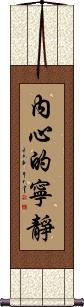
內心的寧靜 is the long way to express the idea of “peace of mind” in Chinese.
The first two characters mean heart or “innermost being.”
The middle character is a connecting modifier.
The last two characters mean peace, tranquility, or serenity.
Some may also translate this as “inner peace,” but I like our other inner-peace options for that idea.
This kind of makes sense in Korean but will have an archaic read - even by those who can understand Korean Hanja.
Peace of Mind
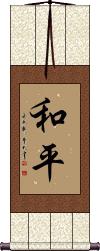
和平 is the Chinese order for these two characters, which means peace but can also be translated as amicability, specifically, or mildness. 和平 is often translated as a simple way to say “peace of mind.” This combination is used in Korean Hanja to mean “peace and harmony.”
Alone, the first character means peace and harmony.
The second character means balance when read by itself.
Note: 和平 are often seen in the opposite order in Japanese with the same meaning (You'll sometimes find them in this order in Japan, so either way is OK).
Peaceful Heart / Peace of Mind / Calm Mind
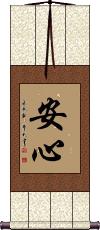
安心 can be defined as relief, peace of mind, feeling at ease, to be relieved, to set one's mind at rest, and easiness.
安心 is a nice word that encompasses great meanings within just two characters. Some of the other meanings include pacifying, settling the mind, and peace of mind. It's also the idea of feeling a sense of security, safety, and confidence in your state of well-being.
This can be used by everyone, but some consider it to be a Buddhist concept (You'll find it in your Zen dictionary).
Note: Can be romanized as Anshin or Anjin in Japanese.
Perfectly Sincere Mind
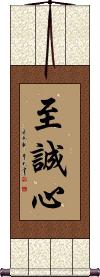
至誠心 is a Buddhist term that means “perfectly sincere mind” or “sincere and devoted heart.”
Presence of Mind
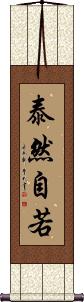
泰然自若 is a Chinese and Japanese proverb/word that means “cool and collected,” “showing no sign of nerves,” “perfectly composed,” “having the presence of mind,” “self-possessed,” “imperturbable,” and/or “calm and self-possessed.”
Presence of Mind
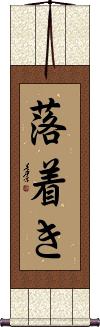
落着き is a Japanese word that means calmness, composure, presence of mind, stability, or steadiness.
Prideful Mind / Self-Respecting Heart
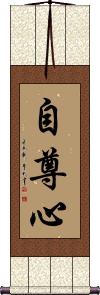
自尊心 is a Japanese and Korean word that means “pride” or “self-respect.”
The first Kanji/Hanja means oneself. The second can mean revered, valuable, precious, noble, or exalted. And the last Kanji/Hanja means heart, mind, and/or spirit.
While these characters make sense and hold the same general meaning in Chinese, this is not a normal Chinese word. This selection should only be used if your audience is Japanese or Korean.
See Also: Respect | Pride | Self-Reliance | Self-Control | Self-Discipline
Purity of Mind
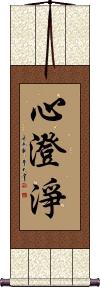
心澄淨 is the Buddhist concept of the pure and calm mind. It is believed that once you achieve a meditative state of pure focused thought, the mind becomes clear and calm. Although, others will say this means that achieving a calm mind will allow you to reach pure thought.
From Sanskrit, this is known as citta-prasāda. The concept of citta-prasāda is sometimes defined as “clear heart-mind,” or “the single and definitive aspiration.”
Stable - Mind at Peace
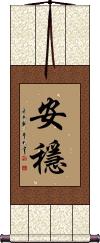
安穩 can mean a steady, stable, sedate, and calm mind.
Other translations include “body and mind at rest,” or “peace and comfort.”
Strong Mind Strong Body
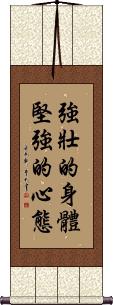
強壯的身體堅強的心態 is the Chinese phrase for “Strong Mind, Strong Body,” however, the character order is actually “Strong Body, Strong Mind,” as that's the more natural word order in Chinese.
Strong Body, Strong Mind
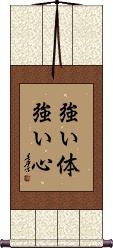
強い体強い心 is a way to write “strong mind, strong body” in Japanese.
Each of the two lines starts with 強い (tsuyoi) which means: strong; powerful; mighty; potent; resistant; resilient; durable; tough; stiff; hard; inflexible.
The body is represented with 体 (the ancient version is 體, romanized as karada), which means: body; build; physique; posture; torso; trunk; health.
Mind is represented with 心 (kokoro), which can mean heart, mind, or soul, depending on context.
強い體強い心 is not a common phrase in Japanese, so it's not the most natural title for calligraphy. In English, you might want to write it, “strong mind, strong body” but, “strong mind, strong body,” is more natural in Japanese.
Note: Because this selection contains some special Japanese Hiragana characters, it should be written by a Japanese calligrapher.
Truth Flashed Through The Mind
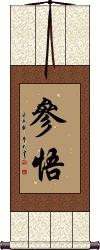
參悟 is a Chan / Zen Buddhism concept that means “to understand (mystery) from meditation” or “to see truth flash through the mind.”
參悟 is a pretty deep idea; therefore, your study and contemplation may be required before fully appreciating it.
Tsuki no Kokoro / Mind like the Moon
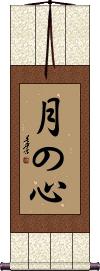
月の心 means “Mind like the Moon” or, more directly translated, “Moon of Mind.”
月の心 is a phrase used in Zen Buddhism and some Japanese martial arts.
A Wise Man Changes His Mind (but a fool never will)
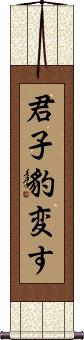
君子豹変す is a Japanese proverb that suggests that a wise man is willing to change his mind, but a fool will stubbornly never change his.
The first word is 君子 (kunshi), a man of virtue, a person of high rank, a wise man.
The second word is 豹変 (hyouhen), sudden change, complete change.
The last part, す (su), modifies the verb to a more humble form.
The “fool” part is merely implied or understood. So if wise and noble people are willing to change their minds, it automatically says that foolish people are unwilling to change.
Work Together with One Mind
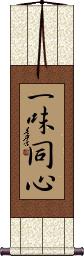
一味同心 is a Japanese phrase that refers to people working together with one mind.
Alert / On Guard / Lingering Mind
Zanshin
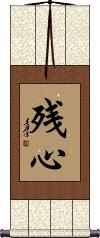
残心 is a Japanese Kanji word meaning: continued alertness; unrelaxed alertness; remaining on one's guard; lingering mind, and being prepared for a counterstrike. This context is used in martial arts, which is probably why you are looking up this word.
In archery and golf, it can be the follow-through.
In the context of love and relationships, it can be lingering affection, attachment, regret, regrets, or reluctance.
Zen Heart / Zen Mind
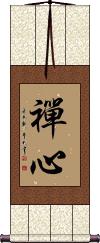
禪心 represents an image of your meditation coming from and filling your heart.
The meaning of the first character is “meditation” and the second character is usually defined as “heart” or sometimes “mind.”
There is a two-fold meaning here, as a good meditation session must start with a centered heart or mind. Yet at the same time, meditation serves to cleanse, focus, and center the heart and mind.
Immovable Mind Way / Fudoshin Way

Immovable Mind Hall / Fudoshin Dojo

不動心道場 can be translated as “Fudoshin Dojo,” or “Immovable Mind Hall,” depending on usage.
不動心 = Fudoshin or immovable mind.
道場 = Dojo or training hall.
Beautiful Heart / Beautiful Spirit
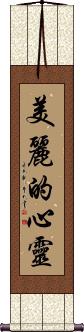
美麗的心靈 means a beautiful heart, a beautiful mind, or a beautiful spirit in Chinese.
Good Heart
A heart of kindness, benevolence, and virtuous intentions
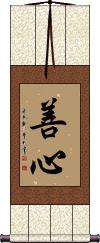
善心 literally reads “Good Heart” but is used to refer to the ideas of kindness, benevolence, philanthropy, virtuous intentions, moral sense, and conscience.
Some will also translate this as the morality of mind (as the character for the heart is often used to mean mind).
In Japanese, this can be the given name Yoshinaka.
To a Willing Heart, All Things Are Possible
Where there is a will, there is a way
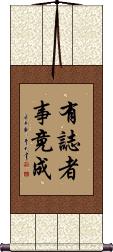
有志者事竟成 is an old Chinese proverb that has been translated many different ways into English. As you read the translations below, keep in mind that in Chinese, heart=mind.
Nothing is impossible to a willing heart.
Nothing is impossible to a willing mind.
Nothing is difficult to a willing heart.
Where there is a will, there is a way.
Nothing in the world is impossible if you set your mind to doing it.
A willful man will have his way.
If you wish it, you will do it.
A determined heart can accomplish anything.
All things are possible with a strong mind.
Determination
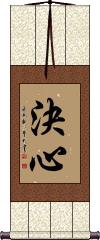
決心 is a Chinese, Japanese, and Korean word that holds the dictionary definition of determination but literally means determined heart.
The first character means to determine or determined.
The second character means heart, mind, or soul, so you can imagine that this form of determination partially means putting your heart into something. It can also be translated as resolve, resolution, or decision (as in a decision made and followed).
See Also: Devotion | Tenacious | Passion | Dedication | Will-Power
Learning is Eternal
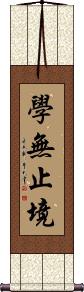
This Chinese philosophy tells of how we continue to learn throughout our lives.
This proverb can be translated in a few ways such as “Study has no end,” “Knowledge is infinite,” “No end to learning,” “There's always something new to study,” or “You live and learn.”
The deeper meaning: Even when we finish school we are still students of the world gaining more knowledge from our surroundings with each passing day.
See Also: An Open Book Benefits Your Mind | Wisdom | Learn From Wisdom
Exercise
(for body or mind)
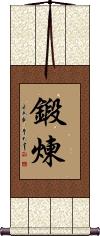
鍛煉/鍛鍊 means to exercise in much the same way we use the word exercise in English.
This can be exercising your body at the gym or exercising your mind in studies. Most of the time, this refers to physical exercise.
This can also be translated as to temper, to toughen, to train, to drill, to forge, or simply discipline.
Inner Peace
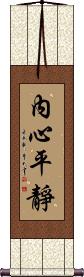
內心平靜 is a Chinese and Japanese phrase that is a direct translation of the western idea of inner peace.
The first two characters contain the idea of “heart,” “innermost being,” or “deep in the/your inner mind.”
The last two characters mean “tranquil” and “serene.”
I have seen this phrase used as “inner peace” for art prints and even on the side of coffee cups. But I think the translation is too literal. It feels like a direct translation from English rather than a nicely composed Chinese or Japanese phrase. See my other entries for “inner peace.”
See Also: Serenity | Simplicity | Peace
Martial Morality / Martial Arts Ethics / Virtue
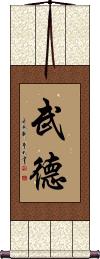
This refers to the virtue, morality, and ethics that any practitioner of martial arts should possess.
This can be used in both Chinese and Japanese in place of English terms such as “soldierly virtue,” “good conduct” (military), “warrior ethics,” and being honorable regarding any fight or competition.
In Japanese, there is a slight variation in the last character, making it 武徳 instead of 武德 in Japan. And yes, just one little horizontal stroke is omitted. If you need the Japanese version, please choose a Japanese calligrapher, or drop me a note so that I make sure you get the characters you intend.
See Also: Morality of Mind | Morality of Deed
Energy Sword Body in Concert
Spirit, Sword & Body as One
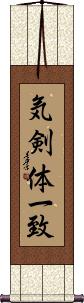
气剑体一致 often gets translated as “Mind Sword Body,” or “Spirit, Sword, and Body as One.” But I think these translations don't tell you enough about what this is really saying.
In this context, 気, which is the modern Japanese version of 氣, means spiritual and unseen energy or “life energy.” In some cases, 気 can be translated as spirit, feeling, or nature. If defined as the mind, it's more about the invisible or intangible parts of one's mind (or soul).
剣 is the Japanese version of 劍 meaning sword.
体 is the modern Japanese version of 體 meaning body.
The Kanji 一 means one, and in this case, suggests “all in one.”
The Kanji 到 means to send, deliver, or convey. But together, 一到 suggests all these things in agreement, union cooperation, or in concert.
Note: Arguments exist as to whether this should be romanized as Kikentaiitchi, Kikentaiicchi, or kikentaiichi. Technically, if you drop the last character, you get 気剣体一 and kikentaiichi (ki ken tai ichi), which is also a valid phrase.
Morality of Deed
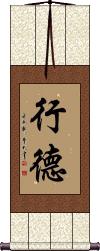
The idea of “morality of deed” goes along with 行德 or “wu de” (martial morality or virtues of the warrior).
Here, the first character is a representation of the actions or deeds that you engage in.
The second character refers to morality or virtue.
This translates better in English in the opposite order, as the Chinese order is literally “deed morality.”
See Also: Morality of Mind | Martial Morality
Spirit
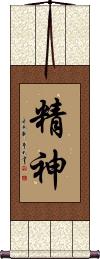
精神 is the kind of spirit you have if you perform well in sports or competitions. It is the idea of having a good attitude and putting your all into something - so much so that others can see or feel your spirit. It is the essence of your being that can only be subjectively described because there are no words that can fully explain what “spirit” really is.
For your information:
My Japanese dictionary further tries to explain this word by comparing it to mind, soul, heart, or intention.
My Chinese dictionary compares these characters to meanings like vigor, vitality, drive, and mentality.
My Korean dictionary defines this as mind, spirit, and soul.
You are only as old as you feel
You're only old if you think you're old
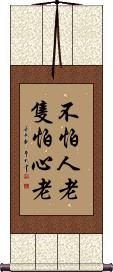
不怕人老只怕心老 literally translates as: Do not be concerned about being old; be concerned about a mind which is old.
Figuratively, this means: You are not as old as you look, you are only as old as you think you are.
This in-stock artwork might be what you are looking for, and ships right away...
Gallery Price: $200.00
Your Price: $118.88

Gallery Price: $202.00
Your Price: $111.88

Gallery Price: $106.00
Your Price: $58.88

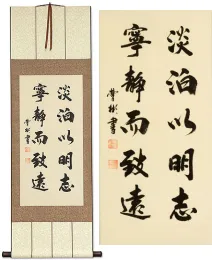
Gallery Price: $198.00
Your Price: $109.88

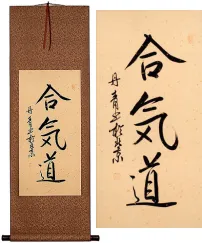

The following table may be helpful for those studying Chinese or Japanese...
| Title | Characters | Romaji (Romanized Japanese) | Various forms of Romanized Chinese | |
| Beautiful Heart Beautiful Mind | 美しい心 | utsukushii kokoro utsukushiikokoro utsukushi kokoro | ||
| Beautiful Mind | 美麗心靈 美丽心灵 | měi lì xīn líng mei3 li4 xin1 ling2 mei li xin ling meilixinling | mei li hsin ling meilihsinling |
|
| Mind of the Beginner | 初心 | sho shin / shoshin | chū xīn / chu1 xin1 / chu xin / chuxin | ch`u hsin / chuhsin / chu hsin |
| Bodhicitta: Enlightened Mind | 冒地質多 冒地质多 | boujiishitta bojishitta | mào dì zhì duō mao4 di4 zhi4 duo1 mao di zhi duo maodizhiduo | mao ti chih to maotichihto |
| The Bodhi Mind | 菩提心 | bo dai shin bodaishin | pú tí xīn pu2 ti2 xin1 pu ti xin putixin | p`u t`i hsin putihsin pu ti hsin |
| Body and Mind | 身心 | shin jin / shinjin | shēn xīn / shen1 xin1 / shen xin / shenxin | shen hsin / shenhsin |
| Body Mind Spirit | 身心霊 | mi shin rei mishinrei | ||
| Buddha Heart Mind of Buddha | 佛心 | busshin / bushin | fó xīn / fo2 xin1 / fo xin / foxin | fo hsin / fohsin |
| Calm and Open Mind | 虛心 虚心 | ko shin / koshin | xū xīn / xu1 xin1 / xu xin / xuxin | hsü hsin / hsühsin |
| Heart Mind Spirit | 心 | kokoro | xīn / xin1 / xin | hsin |
| Heijoshin Presence of Mind | 平常心 | hei jou shin heijoushin hei jo shin | píng cháng xīn ping2 chang2 xin1 ping chang xin pingchangxin | p`ing ch`ang hsin pingchanghsin ping chang hsin |
| Immovable Mind | 不動心 | fu dou shin fudoushin fu do shin | ||
| Seeking Mind | 尋求心 寻求心 | jingu shin / jingushin | xún qiú xīn xun2 qiu2 xin1 xun qiu xin xunqiuxin | hsün ch`iu hsin hsünchiuhsin hsün chiu hsin |
| The Nature of Enlightenment in One's Mind | 覺性 觉性 | kakushou / kakusho | jué xìng / jue2 xing4 / jue xing / juexing | chüeh hsing / chüehhsing |
| Resolute Mind | 決定心 决定心 | ketsujou shin ketsujoushin ketsujo shin | jué dìng xīn jue2 ding4 xin1 jue ding xin juedingxin | chüeh ting hsin chüehtinghsin |
| Lingering Mind | 殘心 残心 | zan shin / zanshin | cán xīn / can2 xin1 / can xin / canxin | ts`an hsin / tsanhsin / tsan hsin |
| Listen with Open Mind | 虛己以聽 虚己以听 | xū jǐ yǐ tīng xu1 ji3 yi3 ting1 xu ji yi ting xujiyiting | hsü chi i t`ing hsüchiiting hsü chi i ting |
|
| Be Master of Mind, Not Mastered by Mind | 願作心師不師於心 愿作心师不师于心 | yuàn zuò xīn shī bù shī yú xīn yuan4 zuo4 xin1 shi1 bu4 shi1 yu2 xin1 yuan zuo xin shi bu shi yu xin yuanzuoxinshibushiyuxin | yüan tso hsin shih pu shih yü hsin | |
| Merciful Heart The Light from a Buddha Mind | 心光 | shin kou / shinkou / shin ko | xīn guāng xin1 guang1 xin guang xinguang | hsin kuang hsinkuang |
| Mind Body Spirit | 身心靈 / 身心霊 身心灵 | mi shin rei mishinrei | shēn xīn líng shen1 xin1 ling2 shen xin ling shenxinling | shen hsin ling shenhsinling |
| Mind Over Matter | 心勝於物 心胜于物 | xīn shèng yú wù xin1 sheng4 yu2 wu4 xin sheng yu wu xinshengyuwu | hsin sheng yü wu hsinshengyüwu |
|
| Mind Over Matter | 物質性を超越する精神力 | busshitsu-sei o chouetsu suru seishin-ryoku bushitsu-sei o choetsu suru seishin-ryoku | ||
| Mind Your Own Business | 不干己事不張口一問搖頭三不知 不干己事不张口一问摇头三不知 | bù gān jǐ shì bù zhāng kǒu yī wèn yáo tóu sān bù zhī bu4 gan1 ji3 shi4 bu4 zhang1 kou3 yi1 wen4 yao2 tou2 san1 bu4 zhi1 bu gan ji shi bu zhang kou yi wen yao tou san bu zhi | pu kan chi shih pu chang k`ou i wen yao t`ou san pu chih pu kan chi shih pu chang kou i wen yao tou san pu chih |
|
| Mind Your Own Business | 余計なお世話 | yokei na osewa yokeinaosewa | ||
| Mind’s Eye | 心眼 | shingan | xīn yǎn / xin1 yan3 / xin yan / xinyan | hsin yen / hsinyen |
| Mind Like Water | 水の心 | mizu no kokoro mizunokokoro | ||
| Morality of Mind | 心德 | xīn dé / xin1 de2 / xin de / xinde | hsin te / hsinte | |
| No Mind Mushin | 無心 无心 | mu shin / mushin | wú xīn / wu2 xin1 / wu xin / wuxin | wu hsin / wuhsin |
| One Heart One Mind Heart and Soul | 一心 | isshin / ishin | yī shì dài yi1 shi4 dai4 yi shi dai yishidai | i shih tai ishihtai |
| One Mind Unity | 和合 | wagou / wago wago / wago | hé hé / he2 he2 / he he / hehe | ho ho / hoho |
| Open and Calm Mind | 虛心坦懐 虚心坦懐 | kyo shin tan kai kyoshintankai | ||
| Open Mind | 開覺 开觉 | kaikaku / kaikaku | kāi jué / kai1 jue2 / kai jue / kaijue | k`ai chüeh / kaichüeh / kai chüeh |
| An Open Book Benefits Your Mind | 開卷有益 开卷有益 | kāi juàn yǒu yì kai1 juan4 you3 yi4 kai juan you yi kaijuanyouyi | k`ai chüan yu i kaichüanyui kai chüan yu i |
|
| The Original Mind | 本心 | hon shin / honshin | běn xīn / ben3 xin1 / ben xin / benxin | pen hsin / penhsin |
| Patience Brings Peace of Mind | 忍耐は心の平和をもたらす | nintai wa kokoro no heiwa o motarasu | ||
| Patience Yields Peace of Mind | 能忍自安 | néng rěn zì ān neng2 ren3 zi4 an1 neng ren zi an nengrenzian | neng jen tzu an nengjentzuan |
|
| Peace of Mind | 內心的寧靜 内心的宁静 | nèi xīn de níng jìng nei4 xin1 de ning2 jing4 nei xin de ning jing neixindeningjing | nei hsin te ning ching neihsinteningching |
|
| Peace of Mind | 和平 | wa hei / wahei | hé píng / he2 ping2 / he ping / heping | ho p`ing / hoping / ho ping |
| Peaceful Heart Peace of Mind Calm Mind | 安心 | an shin / anshin | ān xīn / an1 xin1 / an xin / anxin | an hsin / anhsin |
| Perfectly Sincere Mind | 至誠心 至诚心 | shi jou shin shijoushin shi jo shin | zhì chéng xīn zhi4 cheng2 xin1 zhi cheng xin zhichengxin | chih ch`eng hsin chihchenghsin chih cheng hsin |
| Presence of Mind | 泰然自若 | taizenjijaku | tài rán zì ruò tai4 ran2 zi4 ruo4 tai ran zi ruo tairanziruo | t`ai jan tzu jo taijantzujo tai jan tzu jo |
| Presence of Mind | 落着き | ochitsuki | ||
| Prideful Mind Self-Respecting Heart | 自尊心 | ji son shin jisonshin | zì zūn xīn zi4 zun1 xin1 zi zun xin zizunxin | tzu tsun hsin tzutsunhsin |
| Purity of Mind | 心澄淨 | shin chou jou shinchoujou shin cho jo | xīn chéng jìng xin1 cheng2 jing4 xin cheng jing xinchengjing | hsin ch`eng ching hsinchengching hsin cheng ching |
| Stable - Mind at Peace | 安穩 安稳 | an non / annon | ān wěn / an1 wen3 / an wen / anwen | |
| Strong Mind Strong Body | 強壯的身體堅強的心態 强壮的身体坚强的心态 | qiáng zhuàng de shēn tǐ jiān qiáng de xīn tài qiang2 zhuang4 de shen1 ti3 jian1 qiang2 de xin1 tai4 qiang zhuang de shen ti jian qiang de xin tai | ch`iang chuang te shen t`i chien ch`iang te hsin t`ai chiang chuang te shen ti chien chiang te hsin tai |
|
| Strong Body, Strong Mind | 強い體強い心 強い体強い心 | tsuyo i karada tsuyo i kokoro tsuyoikaradatsuyoikokoro | ||
| Truth Flashed Through The Mind | 參悟 参悟 | cān wù / can1 wu4 / can wu / canwu | ts`an wu / tsanwu / tsan wu | |
| Tsuki no Kokoro Mind like the Moon | 月の心 | tsuki no kokoro tsukinokokoro | ||
| A Wise Man Changes His Mind (but a fool never will) | 君子豹変す | kun shi hyou hen su kunshihyouhensu kun shi hyo hen su | ||
| Work Together with One Mind | 一味同心 | ichi mi dou shin ichimidoushin ichi mi do shin | ||
| Alert On Guard Lingering Mind | 残心 | zan shin / zanshin | ||
| Zen Heart Zen Mind | 禪心 禅心 | zen shin / zenshin | chán xīn / chan2 xin1 / chan xin / chanxin | ch`an hsin / chanhsin / chan hsin |
| Immovable Mind Way Fudoshin Way | 不動心道 | fu dō shin dō fudōshindō | bù dòng xīn dào bu4 dong4 xin1 dao4 bu dong xin dao budongxindao | pu tung hsin tao putunghsintao |
| Immovable Mind Hall Fudoshin Dojo | 不動心道場 | fudōshin-dōjō | bù dòng xīn dào chǎng bu4 dong4 xin1 dao4 chang3 bu dong xin dao chang budongxindaochang | pu tung hsin tao ch`ang putunghsintaochang pu tung hsin tao chang |
| Beautiful Heart Beautiful Spirit | 美麗的心靈 美丽的心灵 | měi lì de xīn líng mei3 li4 de xin1 ling2 mei li de xin ling meilidexinling | mei li te hsin ling meilitehsinling |
|
| Good Heart | 善心 | yoshinaka | shàn xīn / shan4 xin1 / shan xin / shanxin | shan hsin / shanhsin |
| To a Willing Heart, All Things Are Possible | 有志者事竟成 / 有誌者事竟成 有志者事竟成 | yǒu zhì zhě shì jìng chéng you3 zhi4 zhe3 shi4 jing4 cheng2 you zhi zhe shi jing cheng youzhizheshijingcheng | yu chih che shih ching ch`eng yuchihcheshihchingcheng yu chih che shih ching cheng |
|
| Determination | 決心 决心 | kesshin / keshin | jué xīn / jue2 xin1 / jue xin / juexin | chüeh hsin / chüehhsin |
| Learning is Eternal | 學無止境 学无止境 | xué wú zhǐ jìng xue2 wu2 zhi3 jing4 xue wu zhi jing xuewuzhijing | hsüeh wu chih ching hsüehwuchihching |
|
| Exercise | 鍛煉 / 鍛鍊 锻炼 | duàn liàn duan4 lian4 duan lian duanlian | tuan lien tuanlien |
|
| Inner Peace | 內心平靜 内心平静 | naishin heizyou naishinheizyou naishin heizyo | nèi xīn píng jìng nei4 xin1 ping2 jing4 nei xin ping jing neixinpingjing | nei hsin p`ing ching neihsinpingching nei hsin ping ching |
| Martial Morality Martial Arts Ethics Virtue | 武德 | bu toku / butoku | wǔ dé / wu3 de2 / wu de / wude | wu te / wute |
| Energy Sword Body in Concert | 気剣体一致 / 氣劍體一致 气剑体一致 | ki ken tai icchi kikentaiicchi ki ken tai ichi | ||
| Morality of Deed | 行德 | xíng dé / xing2 de2 / xing de / xingde | hsing te / hsingte | |
| Spirit | 精神 | sei shin / seishin | jīng shén jing1 shen2 jing shen jingshen | ching shen chingshen |
| You are only as old as you feel | 不怕人老隻怕心老 不怕人老只怕心老 | bú pà rén lǎo zhǐ pà xīn lǎo bu2 pa4 ren2 lao3 zhi3 pa4 xin1 lao3 bu pa ren lao zhi pa xin lao buparenlaozhipaxinlao | pu p`a jen lao chih p`a hsin lao pupajenlaochihpahsinlao pu pa jen lao chih pa hsin lao |
|
| In some entries above you will see that characters have different versions above and below a line. In these cases, the characters above the line are Traditional Chinese, while the ones below are Simplified Chinese. | ||||



