Custom Rebirth Chinese & Japanese Calligraphy Wall Scroll
We have many options to create artwork with Rebirth characters on a wall scroll or portrait.
If you want to create a cool Rebirth wall scroll, this is the place. Below you will find a few Asian symbols that express the idea of Rebirth.
4. Reincarnation / Transmigration of Souls
5. Reincarnation / Life in Flux
8. New Life
10. No Pain No Gain
11. Phoenix Rise from the Ashes
12. Phuong
13. Pure Land / Jodo
Re-Birth / Renaissance
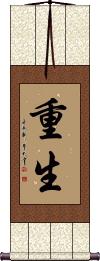
重生 is the Chinese word for rebirth. This can be used literally or metaphorically. As a metaphor, you could use this to say something like, “We are watching the rebirth of New Orleans after the disaster of Katrina.”
重生 is sometimes translated as “renaissance.”
Note: 重生 is not the Buddhist concept of reincarnation or re-birth.
See Also: Reincarnation
Resurrection / Re-Birth
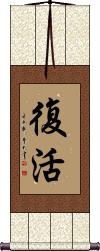
復活 is the Chinese, Japanese and Korean word for resurrection or rebirth.
復活 literally means “return to life.”
It is the term used in most Asian Bibles to refer to the resurrection of Christ. In Japanese, it is sometimes used to mean a Christian Revival. In some contexts, it can mean resuscitation.
See Also: Christianity | Jesus Christ | God of Abraham
Reincarnation (Buddhism)
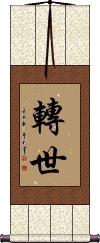
轉世 is the Buddhist idea of reincarnation or transmigration.
Other definitions of this term: “Attainer of Nirvana from within the desire realm,” “A practitioner who enters directly into Nirvana from the desire realm, without traversing the form and formless realms. One of the 27 kinds of Hinayana sages,” or simply, “to return again to this life.”
轉世 is also a Japanese title, but the first Kanji was slightly simplified after WWII. Just let us know if you want the modern Japanese version when you order.
See Also: Buddhism
Reincarnation / Transmigration of Souls
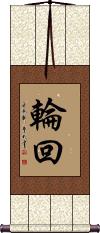
輪回 is a universal word in Japanese and Chinese that expresses the Buddhist idea of “reincarnation,” “transmigration of souls,” or “the eternal cycle of birth and death.”
In some contexts, this can also mean “karma,” and others will say it represents “samsara.”
The first character means wheel, ring, turn, circle, loop, or rotate.
The second character can be thought of as a suffix meaning “-times.” This second character can also refer to something that revolves, returns, goes back, or is a counter of the number of occurrences of some event.
Together the sum supersedes the parts, and it means reincarnation. But knowing the essence of each character may help you understand some of the meaning behind the word.
 Shown to the right is the more common way to write the second character in Japanese.
it’s
an alternate form of this character in Chinese (so neither way is technically wrong in either language). If you select a Japanese calligrapher, expect that is will look like the Kanji to the right.
Shown to the right is the more common way to write the second character in Japanese.
it’s
an alternate form of this character in Chinese (so neither way is technically wrong in either language). If you select a Japanese calligrapher, expect that is will look like the Kanji to the right.
See Also: Buddhism
Reincarnation / Life in Flux
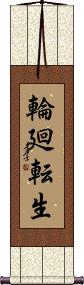
輪廻転生 is a Japanese Zen quote or proverb that expresses the idea of all things being in flux through the endless circle of birth, death, and rebirth or the circle of transmigration.
Eternal Life / Future Life
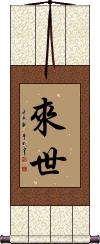
來世 is a word that can be used in many different ways.
It is often used to express the next life (life in heaven or wherever your soul is bound for). So it does have a religious overtone. However, it can also be used to express your life in the future - perhaps during your present lifetime.
It can also be translated as “the next world,” “the next generation,” “the time that is to come,” “otherworld,” or simply “posterity.”
See Also: Eternity | Reincarnation | Immortality
Five Precepts
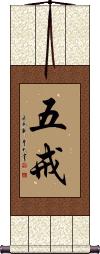
五戒 is the title or name for the five precepts of Buddhism.
These are prohibitions against killing, theft, sexual misconduct, lying, and intoxication.
Also phrased as commandments against murder, stealing, adultery, false speech, and consuming intoxicating liquors.
These five precepts or “pañca-veramaṇī” apply to the Buddhist laity as well as monks and nuns. The observance of these five ensures rebirth in the human realm.
New Life
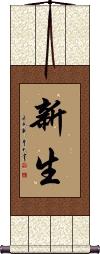
新生 literally means “new life” or “new birth” in Chinese, Japanese Kanji, and old Korean Hanja.
Depending on the context, this word can also mean newborn, new student, rebirth, new birth, or nascent.
In Japanese, this can be the given name Wakaki.
Note: This is not the most common word selection for a calligraphy wall scroll. But if you’re a westerner, you can bend the rules a bit.
The Noble Eightfold Path
Ashtangika Marga / Astangika-Marga / Atthangika Magga
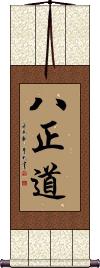
八正道 is a complex set of steps that Buddhists much take to cleanse karma, achieve enlightenment, eventually cease the cycle of rebirth and live in a state of Nirvana.
Note: This term is exclusively used by devout Buddhists. It is not a common term and remains an unknown concept to most Japanese and Chinese people. Sometimes written as 八聖道.
See Also: Buddhism | Enlightenment
No Pain No Gain
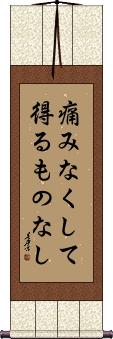
痛みなくして得るものなし is a Japanese phrase that means “no pain, no gain.”
This suggests that with pain, a gain must follow.
The pain Kanji here can also be translated as sorrow or suffering. The gain can also mean profit, advantage, or benefit. In the Japanese Buddhist context, that gain Kanji can mean rebirth in paradise, entering nirvana.
The character breakdown:
痛みなく (itami naku) pain; ache; sore; grief; distress. The naku part adds the meaning of “a lot of” or “extended”
して (shite) and then. (indicates a causative expression; acts as a connective particle)
得る (eru) to get; to acquire; to obtain; to procure; to earn; to win; to gain; to secure; to attain.
もの (mono) conjunctive particle indicating a cause or reason.
なし (nashi) none of; -less; without; no.
Note: Because this selection contains some special Japanese Hiragana characters, it should be written by a Japanese calligrapher.
Phoenix Rise from the Ashes
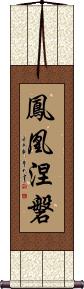
鳳凰涅磐 is a proverb that suggests “Legendary Phoenix rises from the ashes.” It means “Legendary Phoenix [reaches] Nirvana.”
There is a legend in China of a great bird reborn once every 500 years. This bird gathers all the ill will, suffering, desire, and other negative things of the world. The bird then plunges into the fire to burn away all negative things, sacrificing itself in the process (achieving Nirvana, or perhaps allowing others the opportunity to reach Nirvana).
500 years later, the phoenix is reborn from the ashes again, and the cycle repeats.
Phuong
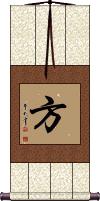
方 is the original Chinese character for the Vietnamese surname Phuong or Phương.
方 means square, upright, or side. In Vietnamese specifically, it can mean "direction" or "phoenix" (rebirth).
In Cambodian there is an unrelated surname, ភួង, meaning "garland necklace (of flowers)" which also romanizes as Phuong. This is probably not the character you want if your name is Cambodian (unless your ancestry is Chinese or you know what you are doing).
Pure Land / Jodo
Also a sect of Buddhism
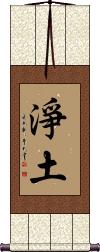
淨土 literally means “pure land” or “clean earth.”
淨土 is also the abbreviated title of a Buddhist sect that involves faith in the rebirth of Buddha Amitabha (Amitābha) in the Western Heaven. Sometimes this sect is translated as “Paradise of the West.” Other titles of this school of Buddhism include Amidism or Elysium.
See Also: Nirvana | Shin Buddhism
Rehabilitation / Rebirth
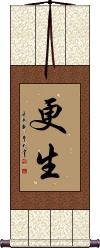
This is a Chinese, Korean and Japanese word that means rebirth or resurrection.
Other definitions include reinvigorated, rejuvenated, a new lease of life, rehabilitation, remaking one's life, starting life anew, regeneration, reorganization, rebuilding, recovery, restoration, remaking, coming back to life, revival, or resuscitation.
Samsara / Endless Cycle of Rebirth
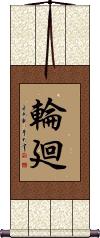
輪廻 is one of a few ways to express संसार or Saṃsāra in Chinese, Japanese, and old Korean.
The Buddhist term can be translated in several ways, including:
An endless cycle of death and rebirth.
The turning of the wheel.
To revolve.
Transmigration in six ways.
The wheel of transmigration.
The round of existence.
The following table may be helpful for those studying Chinese or Japanese...
| Title | Characters | Romaji (Romanized Japanese) | Various forms of Romanized Chinese | |
| Re-Birth Renaissance | 重生 | chóng shēng chong2 sheng1 chong sheng chongsheng | ch`ung sheng chungsheng chung sheng |
|
| Resurrection Re-Birth | 復活 复活 | hukkatsu / hukatsu | fù huó / fu4 huo2 / fu huo / fuhuo | |
| Reincarnation (Buddhism) | 轉世 转世 | ten sei / tensei | zhuǎn shì zhuan3 shi4 zhuan shi zhuanshi | chuan shih chuanshih |
| Reincarnation Transmigration of Souls | 輪回 / 輪廻 轮回 | rin ne / rinne | lún huí / lun2 hui2 / lun hui / lunhui | |
| Reincarnation Life in Flux | 輪廻転生 | rinne tenshou rinnetenshou rinne tensho | ||
| Eternal Life Future Life | 來世 来世 | rai-se | lái shì / lai2 shi4 / lai shi / laishi | lai shih / laishih |
| Five Precepts | 五戒 | go kai / gokai | wǔ jiè / wu3 jie4 / wu jie / wujie | wu chieh / wuchieh |
| New Life | 新生 | waka ki / wakaki | xīn shēng xin1 sheng1 xin sheng xinsheng | hsin sheng hsinsheng |
| The Noble Eightfold Path | 八正道 | hasshoudou / hashodo | bā zhèng dào ba1 zheng4 dao4 ba zheng dao bazhengdao | pa cheng tao pachengtao |
| No Pain No Gain | 痛みなくして得るものなし | itami naku shite erumono wa nashi | ||
| Phoenix Rise from the Ashes | 鳳凰涅磐 凤凰涅磐 | fèng huáng niè pán feng4 huang2 nie4 pan2 feng huang nie pan fenghuangniepan | feng huang nieh p`an fenghuangniehpan feng huang nieh pan |
|
| Phuong | 方 | fāng / fang1 / fang | ||
| Pure Land Jodo | 淨土 净土 | jou do / joudo / jo do | jìng tǔ / jing4 tu3 / jing tu / jingtu | ching t`u / chingtu / ching tu |
| Rehabilitation Rebirth | 更生 | kousei / kose kosei / kose | gēng shēng geng1 sheng1 geng sheng gengsheng | keng sheng kengsheng |
| Samsara Endless Cycle of Rebirth | 輪廻 轮廻 | rinne | lún huí / lun2 hui2 / lun hui / lunhui | |
| In some entries above you will see that characters have different versions above and below a line. In these cases, the characters above the line are Traditional Chinese, while the ones below are Simplified Chinese. | ||||



