Many custom options...


And formats...



Not what you want?
Try other similar-meaning words, fewer words, or just one word.
As I Lay Dying in Chinese / Japanese...
Buy an As I Lay Dying calligraphy wall scroll here!
Personalize your custom “As I Lay Dying” project by clicking the button next to your favorite “As I Lay Dying” title below...
Switched to secondary search mode due to lack of results using primary.
These secondary results may not be very accurate. Try a different but similar meaning word or phrase for better results. Or...
Look up As I Lay Dying in my Japanese Kanji & Chinese Character Dictionary(My dictionary is a different system then the calligraphy search you just tried)
If you want a special phrase, word, title, name, or proverb, feel free to contact me, and I will translate your custom calligraphy idea for you.
1. Chan
2. Chen
3. Choy Li Fut
4. Easter
5. Layosha
6. Leanna
7. Men Die for Wealth, Birds Die for Food
8. Seng
Chan
Cantonese Surname
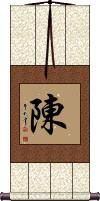
This is the most common Cantonese surname that is often romanized as Chan.
The actual meaning of this character is to lay out, to exhibit, to display, to narrate, to state, to explain, or to tell.
This also can refer to the ancient state of Chan/Chen 1045-479 BC, or the Chen dynasty of China 557-589 BC.
Chen
Surname
This is the most common character for a Chinese surname that romanizes as “Chen.”
This is also a surname, You or Yo in Japanese, though it can also be pronounced as Chin in Japanese.
In Korean, it is a surname romanized as Jin.
As a word, this character means: to lay out; to exhibit; to display; to narrate; to state; to explain; to tell.
The Chen clan, or family, ruled a small kingdom from 1046 BC to 479 BC. It was one of 12 small but powerful vassal states during the Spring and Autumn Period, 770-475 BC. This name reappeared as the Chen Dynasty (陳朝) of the Southern dynasties from 557 AD to 589 AD.
Choy Li Fut

蔡李彿 is Choy Li Fut, a Chinese martial arts that combines Northern and Southern Kung Fu styles.
Choy Li Fut is also known as Choy Lay Fut, Choy Lee Fut, Tsai Li Fo and Cai Li Fo, Choy Li Fut, Choi Lei Fut, Choy Lai Fut, Choy Ley Fut, Choi Lei Faht, Choi Leih Faht. These all come from the same 蔡李彿 characters, but different dialects have different pronunciations and romanization schemes for Chinese vary.
Some will write the third character 佛, others will write 彿 (note subtle extra stoke on left side). If you have a preference, place make a note when you place your order.
Easter
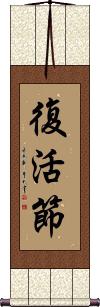
復活節 is the Chinese and old Korean way to write Easter.
Easter is not a well-known holiday in China, but Chinese Christians tend to follow the American tradition of the Easter egg ritual, etc. Non-Christians may think it's a celebration of rabbits that can lay eggs.
South Korea has a higher percentage of Christians than any other Asian country, so they celebrate Easter with plenty of enthusiasm.
Layosha
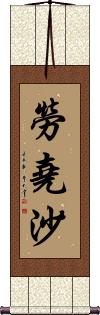
勞堯沙 is the name Lay'Osha in Chinese (Mandarin).
Leanna
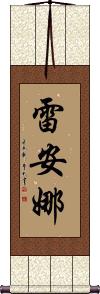
雷安娜 is the third transliteration to Mandarin Chinese for the name Leanna.
This is the version you should pick if you pronounce your name like “Lay-anna” versus the other too which are like “Lee-anna.”
Men Die for Wealth, Birds Die for Food
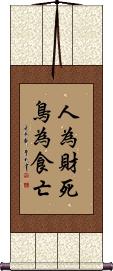
人為財死鳥為食亡 is a Chinese proverb that literally states that human beings will die for riches, just as birds will for food.
Figuratively it means that man will do anything in his means to become rich. Personally, I think dying for food is a more noble cause.
Often translated as “Men die in pursuit of wealth, birds die in pursuit of food. The 人 in this proverb just means human, so “men” is a placeholder for human with that translation - an English language problem that we have no easy gender-neutral nouns.
This proverb is meant to serve as a warning about the follies of greed.
Seng

盛 is the Chinese surname Seng, meaning, “flourishing,” or “prosperous.”
There are other Chinese surnames that can romanize as Seng such as 陳, meaning “to lay out,” or “display,” and
成 meaning, “to succeed,” or “accomplish.”
If you are looking for the German name Seng, please contact me.
Ultimate Loyalty to Your Country
The most famous tattoo in Chinese history
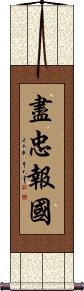
盡忠報國 is a proverb that is the tattoo worn on the back of Yue Fei, a famous Chinese warrior who lived until 1142 A.D.
The tattoo can be translated as “Serve the country with the utmost loyalty.” More literally, it means “[The] Ultimate Loyalty [is too] Duty [of] Country.”
Legend has it that this tattoo once saved his life when he was accused of treason.
The first two characters have come to create a word that means “serve the country faithfully” or “die for the country.” Note: It's more a willingness to die for one's country than the actual act of dying.
The last two characters have come to mean “Dedicate oneself to the service of one's country.”
Both of these words are probably only in the Chinese lexicon because of this famous tattoo.
If you break it down, character-by-character, here is what you get:
1. To the utmost, to the limit of something, the ultimate.
2. Loyalty or duty (a sense of duty to one's master, lord, country, or job).
3. Report, recompense, give back to (in this case, you are giving yourself to your country as payback).
4. Country, state, nation, kingdom.
The following table may be helpful for those studying Chinese or Japanese...
| Title | Characters | Romaji (Romanized Japanese) | Various forms of Romanized Chinese | |
| Chan | 陳 陈 | you / yo | chén / chen2 / chen | ch`en / chen |
| Chen | 陳 陈 | chin | chén / chen2 / chen | ch`en / chen |
| Choy Li Fut | 蔡李彿 蔡李佛 | cài lǐ fó cai4 li3 fo2 cai li fo cailifo | ts`ai li fo tsailifo tsai li fo |
|
| Easter | 復活節 复活节 | fù huó jié fu4 huo2 jie2 fu huo jie fuhuojie | fu huo chieh fuhuochieh |
|
| Layosha | 勞堯沙 劳尧沙 | láo Yáo shā lao2 yao2 sha1 lao yao sha laoyaosha | ||
| Leanna | 雷安娜 | léi ān nà lei2 an1 na4 lei an na leianna | ||
| Men Die for Wealth, Birds Die for Food | 人為財死鳥為食亡 人为财死鸟为食亡 | rén wèi cái sǐ niǎo wèi shí wáng ren2 wei4 cai2 si3 niao3 wei4 shi2 wang2 ren wei cai si niao wei shi wang | jen wei ts`ai ssu niao wei shih wang jen wei tsai ssu niao wei shih wang |
|
| Seng | 盛 | shèng / sheng4 / sheng | ||
| Ultimate Loyalty to Your Country | 盡忠報國 尽忠报国 | jìn zhōng bào guó jin4 zhong1 bao4 guo2 jin zhong bao guo jinzhongbaoguo | chin chung pao kuo chinchungpaokuo |
|
| In some entries above you will see that characters have different versions above and below a line. In these cases, the characters above the line are Traditional Chinese, while the ones below are Simplified Chinese. | ||||

Successful Chinese Character and Japanese Kanji calligraphy searches within the last few hours...



