Many custom options...


And formats...



Not what you want?
Try other similar-meaning words, fewer words, or just one word.
As Long as I Live in Chinese / Japanese...
Buy an As Long as I Live calligraphy wall scroll here!
Personalize your custom “As Long as I Live” project by clicking the button next to your favorite “As Long as I Live” title below...
4. Freedom from Anger and Worry Yields Longevity
6. Banzai
8. 100 Years of Happy Marriage
Live Long and Prosper
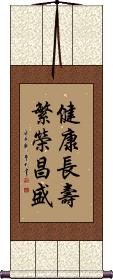
This means “Live Long And Prosper” in Chinese.
A phrase and greeting made famous by Leonard Nimoy in the role of Spock on the original Star Trek TV series.
Longevity / Long Life
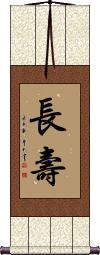
Used as a noun, this word means “longevity” or “the ability to live long.”
It can also be an adjective meaning “long-lived.”
 Please note that Japanese use a simplified version of the second character of longevity - it also happens to be the same simplification used in mainland China. Click on the character to the right if you want the Japanese/Simplified version of this two-character longevity calligraphy.
Eat Drink and Be Merry
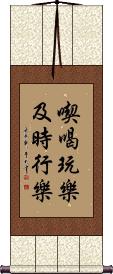
喫喝玩樂及時行樂 is just about the closest proverb to match the western idea of “Eat, drink, and be merry.”
This is a Chinese proverb that more literally means “Eat, drink, play, be merry, enjoy everything as long as you can.”
It's basically a suggestion that you try to enjoy everything in life, as long as you live, or as long as you are able.
Freedom from Anger and Worry Yields Longevity
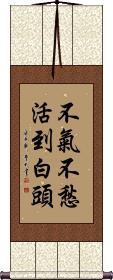
不气不愁活到白头 is a Chinese proverb that means “Without anger or worry, you will have a long life, until after all your hair is white.”
It more literally reads, “Don't get angry or worried [and you will] live [long] till [all your] hair [becomes] white.”
Banzai / Wansui
Old Japanese / Traditional Chinese & Korean
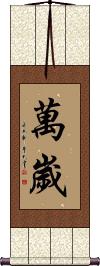
萬歲 is the traditional Chinese, Korean Hanja, and ancient Japanese way of writing banzai.
In modern times, the first character was simplified in Japan and China. So you might want to select the other entry for universal readability.
While it has become a popular, if not an odd, thing to scream as you jump out of an airplane (preferably with a parachute attached), banzai is actually a very old Asian way to say “hooray.” The Japanese word “banzai” comes from the Chinese word “wan sui,” which means “The age of 10,000 years.” It is actually a wish that the Emperor or the Empire live that long.
Imagine long ago when the Emperor made a rare public appearance. 萬歲 is what all people would yell to their leader in respect.
So if you like it as a hooray, or you want to wish someone that they live for 10,000 years, this is the calligraphy for you.
Other translations include Cheers! (not the drinking kind), hurrah!, long live [name]!, and congratulations!
To other things with banzai in their names, I am still waiting for the promised sequel to Buckaroo Banzai.
Notes: Sometimes people confuse banzai with bonsai. A bonsai is a miniature tree. They have nothing to do with each other.
Banzai
Modern Japanese Version
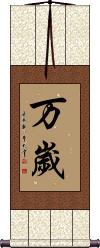
万歲 is the modern Japanese way to write banzai.
We've made two almost identical entries for this word, with just a variation on the first character. In the last century, 萬 was simplified to 万 in Japan and China. The new generation will expect it to be written as 万 but the old generation can still read the more traditional 萬 form. You must make your determination as to what version is best for you. If your audience is mostly Japanese, I suggest 万歲.
While it has become a popular, if not an odd, thing to scream as you jump out of an airplane (preferably with a parachute attached), banzai is actually a very old Asian way to say “hooray.” The Japanese word “banzai” comes from the Chinese word “wan sui” which means “The age of 10,000 years.” It is actually a wish that the Emperor or the Empire live that long.
Imagine long ago when the Emperor made a rare public appearance. This is what all of the people would yell to their leader in respect.
So if you like it as a hooray, or you want to wish someone that they live for 10,000 years, this is the calligraphy for you.
To other things with banzai in their names, I am still waiting for the promised sequel to Buckaroo Banzai.
Other translations: hurrah, long life, congratulations, cheers, live long.
Notes: Sometimes people confuse banzai with bonsai. A bonsai is a miniature tree. They have nothing to do with each other. Further, Bonzai is not a word at all - although it would make a great name for a calcium supplement for older people.
Together Forever in Love
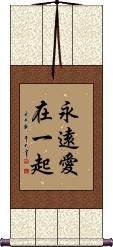
永遠愛在一起 is “together forever in love” in Chinese.
It's a nice phrase if you're a couple who plans to stay together and make your love last as long as you live.
100 Years of Happy Marriage
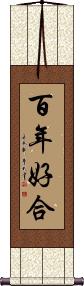
百年好合 is a wish or greeting, often heard at Chinese weddings, for a couple to have 100 good years together.
Some will translate this more naturally into English as: “May you live a long and happy life together.”
The character breakdown:
百 = 100
年 = Years
好 = Good (Happy)
合 = Together
Death Before Dishonor
Better to be broken jade than unbroken pottery
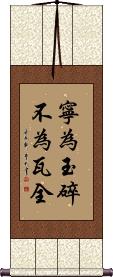
寧為玉碎不為瓦全 is the long version of a Chinese proverb that means “rather be shattered piece of jade than an unbroken piece of pottery.”
A little more explanation:
Death is implied with the “broken” meaning. Jade is one of the most precious materials in Chinese history, and in this case, is compared with one's honor and self-worth. Pottery is just something you eat off of, it has no deep value, just as a person who has lost their honor, or had none to begin with.
Thus, this means “better to die with honor than to live in shame” or words to that effect.
寧為玉碎不為瓦全 is often translated in English as “Death Before Dishonor,” the famous military slogan.
I would also compare this to the English proverb, “Better to die on your feet than to live on your knees.”
This is an idiom. It therefore doesn’t directly say exactly what it means. If you think about the English idiom, "The grass is always greener," it does not directly say "jealousy" or "envy" but everyone knows that it is implied.
Eternal Friendship / Friends Forever
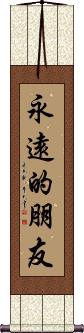
永遠的朋友 means friends that are eternal or a friendship that will last forever - you will remain the best of friends as long as you live.
The first two characters mean forever, eternal, eternity, perpetuity, immortality, and/or permanence.
The middle character links the words (it's a possessive article).
The last two characters represent friendship, or simply “friends.”
Better Late Than Never
It's Never Too Late Too Mend
Long ago in what is now China, there were many kingdoms throughout the land. This time period is known as “The Warring States Period” by historians because these kingdoms often did not get along with each other.
Sometime around 279 B.C. the Kingdom of Chu was a large but not particularly powerful kingdom. Part of the reason it lacked power was the fact that the King was surrounded by “yes men” who told him only what he wanted to hear. Many of the King's court officials were corrupt and incompetent which did not help the situation.
The King was not blameless himself, as he started spending much of his time being entertained by his many concubines.
One of the King's ministers, Zhuang Xin, saw problems on the horizon for the Kingdom, and warned the King, “Your Majesty, you are surrounded by people who tell you what you want to hear. They tell you things to make you happy and cause you to ignore important state affairs. If this is allowed to continue, the Kingdom of Chu will surely perish, and fall into ruins.”
This enraged the King who scolded Zhuang Xin for insulting the country and accused him of trying to create resentment among the people. Zhuang Xin explained, “I dare not curse the Kingdom of Chu but I feel that we face great danger in the future because of the current situation.” The King was simply not impressed with Zhuang Xin's words.
Seeing the King's displeasure with him and the King's fondness for his court of corrupt officials, Zhuang Xin asked permission from the King that he may take leave of the Kingdom of Chu, and travel to the State of Zhao to live. The King agreed, and Zhuang Xin left the Kingdom of Chu, perhaps forever.
Five months later, troops from the neighboring Kingdom of Qin invaded Chu, taking a huge tract of land. The King of Chu went into exile, and it appeared that soon, the Kingdom of Chu would no longer exist.
The King of Chu remembered the words of Zhuang Xin and sent some of his men to find him. Immediately, Zhuang Xin returned to meet the King. The first question asked by the King was “What can I do now?”
Zhuang Xin told the King this story:
A shepherd woke one morning to find a sheep missing. Looking at the pen saw a hole in the fence where a wolf had come through to steal one of his sheep. His friends told him that he had best fix the hole at once. But the Shepherd thought since the sheep is already gone, there is no use fixing the hole.
The next morning, another sheep was missing. And the Shepherd realized that he must mend the fence at once. Zhuang Xin then went on to make suggestions about what could be done to reclaim the land lost to the Kingdom of Qin, and reclaim the former glory and integrity of the Kingdom of Chu.
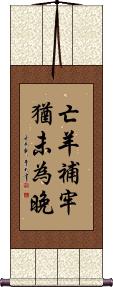
The Chinese idiom shown above came from this reply from Zhuang Xin to the King of Chu almost 2,300 years ago.
It translates roughly into English as...
“Even if you have lost some sheep, it's never too late to mend the fence.”
This proverb, 亡羊补牢犹未为晚, is often used in modern China when suggesting in a hopeful way that someone change their ways, or fix something in their life. It might be used to suggest fixing a marriage, quitting smoking, or getting back on track after taking an unfortunate path in life among other things one might fix in their life.
I suppose in the same way that we might say, “Today is the first day of the rest of your life” in our western cultures to suggest that you can always start anew.
Note: This does have Korean pronunciation but is not a well-known proverb in Korean (only Koreans familiar with ancient Chinese history would know it). Best if your audience is Chinese.
This in-stock artwork might be what you are looking for, and ships right away...

Gallery Price: $61.00
Your Price: $33.88

Gallery Price: $31.00
Your Price: $16.88
Gallery Price: $47.00
Your Price: $26.00
Gallery Price: $31.00
Your Price: $17.00

Gallery Price: $61.00
Your Price: $33.88

Gallery Price: $200.00
Your Price: $122.88

Gallery Price: $130.00
Your Price: $69.88
The following table may be helpful for those studying Chinese or Japanese...
| Title | Characters | Romaji (Romanized Japanese) | Various forms of Romanized Chinese | |
| Live Long and Prosper | 健康長壽繁榮昌盛 健康长寿繁荣昌盛 | Jiàn kāng cháng shòu fán róng chāng shèng Jian4 kang1 chang2 shou4 fan2 rong2 chang1 sheng4 Jian kang chang shou fan rong chang sheng | Chien k`ang ch`ang shou fan jung ch`ang sheng Chien kang chang shou fan jung chang sheng |
|
| Longevity Long Life | 長壽 长寿 | chouju / choju | cháng shòu chang2 shou4 chang shou changshou | ch`ang shou changshou chang shou |
| Eat Drink and Be Merry | 喫喝玩樂及時行樂 吃喝玩乐及时行乐 | chī hē wán lè jí shí xíng lè chi1 he1 wan2 le4 ji2 shi2 xing2 le4 chi he wan le ji shi xing le chihewanlejishixingle | ch`ih ho wan le chi shih hsing le chih ho wan le chi shih hsing le |
|
| Freedom from Anger and Worry Yields Longevity | 不氣不愁活到白頭 不气不愁活到白头 | bù qì bù chóu huó dào bái tóu bu4 qi4 bu4 chou2 huo2 dao4 bai2 tou2 bu qi bu chou huo dao bai tou buqibuchouhuodaobaitou | pu ch`i pu ch`ou huo tao pai t`ou puchipuchouhuotaopaitou pu chi pu chou huo tao pai tou |
|
| Banzai Wansui | 萬歲 万岁 | banzai / manzai | wàn suì / wan4 sui4 / wan sui / wansui | |
| Banzai | 万歲 / 萬歲 万岁 | banzai | wàn suì / wan4 sui4 / wan sui / wansui | |
| Together Forever in Love | 永遠愛在一起 永远爱在一起 | yǒng yuǎn ài zài yī qǐ yong3 yuan3 ai4 zai4 yi1 qi3 yong yuan ai zai yi qi yongyuanaizaiyiqi | yung yüan ai tsai i ch`i yungyüanaitsaiichi yung yüan ai tsai i chi |
|
| 100 Years of Happy Marriage | 百年好合 | bǎi nián hǎo hé bai3 nian2 hao3 he2 bai nian hao he bainianhaohe | pai nien hao ho painienhaoho |
|
| Death Before Dishonor | 寧為玉碎不為瓦全 宁为玉碎不为瓦全 | níng wéi yù suì bù wéi wǎ quán ning2 wei2 yu4 sui4 bu4 wei2 wa3 quan2 ning wei yu sui bu wei wa quan ningweiyusuibuweiwaquan | ning wei yü sui pu wei wa ch`üan ning wei yü sui pu wei wa chüan |
|
| Eternal Friendship Friends Forever | 永遠的朋友 永远的朋友 | yǒng yuǎn de péng yǒu yong3 yuan3 de peng2 you3 yong yuan de peng you yongyuandepengyou | yung yüan te p`eng yu yungyüantepengyu yung yüan te peng yu |
|
| Better Late Than Never | 亡羊補牢猶未為晚 亡羊补牢犹未为晚 | wáng yáng bǔ láo yóu wèi wéi wǎn wang2 yang2 bu3 lao2 you2 wei4 wei2 wan3 wang yang bu lao you wei wei wan | wang yang pu lao yu wei wei wan wangyangpulaoyuweiweiwan |
|
| In some entries above you will see that characters have different versions above and below a line. In these cases, the characters above the line are Traditional Chinese, while the ones below are Simplified Chinese. | ||||

Successful Chinese Character and Japanese Kanji calligraphy searches within the last few hours...



