Many custom options...


And formats...



Not what you want?
Try other similar-meaning words, fewer words, or just one word.
Bai Bai in Chinese / Japanese...
Buy a Bai Bai calligraphy wall scroll here!
Personalize your custom “Bai Bai” project by clicking the button next to your favorite “Bai Bai” title below...
Eternal Peace
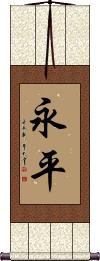
永平 is a way to write “eternal peace” in Chinese and Japanese.
This may also refer to Yongping county in Dali Bai autonomous prefecture. 永平 is also a Japanese surname that romanizes as Nagahira.
Inspire with redoubled courage
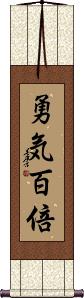
勇気百倍 means to inspire someone with fresh courage or redoubled courage in Japanese.
The Kanji breakdown:
勇気 (yuuki) courage; bravery; valour; valor; nerve; boldness.
百 (hyaku) 100; hundred.
倍 (bai) twice; double; 2-times; 2-fold.
White Eagle Style
Bai Ying Pai
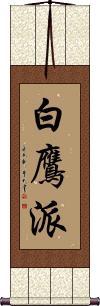
白鷹派 is the title “Bai Ying Pai” or “White Eagle School.”
The first character means white.
The second means eagle, falcon, and/or hawk.
The third means school (as in the school or style of martial arts).
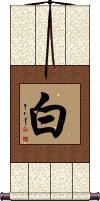
白 is a surname that can romanize as Pai from Chinese.
Meaning: "white," "pure," or "clear".
Context: Can be linked to the Bai/Pai people or geographical features; variations exist.
You might want the Korean surname, 裵, which is often written as Pae but sometimes as Pai.
The Korean surname 裵 is associated with the ancient Kyŏngju Pae clan.
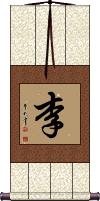
This is the most common Chinese character which sounds like “Lee” or “Li” and is used as a surname / family name in China.
李 actually means “Plum.” So it's really Mr. Plum and Mrs. Plum if you translated the name instead of romanizing.
This is not the only character in Chinese that can be romanized as “Lee” or “Li.” If your family name is “Lee” or “Li” please be sure this is the correct character before you order this scroll (look at your grandparents' Chinese passports or other documents if you are an ABC and are trying to create a heritage wall scroll).
Famous people with this surname include Bruce Lee (Li Xiao-Long), Minister Li Peng, and famous Tang Dynasty poet Li Bai.
In Korea, this is the original character for a surname that romanizes as “Yi.”
Note: This also one version of Lee that is a common Korean surname. However, it’s often romanized as "Yi" and sometimes as "Ri" or "Rhee."
Undaunted After Repeated Setbacks
Persistence to overcome all challenges
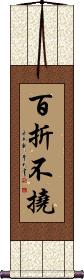
百折不撓 is a Chinese proverb that means “Be undaunted in the face of repeated setbacks.”
More directly translated, it reads, “[Overcome] a hundred setbacks, without flinching.” 百折不撓 is of Chinese origin but is commonly used in Japanese and somewhat in Korean (same characters, different pronunciation).
This proverb comes from a long, and occasionally tragic story of a man that lived sometime around 25-220 AD. His name was Qiao Xuan, and he never stooped to flattery but remained an upright person at all times. He fought to expose the corruption of higher-level government officials at great risk to himself.
Then when he was at a higher level in the Imperial Court, bandits were regularly capturing hostages and demanding ransoms. But when his own son was captured, he was so focused on his duty to the Emperor and the common good that he sent a platoon of soldiers to raid the bandits' hideout, and stop them once and for all even at the risk of his own son's life. While all of the bandits were arrested in the raid, they killed Qiao Xuan's son at first sight of the raiding soldiers.
Near the end of his career, a new Emperor came to power, and Qiao Xuan reported to him that one of his ministers was bullying the people and extorting money from them. The new Emperor refused to listen to Qiao Xuan and even promoted the corrupt Minister. Qiao Xuan was so disgusted that in protest, he resigned from his post as minister (something almost never done) and left for his home village.
His tombstone reads “Bai Zhe Bu Nao” which is now a proverb used in Chinese culture to describe a person of strong will who puts up stubborn resistance against great odds.
My Chinese-English dictionary defines these 4 characters as “keep on fighting despite all setbacks,” “be undaunted by repeated setbacks,” and “be indomitable.”
Our translator says it can mean “never give up” in modern Chinese.
Although the first two characters are translated correctly as “repeated setbacks,” the literal meaning is “100 setbacks” or “a rope that breaks 100 times.” The last two characters can mean “do not yield” or “do not give up.”
Most Chinese, Japanese, and Korean people will not take this absolutely literal meaning but will instead understand it as the title suggests above. If you want a single big word definition, it would be indefatigability, indomitableness, persistence, or unyielding.
See Also: Tenacity | Fortitude | Strength | Perseverance | Persistence
Not the results for bai bai that you were looking for?
Below are some entries from our dictionary that may match your bai bai search...
| Characters If shown, 2nd row is Simp. Chinese |
Pronunciation Romanization |
Simple Dictionary Definition |
永平 see styles |
yǒng píng yong3 ping2 yung p`ing yung ping yunpin ユンピン |
More info & calligraphy: Eternal Peace(place-name) Yongping (China) eternal peace |
倍 see styles |
bèi bei4 pei bai ばい |
(two, three etc) -fold; times (multiplier); double; to increase or multiply (noun - becomes adjective with の) (1) double; twice (as much); (counter) (2) times (as much); -fold; (counter) (3) (e.g. 40倍 = 1 in 40) 1-nth; 1 to n; 1 in n; (surname) Bai Double, double-fold, a fold; to turn from or against, to revolt. |
唄 呗 see styles |
bei bei5 pei bai ばい |
modal particle indicating lack of enthusiasm; modal particle indicating that things should only or can only be done a certain way song; (surname) Bai pāṭha; pāṭhaka; read, recite, intone, chant, hymns in praise of Buddha; 唄匿 is erroneously said to transliterate the Sanskrit root vi-ne and to be the same as 婆陟 (or 婆師), but these are bhāṣa. |
培 see styles |
péi pei2 p`ei pei bai ばい |
to bank up with earth; to cultivate (lit. or fig.); to train (people) (given name) Bai |
孛 see styles |
bèi bei4 pei bai |
comet Po; plants shooting; a comet. |
梖 see styles |
bèi bei4 pei bai |
pattra; 梖多葉 the palm-leaves used for writing; the梖多樹 is erroneously said to be the borassus flabelliformis, described as 60 or 70 feet high, not deciduous, the bark used for writing. |
棓 see styles |
bàng bang4 pang bai |
A flail. |
陪 see styles |
péi pei2 p`ei pei bai |
to accompany; to keep sb company; to assist; old variant of 賠|赔[pei2] To accompany, associated with; add to, assist. |
霾 see styles |
mái mai2 mai bai ばい |
haze (See 黄砂・こうさ・1) loess; yellow sand; bai; dust from the Yellow River region (China) |
劍川 剑川 see styles |
jiàn chuān jian4 chuan1 chien ch`uan chien chuan |
Jianchuan county in Dali Bai autonomous prefecture 大理白族自治州[Da4 li3 Bai2 zu2 zi4 zhi4 zhou1], Yunnan |
場合 场合 see styles |
chǎng hé chang3 he2 ch`ang ho chang ho baai / bai ばあい |
situation; occasion; context; setting; location; venue (colloquialism) (kana only) (dialectal) (See 場合・ばあい) case; occasion; situation; circumstances; (surname) Baai |
宋白 see styles |
sòng bái song4 bai2 sung pai |
Song Bai (936-1012), Northern Song literary man |
彌渡 弥渡 see styles |
mí dù mi2 du4 mi tu |
Midu county in Dali Bai autonomous prefecture 大理白族自治州[Da4 li3 Bai2 zu2 zi4 zhi4 zhou1], Yunnan |
李白 see styles |
lǐ bái li3 bai2 li pai riibai / ribai リーバイ |
Li Bai (701-762), famous Tang Dynasty poet (person) Li Bai (701-762; Tang dynasty poet) |
梅井 see styles |
baii / bai ばいい |
(surname) Baii |
梅居 see styles |
baii / bai ばいい |
(surname) Baii |
民家 see styles |
mín jiā min2 jia1 min chia tamiya たみや |
minka; commoner's house; Bai ethnic group private house; (surname) Tamiya |
洱源 see styles |
ěr yuán er3 yuan2 erh yüan |
Eryuan county in Dali Bai autonomous prefecture 大理白族自治州[Da4 li3 Bai2 zu2 zi4 zhi4 zhou1], Yunnan |
白し see styles |
byakushi びゃくし |
(1) (kana only) bai zhi (Chinese name for angelica species Angelica dahurica); traditional Chinese cure made from the root of this plant; (2) Heracleum nipponicum (species of hogweed) |
白族 see styles |
bái zú bai2 zu2 pai tsu |
Bai ethnic group |
白樸 白朴 see styles |
bái pǔ bai2 pu3 pai p`u pai pu |
Bai Pu (1226-1306), Yuan dynasty dramatist in the 雜劇|杂剧 tradition of musical comedy, one of the Four Great Yuan dramatists 元曲四大家 |
白沢 see styles |
shirozawa しろざわ |
bai ze (mythical chinese animal able to understand human speech, having the body of a lion and eight eyes); (surname) Shirozawa |
白澤 白泽 see styles |
bái zé bai2 ze2 pai tse shirosawa しろさわ |
Bai Ze or White Marsh, legendary creature of ancient China bai ze (mythical chinese animal able to understand human speech, having the body of a lion and eight eyes); (surname) Shirosawa |
白詩 see styles |
hakushi はくし |
(rare) poem by Bai Juyi |
白起 see styles |
bái qǐ bai2 qi3 pai ch`i pai chi |
Bai Qi (-258 BC), famous general of Qin 秦國|秦国, the victor at 長平|长平 in 260 BC; same as 公孫起|公孙起 |
蘭坪 兰坪 see styles |
lán píng lan2 ping2 lan p`ing lan ping |
Lanping Bai and Pumi autonomous county in Nujiang Lisu autonomous prefecture 怒江傈僳族自治州[Nu4 jiang1 Li4 su4 zu2 zi4 zhi4 zhou1] in northwest Yunnan |
詩仙 诗仙 see styles |
shī xiān shi1 xian1 shih hsien shisen しせん |
"immortal of poetry", epithet of Li Bai 李白[Li3 Bai2] great poet |
謫仙 谪仙 see styles |
zhé xiān zhe2 xian1 che hsien |
a genius (literally, an immortal who has been banished from heaven to live on earth), an epithet for exceptional individuals such as the Tang poet Li Bai 李白[Li3 Bai2]; (fig.) banished official |
賓川 宾川 see styles |
bīn chuān bin1 chuan1 pin ch`uan pin chuan |
Binchuan county in Dali Bai autonomous prefecture 大理白族自治州[Da4 li3 Bai2 zu2 zi4 zhi4 zhou1], Yunnan |
醉聖 醉圣 see styles |
zuì shèng zui4 sheng4 tsui sheng |
the Sage of intoxication; refers to Tang Dynasty poet Li Bai 李白 (701-762) |
Click here for more bai bai results from our dictionary
The following table may be helpful for those studying Chinese or Japanese...
| Title | Characters | Romaji (Romanized Japanese) | Various forms of Romanized Chinese | |
| Eternal Peace | 永平 | eihei | yǒng píng yong3 ping2 yong ping yongping | yung p`ing yungping yung ping |
| Inspire with redoubled courage | 勇気百倍 | yuuki hyaku bai yuukihyakubai yuki hyaku bai | ||
| White Eagle Style | 白鷹派 白鹰派 | bái yīng pài bai2 ying1 pai4 bai ying pai baiyingpai | pai ying p`ai paiyingpai pai ying pai |
|
| Pai | 白 | bái / bai2 / bai | pai | |
| Lee | 李 | ri / sumomo | lǐ / li3 / li | |
| Undaunted After Repeated Setbacks | 百折不撓 百折不挠 | hyaku setsu su tou hyakusetsusutou hyaku setsu su to | bǎi zhé bù náo bai3 zhe2 bu4 nao2 bai zhe bu nao baizhebunao | pai che pu nao paichepunao |
| In some entries above you will see that characters have different versions above and below a line. In these cases, the characters above the line are Traditional Chinese, while the ones below are Simplified Chinese. | ||||

Successful Chinese Character and Japanese Kanji calligraphy searches within the last few hours...



