Many custom options...


And formats...



Bang in Chinese / Japanese...
Buy a Bang calligraphy wall scroll here!
Personalize your custom “Bang” project by clicking the button next to your favorite “Bang” title below...
2. Bo Staff
3. Bambang
4. Baseball
5. Bonni
6. Bonny
7. Iban
8. Jabon
9. Pamphile
10. Bunker
11. Rabon
12. Pabon
13. Dupont
14. Bunton
15. Bunting
16. Bunch
17. Bundy
18. Bunce
19. Bounds
20. Bonney
21. Bonner
22. Bonham
23. Mattibong
24. Obongo
25. Abundane
26. Labonte
27. Bunnell
28. Bumgarner
29. Bonnett
30. Bonnell
31. Siyabonga
32. Bumgardner
33. Bontrager
Bojutsu / Bojitsu
The art of using a stick as a weapon
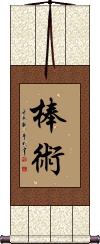
棒術 is the title Bōjutsu (though some use the romanization Bojitsu).
棒術 is a martial art centered around using a “bō” or staff as a weapon.
This title is a combination of the Japanese word “bō” (which means staff, stick, club, rod, pole, or cudgel) with the Japanese word “jutsu” (which means art or technique).
While this word can be pronounced in Chinese (bang shu), it's not a common term in China. Please consider this title to be “Japanese only.”
Bo Staff

棒 is the Kanji for bo staff.
In the context of martial arts, this is a bo staff. However, the actual meaning of this character is stick, club, cudgel, pole, rod, baton, or staff.
Bambang
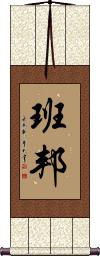
班邦 is the name Bambang in Chinese (Mandarin).
Baseball
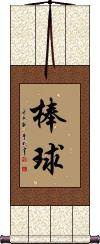
棒球 is the Chinese title for the sport of baseball.
Bonni
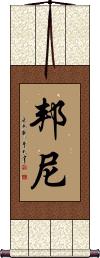
邦尼 is the name Bonni in Chinese (Mandarin).
Bonny
邦尼 is the name Bonny in Chinese (Mandarin).
Iban
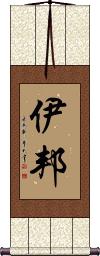
伊邦 is the name Iban in Chinese (Mandarin).
Jabon
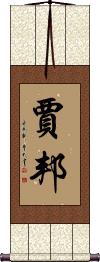
賈邦 is the name Jabon in Chinese (Mandarin).
Pamphile
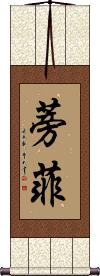
This is a common Mandarin Chinese transliteration for the male French name Pamphile.
Bunker

邦克 is the name Bunker in Chinese (Mandarin).
Rabon

拉邦 is the name Rabon in Chinese (Mandarin).
Pabon

帕邦 is the name Pabon in Chinese (Mandarin).
Dupont

杜邦 is the name Dupont in Chinese (Mandarin).
Bunton

邦頓 is the name Bunton in Chinese (Mandarin).
Bunting

邦廷 is the name Bunting in Chinese (Mandarin).
Bunch

邦奇 is the name Bunch in Chinese (Mandarin).
Bundy

邦迪 is the name Bundy in Chinese (Mandarin).
Bunce

邦斯 is the name Bunce in Chinese (Mandarin).
Bounds

邦茲 is the name Bounds in Chinese (Mandarin).
Bonney
邦尼 is the name Bonney in Chinese (Mandarin).
Bonner

邦納 is the name Bonner in Chinese (Mandarin).
Bonham

邦漢 is the name Bonham in Chinese (Mandarin).
Mattibong
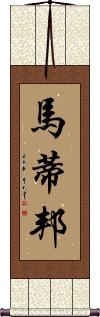
馬蒂邦 is the name Mattibong in Chinese (Mandarin).
Obongo
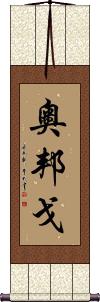
奧邦戈 is the name Obongo in Chinese (Mandarin).
Abundane

阿邦丹 is the name Abundane in Chinese (Mandarin).
Labonte

拉邦特 is the name Labonte in Chinese (Mandarin).
Bunnell

邦內爾 is the name Bunnell in Chinese (Mandarin).
Bumgarner

邦加納 is the name Bumgarner in Chinese (Mandarin).
Bonnett

邦內特 is the name Bonnett in Chinese (Mandarin).
Bonnell
邦內爾 is the name Bonnell in Chinese (Mandarin).
Siyabonga
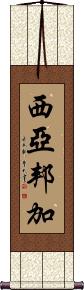
西亞邦加 is the name Siyabonga in Chinese (Mandarin).
Bumgardner

邦加德納 is the name Bumgardner in Chinese (Mandarin).
Bontrager

邦特雷格 is the name Bontrager in Chinese (Mandarin).
Spare the Rod, Spoil the Child
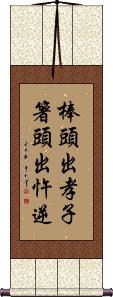
棒頭出孝子箸頭出忤逆 literally translates as:
A stick (or switch) produces filial sons; chopsticks produce disobedient [ones].
Figuratively, this means:
Strict discipline produces dutiful children, whereas indulgence produces disobedient ones.
This proverb is very similar to this English proverb:
“Spare the rod and spoil the child.”
Daodejing / Tao Te Ching - Chapter 54
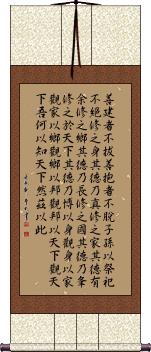
This is the Mawangdui version of Daodejing chapter 54.
By its virtue alone can one generation after another carry on the ancestral sacrifice.
Apply it to yourself, and by its power, you will be freed from dross.
Apply it to your household, and your household shall thereby have abundance.
Apply it to the village, and the village will be made secure.
Apply it to the kingdom, and the kingdom shall thereby be made to flourish.
Apply it to an empire, and the empire shall thereby be extended.
Therefore just as through oneself, one may contemplate Oneself;
So through the household one may contemplate the Household;
And through the village, one may contemplate the Village;
And through the kingdom, one may contemplate the Kingdom;
And through the empire, one may contemplate the Empire.
How do I know that the empire is so? By this.
What is firmly rooted cannot be pulled out;
What is tightly held in the arms will not slip loose;
Through this, the offering of sacrifice by descendants will never come to an end.
Cultivate it in your person, and its virtue will be genuine;
Cultivate it in the family, and its virtue will be more than sufficient;
Cultivate it in the hamlet, and its virtue will endure;
Cultivate it in the state, and its virtue will abound;
Cultivate it in the empire, and its virtue will be pervasive.
Hence look at the person through the person;
Look at the family through the family;
Look at the hamlet through the hamlet;
Look at the state through the state;
Look at the empire through the empire.
How do I know that the empire is like that?
By means of this.
Not the results for bang that you were looking for?
Below are some entries from our dictionary that may match your bang search...
| Characters If shown, 2nd row is Simp. Chinese |
Pronunciation Romanization |
Simple Dictionary Definition |
棒 see styles |
bàng bang4 pang bou / bo ぼう |
More info & calligraphy: Bo Staff(1) pole; rod; stick; baton; (2) line; dash; (expression) (3) (net-sl) (See 棒読み・1) spoken monotonously; (surname) Bou A stick, cudgel. |
杜邦 see styles |
dù bāng du4 bang1 tu pang |
More info & calligraphy: Dupont |
棒球 see styles |
bàng qiú bang4 qiu2 pang ch`iu pang chiu boudama / bodama ぼうだま |
More info & calligraphy: Baseball{baseb} powerless straight ball |
邦迪 see styles |
bāng dí bang1 di2 pang ti |
More info & calligraphy: Bundy |
傍 see styles |
bàng bang4 pang houki / hoki ほうき |
near; approaching; to depend on; (slang) to have an intimate relationship with sb; Taiwan pr. [pang2], [bang1], [bang4] (1) (kana only) near; close; beside; vicinity; proximity; besides; while; (2) third person; (kana only) near; close; beside; vicinity; proximity; besides; while; (irregular okurigana usage) (adj-no,n-adv,n-t) (1) side; edge; beside; besides; nearby; (adverbial noun) (2) (kana only) while (doing); in addition to; at the same time; (personal name) Houki Near, adjoining, side, dependent. |
塝 see styles |
bàng bang4 pang |
the edge; border of a field |
幇 帮 see styles |
bāng bang1 pang |
old variant of 幫|帮[bang1] |
幚 帮 see styles |
bāng bang1 pang |
old variant of 幫|帮[bang1] |
幫 帮 see styles |
bāng bang1 pang |
to help; to assist; to support; for sb (i.e. as a help); hired (as worker); side (of pail, boat etc); outer layer; upper (of a shoe); group; gang; clique; party; secret society |
梆 see styles |
bāng bang1 pang |
watchman's rattle |
棓 see styles |
bàng bang4 pang bai |
A flail. |
浜 see styles |
bāng bang1 pang murahama むらはま |
stream; creek (1) beach; seashore; (2) (abbreviation) (kana only) {go} (See 揚げ浜・2) captured pieces; captured stones; (3) (abbreviation) (See 横浜) Yokohama; (4) (archaism) (osb:) riverbank; riverside; (personal name) Murahama |
牓 榜 see styles |
bǎng bang3 pang |
variant of 榜[bang3] See: 榜 |
玤 see styles |
bàng bang4 pang |
(gem) |
綁 绑 see styles |
bǎng bang3 pang |
to tie; bind or fasten together; to kidnap |
艕 see styles |
bàng bang4 pang |
two boats fastened side by side |
蒡 see styles |
bàng bang4 pang |
used in 牛蒡[niu2 bang4] |
蚌 see styles |
bàng bang4 pang hamaguri はまぐり |
mussel; clam (kana only) common orient clam (Meretrix lusoria) |
蜯 see styles |
bàng bang4 pang |
variant of 蚌[bang4] |
謗 谤 see styles |
bàng bang4 pang hō |
to slander; to defame; to speak ill of To slander. 誹謗 To slander, vilify, defame. |
邦 see styles |
bāng bang1 pang miyako みやこ |
(bound form) country; nation; state (1) country; state; (2) region; (3) national government; central government; (4) home (i.e. hometown, home country); (5) (archaism) province (of Japan); (6) (archaism) land; earth; (female given name) Miyako |
鎊 镑 see styles |
bàng bang4 pang |
pound (sterling) (loanword) |
髈 膀 see styles |
bǎng bang3 pang |
old variant of 膀[bang3] |
上榜 see styles |
shàng bǎng shang4 bang3 shang pang |
to appear on the public roll of successful examinees (i.e. pass an exam); to make the list; (of a song) to hit the charts |
下棒 see styles |
xià bàng xia4 bang4 hsia pang abō |
To lay on the cudgel, beat; syn. for the 德山 Te Shan monastery, whose Chan sect abbot instilled intelligence with his staff. |
丐幫 丐帮 see styles |
gài bāng gai4 bang1 kai pang |
beggars' union; a group of beggars |
中幫 中帮 see styles |
zhōng bāng zhong1 bang1 chung pang |
mid-top (shoes) |
低幫 低帮 see styles |
dī bāng di1 bang1 ti pang |
low-top (shoes) |
依傍 see styles |
yī bàng yi1 bang4 i pang |
to rely on; to depend on; to imitate (a model); to base a work (on some model) |
偎傍 see styles |
wēi bàng wei1 bang4 wei pang |
to snuggle up to |
Click here for more bang results from our dictionary
The following table may be helpful for those studying Chinese or Japanese...
| Title | Characters | Romaji (Romanized Japanese) | Various forms of Romanized Chinese | |
| Bojutsu Bojitsu | 棒術 棒术 | bou jutsu / boujutsu / bo jutsu | bàng shù / bang4 shu4 / bang shu / bangshu | pang shu / pangshu |
| Bo Staff | 棒 | bou / bo | bàng / bang4 / bang | pang |
| Bambang | 班邦 | bān bāng / ban1 bang1 / ban bang / banbang | pan pang / panpang | |
| Baseball | 棒球 | bàng qiú / bang4 qiu2 / bang qiu / bangqiu | pang ch`iu / pangchiu / pang chiu | |
| Bonni | 邦尼 | bāng ní / bang1 ni1 / bang ni / bangni | pang ni / pangni | |
| Bonny | 邦尼 | bāng ní / bang1 ni1 / bang ni / bangni | pang ni / pangni | |
| Iban | 伊邦 | yī bāng / yi1 bang1 / yi bang / yibang | i pang / ipang | |
| Jabon | 賈邦 贾邦 | jiǎ bāng / jia3 bang1 / jia bang / jiabang | chia pang / chiapang | |
| Pamphile | 蒡菲 | bàng fēi / bang4 fei1 / bang fei / bangfei | pang fei / pangfei | |
| Bunker | 邦克 | bāng kè / bang1 ke4 / bang ke / bangke | pang k`o / pangko / pang ko | |
| Rabon | 拉邦 | lā bāng / la1 bang1 / la bang / labang | la pang / lapang | |
| Pabon | 帕邦 | pà bāng / pa4 bang1 / pa bang / pabang | p`a pang / papang / pa pang | |
| Dupont | 杜邦 | dù bāng / du4 bang1 / du bang / dubang | tu pang / tupang | |
| Bunton | 邦頓 邦顿 | bāng dùn / bang1 dun4 / bang dun / bangdun | pang tun / pangtun | |
| Bunting | 邦廷 | bāng tíng bang1 ting2 bang ting bangting | pang t`ing pangting pang ting |
|
| Bunch | 邦奇 | bāng qí / bang1 qi2 / bang qi / bangqi | pang ch`i / pangchi / pang chi | |
| Bundy | 邦迪 | bāng dí / bang1 di2 / bang di / bangdi | pang ti / pangti | |
| Bunce | 邦斯 | bāng sī / bang1 si1 / bang si / bangsi | pang ssu / pangssu | |
| Bounds | 邦茲 邦兹 | bāng zī / bang1 zi1 / bang zi / bangzi | pang tzu / pangtzu | |
| Bonney | 邦尼 | bāng ní / bang1 ni2 / bang ni / bangni | pang ni / pangni | |
| Bonner | 邦納 邦纳 | bāng nà / bang1 na4 / bang na / bangna | pang na / pangna | |
| Bonham | 邦漢 邦汉 | bāng hàn / bang1 han4 / bang han / banghan | pang han / panghan | |
| Mattibong | 馬蒂邦 马蒂邦 | mǎ dì bāng ma3 di4 bang1 ma di bang madibang | ma ti pang matipang |
|
| Obongo | 奧邦戈 奥邦戈 | ào bāng gē ao4 bang1 ge1 ao bang ge aobangge | ao pang ko aopangko |
|
| Abundane | 阿邦丹 | ā bāng dān a1 bang1 dan1 a bang dan abangdan | a pang tan apangtan |
|
| Labonte | 拉邦特 | lā bāng tè la1 bang1 te4 la bang te labangte | la pang t`e lapangte la pang te |
|
| Bunnell | 邦內爾 邦内尔 | bāng nèi ěr bang1 nei4 er3 bang nei er bangneier | pang nei erh pangneierh |
|
| Bumgarner | 邦加納 邦加纳 | bāng jiā nà bang1 jia1 na4 bang jia na bangjiana | pang chia na pangchiana |
|
| Bonnett | 邦內特 邦内特 | bāng nèi tè bang1 nei4 te4 bang nei te bangneite | pang nei t`e pangneite pang nei te |
|
| Bonnell | 邦內爾 邦内尔 | bāng nèi ěr bang1 nei4 er3 bang nei er bangneier | pang nei erh pangneierh |
|
| Siyabonga | 西亞邦加 西亚邦加 | xī yà bāng jiā xi1 ya4 bang1 jia1 xi ya bang jia xiyabangjia | hsi ya pang chia hsiyapangchia |
|
| Bumgardner | 邦加德納 邦加德纳 | bāng jiā dé nà bang1 jia1 de2 na4 bang jia de na bangjiadena | pang chia te na pangchiatena |
|
| Bontrager | 邦特雷格 | bāng tè léi gé bang1 te4 lei2 ge2 bang te lei ge bangteleige | pang t`e lei ko pangteleiko pang te lei ko |
|
| Spare the Rod, Spoil the Child | 棒頭出孝子箸頭出忤逆 | bàng tóu chū xiào zǐ zhù tóu chū wǔ nì bang4 tou2 chu1 xiao4 zi3 zhu4 tou2 chu1 wu3 ni4 bang tou chu xiao zi zhu tou chu wu ni | pang t`ou ch`u hsiao tzu chu t`ou ch`u wu ni pang tou chu hsiao tzu chu tou chu wu ni |
|
| Daodejing Tao Te Ching - Chapter 54 | 善建者不拔善抱者不脫子孫以祭祀不絕修之身其德乃真修之家其德有余修之鄉其德乃長修之國其德乃夆修之於天下其德乃博以身觀身以家觀家以鄉觀鄉以邦觀邦以天下觀天下吾何以知天下然茲以此 善建者不拔善抱者不脱子孙以祭祀不绝修之身其德乃真修之家其德有余修之乡其德乃长修之国其德乃夆修之于天下其德乃博以身观身以家观家以乡观乡以邦观邦以天下观天下吾何以知天下然兹以此 | shàn jiàn zhě bù bá shàn bào zhě bù tuō zǐ sūn yǐ jì sì bù jué xiū zhī shēn qí dé nǎi zhēn xiū zhī jiā qí dé yǒu yú xiū zhī xiāng qí dé nǎi zhǎng xiū zhī guó qí dé nǎi féng xiū zhī yú tiān xià qí dé nǎi bó yǐ shēn guān shēn yǐ jiā guān jiā yǐ xiāng guān xiāng yǐ bāng guān bāng yǐ tiān xià guān tiān xià wú hé yǐ zhī tiān xià rán zī yǐ cǐ shan4 jian4 zhe3 bu4 ba2 shan4 bao4 zhe3 bu4 tuo1 zi3 sun1 yi3 ji4 si4 bu4 jue2 xiu1 zhi1 shen1 qi2 de2 nai3 zhen1 xiu1 zhi1 jia1 qi2 de2 you3 yu2 xiu1 zhi1 xiang1 qi2 de2 nai3 zhang3 xiu1 zhi1 guo2 qi2 de2 nai3 feng2 xiu1 zhi1 yu2 tian1 xia4 qi2 de2 nai3 bo2 yi3 shen1 guan1 shen1 yi3 jia1 guan1 jia1 yi3 xiang1 guan1 xiang1 yi3 bang1 guan1 bang1 yi3 tian1 xia4 guan1 tian1 xia4 wu2 he2 yi3 zhi1 tian1 xia4 ran2 zi1 yi3 ci3 shan jian zhe bu ba shan bao zhe bu tuo zi sun yi ji si bu jue xiu zhi shen qi de nai zhen xiu zhi jia qi de you yu xiu zhi xiang qi de nai zhang xiu zhi guo qi de nai feng xiu zhi yu tian xia qi de nai bo yi shen guan shen yi jia guan jia yi xiang guan xiang yi bang guan bang yi tian xia guan tian xia wu he yi zhi tian xia ran zi yi ci | shan chien che pu pa shan pao che pu t`o tzu sun i chi ssu pu chüeh hsiu chih shen ch`i te nai chen hsiu chih chia ch`i te yu yü hsiu chih hsiang ch`i te nai chang hsiu chih kuo ch`i te nai feng hsiu chih yü t`ien hsia ch`i te nai po i shen kuan shen i chia kuan chia i hsiang kuan hsiang i pang kuan pang i t`ien hsia kuan t`ien hsia wu ho i chih t`ien hsia jan tzu i tz`u shan chien che pu pa shan pao che pu to tzu sun i chi ssu pu chüeh hsiu chih shen chi te nai chen hsiu chih chia chi te yu yü hsiu chih hsiang chi te nai chang hsiu chih kuo chi te nai feng hsiu chih yü tien hsia chi te nai po i shen kuan shen i chia kuan chia i hsiang kuan hsiang i pang kuan pang i tien hsia kuan tien hsia wu ho i chih tien hsia jan tzu i tzu |
|
| In some entries above you will see that characters have different versions above and below a line. In these cases, the characters above the line are Traditional Chinese, while the ones below are Simplified Chinese. | ||||

Successful Chinese Character and Japanese Kanji calligraphy searches within the last few hours...



