Many custom options...


And formats...



Becomes in Chinese / Japanese...
Buy a Becomes calligraphy wall scroll here!
Personalize your custom “Becomes” project by clicking the button next to your favorite “Becomes” title below...
1. Self Awareness Becomes a Buddha
2. When Three People Gather, One Becomes a Teacher
3. Student
5. Freedom from Anger and Worry Yields Longevity
6. Seeing one’s Nature and becoming a Buddha
9. No Trouble / Freedom from Problems
10. Beauty Shop / Beauty Salon
12. Moon
13. Sword
14. Daodejing / Tao Te Ching - Chapter 27
15. Push or Knock
Self Awareness Becomes a Buddha
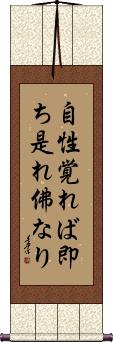
自性覚れば即ち是れ佛なり is a Zen quote that means “If one realizes one's own nature, one becomes a Buddha.”
The inference here is that if you understand who you really are, and become truly aware of yourself and your original nature, you are well on your way to becoming a liberated person (a Buddha).
Note: Because this selection contains some special Japanese Hiragana characters, it should be written by a Japanese calligrapher.
When Three People Gather, One Becomes a Teacher
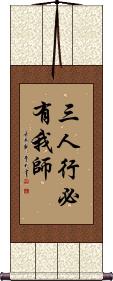
三人行必有我师 means “when three people meet, one becomes the teacher.”
This famous Chinese philosophy suggests that when people come together, they can always learn from each other.
One person must be the teacher and others learn. And in turn, the others become the teachers of the knowledge they possess.
It is important to remember that we all have something to teach, and we all have something to learn as well.
Student
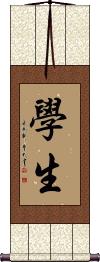
學生 is how to write “student” in Chinese, pre-WWII Japanese Kanji, and old Korean Hanja.
If you are a “student of life,” this might be an interesting wall scroll to hang in your reading room.
The first character means “study” or “learning.”
The second character means “life” or “birth.” Don't read too much into that second character unless you decide that this means “the birth of studies” or “the life of learning.” Everyone in China, Japan (and those who can read Hanja in Korea) will just read this word with the meaning of “student.”
If you put the character for “little” in front of this word, it becomes “elementary school student.” Prefixed with “middle,” it becomes “middle school student.” Prefixed with “big,” it becomes “university student” (though when these two characters for student are seen alone, it often suggests “university student”). The term “high school student” is written differently.
 There is a very common simplified version of the first character for this word. You will see this form in modern Japan and mainland China, Singapore, and other places. If you want this simplified version, please click on the character shown to the right instead of the "select and customize" button above.
Home is where the heart is
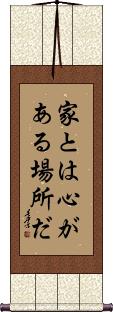
家とは心がある場所だ is, “Home is where the heart is,” in Japanese.
Most Japanese will take this to mean:
If you are with the person or at the place you love most, it becomes your true home.
Note: Because this selection contains some special Japanese Hiragana characters, it should be written by a Japanese calligrapher.
Freedom from Anger and Worry Yields Longevity
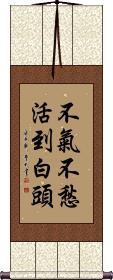
不气不愁活到白头 is a Chinese proverb that means “Without anger or worry, you will have a long life, until after all your hair is white.”
It more literally reads, “Don't get angry or worried [and you will] live [long] till [all your] hair [becomes] white.”
Seeing one’s Nature and becoming a Buddha
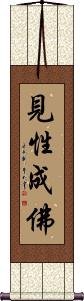
見性成佛 is a universal phrase that suggests that one may see one's nature and accomplish Buddhahood.
見性 suggests penetrating deep inside oneself to see one's “Original finally
Mind.”
成佛 refers to a sentient being who dispenses with illusions and delusions
through ascetic practice, is enlightened to the truth, and becomes a Buddha.
This is used by Mahayana, Chan, and Zen Buddhists in China, Korea, and Japan.
You will also see this with the last character written as 仏 in Japanese. In the religious context, 佛 is commonly used to mean Buddha. If you want the other version, see Kenshō Jōbutsu 見性成仏
Wisdom from Hard Knocks
The school of hard knocks
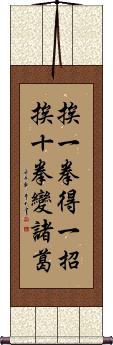
挨一拳得一招挨十拳變諸葛 is a Chinese proverb that literally translates as: Receive one blow, [and one] learns a lesson; Receive ten blows, [and one] becomes a great Zhuge [Liang].
You must first understand that a man named Zhuge Liang was one of the great strategists and philosophers in Chinese history. He's known as a man of great wisdom.
Figuratively, this phrase means:
One can learn much from failure or “hard knocks.”
Purity of Mind
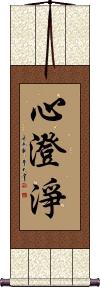
心澄淨 is the Buddhist concept of the pure and calm mind. It is believed that once you achieve a meditative state of pure focused thought, the mind becomes clear and calm. Although, others will say this means that achieving a calm mind will allow you to reach pure thought.
From Sanskrit, this is known as citta-prasāda. The concept of citta-prasāda is sometimes defined as “clear heart-mind,” or “the single and definitive aspiration.”
No Trouble / Freedom from Problems
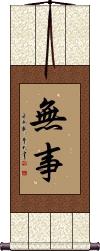
無事 is a Zen Buddhist term meaning no problem and no trouble.
無事 is the Zen state of perfect freedom from troubles and leaving secular affairs behind.
Sometimes this is used to describe the state of satori and complete tranquility of mind.
Written as 無事に with an extra Hiragana at the end, this becomes an adverb to describe something in the condition of safety, peace, quietness, and without troubles.
無事 (Buji) can also be a given name in Japan.
This has more meaning in the Japanese Zen Buddhist community than in China or Korea, where it can mean “be free” or “nothing to do or worry about.”
Beauty Shop / Beauty Salon
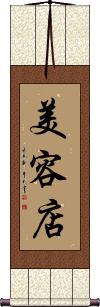
美容店 is how to write “Beauty Shop” or “Beauty Salon.”
If you own such a business, this will make a nice wall scroll to hang up - and many of your Asian customers will be able to read and appreciate it.
When traveling in China, you will see signs like this in the window of any place that offers full services of hair styling, manicures, pedicures, and often shampoo with head and back massage.
However, as a handmade wall scroll, this becomes a very fancy piece of artwork that shows the high class of your business (a great sign for your window if you don't get direct sunlight).
Family / Household
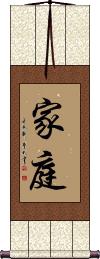
家庭/傢庭 is a common way to express family, household, or home in Chinese, Japanese Kanji, and old Korean Hanja.
However, for a wall scroll, we recommend the single-character form (which is just the first character of this two-character word). If you want that, just click here: Family Single-Character
The first character means “family” or “home.” The second means “courtyard” or “garden.” When combined, the meaning is a bit different, as it becomes “household” or “family.” The home and/or property traditionally has a strong relationship with family in Asia. Some Chinese, Korean, and Japanese families have lived in the same house for 7 or more generations!
Moon
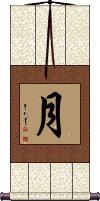
月 is how to write the title for “moon” in Chinese, Korean Hanja, and Japanese Kanji.
月 is also used to refer to the month. This is because China traditionally uses a lunar calendar, so saying “next moon” is the same as saying “next month” etc.
In modern Chinese and Japanese and old Korean, the character for a number is put in front of this moon character to represent western months. So “one moon” is January “two moons” is February etc.
If you are wondering, in the east Asian way to write dates, the character for “sun” or “day” is used with a number in front of it to express the day of the month. So “ten moons, one sun” becomes “October 1st” or “10/1” (this date happens to be Chinese National Day - The equivalent of Independence Day in the USA, Canada Day, or the Queen's Birthday).
In Japanese, 月 can be a surname that romanizes as Tsuki, Tsukizaki, or Takagetsu.
Sword
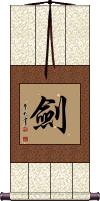
劍 is pronounced “jian” in Chinese. When you say it, imagine that you are making the sound of a sword as it clashes with a metal shield. This might get you closer to the correct pronunciation in Chinese.
I actually wonder if this word came from the metallic ringing sounds of a sword in battle - but such knowledge is lost in history.
The sword is a symbol of a warrior. The one thing that a soldier in ancient China lived and died by. A warrior with his skills and sword proves himself of great value. A warrior who losses his sword instantly becomes worthless.
劍 is an excellent scroll for someone in the military (especially officers of all services - as well as enlisted NCO Marines since they still carry swords even if mainly for ceremonial purposes). Or perhaps someone who practices variations of kung fu or tai chi that involve weapons.
Please note that while this character is understood with the sword meaning in Japanese, you might be looking for the word “katana” which also means sword in Japanese but means “knife” in Chinese.
There are other ways to write sword, and here are a few...


If you are particular about the version you receive, please let me know when you place your order (Note: Special styles are only available from one of our master calligraphers).
Daodejing / Tao Te Ching - Chapter 27
The Mastery of Effortless Skill

Chapter 27 of the Daodejing reveals a profound truth about mastery: the highest skill leaves no trace, requires no force, and appears almost invisible.
善行無轍跡,
善言無瑕謫,
善數不用籌策,
善閉無關鍵而不可開,
善結無繩約而不可解。
是以聖人常善救人,
故無棄人;
常善救物,
故無棄物。
是謂襲明。
故善人者,不善人之師;
不善人者,善人之資。
不貴其師,不愛其資,
雖智大迷,
是謂要妙。
The sage moves through life with such natural harmony that nothing seems imposed; doors need no locks, knots require no rope, and actions leave no mark behind.
This is the essence of wúwéi (effortless action), where true ability arises from deep alignment with the Tao rather than deliberate effort.
At its heart, this chapter teaches compassion without exception. The sage “abandons no one and nothing,” recognizing value in all people and all things. Even those who seem flawed or unrefined are not rejected, but understood as part of a greater whole with each person both a student and a teacher in the unfolding of life.
Laozi reminds us that wisdom is not about perfection or control, but about subtle awareness. The truly skilled individual does not rely on tools, rules, or rigid structures; instead, they embody an intuitive understanding that makes their actions naturally complete.
In this way, excellence becomes quiet, effortless, and beyond imitation.
This teaching also reflects a deeper philosophical insight: Opposites are interdependent. The “good” person learns from the “not good,” and the “not good” provides the material for growth. To reject either is to misunderstand the balance of existence itself.
As calligraphy, Daodejing Chapter 27 serves as a reminder to cultivate inner mastery rather than outward display. It is a meditation on refinement, humility, and the quiet power of skill perfected through harmony with the natural order.
Note: The Chinese text used here is based on the early Mawangdui silk manuscript tradition (2nd century BCE). The Guodian manuscripts do NOT preserve Chapter 27 in full form.
Push or Knock
To weigh one's words
During the Tang Dynasty, a man named Jia Dao (born in the year 779), a well-studied scholar and poet, went to the capital to take the imperial examination.
One day as he rides a donkey through the city streets, a poem begins to form in his mind. A portion of the poem comes into his head like this:
“The bird sits on the tree branch near a pond,
A monk approaches and knocks at the gate...”
At the same time, he wondered if the word “push” would be better than “knock” in his poem.
As he rides down the street, he imagines the monk pushing or knocking. Soon he finds himself making motions of pushing and shaking a fist in a knocking motion as he debates which word to use. He is quite a sight as he makes his way down the street on his donkey with hands and fists flying about as the internal debate continues.
As he amuses people along the street, he becomes completely lost in his thoughts and does not see the mayor's procession coming in the opposite direction. Jia Bao is blocking the way for the procession to continue down the road, and the mayor's guards immediately decide to remove Jia Bao by force. Jia Bao, not realizing that he was in the way, apologizes, explains his poetic dilemma and awaits his punishment for blocking the mayor's way.
The mayor, Han Yu, a scholar and author of prose himself, finds himself intrigued by Jia Dao's poem and problem. Han Yu gets off his horse and addresses Jia Bao, stating, “I think knock is better.” The relieved Jia Bao raises his head and is invited by the mayor to join the procession, and are seen riding off together down the street, exchanging their ideas and love of poetry.
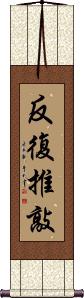
In modern Chinese, this 反復推敲 idiom is used when someone is trying to decide which word to use in their writing or when struggling to decide between two things when neither seems to have a downside.
Kenpo / Kempo / Quan Fa / Chuan Fa
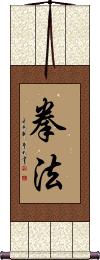
拳法 is a form of martial arts that can be translated in several ways.
Some will call it “fist principles,” “the way of the fist,” or even “law of the fist.” The first character literally means fist. The second can mean law, method, way, principle, or Buddhist teaching.
Kempo is really a potluck of martial arts. Often a combination of Chinese martial arts such as Shaolin Kung Fu with Japanese martial arts such as Karate, Jujutsu (Jujitsu), Aikido, and others. You may see the term “Kempo Karate,” which basically means Karate with other disciplines added. In this way, Kempo becomes an adjective rather than a title or school of martial arts.
These facts will long be argued by various masters and students of Kempo. Even the argument as to whether it should be spelled “kenpo” or “Kempo” ensues at dojos around the world (the correct Romaji should actually be “kenpou” if you precisely follow the rules).
The benefit of Kempo is that the techniques are easier to learn and master than pure Kung Fu (wu shu). Students are often taught basic Karate moves, kicks, and punches before augmenting the basic skills with complex Kung Fu techniques. This allows students of Kempo to achieve a level where they can defend themselves or fight in a relatively short amount of time (a few years rather than a decade or more).
Because the definition of this word is so fluid, I should make some notes here:
1. Purists in Okinawa will claim that “Okinawa Kenpo” or “Ryukyu Hon Kenpo” is the original and true version of this martial art from the old kingdom. It is actually little or no connection between Okinawa Kenpo and the way the word is used elsewhere.
2. In Chinese, where these characters are pronounced “quan fa” (sometimes Romanized as “chuan fa” because the Chinese-pinyin “q” actually sounds like an English “ch” sound), these characters do not hold the connotation of being a mixed martial art. It is simply defined as “the law of the fist.”
3. My Japanese dictionary oddly defines Kenpo as the “Chinese art of self-defense.” I personally don't feel this is the most common way that people perceive the word but just something you should know.
This in-stock artwork might be what you are looking for, and ships right away...

Gallery Price: $72.00
Your Price: $39.88
The following table may be helpful for those studying Chinese or Japanese...
| Title | Characters | Romaji (Romanized Japanese) | Various forms of Romanized Chinese | |
| Self Awareness Becomes a Buddha | 自性覚れば即ち是れ佛なり | Jishou satore ba sunawachi kore butsu nari Jisho satore ba sunawachi kore butsu nari | ||
| When Three People Gather, One Becomes a Teacher | 三人行必有我師 三人行必有我师 | sān rén xíng bì yǒu wǒ shī san1 ren2 xing2 bi4 you3 wo3 shi1 san ren xing bi you wo shi sanrenxingbiyouwoshi | san jen hsing pi yu wo shih sanjenhsingpiyuwoshih |
|
| Student | 學生 学生 | gakusei | xué shēng xue2 sheng1 xue sheng xuesheng | hsüeh sheng hsüehsheng |
| Home is where the heart is | 家とは心がある場所だ | ie to wa kokoro ga aru basho da ietowakokorogaarubashoda | ||
| Freedom from Anger and Worry Yields Longevity | 不氣不愁活到白頭 不气不愁活到白头 | bù qì bù chóu huó dào bái tóu bu4 qi4 bu4 chou2 huo2 dao4 bai2 tou2 bu qi bu chou huo dao bai tou buqibuchouhuodaobaitou | pu ch`i pu ch`ou huo tao pai t`ou puchipuchouhuotaopaitou pu chi pu chou huo tao pai tou |
|
| Seeing one’s Nature and becoming a Buddha | 見性成佛 见性成佛 | ken shou jou butsu kenshoujoubutsu ken sho jo butsu | jiàn xìng chéng fó jian4 xing4 cheng2 fo2 jian xing cheng fo jianxingchengfo | chien hsing ch`eng fo chienhsingchengfo chien hsing cheng fo |
| Wisdom from Hard Knocks | 挨一拳得一招挨十拳變諸葛 挨一拳得一招挨十拳变诸葛 | ái yī quán dé yī zhāo ái shí quán biàn zhū gě ai2 yi1 quan2 de2 yi1 zhao1 ai2 shi2 quan2 bian4 zhu1 ge3 ai yi quan de yi zhao ai shi quan bian zhu ge | ai i ch`üan te i chao ai shih ch`üan pien chu ko ai i chüan te i chao ai shih chüan pien chu ko |
|
| Purity of Mind | 心澄淨 | shin chou jou shinchoujou shin cho jo | xīn chéng jìng xin1 cheng2 jing4 xin cheng jing xinchengjing | hsin ch`eng ching hsinchengching hsin cheng ching |
| No Trouble Freedom from Problems | 無事 无事 | buji | wú shì / wu2 shi4 / wu shi / wushi | wu shih / wushih |
| Beauty Shop Beauty Salon | 美容店 | měi róng diàn mei3 rong2 dian4 mei rong dian meirongdian | mei jung tien meijungtien |
|
| Family Household | 家庭 / 傢庭 家庭 | ka tei / katei | jiā tíng / jia1 ting2 / jia ting / jiating | chia t`ing / chiating / chia ting |
| Moon | 月 | tsuki | yuè / yue4 / yue | yüeh |
| Sword | 劍 剑 | ken / tsurugi | jiàn / jian4 / jian | chien |
| Daodejing Tao Te Ching - Chapter 27 | 善行無轍跡善言無瑕謫善數不用籌策善閉無關鍵而不可開善結無繩約而不可解是以聖人常善救人故無棄人常善救物故無棄物是謂襲明故善人者不善人之師不善人者善人之資不貴其師不愛其資雖智大迷是謂要妙 善行无辙迹善言无瑕谪善数不用筹策善闭无关键而不可开善结无绳约而不可解是以圣人常善救人故无弃人常善救物故无弃物是谓袭明故善人者不善人之师不善人者善人之资不贵其师不爱其资虽智大迷是谓要妙 | shàn xíng wú zhé jì shàn yán wú xiá zhé shàn shù bù yòng chóu cè shàn bì wú guān jiàn ér bù kě kāi shàn jié wú shéng yuē ér bù kě jiě shì yǐ shèng rén cháng shàn jiù rén gù wú qì rén cháng shàn jiù wù gù wú qì wù shì wèi xí míng gù shàn rén zhě bù shàn rén zhī shī bù shàn rén zhě shàn rén zhī zī bù guì qí shī bù ài qí zī suī zhì dà mí shì wèi yào miào shan4 xing2 wu2 zhe2 ji4 shan4 yan2 wu2 xia2 zhe2 shan4 shu4 bu4 yong4 chou2 ce4 shan4 bi4 wu2 guan1 jian4 er2 bu4 ke3 kai1 shan4 jie2 wu2 sheng2 yue1 er2 bu4 ke3 jie3 shi4 yi3 sheng4 ren2 chang2 shan4 jiu4 ren2 gu4 wu2 qi4 ren2 chang2 shan4 jiu4 wu4 gu4 wu2 qi4 wu4 shi4 wei4 xi2 ming2 gu4 shan4 ren2 zhe3 bu4 shan4 ren2 zhi1 shi1 bu4 shan4 ren2 zhe3 shan4 ren2 zhi1 zi1 bu4 gui4 qi2 shi1 bu4 ai4 qi2 zi1 sui1 zhi4 da4 mi2 shi4 wei4 yao4 miao4 shan xing wu zhe ji shan yan wu xia zhe shan shu bu yong chou ce shan bi wu guan jian er bu ke kai shan jie wu sheng yue er bu ke jie shi yi sheng ren chang shan jiu ren gu wu qi ren chang shan jiu wu gu wu qi wu shi wei xi ming gu shan ren zhe bu shan ren zhi shi bu shan ren zhe shan ren zhi zi bu gui qi shi bu ai qi zi sui zhi da mi shi wei yao miao | shan hsing wu che chi shan yen wu hsia che shan shu pu yung ch`ou ts`e shan pi wu kuan chien erh pu k`o k`ai shan chieh wu sheng yüeh erh pu k`o chieh shih i sheng jen ch`ang shan chiu jen ku wu ch`i jen ch`ang shan chiu wu ku wu ch`i wu shih wei hsi ming ku shan jen che pu shan jen chih shih pu shan jen che shan jen chih tzu pu kuei ch`i shih pu ai ch`i tzu sui chih ta mi shih wei yao miao shan hsing wu che chi shan yen wu hsia che shan shu pu yung chou tse shan pi wu kuan chien erh pu ko kai shan chieh wu sheng yüeh erh pu ko chieh shih i sheng jen chang shan chiu jen ku wu chi jen chang shan chiu wu ku wu chi wu shih wei hsi ming ku shan jen che pu shan jen chih shih pu shan jen che shan jen chih tzu pu kuei chi shih pu ai chi tzu sui chih ta mi shih wei yao miao |
|
| Push or Knock | 反復推敲 反复推敲 | fǎn fù tuī qiāo fan3 fu4 tui1 qiao1 fan fu tui qiao fanfutuiqiao | fan fu t`ui ch`iao fanfutuichiao fan fu tui chiao |
|
| Kenpo Kempo Quan Fa Chuan Fa | 拳法 | kenpou / kenpo | quán fǎ / quan2 fa3 / quan fa / quanfa | ch`üan fa / chüanfa / chüan fa |
| In some entries above you will see that characters have different versions above and below a line. In these cases, the characters above the line are Traditional Chinese, while the ones below are Simplified Chinese. | ||||

Successful Chinese Character and Japanese Kanji calligraphy searches within the last few hours...



