Many custom options...


And formats...



Bone in Chinese / Japanese...
Buy a Bone calligraphy wall scroll here!
Personalize your custom “Bone” project by clicking the button next to your favorite “Bone” title below...
Bones
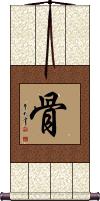
骨 is Chinese, Japanese, and Korean for bone or bones.
If your name happens to be Bone or Bones, this is a cool character for a wall scroll to hang in your home or office.
Sense of Humor
Funny Bone
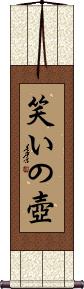
笑いの壺 is the Japanese way to say “sense of humor” (humour), or colloquially a way to say “funny bone.”
Note: Because this selection contains some special Japanese Hiragana characters, it should be written by a Japanese calligrapher.
Taido
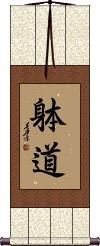
Taidō (The Way of the Body) is a style of Karate practiced in Japan and popular worldwide.
Taidō or 躰道 traces a lineage from Genseiryū (玄制流), which came from Shuri-te (首里手), one of the original martial arts schools of ancient Okinawa.
The first character 躰 is a variant of the original Chinese character 體. In modern Japan, they tend to use 体, a more simple character form. 体 is also the modern Simplified Chinese form of 體.
The 躰 character is correct for this 躰道 martial arts title. But it can be confusing with so many variants out there, not to mention other homophonic Japanese words that also romanize as Taidō or Taidou.
To have a bit more fun with this 躰 character, it has a 身 radical on the left, which sets it apart. The meaning doubles up on the “body” as 身 (shin) is a character that also means body in Japanese and Chinese. On the right is 本, which often means root, stem, origin, source, or fundamental (but can also mean “book” in some contexts). This has deviated from the original 體 which was 骨 (bone) + 豊 (vessel). Hence, the body was your “bone vessel” in ancient Asia.
The meaning of 躰, as well as 體 and 体, is usually translated as the body. When related to the physical body, it can also refer to the torso, trunk, build, physique, or the constitution of a person. As an extension of this, it can also refer to someone's health (good body = good health).
However, depending on the context, it can encompass other meanings such as form, style, system, experience, aspect, corpus, corporeal, substance, or essentials.
The second character, 道, is recognized and well-known as the “Way” and is the same “do” as in Karate-do or Aikido.
Strong bones come from hard knocks
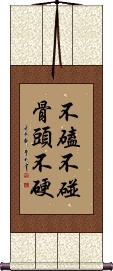
不磕不碰骨頭不硬 is a Chinese proverb that literally translates as: Without being knocked around a bit, [one's] bones won't become hard.
Figuratively, this means: One can't become strong without first being tempered by “hard knocks.”
While true for everyone, this sounds like the “Iron Body” form of Kung Fu, where practitioners' bodies are beaten (and often bone fractured) in order to become stronger.
For the rest of us, this is just about how we can be tempered and build character through the hardships in our lives.
This is not a common title for a wall scroll in China.
Not the results for bone that you were looking for?
Below are some entries from our dictionary that may match your bone search...
| Characters If shown, 2nd row is Simp. Chinese |
Pronunciation Romanization |
Simple Dictionary Definition |
身 see styles |
shēn shen1 shen misaki みさき |
More info & calligraphy: Body(1) one's body; one's person; (2) oneself; one's appearance; (3) one's place (in society, etc.); one's position; (4) main part; meat (as opposed to bone, skin, etc.); wood (as opposed to bark); blade (as opposed to its handle); container (as opposed to its lid); (surname) Misaki kāya; tanu; deha. The body; the self.; Two forms of body; there are numerous pairs, e. g. (1) (a) 分段身 The varied forms of the karmic or ordinary mortal body, or being; (b) 變易身 the transformable, or spiritual body. (2) (a) 生身 The earthly body of the Buddha; (b) 化身 hinirmāṇakāya, which may take any form at will. (3) (a) 生身 his earthly body; (b) 法身 his moral and mental nature—a Hīnayāna definition, but Mahāyāna takes his earthly nirmāṇakāya as the 生身 and his dharmakāya or that and his saṃbhogakāya as 法身. (4) 眞應二身 The dharmakāya and nirmāṇakāya. (5) (a) 實相身 The absolute truth, or light, of the Buddha, i. e. the dharmakāya; (b) 爲物身 the functioning or temporal body. (6) (a) 眞身 the dharmakāya and saṃbhogakāya; (b) 化身 the nirmāṇakāya. (7) (a) 常身 his permanent or eternal body; (b) 無常身 his temporal body. (8) (a) 實身 and 化身 idem 二色身. |
骨 see styles |
gǔ gu3 ku hone ほね |
More info & calligraphy: Bones(1) bone; (2) frame; (3) outline; core; (4) backbone; spirit; fortitude; (noun or adjectival noun) (5) laborious; troublesome; difficult; (personal name) Hone Bone: bones, relics. |
笑いの壺 see styles |
warainotsubo わらいのつぼ |
More info & calligraphy: Sense of Humor |
剉 锉 see styles |
cuò cuo4 ts`o tso |
(literary) to fracture (a bone); (literary) to cut; to hack; variant of 銼|锉[cuo4] |
叼 see styles |
diāo diao1 tiao |
to hold with one's mouth (as a smoker with a cigarette or a dog with a bone) |
棘 see styles |
jí ji2 chi natsume なつめ |
thorns (1) thorn; spine; prickle; (2) splinter (esp. lodged in one's flesh); hard sharp item (esp. lodged in one's throat, e.g. fish bone); (3) biting words; (noun or adjectival noun) briars; thicket; the bush; (1) thorny shrub; (2) wild rose; briar; (3) thorn; (4) (archit) cusp; (surname) Natsume |
橈 桡 see styles |
ráo rao2 jao |
radius (anatomy); bone of the forearm |
牼 see styles |
kēng keng1 k`eng keng |
shank bone of ox |
胏 see styles |
zǐ zi3 tzu |
dried meat with bone |
腄 see styles |
chuí chui2 ch`ui chui |
callus on the hand or foot; upper leg bone of horse or bird; buttocks |
謋 see styles |
huò huo4 huo |
sound of flesh being separated from the bone |
踝 see styles |
huái huai2 huai kurubushi くるぶし |
ankle (kana only) {anat} ankle; malleolus; ankle bone ankle |
軱 see styles |
gū gu1 ku |
big bone |
骽 腿 see styles |
tuǐ tui3 t`ui tui |
hip bone; old variant of 腿[tui3] See: 腿 |
髂 see styles |
qià qia4 ch`ia chia |
ilium; outermost bone of the pelvic girdle; Taiwan pr. [ka4] |
髎 see styles |
liáo liao2 liao |
(literary) hip bone; (TCM) space between two joints |
髓 see styles |
suǐ sui3 sui zui |
(bound form) bone marrow; (fig.) innermost part; (botany) pith marrow |
鯁 鲠 see styles |
gěng geng3 keng nogi のぎ |
to choke on a piece of food; (literary) a fish bone lodged in one's throat (archaism) small fish bone stuck in one's throat |
ボネ see styles |
bone ボネ |
(surname) Bonnet |
交骨 see styles |
jiāo gǔ jiao1 gu3 chiao ku |
pubic bone |
仙骨 see styles |
senkotsu せんこつ |
(noun - becomes adjective with の) (1) sacrum; sacral bone; (2) hermitry; appearance of an hermit; unworldliness; unusual physique; outstanding appearance; (given name) Senkotsu |
佛骨 see styles |
fó gǔ fo2 gu3 fo ku bukkotsu |
Buddha's bones (as a sacred relic) A bone of the Buddha, especially the bone against whose reception by the emperor Xianzong the famous protest of Hanyu was made in 819. |
刺骨 see styles |
cì gǔ ci4 gu3 tz`u ku tzu ku |
piercing; cutting; bone-chilling; penetrating (cold) |
卜骨 see styles |
bǔ gǔ bu3 gu3 pu ku bokkotsu ぼっこつ |
oracle bone fortune-telling using animal bones |
反骨 see styles |
fǎn gǔ fan3 gu3 fan ku hankotsu はんこつ |
(physiognomy) protruding bone at the back of the head, regarded as a sign of a renegade nature (abbreviation) rebellious spirit |
四馬 四马 see styles |
sì mǎ si4 ma3 ssu ma shime |
Four kinds of horses, likened to four classes of monks: those that respond to the shadow of the whip, its lightest touch, its mild application, and those who need the spur to bite the bone. |
坐骨 see styles |
zuò gǔ zuo4 gu3 tso ku zakotsu ざこつ |
ischium ischium; ischial bone |
大骨 see styles |
oobone おおぼね |
large bone; thick bone |
寛骨 see styles |
kankotsu かんこつ |
{anat} hipbone; innominate bone |
尺骨 see styles |
chǐ gǔ chi3 gu3 ch`ih ku chih ku shakkotsu しゃっこつ |
ulna (anatomy); bone of the forearm {anat} ulna |
Click here for more bone results from our dictionary
The following table may be helpful for those studying Chinese or Japanese...
| Title | Characters | Romaji (Romanized Japanese) | Various forms of Romanized Chinese | |
| Bones | 骨 | hone / kotsu | gǔ / gu3 / gu | ku |
| Sense of Humor | 笑いの壺 | warainotsubo | ||
| Taido | 躰道 | tai dou / taidou / tai do | ||
| Strong bones come from hard knocks | 不磕不碰骨頭不硬 不磕不碰骨头不硬 | bù kē bù pèng gǔ tóu bù yìng bu4 ke1 bu4 peng4 gu3 tou2 bu4 ying4 bu ke bu peng gu tou bu ying bukebupenggutoubuying | pu k`o pu p`eng ku t`ou pu ying pukopupengkutoupuying pu ko pu peng ku tou pu ying |
|
| In some entries above you will see that characters have different versions above and below a line. In these cases, the characters above the line are Traditional Chinese, while the ones below are Simplified Chinese. | ||||

Successful Chinese Character and Japanese Kanji calligraphy searches within the last few hours...



