Many custom options...


And formats...



Not what you want?
Try other similar-meaning words, fewer words, or just one word.
Bu Ke Qi in Chinese / Japanese...
Buy a Bu Ke Qi calligraphy wall scroll here!
Personalize your custom “Bu Ke Qi” project by clicking the button next to your favorite “Bu Ke Qi” title below...
Switched to secondary search mode due to lack of results using primary.
These secondary results may not be very accurate. Try a different but similar meaning word or phrase for better results. Or...
Look up Bu Ke Qi in my Japanese Kanji & Chinese Character Dictionary(My dictionary is a different system then the calligraphy search you just tried)
If you want a special phrase, word, title, name, or proverb, feel free to contact me, and I will translate your custom calligraphy idea for you.
4. Three Treasures of Chinese Medicine
6. Life Energy / Spiritual Energy
7. Mencius
8. Neijia Fist
9. Neijing
10. Undaunted After Repeated Setbacks
14. Takemusu Aiki
Bravery / Courage
Courageous Energy
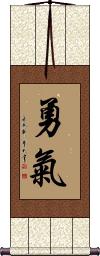
勇氣 is one of several ways to express bravery and courage in Chinese, Japanese, and Korean.
This version is the most spiritual. This is the essence of bravery from deep within your being. This is the mental state of being brave versus actual brave behavior. You'd more likely use this to say, “He is very courageous,” rather than “He fought courageously in the battle.”
The first character also means bravery or courage when it's seen alone. With the second character added, an element of energy or spirit is added. The second character is the same “chi” or “qi” energy that Kung Fu masters focus on when they strike. For this reason, you could say this means “spirit of courage” or “brave spirit.”
This is certainly a stronger word than just the first character alone.
Beyond bravery or courage, dictionaries also translate this word as valor/valour, nerve, audacity, daring, pluck, plucky, gallantry, guts, gutsy, and boldness.
This is also one of the 8 key concepts of tang soo do.
 While the version shown to the left is commonly used in Chinese and Korean Hanja (and ancient Japanese Kanji), please note that the second character is written with slightly fewer strokes in modern Japanese. If you want the modern Japanese version, please click on the character to the right. Both styles would be understood by native Chinese, Japanese, and many (but not all) Korean people. You should make your selection based on the intended audience for your calligraphy artwork. Or pick the single-character form of bravery/courage which is universal.
Family / Home
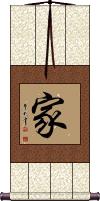
家 is the single character that means family in Chinese and Japanese.
It can also mean home or household depending on context.
Hanging this on your wall suggests that you put “family first.”
Pronunciation varies in Japanese depending on context. When pronounced “uchi” in Japanese, it means home, but when pronounced “ke,” it means family.
 Note that there is an alternate form of this character. It has an additional radical on the left side but no difference in meaning or pronunciation. The version shown above is the most universal, and is also ancient/traditional. The image shown to the right is only for reference.
Forgive and Forget
Confucian Proverb
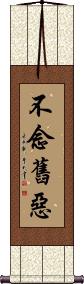
不念舊惡 is a Chinese proverb that can be translated as “Do not recall old grievances,” or more simply as “Forgive and forget.”
The character breakdown:
不 (bù) not; no; don't.
念 (niàn) read aloud.
舊 (jiù) old; former.
惡 (è) wicked deeds; grievances; sins.
This proverb comes from the Analects of Confucius.
Three Treasures of Chinese Medicine
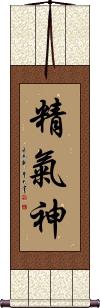
精, 氣, 神 are the characters jing, qi, and shen.
As a set, these three characters are known in English as the treasures of traditional Chinese medicine, the treasures of Qi Gong, or the three treasures of Taoism / Daoism.
Sometimes this set is titled 三寶 (sānbǎo) or “three treasures,” but here, we're writing each treasure out.
Here's how these characters are perceived in this context...
Jing: nutritive essence; refined; perfected; pure
Qi: vitality; energy; force; breath; vigor
Shen: spirit; soul; mind; being
To keep it simple, you can use “essence, vitality, and spirit” to define these.
Jin Shin Jyutsu
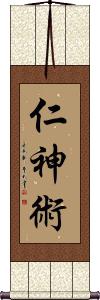
仁神術 is Jin Shin Jyutsu or Jin Shin Jutsu.
This is a practice of calming the mind and clearing the flow of Qi energy in the body. Jin Shin Jyutsu has some commonality with the practice of Reiki.
A good translation of 仁神術 would be “Benevolent Spirit Method.”
We can break that down into all of the possible meanings:
仁 = benevolence (esp. as a virtue of Confucianism), consideration, compassion, humanity, charity, kindness, or virtue.
神 = deity, soul, spirit, mysterious, psyche, god, divinity, spiritual powers, deva, divine, spiritual, or supernatural.
術 = way, method, means, art, trick, or plan. The correct romaji for this 術 Kanji should be “jutsu.” However, in martial arts, this is often written “jitsu” but in this case, “jyutsu” became common.
Life Energy / Spiritual Energy
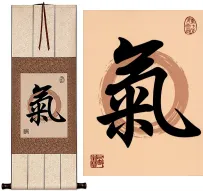
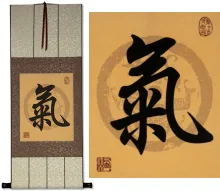
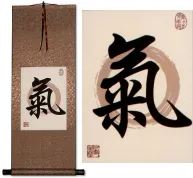
Chi Energy: Essence of Life / Energy Flow
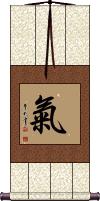
This 氣 energy flow is a fundamental concept of traditional Asian culture.
氣 is romanized as “Qi” or “Chi” in Chinese, “Gi” in Korean, and “Ki” in Japanese.
Chi is believed to be part of everything that exists, as in “life force” or “spiritual energy.” It is most often translated as “energy flow” or literally as “air” or “breath.” Some people will simply translate this as “spirit,” but you must consider the kind of spirit we're talking about. I think this is weighted more toward energy than spirit.
The character itself is a representation of steam (or breath) rising from rice. To clarify, the character for rice looks like this: 
Steam was apparently seen as visual evidence of the release of “life energy” when this concept was first developed. The Qi / Chi / Ki character is still used in compound words to mean steam or vapor.
The etymology of this character is a bit complicated. It's suggested that the first form of this character from bronze script (about 2500 years ago) looked like these samples: 

However, it was easy to confuse this with the character for the number three. So the rice radical was added by 221 B.C. (the exact time of this change is debated). This first version with the rice radical looks like this: 
The idea of Qi / Chi / Ki is really a philosophical concept. It's often used to refer to the “flow” of metaphysical energy that sustains living beings. Yet there is much debate that has continued for thousands of years as to whether Qi / Chi / Ki is pure energy or consists partially or fully of matter.
You can also see the character for Qi / Chi / Ki in common compound words such as Tai Chi / Tai Qi, Aikido, Reiki, and Qi Gong / Chi Kung.
In the modern Japanese Kanji, the rice radical has been changed into two strokes that form an X.
The original and traditional Chinese form is still understood in Japanese, but we can also offer that modern Kanji form in our custom calligraphy. If you want this Japanese Kanji, please click on the character to the right instead of the “Select and Customize” button above.
More language notes: This is pronounced like “chee” in Mandarin Chinese, and like “key” in Japanese.
This is also the same way to write this in Korean Hanja where it is Romanized as “gi” and pronounced like “gee” but with a real G-sound, not a J-sound.
Though Vietnamese no longer use Chinese characters in their daily language, this character is still widely known in Vietnam.
See Also: Energy | Life Force | Vitality | Life | Birth | Soul
Mencius
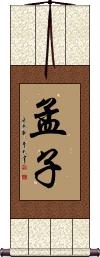
孟子 is the name Mencius in Chinese.
Mencius had the name “Mèng Kē” (孟軻) at birth. This later changed to Mèng Zǐ (孟子). He lived between 372 and 289 BCE.
Mencius was a Chinese Confucian philosopher who has often been referred to as the “Second Sage” following Confucius himself.
For disambiguation, one of the classic books of Confucianism is also titled 孟子.
Romanization of Mencius from Chinese includes Meng Tsu, Mengzi, and his original name Mengke or Meng Ko. In Japanese, he is Mōshi or Moushi.
Neijia Fist
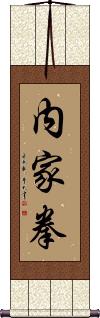
内家拳 is Neijia Fist or internal martial arts.
内家拳 is a Chinese martial arts style based on spiritual, mental, or qi-related aspects.
This style is somewhat known in martial arts circles in Japan as well.
Neijing
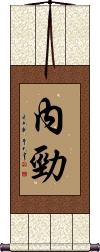
內勁 is Neijing or Nei Jing, the Kung Fu technique of using the conscious control of the practitioner's “qi” or “life energy” to gain advantages in combat.
Undaunted After Repeated Setbacks
Persistence to overcome all challenges
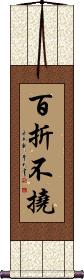
百折不撓 is a Chinese proverb that means “Be undaunted in the face of repeated setbacks.”
More directly translated, it reads, “[Overcome] a hundred setbacks, without flinching.” 百折不撓 is of Chinese origin but is commonly used in Japanese and somewhat in Korean (same characters, different pronunciation).
This proverb comes from a long, and occasionally tragic story of a man that lived sometime around 25-220 AD. His name was Qiao Xuan, and he never stooped to flattery but remained an upright person at all times. He fought to expose the corruption of higher-level government officials at great risk to himself.
Then when he was at a higher level in the Imperial Court, bandits were regularly capturing hostages and demanding ransoms. But when his own son was captured, he was so focused on his duty to the Emperor and the common good that he sent a platoon of soldiers to raid the bandits' hideout, and stop them once and for all even at the risk of his own son's life. While all of the bandits were arrested in the raid, they killed Qiao Xuan's son at first sight of the raiding soldiers.
Near the end of his career, a new Emperor came to power, and Qiao Xuan reported to him that one of his ministers was bullying the people and extorting money from them. The new Emperor refused to listen to Qiao Xuan and even promoted the corrupt Minister. Qiao Xuan was so disgusted that in protest, he resigned from his post as minister (something almost never done) and left for his home village.
His tombstone reads “Bai Zhe Bu Nao” which is now a proverb used in Chinese culture to describe a person of strong will who puts up stubborn resistance against great odds.
My Chinese-English dictionary defines these 4 characters as “keep on fighting despite all setbacks,” “be undaunted by repeated setbacks,” and “be indomitable.”
Our translator says it can mean “never give up” in modern Chinese.
Although the first two characters are translated correctly as “repeated setbacks,” the literal meaning is “100 setbacks” or “a rope that breaks 100 times.” The last two characters can mean “do not yield” or “do not give up.”
Most Chinese, Japanese, and Korean people will not take this absolutely literal meaning but will instead understand it as the title suggests above. If you want a single big word definition, it would be indefatigability, indomitableness, persistence, or unyielding.
See Also: Tenacity | Fortitude | Strength | Perseverance | Persistence
Qi Gong / Chi Kung
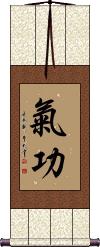
氣功 or Qigong is the title of a technique that is somewhere between medical practice, meditation, and in some cases, religion.
The definition is blurred depending on which school of Qigong you are following. In some cases, it is even incorporated with martial arts.
Some people (even Chinese people) mix this title with Tai Chi (Tai Qi) exercises.
Lately, in China, people will claim to practice Tai Chi rather than Qigong because the Qigong title was recently used as a cover for an illegal pseudo-religious movement in China with the initials F.G. or F.D. (I can not write those names here for fear of our website being banned in China).
You can learn those names and more here: Further info about Qigong
If you are wondering why I wrote “Qi Gong” and “Chi Kung” as the title of this calligraphy entry, I should teach you a little about the various ways in which Chinese can be Romanized. One form writes this as “Chi Kung” or “Chikung” (Taiwan). In the mainland and elsewhere, it is Romanized as “Qi Gong” or “Qigong.” The pronunciation is the same in Taiwan, mainland, and Singapore Mandarin. Neither Romanization is exactly like English. If you want to know how to say this with English rules, it would be something like “Chee Gong” (but the “gong” has a vowel sound like the “O” in “go”).
Romanization is a really confusing topic and has caused many Chinese words to be mispronounced in the west. One example is “Kung Pao Chicken,” which should actually be more like “Gong Bao” with the “O” sounding like “oh” for both characters. Neither the Romanization system in Taiwan nor the Mainland is perfect, in my opinion, and leads to many misunderstandings.
In modern Japan, you may see this written as 気功, but the original 氣功 is still recognized. If you need the Japanese version, please contact me.
Sit Quietly in Meditation
A state of mind
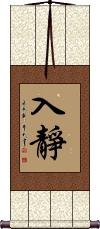
入靜 is used in Taoism and Qi Gong to describe the state you can reach while sitting quietly in meditation. It contains the idea of achieving a highly-tranquil and peaceful state. Some may describe this state as “sleeping while still awake.”
If you have a relaxation or meditation room, this is the calming wall scroll that you would want hanging in that room.
Tai Chi Wing Chun Kung Fu
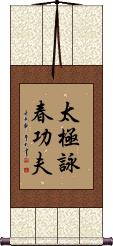
太極詠春功夫 is the title Tai Chi Wing Chun Kung Fu.
Please note that it can be romanized in a variety of ways such as:
Tai Chi Ving Tsun Kung Fu
Tai Qi Yong Chun Gong Fu
Taai Gik Wing Ceon Gung Fu
Be sure this is the right title for what you are looking for before you order.
Takemusu Aiki
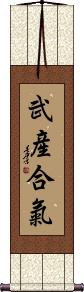
武産合氣 is one of the core spiritual concepts developed by Morihei Ueshiba to support his practice of Aikido.
Breaking down the characters:
武 - Bu (as in Bushido) is read as “Take” here. It means martial.
産 - Musu means innocent or naive, but also refers to the idea of birth and creation.
合氣 - Aiki as in Aikido - unifying spirit.
Unselfish: Perfectly Impartial
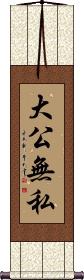
大公無私 is a Chinese proverb that comes from an old story from some time before 476 BC. About a man named Qi Huangyang, who was commissioned by the king to select the best person for a certain job in the Imperial Court.
Qi Huangyang selected his enemy for the job. The king was very confused by the selection, but Qi Huangyang explained that he was asked to find the best person for the job, not necessarily someone that he liked or had a friendship with.
Later, Confucius commented on how unselfish and impartial Qi Huangyang was by saying, “Da Gong Wu Si” which, if you look it up in a Chinese dictionary, is generally translated as “Unselfish” or “Just and Fair.”
If you translate each character, you'd have something like
“Big/Deep Justice Without Self.”
Direct translations like this leave out a lot of what the Chinese characters really say. Use your imagination, and suddenly you realize that “without self” means “without thinking about yourself in the decision” - together, these two words mean “unselfish.” The first two characters serve to drive the point home that we are talking about a concept that is similar to “blind justice.”
One of my Chinese-English dictionaries translates this simply as “just and fair.” So that is the short and simple version.
Note: This can be pronounced in Korean, but it's not a commonly used term.
See Also: Selflessness | Work Unselfishly for the Common Good | Altruism
Work Unselfishly for the Common Good
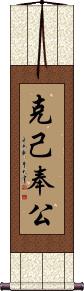
克己奉公 is a Chinese proverb that is often used to express how one should act as a government official. Most of us wish our public officials would hold themselves to higher standards. I wish I could send this scroll, along with the meaning to every member of Congress, and the President (or if I was from the UK, all the members of Parliament, and the PM)
This can also mean: “Place Strict Standards on Oneself in Public Service.”
The story behind this ancient Chinese idiom:
Cai Zun was born in China a little over 2000 years ago. In 24 AD, he joined an uprising led by Liu Xiu, who later became the emperor of the Eastern Han Dynasty.
Later, the new emperor put Cai Zun in charge of the military court. Cai Zun exercised his power in strict accordance with military law, regardless of the offender's rank or background. He even ordered the execution of one of the emperor's close servants after the servant committed a serious crime.
Cai Zun led a simple life but put great demands on himself to do all things honorably. The emperor rewarded him for his honest character and honorable nature by promoting him to the rank of General and granting him the title of Marquis.
Whenever Cai Zun would receive an award, he would give credit to his men and share the reward with them.
Cai Zun was always praised by historians who found many examples of his selfless acts that served the public interest.
Sometime long ago in history, people began to refer to Cai Zun as “ke ji feng gong.”
See Also: Unselfish | Selflessness | Altruism
This in-stock artwork might be what you are looking for, and ships right away...
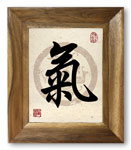

Gallery Price: $31.00
Your Price: $16.88
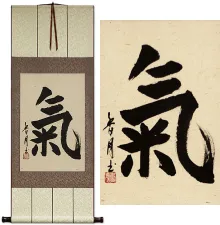
Gallery Price: $300.00
Your Price: $109.88
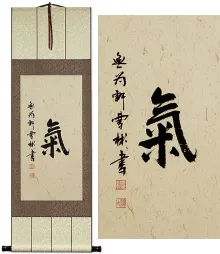
Gallery Price: $106.00
Your Price: $58.77
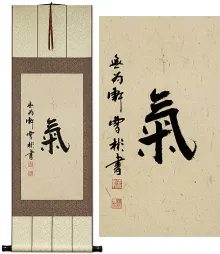
Gallery Price: $106.00
Your Price: $58.77

Gallery Price: $90.00
Your Price: $49.88
Gallery Price: $90.00
Your Price: $49.88
Gallery Price: $65.00
Your Price: $39.88
The following table may be helpful for those studying Chinese or Japanese...
| Title | Characters | Romaji (Romanized Japanese) | Various forms of Romanized Chinese | |
| Bravery Courage | 勇氣 勇气 / 勇気 | yuuki / yuki | yǒng qì / yong3 qi4 / yong qi / yongqi | yung ch`i / yungchi / yung chi |
| Family Home | 家 / 傢 家 | ei / uchi / ke | jiā / jia1 / jia | chia |
| Forgive and Forget | 不念舊惡 不念旧恶 | bú niàn jiù è bu2 nian4 jiu4 e4 bu nian jiu e bunianjiue | pu nien chiu o punienchiuo |
|
| Three Treasures of Chinese Medicine | 精氣神 精气神 | jīng qì shén jing1 qi4 shen2 jing qi shen jingqishen | ching ch`i shen chingchishen ching chi shen |
|
| Jin Shin Jyutsu | 仁神術 | jin shin jutsu jinshinjutsu | rén shén shù ren2 shen2 shu4 ren shen shu renshenshu | jen shen shu jenshenshu |
| Life Energy Spiritual Energy | 氣 气 / 気 | ki | qì / qi4 / qi | ch`i / chi |
| Mencius | 孟子 | mou shi / moushi / mo shi | mèng zi / meng4 zi5 / meng zi / mengzi | meng tzu / mengtzu |
| Neijia Fist | 内家拳 | naikaken | nèi jiā quán nei4 jia1 quan2 nei jia quan neijiaquan | nei chia ch`üan neichiachüan nei chia chüan |
| Neijing | 內勁 内劲 | nèi jìng / nei4 jing4 / nei jing / neijing | nei ching / neiching | |
| Undaunted After Repeated Setbacks | 百折不撓 百折不挠 | hyaku setsu su tou hyakusetsusutou hyaku setsu su to | bǎi zhé bù náo bai3 zhe2 bu4 nao2 bai zhe bu nao baizhebunao | pai che pu nao paichepunao |
| Qi Gong Chi Kung | 氣功 气功 | ki kou / kikou / ki ko | qì gōng / qi4 gong1 / qi gong / qigong | ch`i kung / chikung / chi kung |
| Sit Quietly in Meditation | 入靜 入静 | rù jìng / ru4 jing4 / ru jing / rujing | ju ching / juching | |
| Tai Chi Wing Chun Kung Fu | 太極詠春功夫 太极咏春功夫 | tài jí yǒng chūn gōng fu tai4 ji2 yong3 chun1 gong1 fu tai ji yong chun gong fu taijiyongchungongfu | t`ai chi yung ch`un kung fu taichiyungchunkungfu tai chi yung chun kung fu |
|
| Takemusu Aiki | 武産合氣 | take musu ai ki takemusuaiki | ||
| Unselfish: Perfectly Impartial | 大公無私 大公无私 | dà gōng wú sī da4 gong1 wu2 si1 da gong wu si dagongwusi | ta kung wu ssu takungwussu |
|
| Work Unselfishly for the Common Good | 克己奉公 | kè jǐ fèng gōng ke4 ji3 feng4 gong1 ke ji feng gong kejifenggong | k`o chi feng kung kochifengkung ko chi feng kung |
|
| In some entries above you will see that characters have different versions above and below a line. In these cases, the characters above the line are Traditional Chinese, while the ones below are Simplified Chinese. | ||||

Successful Chinese Character and Japanese Kanji calligraphy searches within the last few hours...



