Many custom options...


And formats...



Buddh in Chinese / Japanese...
Buy a Buddh calligraphy wall scroll here!
Personalize your custom “Buddh” project by clicking the button next to your favorite “Buddh” title below...
Switched to secondary search mode due to lack of results using primary.
These secondary results may not be very accurate. Try a different but similar meaning word or phrase for better results. Or...
Look up Buddh in my Japanese Kanji & Chinese Character Dictionary(My dictionary is a different system then the calligraphy search you just tried)
If you want a special phrase, word, title, name, or proverb, feel free to contact me, and I will translate your custom calligraphy idea for you.
1. Wisdom and Insight of the Buddha
4. Triple Truth of Japanese Buddhism
5. Happy Buddha
8. Buddha Heart / Mind of Buddha
9. Seeing one’s Nature and becoming a Buddha
10. The Buddha Realm / Buddhahood
13. Buddhism
14. Buddha Way
15. The Principles of Buddhism
16. The Buddha is in Each Sentient Being
17. Dharma / Buddhist Doctrine
18. Amitabha Buddha
20. Kensho Jobutsu - Enlightenment - Path to Buddha
21. Meet the Buddha, Kill the Buddha
22. Merciful Heart / The Light from a Buddha Mind
23. Mercy / Compassion / Buddhist Loving Kindness
24. Buddhist Monk
27. Mantra to Buddha / Nembutsu
28. Pure Land Buddhism / Jodo Buddhism
29. Reincarnation
30. Self Awareness Becomes a Buddha
32. Three Treasures of Buddhism
33. Shin Buddhism
34. True Religion / Buddha Truth
35. Zen Buddhism
Wisdom and Insight of the Buddha
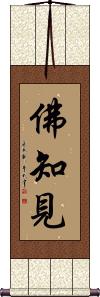
This title represents the wisdom and insight of the Buddha, or the penetrative power of Buddha's wisdom, or vision.
佛知見 is a term derived from the Lotus Sutra, perhaps up to 1900 years ago.
The Aura of Buddha
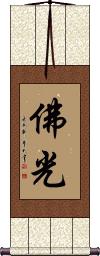
佛光 means Buddha's teachings, or Buddha's Light.
This often refers to the aura around the head of Buddha.
Alternate meanings include Spiritual Enlightenment (from Buddha), Buddha's Halo, Light of the Buddha, or Buddha's Glory.
The Eye of the Buddha
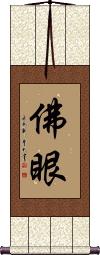
佛眼 is the “Eye of Buddha,” the enlightened one who sees all and is omniscient.
 In modern Japan, they also write the first Kanji as shown to the right. Both versions are correct but if you want the modern Japanese version, click on the Kanji to the right instead of the button above.
Triple Truth of Japanese Buddhism

人間性を再生するのは寛容な心親切な言葉奉仕と思いやりの精神 is known as the Triple Truth of Buddhism in Japanese.
The Buddha ordered that all should know this triple truth...
A generous heart, kind speech, and a life of service and compassion are the things that renew humanity.
That is the English translation most commonly used for this Japanese Buddhist phrase. You might have seen this on a coffee cup or tee shirt.
Note: Because this selection contains some special Japanese Hiragana characters, it should be written by a Japanese calligrapher.
Happy Buddha
Buddha of Joyful Light
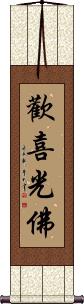
This title is Buddha of Joyful Light.
歡喜光佛 is Amitābha from Sanskrit but pronounced very differently in Chinese and Japanese.
Buddha Seeking
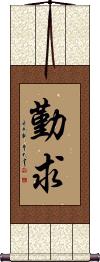
勤求 is a complex word that means inquiring in the Buddha way.
To put it another way, it is seeking something in the right way, at the right time, and diligently seeking only truth or the good.
Buddha Dharma Sangha
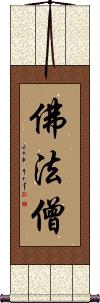
佛法僧 is the Buddha, Dharma, and Saṅgha.
These three characters are the “Triple Gem” of Buddhism or the Buddhist Trinity.
Buddha Heart / Mind of Buddha
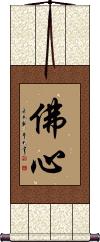
佛心 means the Buddha's mind, Buddha-heart, or the spiritually enlightened heart/mind.
The Buddha Heart is detached from good and evil and other such constructs. The Buddha Heart has mercy, compassion, and loving-kindness for all sentient life, the good, the wicked, and all in between.
The heart and mind (心) are the same concepts in the ancient Orient, so you can use heart and mind interchangeably in this context.
Seeing one’s Nature and becoming a Buddha
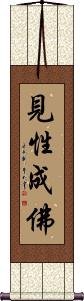
見性成佛 is a universal phrase that suggests that one may see one's nature and accomplish Buddhahood.
見性 suggests penetrating deep inside oneself to see one's “Original finally
Mind.”
成佛 refers to a sentient being who dispenses with illusions and delusions
through ascetic practice, is enlightened to the truth, and becomes a Buddha.
This is used by Mahayana, Chan, and Zen Buddhists in China, Korea, and Japan.
You will also see this with the last character written as 仏 in Japanese. In the religious context, 佛 is commonly used to mean Buddha. If you want the other version, see Kenshō Jōbutsu 見性成仏
The Buddha Realm / Buddhahood
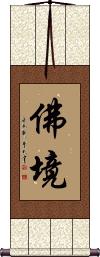
佛境 means the spiritual region of Buddhas, the state of the Buddha, or the Buddha realm.
佛境 is Bukkyō in Japanese and Fójìng in Mandarin Chinese.
If you are contemplating the Metaverse, in contrast, 佛境 is the Buddha-sphere or Buddhaverse.
Buddhism / Buddha
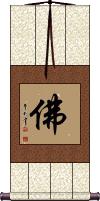
佛 is the essence of the Buddha or Buddhism.
Depending on the context, this word and character can be used to refer to the religion and lifestyle of Buddhism, or in some cases, the Buddha himself.
It is interesting to note that this word is separate from all others in the Chinese language. The sound of “fo” has only this meaning. 佛 is in contrast to many sounds in the Chinese language, which can have one of four tones, and more than 20 possible characters and meanings. This language anomaly shows how significantly Buddhism has affected China since ancient times.
More about Buddhism
佛 is also used with the same meaning in Korean Hanja.
It's used in the very religious context of Buddhism in Japan. It should be noted that there are two forms of this Kanji in use in Japan - this is the more formal/ancient version, but it's rarely seen outside of religious artwork and may not be recognized by all Japanese people.
It also acts as a suffix or first syllable for many Buddhist-related words in Chinese, Japanese, and Korean.
See our Buddhism & Zen page
See Also: Bodhisattva | Enlightenment
Buddha / Buddhism
Hotoke
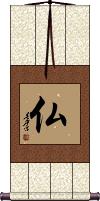
仏 is the single Japanese Kanji that can mean Buddha or Buddhism.
This Kanji was a shorthand way to write 佛 (Buddha) in Chinese (popular around the 13th century). Somehow, this became the version of this Chinese character that was absorbed into Japanese and thus became part of standard Kanji. Centuries later, this character is not recognized in China (except for those from China with a background in Chinese literature or language).
仏 is also a rare or derivative Korean Hanja form - but I doubt you will find any Korean that knows that.
Buddhism
(2 Kanji)
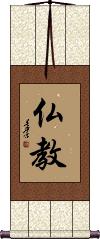
仏教 can mean Buddha or Buddhism in Japanese.
Depending on the context, this word can be used to refer to the religion and lifestyle of Buddhism or in some cases, the Buddha himself.
Note: Until the 5th century, Japan did not have a written language. At that time, Japan absorbed Chinese characters to form their written language (these characters are known as “Kanji” in Japanese). The first character of this Buddhism title was a shorthand way to write 佛 (Buddha) in Chinese (popular around the 13th century). Somehow, this became the version of this character that was absorbed into Japanese and thus became part of standard Kanji. Centuries later, this character is not recognized in China at all.
仏 is also a rare form of Buddha Korean Hanja - though seldom used even when the Korean Hanja writing system was more common 100 years ago.
Buddhism
(2 characters)
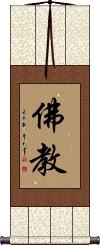
佛教 is the more exact way to express the religion or lifestyle of Buddhism.
It can also be read as “Buddha's Teachings.” 佛教 is Chinese only, as a different character is more commonly used in Japanese to express Buddhism. The same first character is used in Korea, but a slight variation exists in the second character in Korean Hanja. However, it would be fully recognized by any Korean person who can read Hanja.
Buddha Way
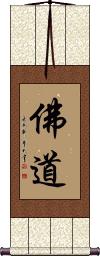
佛道 is “The way of Buddha, leading to Buddhahood” or the way to becoming a bodhi and enlightened.
Known in Japanese as Butsudō, in Mandarin Chinese as Fódào, and in Korean as Buldo or 불도.
The Principles of Buddhism
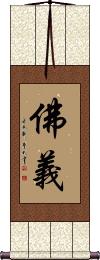
In short, 佛義 is the Principles of Buddhism, but there is more (especially for the second character):
佛 is the character for the Buddha and Buddhism.
義 has deeper meanings including justice, righteousness, morality, honour/honor, teachings, doctrine, right, proper, righteous, loyalty, purpose, or meaning. So the single word “principles” is often used to encompass all these ideas.
The Buddha is in Each Sentient Being
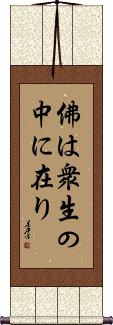
佛は衆生の中に在り is “Butsu wa shujo no naka ni ari” and means that the Buddha (potential for Buddhahood) exists in all beings in the universe.
So yes, your dog has the potential to be a Buddha (but only in a future reincarnation as a human). But all things, from the tiny cricket to the humpback whale have Buddha nature within them. If one takes the time to look and contemplate, one will see the Buddha in all things.
In Japan, sometimes the Buddha character is written 仏 instead of 佛, so you might see the whole phrase written as 仏は衆生の中に在り.
Note: Because this selection contains some special Japanese Hiragana characters, it should be written by a Japanese calligrapher.
Dharma / Buddhist Doctrine
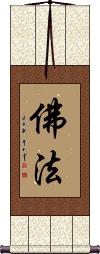
Amitabha Buddha
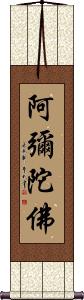
This title can mean the Buddha of the Western paradise.
But it's more a chant that means “May the lord Buddha preserve us!” or “Merciful Buddha!.”
阿彌陀佛 is also a translation to Chinese, Japanese, and Korean for “Amitâbha Buddha.”
Asian Buddhists will often greet and say goodbye to each other with this phrase/chant/title.
Four Noble Truths (Buddhism)
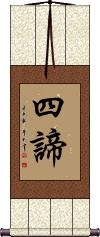
四諦 is the title of the Four Noble Truths as taught in virtually all sects of Buddhism.
These truths are suffering (dukkha), desire/attachment (samudaya), release from desire/attachment (nirodha), and the path leading away from suffering (magga).
The suggestion behind these truths is that all things in nature suffer. All things in nature have desire and attachment for things in the physical world. The enlightened can release themselves from the bonds of desire and attachment. And finally, once they release all desire and attachment, the enlightened will find a path that leads away from suffering.
This term is exclusively used by devout Buddhists. It is not a common term, and is remains an unknown concept to most Japanese, Chinese, and Korean people.
See Also: Enlightenment
Kensho Jobutsu - Enlightenment - Path to Buddha
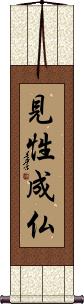
見性成仏 or Kenshō Jōbutsu is the initial enlightenment that leads to self-awareness, becoming Buddha, and the path to enter Nirvana.
Kenshō Jōbutsu is a complex concept in Japanese Buddhism. 見性成仏 is probably better translated as “Seeing one’s nature and becoming a Buddha.”
See Also: Enlightenment | Initial Enlightenment
Meet the Buddha, Kill the Buddha
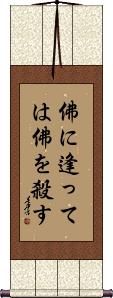
This controversial Buddhist koan means “On encountering Buddha, you should kill him.”
This is the short concise Japanese version of an original statement by ninth-century Chinese Buddhist monk Linji Yixuan, “If You Meet The Buddha On The Road, Kill Him.”
This takes some explaining... The concept here is that if you think you have seen, experienced, or achieved true enlightenment, the chances that you really have are so slim that you should kill or dismiss that idea.
Another suggestion is that one's path to becoming a Buddha is one's own, and one should not get caught up in religious fervor, and avoid “showing off” that they are a Buddhist.
Helpful references for this concept:
Lion's Roar addresses "If You Meet The Buddha On The Road, Kill Him"
Kill the Buddha
Note: Because this selection contains some special Japanese Hiragana characters, it should be written by a Japanese calligrapher.
Merciful Heart / The Light from a Buddha Mind
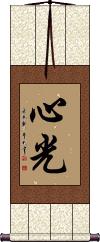
心光 can mean the light from a Buddha's mind or “merciful heart.”
This would especially be the light emanating from Amitābha.
Note that the character 心 can mean mind or heart. 光 means light or brightness - but in this context can suggest a glow of mercy or compassion.
This can also be a Japanese surname that is romanized as Shinkou or Shinko.
Mercy / Compassion / Buddhist Loving Kindness
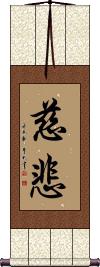
Besides the title above, 慈悲 can also be defined as clemency or lenience and sometimes the act of giving charity.
In the Buddhist context, it can be defined as “benevolence,” “loving-kindness and compassion,” or “mercy and compassion.”
This Buddhist virtue is perhaps the most important to employ in your life. All sentient beings that you encounter should be given your loving kindness. And trust me, however much you can give, it comes back. Make your life and the world a better place!
This Chinese/Japanese Buddhist term is the equivalent of Metta Karuna from Pali or Maitri Karuna from Sanskrit.
慈 can mean loving-kindness by itself.
悲 adds a component of sorrow, empathy, compassion, and sympathy for others.
See Also: Benevolence
Buddhist Monk
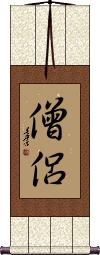
僧侶/僧侶 is a Japanese title for a Buddhist monk.
The first Kanji means Buddhist priest or monk by itself.
The second Kanji means follower or companion.
 Note, if you order this from the Japanese master calligrapher, the first character will look a bit more like the Kanji shown to the right than the Kanji shown above. Let us know if you have a preference, as both versions are technically-correct in both Chinese and Japanese.
Namo Amitabha Buddha
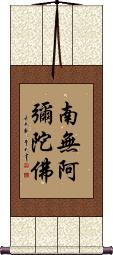
南無阿彌陀佛 is how to express “The Compassionate Amitabha Buddha” (especially for the Pure Land Buddhist Sect).
Some will translate as “Homage to Amitâbha Buddha” or “I seek refuge in the Amitâbha Buddha.”
This is valid in Chinese characters, Japanese Kanji, and old Korean Hanja.
Sometimes modern Japanese use a different version of the 4th and last Kanji, but the version shown here is the most universal.
This is used to pay homage to Amitabha Buddha.
See Also: Bodhisattva | Nirvana
Namo Shakyamuni Buddha
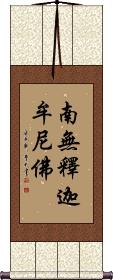
南無釋迦牟尼佛 is a Buddhist chant or prayer of respect to the Shakyamuni Buddha.
Some will translate this as the Buddhist vow.
The first two characters, 南無, are sometimes translated as “amen”; others will translate it as “belief in” or “homage to.”
To expand on this, 南無 can also mean “taking of refuge in” while representing devotion or conviction. 南無 as with most religious concepts or words, different people or denominations will have varying definitions.
Mantra to Buddha / Nembutsu
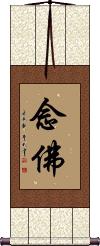
念佛 is used primarily in Japanese, where it is romanized as nenbutsu.
The meaning is to pray to Buddha, chant the name of Buddha, or repeat the name of Buddha. This can be an audible or inaudible chant.
Pure Land Buddhism / Jodo Buddhism
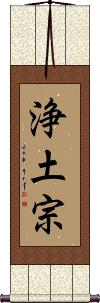
浄土宗 is the title of Japanese “Pure Land Buddhism.” This form is also romanized/known as “Jodo Shu” (jōdo shū).
Also known as Amidism for the fact that this is a branch of Mahayana (Mahāyāna) Buddhism which focuses on Amitabha (Amitābha) Buddha. This form of Buddhism, along with Chinese characters, came to Japan via China in the 5th century, according to most historians.
Notes:
Pure Land Buddhism is also known as 


 (jōdo bukkyō).
Some will just express it with just (Pure Land).
Reincarnation (Buddhism)
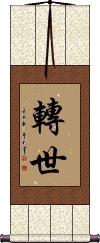
轉世 is the Buddhist idea of reincarnation or transmigration.
Other definitions of this term: “Attainer of Nirvana from within the desire realm,” “A practitioner who enters directly into Nirvana from the desire realm, without traversing the form and formless realms. One of the 27 kinds of Hinayana sages,” or simply, “to return again to this life.”
轉世 is also a Japanese title, but the first Kanji was slightly simplified after WWII. Just let us know if you want the modern Japanese version when you order.
See Also: Rebirth
Self Awareness Becomes a Buddha
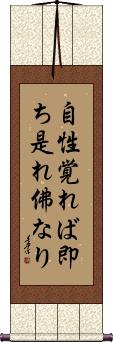
自性覚れば即ち是れ佛なり is a Zen quote that means “If one realizes one's own nature, one becomes a Buddha.”
The inference here is that if you understand who you really are, and become truly aware of yourself and your original nature, you are well on your way to becoming a liberated person (a Buddha).
Note: Because this selection contains some special Japanese Hiragana characters, it should be written by a Japanese calligrapher.
Shakyamuni / The Buddha
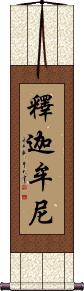
釋迦牟尼 is a transliteration of “Shakyamuni” or “Sakyamuni” in Chinese, Japanese, and old Korean.
The perceived meaning of the name is roughly translated as “Sage of the Sakyas.”
This same Buddha is also known as “Siddhartha Gautama,” “Gotama Buddha,” “Tathagata,” or simply, “The Supreme Buddha.”
Shakyamuni is the legendary man and prince who eventually established the Buddhist religion.
Note: Occasionally Romanized as “Siddhattha Gotama.”
This combination of characters is sometimes seen and used in South Korea and Japan as well (with the same meaning).
Note: 釋迦牟尼 came from the Sanskrit शाक्यमुनि and can also be romanized with diuretics as Śākyamuni.
Shakyamuni / The Buddha
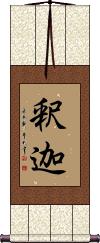
釈迦 is the way to write Shakyamuni in Japanese.
It's just two Kanji, the first is a simplified version of the one used in Chinese for Shakyamuni, and the second one is identical to the Chinese.
This refers to the Buddha (Siddhartha Gautama, 563 BCE-483 BCE) also known as Sakyamuni and Gautama Buddha.
This has a very good meaning in Japanese but is an odd selection for a wall scroll. It appears here more for reference.
Three Treasures of Buddhism
The Triple Gem
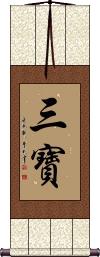
三寶 is the title for “Three Precious Treasures of Buddhism” or “The Triple Gem.”
These three treasures are the Buddha 佛, the Dharma 法 (teachings or the law of the Buddha), and the Sangha 僧 (the community of monks or followers).
This term is used by most (perhaps not all) Buddhists in China, Japan, and South Korea (written the same in the original form but pronounced differently in each language). Non-Buddhists may just read this as “Three Treasures” without the religious context. For instance, there is also a “Three Treasures of Chinese Medicine” that is sometimes titled the same way.
In modern Japanese and Simplified Chinese, this is written 三宝 instead of 三寶.
Shin Buddhism
True Pure Land Buddhism
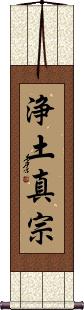
浄土真宗 is known in the west as “Shin Buddhism.”
This is a school of Japanese “Pure Land Buddhism.” This form is also known as “True Pure Land Buddhism” or “Jodoshinshu” (jōdoshinshū).
If you are looking for this title, you probably already know the rest of the story.
True Religion / Buddha Truth
The way of the truth
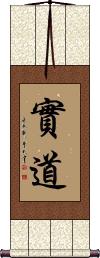
實道 is a Buddhist title that means “The true way,” “The true religion,” “The way of the truth,” or “The absolute Buddha-truth.”
Zen Buddhism
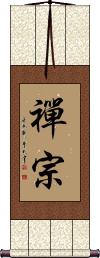
禪宗 is one way to title “Zen Buddhism.” Because the original pronunciation of Zen in Chinese is Chan, you'll also see this expressed as Chan Buddhism.
From the Buddhist Dictionary:
The Chan, meditative or intuitional, sect is usually said to have been established in China by Bodhidharma, the twenty-eighth patriarch, who brought the tradition of the Buddha-mind from India. This sect, believing in direct enlightenment, disregarded ritual and sūtras and depended upon the inner light and personal influence for the propagation of its tenets, founding itself on the esoteric tradition supposed to have been imparted to Kāśyapa by the Buddha, who indicated his meaning by plucking a flower without further explanation. Kāśyapa smiled in apprehension and is supposed to have passed on this mystic method to the patriarchs. The successor of Bodhidharma was 慧可 Huike, and he was succeeded by 僧璨 Sengcan, 道信 Daoxin, 弘忍 Hongren, 慧能 Huineng, and 神秀 Shenxiu, the sect dividing under the two latter into the southern and northern schools: the southern school became prominent, producing 南嶽 Nanyue and 靑原 Qingyuan, the former succeeded by 馬祖 Mazu, the latter by 石頭 Shitou. From Mazu's school arose the five later schools.
The following table may be helpful for those studying Chinese or Japanese...
| Title | Characters | Romaji (Romanized Japanese) | Various forms of Romanized Chinese | |
| Wisdom and Insight of the Buddha | 佛知見 佛知见 | bucchiken / buchiken | fó zhī jiàn fo2 zhi1 jian4 fo zhi jian fozhijian | fo chih chien fochihchien |
| The Aura of Buddha | 佛光 | bukkou / buko | fó guāng / fo2 guang1 / fo guang / foguang | fo kuang / fokuang |
| The Eye of the Buddha | 佛眼 佛眼 / 仏眼 | butsugen / butsugen | wǔ yǎn / wu3 yan3 / wu yan / wuyan | wu yen / wuyen |
| Triple Truth of Japanese Buddhism | 人間性を再生するのは寛容な心親切な言葉奉仕と思いやりの精神 | ningensei o saisei suruno wa kanyou na kokoro shinsetsu na kotoba houshi to omoi yari no seishin ningensei o saisei suruno wa kanyo na kokoro shinsetsu na kotoba hoshi to omoi yari no seishin | ||
| Happy Buddha | 歡喜光佛 欢喜光佛 | kan gi kou butsu kangikoubutsu kan gi ko butsu | huān xǐ guāng fó huan1 xi3 guang1 fo2 huan xi guang fo huanxiguangfo | huan hsi kuang fo huanhsikuangfo |
| Buddha Seeking | 勤求 | gongu | qín qiú / qin2 qiu2 / qin qiu / qinqiu | ch`in ch`iu / chinchiu / chin chiu |
| Buddha Dharma Sangha | 佛法僧 | buppō sō / buppōsō / bupō sō | fó fǎ sēng fo2 fa3 seng1 fo fa seng fofaseng | |
| Buddha Heart Mind of Buddha | 佛心 | busshin / bushin | fó xīn / fo2 xin1 / fo xin / foxin | fo hsin / fohsin |
| Seeing one’s Nature and becoming a Buddha | 見性成佛 见性成佛 | ken shou jou butsu kenshoujoubutsu ken sho jo butsu | jiàn xìng chéng fó jian4 xing4 cheng2 fo2 jian xing cheng fo jianxingchengfo | chien hsing ch`eng fo chienhsingchengfo chien hsing cheng fo |
| The Buddha Realm Buddhahood | 佛境 | bukkyou / bukyo | fó jìng / fo2 jing4 / fo jing / fojing | fo ching / foching |
| Buddhism Buddha | 佛 | hotoke | fó / fo2 / fo | |
| Buddha Buddhism | 佛 仏 | hotoke / butsu | ||
| Buddhism | 仏教 | bukkyou / bukyo | ||
| Buddhism | 佛教 | fó jiào / fo2 jiao4 / fo jiao / fojiao | fo chiao / fochiao | |
| Buddha Way | 佛道 | butsudō | fó dào / fo2 dao4 / fo dao / fodao | fo tao / fotao |
| The Principles of Buddhism | 佛義 佛义 | butsu gi / butsugi | fó yì / fo2 yi4 / fo yi / foyi | fo i / foi |
| The Buddha is in Each Sentient Being | 佛は衆生の中に在り | butsu wa shujou no naka ni ari butsuwashujounonakaniari butsu wa shujo no naka ni ari | ||
| Dharma Buddhist Doctrine | 佛法 | fó fǎ / fo2 fa3 / fo fa / fofa | ||
| Amitabha Buddha | 阿彌陀佛 阿弥陀佛 | amida butsu amidabutsu | ē mí tuó fó e1 mi2 tuo2 fo2 e mi tuo fo emituofo | o mi t`o fo omitofo o mi to fo |
| Four Noble Truths (Buddhism) | 四諦 四谛 | shitai | sì dì / si4 di4 / si di / sidi | ssu ti / ssuti |
| Kensho Jobutsu - Enlightenment - Path to Buddha | 見性成佛 見性成仏 | ken shou jou butsu kenshoujoubutsu ken sho jo butsu | ||
| Meet the Buddha, Kill the Buddha | 佛に逢っては佛を殺す | butsu ni atte wa butsu o korosu | ||
| Merciful Heart The Light from a Buddha Mind | 心光 | shin kou / shinkou / shin ko | xīn guāng xin1 guang1 xin guang xinguang | hsin kuang hsinkuang |
| Mercy Compassion Buddhist Loving Kindness | 慈悲 | ji hi / jihi | cí bēi / ci2 bei1 / ci bei / cibei | tz`u pei / tzupei / tzu pei |
| Buddhist Monk | 僧侶 / 僧侶 僧侶 | sou ryo / souryo / so ryo | ||
| Namo Amitabha Buddha | 南無阿彌陀佛 南无阿弥陀佛 | na mu a mi da butsu namuamidabutsu | nā mó ē mí tuó fó na1 mo2 e1 mi2 tuo2 fo2 na mo e mi tuo fo namoemituofo | na mo o mi t`o fo namoomitofo na mo o mi to fo |
| Namo Shakyamuni Buddha | 南無釋迦牟尼佛 南无释迦牟尼佛 | namu shakamuni butsu namushakamunibutsu | nán wú shì jiā móu ní fó nan2 wu2 shi4 jia1 mou2 ni2 fo2 nan wu shi jia mou ni fo nanwushijiamounifo | nan wu shih chia mou ni fo nanwushihchiamounifo |
| Mantra to Buddha Nembutsu | 念佛 | nenbutsu | niàn fó / nian4 fo2 / nian fo / nianfo | nien fo / nienfo |
| Pure Land Buddhism Jodo Buddhism | 淨土宗 浄土宗 | jou do shuu joudoshuu jo do shu | jìng tǔ zōng jing4 tu3 zong1 jing tu zong jingtuzong | ching t`u tsung chingtutsung ching tu tsung |
| Reincarnation (Buddhism) | 轉世 转世 | ten sei / tensei | zhuǎn shì zhuan3 shi4 zhuan shi zhuanshi | chuan shih chuanshih |
| Self Awareness Becomes a Buddha | 自性覚れば即ち是れ佛なり | Jishou satore ba sunawachi kore butsu nari Jisho satore ba sunawachi kore butsu nari | ||
| Shakyamuni The Buddha | 釋迦牟尼 释迦牟尼 | sha ka mu ni shakamuni | shì jiā móu ní shi4 jia1 mou2 ni2 shi jia mou ni shijiamouni | shih chia mou ni shihchiamouni |
| Shakyamuni The Buddha | 釈迦 | sha ka / shaka | shì jiā / shi4 jia1 / shi jia / shijia | shih chia / shihchia |
| Three Treasures of Buddhism | 三寶 三宝 | san bou / sanbou / san bo | sān bǎo / san1 bao3 / san bao / sanbao | san pao / sanpao |
| Shin Buddhism | 浄土真宗 | jou do shin shuu joudoshinshuu jo do shin shu | ||
| True Religion Buddha Truth | 實道 实道 | jitsu dou / jitsudou / jitsu do | shí dào / shi2 dao4 / shi dao / shidao | shih tao / shihtao |
| Zen Buddhism | 禪宗 禅宗 | zen shuu / zenshuu / zen shu | chán zōng chan2 zong1 chan zong chanzong | ch`an tsung chantsung chan tsung |
| In some entries above you will see that characters have different versions above and below a line. In these cases, the characters above the line are Traditional Chinese, while the ones below are Simplified Chinese. | ||||

Successful Chinese Character and Japanese Kanji calligraphy searches within the last few hours...



