Many custom options...


And formats...



Burning in Chinese / Japanese...
Buy a Burning calligraphy wall scroll here!
Personalize your custom “Burning” project by clicking the button next to your favorite “Burning” title below...
Aspire / Burning Desire
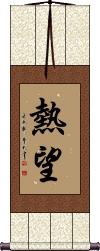
熱望 is a Chinese, Japanese Kanji, and old Korean Hanja word that means, to aspire, longing for, or burning desire.
The first character means hot, heated, or burning.
The second character means hope, expectations, aspiration, or desire.
Put out a burning wood cart with a cup of water
An utterly inadequate measure
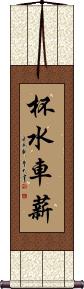
杯水車薪 is a warning against a futile effort.
This proverb literally refers to one who is “trying to put out a burning cart of wood with a cup of water,” or “throw a cup of water on a cartload of wood.” The lesson to be learned is about using the right measure or tool for the job and not wasting your effort if you are inadequately equipped for the task at hand - in other words the postscript should be “go get a bucket or a fire hose.”
Ardent / Fierce
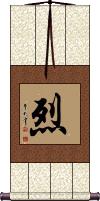
烈 is a Chinese word that means ardent; intense; fierce; stern; upright; to give one's life for a noble cause.
In another context, this character can refer to one's exploits or achievements.
In the Buddhist context, this is burning, fierce, virtuous, and/or heroic.
While technically, it had the same meaning in Japanese, it's usually a female given name, Retsu in Japanese these days.
Drain the pond to get all the fish
Kill the goose that lays the golden eggs
In 632 BC, Duke Wen of the Kingdom of Jin was about to lead an army against the forces of the Kingdom of Chu.
The Duke asked one of his advisers, Jiu Fan, how they could win the impending battle, as they were drastically outnumbered.
Jiu Fan said, “All is fair in war,” and suggested a plan of dishonorable tactics (cheating).
The Duke was unsure of this advice, so he asked another adviser, Yong Ji, who replied, “If you catch fish by draining the pond, you can certainly get all the fish. But there will be no fish the following year. You can cheat this one time in battle, but such tactics can only be used once, as the enemy will be wise in future encounters.”
The Duke heard the words of his wiser adviser but cheated to gain victory in the battle. However, he rewarded Yong Ji more than Jiu Fan at the victory celebration, stating that while Jiu Fan's advice gained one victory, the wise words of Yong Ji would last forever.
This Chinese idiom/proverb is still used, over 2600 years later to remind people not to burn bridges, cheat, or dishonor themselves in exchange for a short-term gain while sacrificing the future.
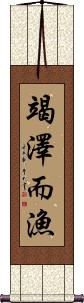
竭澤而漁 is very similar to the meaning of the English phrase, “Kill the goose that lays the golden eggs.”
Phoenix Rise from the Ashes
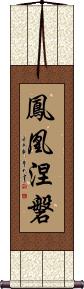
鳳凰涅磐 is a proverb that suggests “Legendary Phoenix rises from the ashes.” It means “Legendary Phoenix [reaches] Nirvana.”
There is a legend in China of a great bird reborn once every 500 years. This bird gathers all the ill will, suffering, desire, and other negative things of the world. The bird then plunges into the fire to burn away all negative things, sacrificing itself in the process (achieving Nirvana, or perhaps allowing others the opportunity to reach Nirvana).
500 years later, the phoenix is reborn from the ashes again, and the cycle repeats.
Not the results for burning that you were looking for?
Below are some entries from our dictionary that may match your burning search...
| Characters If shown, 2nd row is Simp. Chinese |
Pronunciation Romanization |
Simple Dictionary Definition |
烈 see styles |
liè lie4 lieh retsu れつ |
More info & calligraphy: Ardent / Fierce(female given name) Retsu Burning, fierce; virtuous, heroic. |
鬼 see styles |
guǐ gui3 kuei miniwa みにわ |
More info & calligraphy: Ghost Demon(1) ogre; demon; oni; (2) (See 亡魂) spirit of a deceased person; (3) (おに only) ogre-like person (i.e. fierce, relentless, merciless, etc.); (4) (おに only) (See 鬼ごっこ・おにごっこ) it (in a game of tag, hide-and-seek, etc.); seeker; chaser; tagger; tigger; (5) (き only) {astron} (See 二十八宿,朱雀・すざく・2) Chinese "ghost" constellation (one of the 28 mansions); (prefix) (6) (おに only) (slang) (See 超・1) very; extremely; super-; (surname) Miniwa preta 薜荔多, departed, dead; a disembodied spirit, dead person, ghost; a demon, evil being; especially a 餓鬼 hungry ghost. They are of many kinds. The Fan-i ming i classifies them as poor, medium, and rich; each again thrice subdivided: (1) (a) with mouths like burning torches; (b) throats no bigger than needles; (c) vile breath, disgusting to themselves; (2) (a) needle-haired, self-piercing; (b) hair sharp and stinking; (c) having great wens on whose pus they must feed. (3) (a) living on the remains of sacrifices; (b) on leavings in general; (c) powerful ones, yakṣas, rākṣasas, piśācas, etc. All belong to the realm of Yama, whence they are sent everywhere, consequently are ubiquitous in every house, lane, market, mound, stream, tree, etc. |
地獄 地狱 see styles |
dì yù di4 yu4 ti yü jigoku じごく |
More info & calligraphy: Hell(1) {Buddh} hell realm; Naraka; (2) {Christn} Hell; (3) hell; misery; nightmare; inferno; (4) place where a volcano or hot springs constantly spew smoke or steam; (place-name) Jigoku naraka, 捺落迦 (or 那落迦) ; niraya 泥犂; explained by 不樂 joyless; 可厭 disgusting, hateful; 苦具, 苦器 means of suffering; if 地獄 earth-prison; 冥府 the shades, or departments of darkness. Earth-prison is generally intp. as hell or the hells; it may also be termed purgatory; one of the six gati or ways of transmigration. The hells are divided into three classes: I. Central, or radical, 根本地獄 consisting of (1) The eight hot hells. These were the original hells of primitive Buddhism, and are supposed to be located umder the southern continent Jambudvīpa 瞻部州, 500 yojanas below the surface. (a) 等活 or 更活 Saṃjīva, rebirth, where after many kinds of suffering a cold wind blows over the soul and returns it to this life as it was before, hence the name 等活. (b) 黑繩 Kaslasūtra, where the sufferer is bound with black chains and chopped or sawn asunder. (c) 線合; 衆合; 堆壓 Saṃghāta, where are multitudes of implements of torture, or the falling of mountains upon the sufferer. (d) 號呌; 呼呼; 叫喚 Raurava, hell of wailing. (e) 大呌; 大號呌; 大呼 Mahāraurava, hell of great wailing. (f) 炎熱; 燒炙 Tapana, hell of fames and burning. (g) 大熱; 大燒炙; 大炎熱 Pratāpana, hell of molten lead. (h) 無間; 河鼻旨; 阿惟越致; 阿毗至; 阿鼻; 阿毗 Avīci, unintermitted suffering, where sinners die and are reborn to suffer without interval. (2) The eight cold hells 八寒地獄. (a) 頞浮陀地獄 Arbuda, where the cold causes blisters. (b) 尼刺部陀 Nirarbuda, colder still causing the blisters to burst. (c) 頞哳吒; 阿吒吒 Atata, where this is the only possible sound from frozen lips. (d) 臛臛婆; 阿波波 Hahava or Apapa, where it is so cold that only this sound can be uttered. (e) 虎虎婆 Hāhādhara or Huhuva, where only this sound can be uttered. (f) 嗢鉢羅; 鬱鉢羅 (or 優鉢羅) Utpala, or 尼羅鳥 (or 漚) 鉢羅 Nīlotpala, where the skin is frozen like blue lotus buds. (g) 鉢特摩 Padma, where the skin is frozen and bursts open like red lotus buds. (h) 摩訶鉢特摩 Mahāpadma, ditto like great red lotus buds. Somewhat different names are also given. Cf. 倶舍論 8; 智度論 16; 涅槃經 11. II. The secondary hells are called 近邊地獄 adjacent hells or 十六遊增 each of its four sides, opening from each such door are four adjacent hells, in all sixteen; thus with the original eight there are 136. A list of eighteen hells is given in the 十八泥梨經. III. A third class is called the 孤地獄 (獨地獄) Lokāntarika, or isolated hells in mountains, deserts, below the earth and above it. Eitel says in regard to the eight hot hells that they range 'one beneath the other in tiers which begin at a depth of 11,900 yojanas and reach to a depth of 40,000 yojanas'. The cold hells are under 'the two Tchahavālas and range shaft-like one below the other, but so that this shaft is gradually widening to the fourth hell and then narrowing itself again so that the first and last hell have the shortest, those in the centre the longest diameter'. 'Every universe has the same number of hells, ' but 'the northern continent has no hell whatever, the two continents east and west of Meru have only small Lokāntarika hells... whilst all the other hells are required for the inhabitants of the southern continent '. It may be noted that the purpose of these hells is definitely punitive, as well as purgatorial. Yama is the judge and ruler, assisted by eighteen officers and a host of demons, who order or administer the various degrees of torture. 'His sister performs the same duties with regard to female criminals, ' and it may be mentioned that the Chinese have added the 血盆池 Lake of the bloody bath, or 'placenta tank' for women who die in childbirth. Release from the hells is in the power of the monks by tantric means. |
熱望 热望 see styles |
rè wàng re4 wang4 je wang netsubou / netsubo ねつぼう |
More info & calligraphy: Aspire / Burning Desire(noun, transitive verb) longing for; burning desire |
杯水車薪 杯水车薪 see styles |
bēi shuǐ chē xīn bei1 shui3 che1 xin1 pei shui ch`e hsin pei shui che hsin |
More info & calligraphy: Put out a burning wood cart with a cup of water |
炎 see styles |
yán yan2 yen homura ほむら |
flame; inflammation; -itis (suffix) {med} (See 扁桃腺炎) -itis (indicating an inflammatory disease); (female given name) Homura Blazing, burning. |
焌 see styles |
qū qu1 ch`ü chü |
to extinguish a burning object; to singe something with a smoldering object (e.g. burn a hole in one's trousers with a cigarette); to stir-fry; to pour a mixture of hot oil and flavorings over food |
熄 see styles |
xī xi1 hsi |
to extinguish; to put out (fire); to quench; to stop burning; to go out (of fire, lamp etc); to come to an end; to wither away; to die out; Taiwan pr. [xi2] |
熰 𬉼 see styles |
ǒu ou3 ou |
copious smoke produced by smoldering firewood; half alight; to use the smoke of burning wormwood etc to repel insects |
錠 锭 see styles |
dìng ding4 ting tei / te てい |
(weaving) spindle; ingot; pressed cake of medicine etc; classifier for: gold and silver ingots, ink sticks (1) lock; padlock; (n,n-suf,ctr) (2) tablet; lozenge; pill; (female given name) Tei burning brightly |
一炷 see styles |
yī zhù yi1 zhu4 i chu isshu |
One burning of incense; a candle, or lamp. |
三車 三车 see styles |
sān chē san1 che1 san ch`e san che sansha |
triyāna. 三乘 or 三乘法門 (1) The three vehicles across saṃsāra into nirvāṇa, i.e. the carts offered by the father in the Lotus Sutra to lure his children out of the burning house: (a) goat carts, representing śrāvakas; (b) deer carts, pratyekabuddhas; (c) bullock carts, bodhisattvas. (2) The three principal schools of Buddhism— Hīnayāna, Madhyamayāna, Mahāyāna. |
下火 see styles |
xià huǒ xia4 huo3 hsia huo shimoppi しもっぴ |
burning low; waning; declining; (place-name) Shimoppi 下炬 To apply the torch; syn. for setting alight the funeral pyre of a monk. |
九鬼 see styles |
jiǔ guǐ jiu3 gui3 chiu kuei kuki くき |
(place-name, surname) Kuki The nine classes of ghosts are of three kinds: without means, small means, rich. The first group have 炬口 burning torch-like mouths, or 鍼口 narrow needle mouths, or 臭口 stinking mouths; the second group have hair like needles, or stinking hair, or tumours; the rich ghosts haunt sacrifices to the dead, or eat human leavings, or live truculently. |
五燒 五烧 see styles |
wǔ shāo wu3 shao1 wu shao goshō |
The five burnings, or 五痛 five pains, i. e. infraction of the first five commandments leads to state punishment in this life and the hells in the next. |
五逆 see styles |
wǔ nì wu3 ni4 wu ni gogyaku ごぎゃく |
(1) {Buddh} five cardinal sins (killing one's father, killing one's mother, killing an arhat, shedding the blood of a Buddha, causing a schism within the sangha); (2) (hist) crime of killing one's master, father, grandfather, mother, or grandmother pañcānantarya; 五無間業 The five rebellious acts or deadly sins, parricide, matricide, killing an arhat, shedding the blood of a Buddha, destroying the harmony of the sangha, or fraternity. The above definition is common both to Hīnayāna and Mahāyāna. The lightest of these sins is the first; the heaviest the last. II. Another group is: (1) sacrilege, such as destroying temples, burning sutras, stealing a Buddha's or a monk's things, inducing others to do so, or taking pleasure therein; (2) slander, or abuse of the teaching of śrāvaka s, pratyekabuddhas, or bodhisattvas; (3) ill-treatment or killing of a monk; (4) any one of the five deadly sins given above; (5) denial of the karma consequences of ill deeds, acting or teaching others accordingly, and unceasing evil life. III. There are also five deadly sins, each of which is equal to each of the first set of five: (1) violation of a mother, or a fully ordained nun; (2) killing a bodhisattva in a sangha; (5) destroying a Buddha's stūpa. IV. The five unpardonable sin of Devadatta who (1) destroyed the harmony of the community; (2) injured Śākyamuni with a stone, shedding his blood; (3) induced the king to let loose a rutting elephant to trample down Śākyamuni; (4) killed a nun; (5) put poison on his finger-nails and saluted Śākyamuni intending to destroy him thereby. |
余炎 see styles |
yoen よえん |
burning embers |
光宅 see styles |
guāng zhái guang1 zhai2 kuang chai Kōtaku |
Kuang-chai, name of the temple where 法雲 Fa-yun early in the sixth century wrote his commentary on the Lotus Sutra, which is known as the 光宅疏; 光宅 became his epithet. He made a division of four yāna from the Burning House parable, the goat cart representing the śrāvaka, the deer cart the pratyekabuddha, the ox-cart the Hīnayāna bodhisattva, and the great white ox-cart the Mahāyāna bodhisattva; a division adopted by T'ien-t'ai. |
四教 see styles |
sì jiào si4 jiao4 ssu chiao shikyō |
Four teachings, doctrines, or schools; five groups are given, whose titles are abbreviated to 光天曉苑龍: (1) 光宅四教 The four schools of 法雲 Fayun of the 光宅 Guangzhai monastery are the four vehicles referred to in the burning house parable of the Lotus Sutra, i. e. śrāvaka, pratyekabuddha, bodhisattva, and the final or one vehicle teaching. (2) 天台四教 The Tiantai four are 藏通, 別, and 圓, v. 八教. (3) 曉公四教 The group of 元曉 Wŏnhyo of 海東 Haedong are the 三乘別教 represented by the 四諦緣起經; 三乘通教 represented by the 般若深密教; 一乘分教 represented by the 究網經; and 一乘滿教 represented by the 華嚴經. (4) 苑公四教 The group of 慧苑 Huiyuan: the schools of unbelievers, who are misled and mislead; of śrāvakas and pratyekabuddhas who know only the phenomenal bhūtatathatā; of novitiate bodhisattvas who know only the noumenal bhūtatathatā; and of fully developed bodhisattvas, who know both. (5) 龍樹四教 Nāgārjuna's division of the canon into 有 dealing with existence, or reality, cf. the 四阿含; 空 the Void, cf. 般若經; 亦有亦 空 both, cf. 深密經; and 非有非 空 neither, cf. 中論. |
大車 大车 see styles |
dà chē da4 che1 ta ch`e ta che ooguruma おおぐるま |
(surname) Ooguruma The great bullock-cart in the parable of the burning house, i.e. Mahāyāna, v. Lotus Sutra. |
常灯 see styles |
joutou / joto じょうとう |
(1) continuously burning light (e.g. at a Buddhist altar); (2) roadside lamp that stays lit all night |
延燒 延烧 see styles |
yán shāo yan2 shao1 yen shao |
(of fire) to continue burning; to spread; (fig.) (of a disease, controversy, issue or trend) to spread; to intensify; to gain traction |
情炎 see styles |
jouen / joen じょうえん |
burning passion; flaming desires |
情焔 see styles |
jouen / joen じょうえん |
burning passion; flaming desires |
捨身 舍身 see styles |
shě shēn she3 shen1 she shen shashin しゃしん |
to give one's life (n,vs,vi) (1) {Buddh} renouncing the flesh or the world; becoming a priest; (n,vs,vi) (2) {Buddh} sacrificing one's life for the sake of mankind or Buddhist teachings Bodily sacrifice, e.g. by burning, or cutting off a limb, etc. |
摩頂 摩顶 see styles |
mó dǐng mo2 ding3 mo ting machō |
To lay the hand on the top of the head, a custom of Buddha in teaching his disciples, from which the burning of the spots on the head of a monk is said to have originated. |
暑い see styles |
atsui(p); azui(sk); ajiぃ(sk); ajii(sk); ajii(sk); attsui(sk); atsui(sk); atsui(sk) / atsui(p); azui(sk); ajiぃ(sk); aji(sk); aji(sk); attsui(sk); atsui(sk); atsui(sk) あつい(P); あづい(sk); あぢぃ(sk); あぢー(sk); あぢい(sk); あっつい(sk); アツイ(sk); アツい(sk) |
(adjective) (1) (ant: 寒い・1) hot; warm; sultry; heated; (adjective) (2) passionate; impassioned; burning (desire, etc.); (adjective) (3) on everybody's mind; on the radar; du jour; interested (gaze, etc.) |
樂經 乐经 see styles |
yuè jīng yue4 jing1 yüeh ching |
Book of Music, said to be one of the Six Classics lost after Qin's burning of the books in 212 BC, but may simply refer to Book of Songs 詩經|诗经 |
欝蒸 see styles |
yù zhēng yu4 zheng1 yü cheng utsujō |
burning distress |
火中 see styles |
kachuu; honaka(rk) / kachu; honaka(rk) かちゅう; ほなか(rk) |
(1) in the fire; in the flames; (noun, transitive verb) (2) (かちゅう only) burning (something); throwing into the fire; committing to the flames |
Click here for more burning results from our dictionary
The following table may be helpful for those studying Chinese or Japanese...
| Title | Characters | Romaji (Romanized Japanese) | Various forms of Romanized Chinese | |
| Aspire Burning Desire | 熱望 热望 | netsubou / netsubo | rè wàng / re4 wang4 / re wang / rewang | je wang / jewang |
| Put out a burning wood cart with a cup of water | 杯水車薪 杯水车薪 | bēi shuǐ chē xīn bei1 shui3 che1 xin1 bei shui che xin beishuichexin | pei shui ch`e hsin peishuichehsin pei shui che hsin |
|
| Ardent Fierce | 烈 | retsu | liè / lie4 / lie | lieh |
| Drain the pond to get all the fish | 竭澤而漁 竭泽而渔 | jié zé ér yú jie2 ze2 er2 yu2 jie ze er yu jiezeeryu | chieh tse erh yü chiehtseerhyü |
|
| Phoenix Rise from the Ashes | 鳳凰涅磐 凤凰涅磐 | fèng huáng niè pán feng4 huang2 nie4 pan2 feng huang nie pan fenghuangniepan | feng huang nieh p`an fenghuangniehpan feng huang nieh pan |
|
| In some entries above you will see that characters have different versions above and below a line. In these cases, the characters above the line are Traditional Chinese, while the ones below are Simplified Chinese. | ||||

Successful Chinese Character and Japanese Kanji calligraphy searches within the last few hours...



