Many custom options...


And formats...



Camp in Chinese / Japanese...
Buy a Camp calligraphy wall scroll here!
Personalize your custom “Camp” project by clicking the button next to your favorite “Camp” title below...
Camp
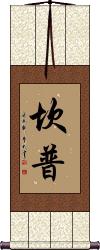
坎普 is the name Camp in Chinese (Mandarin).
Camp

キャンプ is the name Camp in Japanese Katakana.
Note: Because this title is entirely Japanese Katakana, it should be written by a Japanese calligrapher.
Stronghold
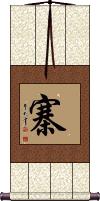
寨 is a Chinese, Japanese Kanji, and old Korean Hanja word that means stronghold, stockade, camp, fort, fortress, or fortification.
Pain is Weakness Leaving the Body
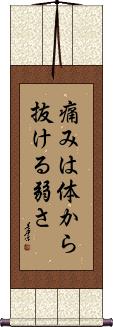
痛みは体から抜ける弱さ is how to write “pain is weakness leaving the body” in Japanese.
I remember this being shouted a lot during U.S. Marine Corps boot camp.
Note: Because this selection contains some special Japanese Hiragana characters, it should be written by a Japanese calligrapher.
Pain is Weakness Leaving the Body
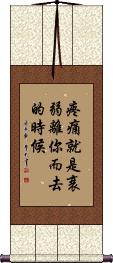
I remember this being shouted a lot during U.S. Marine Corps boot camp. 疼痛就是衰弱離你而去的時候 is how to write that phrase in Chinese. At least, this is as close as we could compose/translate it, and hold the full original meaning and connotations.
The version shown here is really, “Pain is weakness leaving your body.” Although it's said in English both ways (the or your), it works better in Chinese with “your.”
Not the results for camp that you were looking for?
Below are some entries from our dictionary that may match your camp search...
| Characters If shown, 2nd row is Simp. Chinese |
Pronunciation Romanization |
Simple Dictionary Definition |
勢 势 see styles |
shì shi4 shih seiji / seji せいじ |
More info & calligraphy: Potential / Momentum(suffix noun) group (of people, players, companies, etc.); camp; team; (personal name) Seiji bala, sthāman. Power, influence, authority; aspect, circumstances. |
寨 see styles |
zhài zhai4 chai toride とりで |
More info & calligraphy: Strongholdfort; fortress; stronghold; fortification |
派 see styles |
pài pai4 p`ai pai minamata みなまた |
(literary) tributary; branch of a river; clique; school; group; faction; (bound form) style; manner; to send (a person or resource); to dispatch; to allocate (a resource or task); to appoint (sb); classifier for factions, groups etc; (preceded by 一[yi1]) classifier used in characterizing a scene, atmosphere, demeanor, sound, remark etc; (loanword) pi (Greek letter Π, π); the circular ratio 𝜋 = 3.14159...; (loanword) pie (n,n-suf) (1) group; faction; clique; coterie; (n,n-suf) (2) (political) faction; wing; camp; (n,n-suf) (3) school (of thought, painting, etc.); (n,n-suf) (4) sect; denomination; (surname) Minamata branch |
キャンプ see styles |
kyanpu キャンプ |
More info & calligraphy: Camp |
屯 see styles |
zhūn zhun1 chun ton とん |
used in 屯邅[zhun1 zhan1] (ateji / phonetic) (kana only) ton (now usu. a metric ton, i.e. 1,000kg) (eng:); tonne; (out-dated or obsolete kana usage) (1) gathering; place where people gather; (2) (archaism) police station; camp; barracks; (given name) Ton Collect, mass; to quarter, camp. To sprout; very; stingy. |
營 营 see styles |
yíng ying2 ying ei / e えい |
camp; barracks; battalion; to build; to operate; to manage; to strive for (surname) Ei occupied |
轅 辕 see styles |
yuán yuan2 yüan nagae ながえ |
shaft of a cart or carriage; (bound form) entrance gate of a military camp or yamen; (fig.) government office shafts (attached to the yoke of a cart, plow, etc.) |
陣 阵 see styles |
zhèn zhen4 chen noburu のぶる |
disposition of troops; wave; spate; burst; spell; short period of time; classifier for events or states of short duration (1) (See 背水の陣) battle formation; (2) (See 陣を張る) camp; encampment; position; (n,n-suf) (3) (See 報道陣) group; gang; party; corps; (4) (See 大坂夏の陣) war; battle; campaign; (given name) Noburu a file of soldiers |
兵營 兵营 see styles |
bīng yíng bing1 ying2 ping ying |
military camp; barracks |
副官 see styles |
fù guān fu4 guan1 fu kuan fukukan; fukkan ふくかん; ふっかん |
aide-de-camp adjutant; aide; aide-de-camp |
劫寨 see styles |
jié zhài jie2 zhai4 chieh chai |
to seize a stronghold; to surprise the enemy in his camp |
劫營 劫营 see styles |
jié yíng jie2 ying2 chieh ying |
to seize a camp; to surprise the enemy in bed |
勞改 劳改 see styles |
láo gǎi lao2 gai3 lao kai |
abbr. for 勞動改造|劳动改造[lao2 dong4 gai3 zao4]; reform through labor; laogai (prison camp) |
参陣 see styles |
sanjin さんじん |
(n,vs,vi) arrival at a military camp; joining in a battle |
參軍 参军 see styles |
cān jun can1 jun1 ts`an chün tsan chün |
to join the army; (official title in imperial China) military adviser; aide-de-camp |
反間 反间 see styles |
fǎn jiàn fan3 jian4 fan chien hankan はんかん |
to feed the enemy misinformation through their own spies; to sow discord in the enemy camp counterintelligence |
合宿 see styles |
gasshuku がっしゅく |
(n,vs,vi) lodging together; training camp; boarding house |
営所 see styles |
eisho / esho えいしょ |
barracks; camp |
土共 see styles |
tǔ gòng tu3 gong4 t`u kung tu kung |
(coll.) commie (derog., used by the KMT); CCP, the party of the people (used by CCP supporters); pro-Beijing camp (HK); (abbr.) Communist Party of Turkey; (abbr.) Communist Party of Turkmenistan |
安營 安营 see styles |
ān yíng an1 ying2 an ying |
to pitch camp; to camp |
宿営 see styles |
shukuei / shukue しゅくえい |
(n,vs,vi) {mil} billeting; camp |
宿營 宿营 see styles |
sù yíng su4 ying2 su ying |
to camp; to bivouac; to lodge |
寄場 see styles |
yoriba よりば |
(1) gathering place; (2) (abbreviation) labour camp for drifters, criminals, etc. (Edo period); (3) entertainment hall (for rakugo, manzai, magic, music, etc.); vaudeville theater (theatre); music hall; (surname) Yoriba |
密営 see styles |
mitsuei; miryon / mitsue; miryon みつえい; ミリョン |
secret military camp (Korea) (kor: miryeong); guerrilla camp |
将几 see styles |
shougi / shogi しょうぎ |
camp stool; folding stool |
屯営 see styles |
tonei / tone とんえい |
(noun/participle) military camp; barracks; camping |
帰陣 see styles |
kijin きじん |
(n,vs,vi) returning from the battlefield; returning to camp |
幕営 see styles |
bakuei / bakue ばくえい |
(n,vs,vi) camp; camping |
幕舎 see styles |
bakusha ばくしゃ |
camp; barracks |
床几 see styles |
shougi / shogi しょうぎ |
camp stool; folding stool |
Click here for more camp results from our dictionary
The following table may be helpful for those studying Chinese or Japanese...
| Title | Characters | Romaji (Romanized Japanese) | Various forms of Romanized Chinese | |
| Camp | 坎普 | kǎn pǔ / kan3 pu3 / kan pu / kanpu | k`an p`u / kanpu / kan pu | |
| Camp | キャンプ | kyanpu | ||
| Stronghold | 寨 | toride | zhài / zhai4 / zhai | chai |
| Pain is Weakness Leaving the Body | 痛みは體から抜ける弱さ 痛みは体から抜ける弱さ | itami wa karada kara nukeru yowasa | ||
| Pain is Weakness Leaving the Body | 疼痛就是衰弱離你而去的時候 疼痛就是衰弱离你而去的时候 | téng tòng jiù shì shuāi ruò lí nǐ ér qù de shí hòu teng2 tong4 jiu4 shi4 shuai1 ruo4 li2 ni3 er2 qu4 de shi2 hou4 teng tong jiu shi shuai ruo li ni er qu de shi hou | t`eng t`ung chiu shih shuai jo li ni erh ch`ü te shih hou teng tung chiu shih shuai jo li ni erh chü te shih hou |
|
| In some entries above you will see that characters have different versions above and below a line. In these cases, the characters above the line are Traditional Chinese, while the ones below are Simplified Chinese. | ||||

Successful Chinese Character and Japanese Kanji calligraphy searches within the last few hours...



