Many custom options...


And formats...



Chua in Chinese / Japanese...
Buy a Chua calligraphy wall scroll here!
Personalize your custom “Chua” project by clicking the button next to your favorite “Chua” title below...
Switched to secondary search mode due to lack of results using primary.
These secondary results may not be very accurate. Try a different but similar meaning word or phrase for better results. Or...
Look up Chua in my Japanese Kanji & Chinese Character Dictionary(My dictionary is a different system then the calligraphy search you just tried)
If you want a special phrase, word, title, name, or proverb, feel free to contact me, and I will translate your custom calligraphy idea for you.
1. Chuan
2. Chuanito
3. Kenpo / Kempo / Quan Fa / Chuan Fa
5. Shaolin Chuan / Shao Lin Quan
6. Tai Chi Chuan / Tai Ji Quan
7. Tai Chi Chuan Dao / Tai Ji Quan Dao
8. Tai Chi Chuan Fa / Tai Ji Quan Fa
Chuan
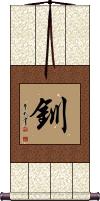
This can be a Mandarin Chinese surname that romanizes as Chuan.
The actual meaning of the character is armlet or bracelet.
Chuanito

丘阿尼托 is the name Chuanito in Chinese (Mandarin).
Chuanito

チュアニート is the name Chuanito in Japanese Katakana.
Note: Because this title is entirely Japanese Katakana, it should be written by a Japanese calligrapher.
Kenpo / Kempo / Quan Fa / Chuan Fa
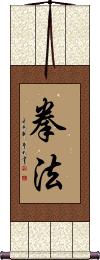
拳法 is a form of martial arts that can be translated in several ways.
Some will call it “fist principles,” “the way of the fist,” or even “law of the fist.” The first character literally means fist. The second can mean law, method, way, principle, or Buddhist teaching.
Kempo is really a potluck of martial arts. Often a combination of Chinese martial arts such as Shaolin Kung Fu with Japanese martial arts such as Karate, Jujutsu (Jujitsu), Aikido, and others. You may see the term “Kempo Karate,” which basically means Karate with other disciplines added. In this way, Kempo becomes an adjective rather than a title or school of martial arts.
These facts will long be argued by various masters and students of Kempo. Even the argument as to whether it should be spelled “kenpo” or “Kempo” ensues at dojos around the world (the correct Romaji should actually be “kenpou” if you precisely follow the rules).
The benefit of Kempo is that the techniques are easier to learn and master than pure Kung Fu (wu shu). Students are often taught basic Karate moves, kicks, and punches before augmenting the basic skills with complex Kung Fu techniques. This allows students of Kempo to achieve a level where they can defend themselves or fight in a relatively short amount of time (a few years rather than a decade or more).
Because the definition of this word is so fluid, I should make some notes here:
1. Purists in Okinawa will claim that “Okinawa Kenpo” or “Ryukyu Hon Kenpo” is the original and true version of this martial art from the old kingdom. It is actually little or no connection between Okinawa Kenpo and the way the word is used elsewhere.
2. In Chinese, where these characters are pronounced “quan fa” (sometimes Romanized as “chuan fa” because the Chinese-pinyin “q” actually sounds like an English “ch” sound), these characters do not hold the connotation of being a mixed martial art. It is simply defined as “the law of the fist.”
3. My Japanese dictionary oddly defines Kenpo as the “Chinese art of self-defense.” I personally don't feel this is the most common way that people perceive the word but just something you should know.
Shaolin Chang Chuan
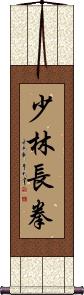
少林長拳 is a combination of two titles. The first two characters mean little forest, as in the little forest of the Shaolin monks (shao lin = little forest). The second two characters mean “long fist.”
This title is specific to a particular technique - if you are studying Shaolin Chang Chuan, then you are already aware of all the ramifications.
Shaolin Chuan / Shao Lin Quan
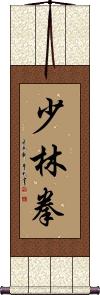
少林拳 is the title of the martial art (style of Kung Fu) that is taught to the monks and students in the Shaolin Buddhist Monastery.
The addition of Chuan or Quan, which means fist is what signifies that you are talking about this school or form of martial arts.
Tai Chi Chuan / Tai Ji Quan
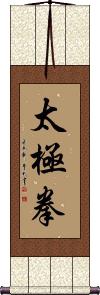
太極拳 is the famous Taoist meditation and martial art exercise. The direct translation of these characters would be something like “grand ultimate fist,” but that does not quite hit the mark for what this title really means.
An early-morning walk through any city in China near a park or an open area will yield a view of Chinese people practicing this ancient technique.
A typical scene is an old man of no less than 80 years on this earth, with a wispy white beard and perhaps a sword in one hand. He makes slow moves that are impossibly smooth. He is steady-footed and always in balance. For him, time is meaningless and proper form, and technique is far more important than speed.
For the younger generation, faster moves may look impressive and seem smooth to the casual observer. But more discipline and mental strength are needed to create perfectly smooth moves in virtual slow motion.
Note: There are two ways to Romanize these Chinese characters, as seen in the title above. The pronunciation and actual characters are the same in Chinese. If you really used English sounds/words to pronounce this, it would be something like “tie jee chew-on” (make the “chew-on” one flowing syllable).
Tai Chi Chuan Dao / Tai Ji Quan Dao
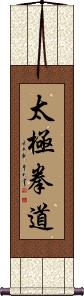
太極拳道 is the common Tai Chi Chuan title with “Dao” (the Way) added to the end.
If you're not sure, I suggest shorter titles such as “Tai Chi Chuan,” or just “Tai Chi.”
Tai Chi Chuan Fa / Tai Ji Quan Fa
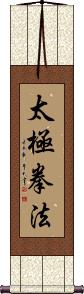
太极拳法 literally translates as “Tai Chi Fist Law” though 拳法 is also known in Japanese as “Kempo” which is sometimes read as “boxing” depending on context.
Fundamental Principles of Tai Chi Chuan
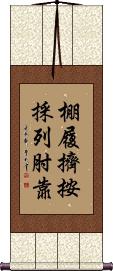
Peng, Lu, Ji, An, Cai, Lie, Zhou, and Kao are the eight fundamentals or forces of Tai Chi Chuan or Taiqiquan.
棚 (Peng) refers to the outward (or upward) expansion of energy.
履 (Lu) is often referred to as “rollback.” Lu is the ability to absorb, yield/deflect incoming force.
擠 (Ji) is often thought of as a “forward press.” However, it is also best described as a “squeezing out of space.”
按 (An) is a downward movement of energy, best translated as “(relaxed) sinking.”
採 (Cai or Tsai) translated as “downward pluck.” Cai is a combination of Lu and An.
列 (Lie or Lieh) is “Split” and is a combination of Peng and Ji.
肘 (Zhou) Elbowing.
靠 (Kao) Shouldering (for when the arms are bound/distance is too close to punch).
Source: https://combativecorner.wordpress.com/2015/12/03/the-8-energies-and-5-movements-of-taijiquan/
Zhuangzi / Chuang Tzu
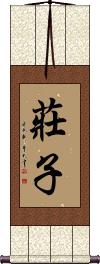
莊子 is the name of Zhuangzi or Chuang Tzu (369-286 BC).
Like Laozi or Lao Tzu, he was a Daoist author, poet, and philosopher.
Not the results for chua that you were looking for?
Below are some entries from our dictionary that may match your chua search...
| Characters If shown, 2nd row is Simp. Chinese |
Pronunciation Romanization |
Simple Dictionary Definition |
抓 see styles |
zhuā zhua1 chua |
to grab; to catch; to arrest; to snatch; to scratch |
撾 挝 see styles |
zhuā zhua1 chua |
ancient weapon with a tip shaped like a hand or claw; old variant of 抓[zhua1]; to strike; to beat |
爪 see styles |
zhuǎ zhua3 chua tsume つめ |
(coll.) foot of an animal or bird; (coll.) foot supporting a cooking pot etc (1) nail (e.g. fingernail, toenail); claw; talon; hoof; (2) plectrum; pick; (3) hook; clasp; (surname) Tsume Claws, talons; servants. |
髽 see styles |
zhuā zhua1 chua |
dress the hair |
主抓 see styles |
zhǔ zhuā zhu3 zhua1 chu chua |
to be in charge of; to concentrate on |
亂抓 乱抓 see styles |
luàn zhuā luan4 zhua1 luan chua |
to claw wildly; to scratch frantically; to arrest people indiscriminately |
冰爪 see styles |
bīng zhuǎ bing1 zhua3 ping chua |
crampon |
去爪 see styles |
qù zhuǎ qu4 zhua3 ch`ü chua chü chua |
to declaw (a cat etc); (food preparation) to remove claws, pincer legs or similar hard tips |
抓住 see styles |
zhuā zhù zhua1 zhu4 chua chu |
to grab hold of; to capture |
抓傷 抓伤 see styles |
zhuā shāng zhua1 shang1 chua shang |
to injure by scratching or clawing |
抓力 see styles |
zhuā lì zhua1 li4 chua li |
grip |
抓包 see styles |
zhuā bāo zhua1 bao1 chua pao |
to catch sb in the act; (computing) to capture data packets |
抓去 see styles |
zhuā qù zhua1 qu4 chua ch`ü chua chü |
to arrest and take away |
抓取 see styles |
zhuā qǔ zhua1 qu3 chua ch`ü chua chü |
to seize |
抓周 see styles |
zhuā zhōu zhua1 zhou1 chua chou |
custom of placing a variety of articles (writing brush, abacus etc) before an infant on its first birthday to see which one he or she picks up (The article chosen is supposed to be an indication of the child's inclinations, future career etc.) |
抓哏 see styles |
zhuā gén zhua1 gen2 chua ken |
(of a comedian) to seize on something sb has just said or done to make an ad lib joke |
抓地 see styles |
zhuā dì zhua1 di4 chua ti |
grip on the road; roadholding |
抓姦 抓奸 see styles |
zhuā jiān zhua1 jian1 chua chien |
to catch a couple in the act (adultery, illicit sexual relations) |
抓嫖 see styles |
zhuā piáo zhua1 piao2 chua p`iao chua piao |
(of the police) to hunt prostitutes and their clients |
抓手 see styles |
zhuā shǒu zhua1 shou3 chua shou |
starting point; mechanical hand; gripper |
抓拍 see styles |
zhuā pāi zhua1 pai1 chua p`ai chua pai |
to capture (an image); to snap (a photo) |
抓捕 see styles |
zhuā bǔ zhua1 bu3 chua pu |
to seize; to capture |
抓搔 see styles |
zhuā sāo zhua1 sao1 chua sao |
to scratch an itch |
抓撓 抓挠 see styles |
zhuā nao zhua1 nao5 chua nao |
to scratch; to mess about with; to quarrel; to scramble to do; sb or something that one can rely on |
抓狂 see styles |
zhuā kuáng zhua1 kuang2 chua k`uang chua kuang |
(Tw) (coll.) to be driven crazy (with frustration, stress, anger etc); to tear one's hair out; to freak out |
抓猴 see styles |
zhuā hóu zhua1 hou2 chua hou |
(Tw) to catch an adulterous man in the act (from Taiwanese 掠猴, Tai-lo pr. [lia̍h-kâu]) |
抓獲 抓获 see styles |
zhuā huò zhua1 huo4 chua huo |
to arrest |
抓癢 抓痒 see styles |
zhuā yǎng zhua1 yang3 chua yang |
to scratch an itch |
抓瞎 see styles |
zhuā xiā zhua1 xia1 chua hsia |
to be caught unprepared |
抓緊 抓紧 see styles |
zhuā jǐn zhua1 jin3 chua chin |
to keep a firm grip on; to pay close attention to; to lose no time in (doing something) |
Click here for more chua results from our dictionary
The following table may be helpful for those studying Chinese or Japanese...
| Title | Characters | Romaji (Romanized Japanese) | Various forms of Romanized Chinese | |
| Chuan | 釧 钏 | kushiro | chuàn / chuan4 / chuan | ch`uan / chuan |
| Chuanito | 丘阿尼托 | qiū ā ní tuō qiu1 a1 ni2 tuo1 qiu a ni tuo qiuanituo | ch`iu a ni t`o chiuanito chiu a ni to |
|
| Chuanito | チュアニート | chuaniito / chuanito | ||
| Kenpo Kempo Quan Fa Chuan Fa | 拳法 | kenpou / kenpo | quán fǎ / quan2 fa3 / quan fa / quanfa | ch`üan fa / chüanfa / chüan fa |
| Shaolin Chang Chuan | 少林長拳 少林长拳 | shào lín cháng quán shao4 lin2 chang2 quan2 shao lin chang quan shaolinchangquan | shao lin ch`ang ch`üan shaolinchangchüan shao lin chang chüan |
|
| Shaolin Chuan Shao Lin Quan | 少林拳 | shǎo lín quán shao3 lin2 quan2 shao lin quan shaolinquan | shao lin ch`üan shaolinchüan shao lin chüan |
|
| Tai Chi Chuan Tai Ji Quan | 太極拳 太极拳 | tai kyoku ken taikyokuken | tài jí quán tai4 ji2 quan2 tai ji quan taijiquan | t`ai chi ch`üan taichichüan tai chi chüan |
| Tai Chi Chuan Dao Tai Ji Quan Dao | 太極拳道 太极拳道 | tài jí quán dào tai4 ji2 quan2 dao4 tai ji quan dao taijiquandao | t`ai chi ch`üan tao taichichüantao tai chi chüan tao |
|
| Tai Chi Chuan Fa Tai Ji Quan Fa | 太極拳法 太极拳法 | tài jí quán fǎ tai4 ji2 quan2 fa3 tai ji quan fa taijiquanfa | t`ai chi ch`üan fa taichichüanfa tai chi chüan fa |
|
| Fundamental Principles of Tai Chi Chuan | 棚履擠按採列肘靠 棚履挤按采列肘靠 | péng lǚ jǐ àn cǎi liè zhǒu kào peng2 lv3 ji3 an4 cai3 lie4 zhou3 kao4 peng lv ji an cai lie zhou kao penglvjiancailiezhoukao | p`eng lü chi an ts`ai lieh chou k`ao peng lü chi an tsai lieh chou kao |
|
| Zhuangzi Chuang Tzu | 莊子 庄子 | Sōshi | zhuāng zǐ zhuang1 zi3 zhuang zi zhuangzi | chuang tzu chuangtzu |
| In some entries above you will see that characters have different versions above and below a line. In these cases, the characters above the line are Traditional Chinese, while the ones below are Simplified Chinese. | ||||

Successful Chinese Character and Japanese Kanji calligraphy searches within the last few hours...



