Many custom options...


And formats...



Confu in Chinese / Japanese...
Buy a Confu calligraphy wall scroll here!
Personalize your custom “Confu” project by clicking the button next to your favorite “Confu” title below...
Switched to secondary search mode due to lack of results using primary.
These secondary results may not be very accurate. Try a different but similar meaning word or phrase for better results. Or...
Look up Confu in my Japanese Kanji & Chinese Character Dictionary(My dictionary is a different system then the calligraphy search you just tried)
If you want a special phrase, word, title, name, or proverb, feel free to contact me, and I will translate your custom calligraphy idea for you.
1. Chaos / Anarchy / Confusion / Mayhem
2. Confucius
3. The Five Tenets of Confucius
4. Confucius: Golden Rule / Ethic of Reciprocity
Chaos / Anarchy / Confusion / Mayhem
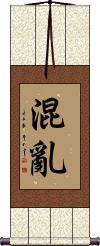
The first character means confused, dirty, muddy, or mixed.
The second character means confusion and disorder.
Together, these characters mean chaos and sometimes extended to mean a type of anarchy.
This term is often used in a less-than-literal term to describe anything in disarray. Someone might use this word in a sentence like, “My kitchen is in a state of chaos” or “my life is so chaotic.”
 Please note that Japanese use an alternate/simplified version of the second character of chaos - it also happens to be the same simplification used in mainland China. Click on the character to the right if you want the Japanese/Simplified version of this two-character chaos calligraphy.
Confucius
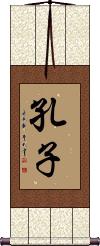
孔子 is how to write the name of the great sage, known in the West as Confucius.
His real name is Kongzi (The name Confucius is a westernized version of his name - his family name is Kong, and “zi” was added as a title of distinction).
He lived some 2500 years ago in Qufu, a town in modern-day Shandong Province of Northern China (about 6 hours south of Beijing by bus). He was a consort to Emperors, and after his death, the impact of his philosophies still served to advise emperors, officials, and common people for generations.
Also during these thousands of years, the Kong family remained powerful in China, and the Kong estate was much like the Vatican in Rome. The Kong estate existed as if on sovereign ground with its own small garrison of guards and the privileges of a kingdom within an empire.
This was true up until the time the Kong family had to flee to Taiwan in 1949 when the Red Army took victory over the Nationalists during the Revolution. The home of Confucius was later razed and all statues were defaced or stolen during the Cultural Revolution. Finally, after years of smearing his name and image, it is once again okay to celebrate the teachings of Confucius in mainland China.
Known as Khổng Tử in Vietnamese.
The Five Tenets of Confucius
The Five Cardinal Rules / Virtues of Confucius
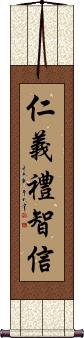
仁義禮智信 are the core of Confucius's philosophy.
Simply stated:
仁 = Benevolence / Charity
義 = Justice / Rectitude
禮 = Courtesy / Politeness / Tact
智 = Wisdom / Knowledge
信 = Fidelity / Trust / Sincerity
Many of these concepts can be found in various religious teachings. It should be clearly understood that Confucianism is not a religion but should instead be considered a moral code for a proper and civilized society.
This title is also labeled “5 Confucian virtues.”
 If you order this from the Japanese calligrapher, expect the middle Kanji to be written in a more simple form (as seen to the right). This can also be romanized as "jin gi rei satoshi shin" in Japanese. Not all Japanese will recognize this as Confucian tenets but they will know all the meanings of the characters.
See Also: Ethics
Confucius: Golden Rule / Ethic of Reciprocity
Do not do to others what you do not want done to yourself
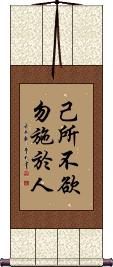
Some may think of this as a “Christian trait,” but actually, it transcends many religions.
This Chinese teaching dates back to about 2,500 years ago in China. Confucius had always taught the belief in being benevolent (ren), but this idea was hard to grasp for some of his students, as benevolence could be kind-heartedness or an essence of humanity itself.
When answering Zhong Gong's question as to what "ren" actually meant, Confucius said:
己所不欲勿施于人 or "When you go out, you should behave as if you were in the presence of a distinguished guest; when people do favors for you, act as if a great sacrifice was made for you. Whatever you wouldn't like done to you, do not do that thing to others. Don't complain at work or home.”
Hearing this, Zhong Gong said humbly, “Although I am not clever, I will do what you say.”
From this encounter, the Chinese version of the “Golden Rule” or “Ethic of Reciprocity” came to be.
The characters you see above express, “Do not do to others whatever you do not want to be done to yourself.”
See Also: Benevolence
Confucius: Universal Education
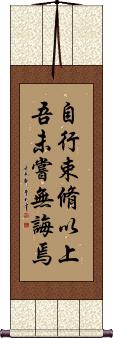
自行束脩以上吾未尝无诲焉 means, for anyone who brings even the smallest token of appreciation, I have yet to refuse instruction.
Another way to put it is: If a student (or potential student) shows just an ounce of interest, desire, or appreciation for the opportunity to learn, a teacher should offer a pound of knowledge.
This quote is from the Analects of Confucius.
This was written over 2500 years ago. The composition is in ancient Chinese grammar and phrasing. A modern Chinese person would need a background in Chinese literature to understand this without the aid of a reference.
Lost / Dazed and Confused
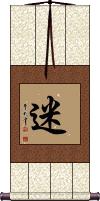
迷 is one of those characters that can mean a lot of different things depending on context. When written alone, as a single character on a wall scroll, it opens up the possibilities and allows you to decide what it means to you.
The key definition is “to be lost.” This could be physically or mentally lost. It can be someone lost in their thoughts, lost in an ocean, or just confused about where they are. The reason for the confused state may be due to internal or external reasons.
Here are some entries from various Asian dictionaries...
Chinese: lost, confused, bewilder, crazy about, fan, enthusiast, mystery.
Japanese: lost, astray, perplexed, in doubt, err, illusion.
Korean: lost, bewildered, fascinated, deluded.
Scholar / Confucian
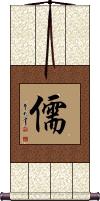
儒 is a unique single character that means scholar or Confucian and leaves a favorable impression when read in Chinese.
Specifically, in Japanese Kanji, this means Confucianism, Confucianist or Chinese scholar.
In old Korean Hanja, this means scholar, Confucian scholar, Confucianist, or learned (one who has learned and knows much).
Basically, it's the same in all three languages.
The following table may be helpful for those studying Chinese or Japanese...
| Title | Characters | Romaji (Romanized Japanese) | Various forms of Romanized Chinese | |
| Chaos Anarchy Confusion Mayhem | 混亂 混乱 | kon ran / konran | hùn luàn / hun4 luan4 / hun luan / hunluan | |
| Confucius | 孔子 | koushi / koshi | kǒng zǐ / kong3 zi3 / kong zi / kongzi | k`ung tzu / kungtzu / kung tzu |
| The Five Tenets of Confucius | 仁義禮智信 仁义礼智信 | jin gi rei tomo nobu jingireitomonobu | rén yì lǐ zhì xìn ren2 yi4 li3 zhi4 xin4 ren yi li zhi xin renyilizhixin | jen i li chih hsin jenilichihhsin |
| Confucius: Golden Rule Ethic of Reciprocity | 己所不欲勿施於人 己所不欲勿施于人 | jǐ suǒ bú yù wù shī yú rén ji3 suo3 bu2 yu4, wu4 shi1 yu2 ren2 ji suo bu yu, wu shi yu ren jisuobuyu,wushiyuren | chi so pu yü, wu shih yü jen chisopuyü,wushihyüjen |
|
| Confucius: Universal Education | 自行束脩以上吾未嘗無誨焉 (note 嘗 = 嚐) 自行束脩以上吾未尝无诲焉 | zì xíng shù xiū yǐ shàng wú wèi cháng wú huì yān zi4 xing2 shu4 xiu1 yi3 shang4 wu2 wei4 chang2 wu2 hui4 yan1 zi xing shu xiu yi shang wu wei chang wu hui yan | tzu hsing shu hsiu i shang wu wei ch`ang wu hui yen tzu hsing shu hsiu i shang wu wei chang wu hui yen |
|
| Lost Dazed and Confused | 迷 | mei | mí / mi2 / mi | |
| Scholar Confucian | 儒 | ju | rú / ru2 / ru | ju |
| In some entries above you will see that characters have different versions above and below a line. In these cases, the characters above the line are Traditional Chinese, while the ones below are Simplified Chinese. | ||||

Successful Chinese Character and Japanese Kanji calligraphy searches within the last few hours...



