Many custom options...


And formats...



Cour in Chinese / Japanese...
Buy a Cour calligraphy wall scroll here!
Personalize your custom “Cour” project by clicking the button next to your favorite “Cour” title below...
Switched to secondary search mode due to lack of results using primary.
These secondary results may not be very accurate. Try a different but similar meaning word or phrase for better results. Or...
Look up Cour in my Japanese Kanji & Chinese Character Dictionary(My dictionary is a different system then the calligraphy search you just tried)
If you want a special phrase, word, title, name, or proverb, feel free to contact me, and I will translate your custom calligraphy idea for you.
1. Betancourt
2. Bettencourt
4. Learning leads to Knowledge, Study leads to Benevolence, Shame leads to Courage
5. Courage to do what is right
9. Coursey
10. Courson
11. Court
12. Courteney
15. Courtland
16. Courtney
17. Courtney-Ann
18. Courtney
19. Courtney-Ann
20. Courville
21. Encourage
23. Fierce and courageous training defeats the strong and protects the body.
24. Courage To Do What Is Right
25. Honor Courage
28. Inspire with redoubled courage
29. Lacour
30. McCourt
32. Vaillancourt
Betancourt

貝坦庫爾 is the name Betancourt in Chinese (Mandarin).
Betancourt

ベタンコート is the name Betancourt in Japanese Katakana.
Note: Because this title is entirely Japanese Katakana, it should be written by a Japanese calligrapher.
Bettencourt

貝當古 is the name Bettencourt in Chinese (Mandarin).
Bettencourt

ベッテンコート is the name Bettencourt in Japanese Katakana.
Note: Because this title is entirely Japanese Katakana, it should be written by a Japanese calligrapher.
Bravery / Courage
Courage in the face of Fear
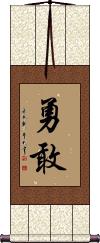
勇敢 is about courage or bravery in the face of fear.
You do the right thing even when it is hard or scary. When you are courageous, you don't give up. You try new things. You admit mistakes. This kind of courage is the willingness to take action in the face of danger and peril.
勇敢 can also be translated as braveness, valor, heroic, fearless, boldness, prowess, gallantry, audacity, daring, dauntless, and/or courage in Japanese, Chinese, and Korean. This version of bravery/courage can be an adjective or a noun. The first character means bravery and courage by itself. The second character means “daring” by itself. The second character emphasizes the meaning of the first but adds the idea that you are not afraid of taking a dare, and you are not afraid of danger.
勇敢 is more about brave behavior and not so much the mental state of being brave. You'd more likely use this to say, “He fought courageously in the battle,” rather than “He is very courageous.”
Bravery / Courage
Single Character for Courage
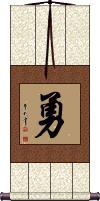
勇 can be translated as bravery, courage, valor, or fearless in Chinese, Japanese and Korean.
勇 is the simplest form to express courage or bravery, as there is also a two-character form that starts with this same character.
勇 can also be translated as brave, daring, fearless, plucky, or heroic.
This is also a virtue of the Samurai Warrior
See our page with just Code of the Samurai / Bushido here
See Also: Bravery
Learning leads to Knowledge, Study leads to Benevolence, Shame leads to Courage
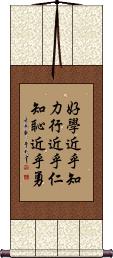
好學近乎知力行近乎仁知恥近乎勇 is a Saying from Confucius which relates certain actions to virtues.
A more verbose translation:
To love learning is akin to knowledge,
to study diligently is akin to benevolence,
to know shame is akin to courage.
Courage to do what is right
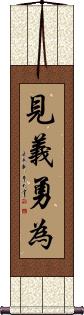
見義勇為 means the courage to do what is right in Chinese.
This could also be translated as “Never hesitate to do what is right.”
This comes from Confucian thought:
Your courage should head in an honorable direction. For example, you should take action when the goal is to attain a just result as, without honorable intent, a person’s gutsy fervor can easily lead them astray.
One who flaunts courage but disregards justice is bound to do wrong; someone who possesses courage and morality is destined to become a hero.
Some text above paraphrased from The World of Chinese - The Character of 勇
See Also: Work Unselfishly for the Common Good | Justice | Bravery
Courage and Strength
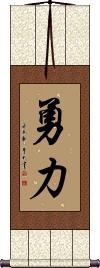
勇力 is a very short way to say “courage and strength” in Chinese and Japanese.
In Japanese, it's read more like “strong courage” or “powerful courage.” This can also be the personal name Yuri or Yuuri in Japanese.
Bravery / Courage
Courageous Energy
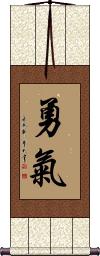
勇氣 is one of several ways to express bravery and courage in Chinese, Japanese, and Korean.
This version is the most spiritual. This is the essence of bravery from deep within your being. This is the mental state of being brave versus actual brave behavior. You'd more likely use this to say, “He is very courageous,” rather than “He fought courageously in the battle.”
The first character also means bravery or courage when it's seen alone. With the second character added, an element of energy or spirit is added. The second character is the same “chi” or “qi” energy that Kung Fu masters focus on when they strike. For this reason, you could say this means “spirit of courage” or “brave spirit.”
This is certainly a stronger word than just the first character alone.
Beyond bravery or courage, dictionaries also translate this word as valor/valour, nerve, audacity, daring, pluck, plucky, gallantry, guts, gutsy, and boldness.
This is also one of the 8 key concepts of tang soo do.
 While the version shown to the left is commonly used in Chinese and Korean Hanja (and ancient Japanese Kanji), please note that the second character is written with slightly fewer strokes in modern Japanese. If you want the modern Japanese version, please click on the character to the right. Both styles would be understood by native Chinese, Japanese, and many (but not all) Korean people. You should make your selection based on the intended audience for your calligraphy artwork. Or pick the single-character form of bravery/courage which is universal.
Courageous Spirit
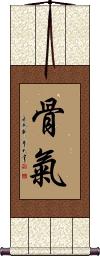
骨氣 is a Chinese title that means “unyielding character,” “courageous spirit,” “integrity,” or “moral backbone.”
Coursey

庫爾西 is the name Coursey in Chinese (Mandarin).
Coursey

コースィー is the name Coursey in Japanese Katakana.
Note: Because this title is entirely Japanese Katakana, it should be written by a Japanese calligrapher.
Courson
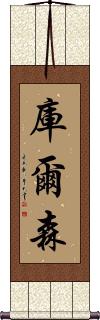
庫爾森 is the name Courson in Chinese (Mandarin).
Courson

クールソン is the name Courson in Japanese Katakana.
Note: Because this title is entirely Japanese Katakana, it should be written by a Japanese calligrapher.
Court
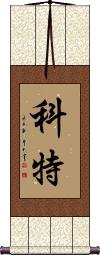
科特 is the name Court in Chinese (Mandarin).
Court

コート is the name Court in Japanese Katakana.
Note: Because this title is entirely Japanese Katakana, it should be written by a Japanese calligrapher.
Courteney
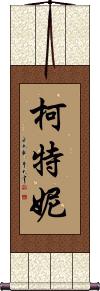
柯特妮 is the name Courteney in Chinese (Mandarin).
Courteney
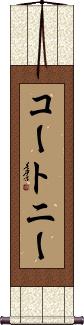
コートニー is the name Courteney in Japanese (Katakana).
Note: Because this title is entirely Japanese Katakana, it should be written by a Japanese calligrapher.
Courtesy / Etiquette
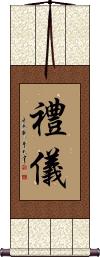
In Chinese, old Korean Hanja, and old Japanese Kanji, 禮儀 means “etiquette” or “courtesy.”
You'll also find a Japanese entry on our website, which uses a modern/simplified first Kanji. The characters shown here compose the best choice if your audience is Chinese or Korean - but also acceptable if you want an ancient-style Japanese scroll (in modern Japanese, it has the same pronunciation, but is written 礼儀).
Note: This can also be translated as propriety, decorum, or formality.
Courtesy / Etiquette
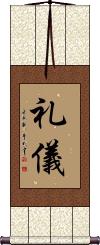
In Japanese, 礼儀 means “manners,” “courtesy,” or “etiquette.”
This also clearly means etiquette in Chinese, though the first Japanese Kanji has been “modernized” and happens to be the same as the modern Simplified Chinese version. Therefore, this word will be understood by both Japanese and Chinese people but best if your audience is mostly Japanese (Chinese people would generally prefer the ancient Traditional Chinese version).
Courtesy / Politeness
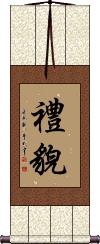
禮貌 is a Chinese and old Korean word that means courtesy or politeness.
Courtesy is being polite and having good manners. When you speak and act courteously, you give others a feeling of being valued and respected. Greet people pleasantly. Bring courtesy home. Your family needs it most of all. Courtesy helps life to go smoothly.
If you put the words "fēi cháng bù" in front of this, it is like adding "very much not." it’s a great insult in China, as nobody wants to be called "extremely discourteous" or "very much impolite."
Courtland

科特蘭 is the name Courtland in Chinese (Mandarin).
Courtland

コートランド is the name Courtland in Japanese Katakana.
Note: Because this title is entirely Japanese Katakana, it should be written by a Japanese calligrapher.
Courtney
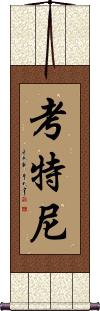
考特尼 is the name Courtney in Chinese (Mandarin).
Courtney-Ann
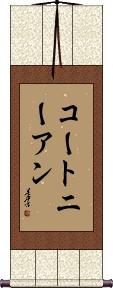
コートニー・アン is the name Courtney-Ann in Japanese (Katakana).
Note: Because this title is entirely Japanese Katakana, it should be written by a Japanese calligrapher.
Courtney
コートニー is the name Courtney in Japanese.
Note: Because this title is entirely Japanese Katakana, it should be written by a Japanese calligrapher.
Courtney-Ann
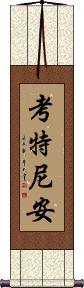
考特尼安 is the name Courtney-Ann in Chinese (Mandarin).
Courville

庫維爾 is the name Courville in Chinese (Mandarin).
Courville

クールヴィル is the name Courville in Japanese Katakana.
Note: Because this title is entirely Japanese Katakana, it should be written by a Japanese calligrapher.
Encourage
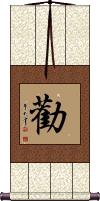
勸 is the simplest Chinese, Japanese Kanji, and old Korean Hanja word for encouragement or the act of encouraging someone.
This can also mean: to advise; to urge; to try to persuade; to exhort; to console; to soothe.
Fidelity Honor Courage
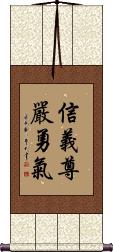
信義尊嚴勇氣 means fidelity, honor, and courage in Chinese.
This is a word list that was requested by a customer. Word lists are not common in Chinese, but we've put this one in the best order/context to make it as natural as possible.
We used the “honor” that leans toward the definition of “dignity” since that seemed the best match for the other two words.
Please note: These are three two-character words. You should choose the single-column format when you get to the options when you order this selection. The two-column option would split one word or be arranged with four characters on one side and two on the other.
Fierce and courageous training defeats the strong and protects the body.

This is a martial arts phrase that roughly translates as, “Fierce and courageous training defeats the strong and protects the body,” or “Brave and fierce training result in victory over the strong and defend the body.”
Courage To Do What Is Right
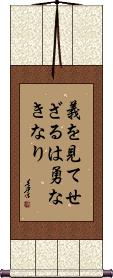
義を見てせざるは勇なきなり is a Japanese proverb that means “Knowing what is right and not doing is a want of courage.”
I've also seen it translated as:
To see what is right, yet fail to do so, is a lack of courage.
To know righteousness, but take no action is cowardice.
You are a coward if you knew what was the right thing to do, but you did not take action.
Knowing what is right without practicing it betrays one's cowardice.
Note: Because this selection contains some special Japanese Hiragana characters, it should be written by a Japanese calligrapher.
Honor Courage
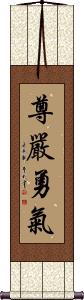
尊嚴勇氣 is a word list that means “Honor [and] Courage.”
Word lists are not common in Chinese, but we've put this one in the best order/context to make it as natural as possible.
We used the “honor” that leans toward the definition of dignity and integrity since that seemed like the best match for courage.
Honor Courage Commitment
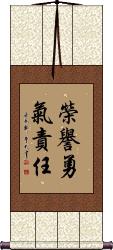
榮譽勇氣責任 is a word list that reads, “榮譽 勇氣 責任” or “honor courage commitment.”
If you are looking for this, it is likely that you are in the military (probably Navy or Marines).
We worked on this for a long time to find the right combination of words in Chinese. However, it should still be noted that word lists are not very natural in Chinese. Most of the time, there would be a subject, verb, and object for a phrase with this many words.
Honor Courage Commitment
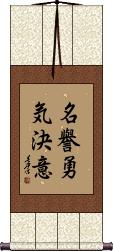
This means “Honor, Courage, Commitment” in Japanese.
名譽勇気決意 is a common military phrase in English used in the Navy and Marines.
This is a word list, which is not the most natural kind of composition in Japanese (usually there is a subject, object, and verb - or a single word).
Indomitable Courage

不屈勇氣 can be translated as “Unyielding,” “Unstoppable Bravery,” or “Indomitable Courage.”
In martial contexts, this phrase is often used as a motto emphasizing mindset, conduct, or training attitude.
Inspire with redoubled courage
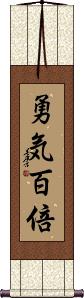
勇気百倍 means to inspire someone with fresh courage or redoubled courage in Japanese.
The Kanji breakdown:
勇気 (yuuki) courage; bravery; valour; valor; nerve; boldness.
百 (hyaku) 100; hundred.
倍 (bai) twice; double; 2-times; 2-fold.
Lacour

拉庫爾 is the name Lacour in Chinese (Mandarin).
Lacour

ラクール is the name Lacour in Japanese Katakana.
Note: Because this title is entirely Japanese Katakana, it should be written by a Japanese calligrapher.
McCourt

麥考特 is the name McCourt in Chinese (Mandarin).
McCourt

マコート is the name McCourt in Japanese Katakana.
Note: Because this title is entirely Japanese Katakana, it should be written by a Japanese calligrapher.
Strength and Courage
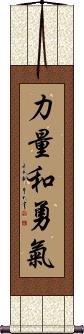
While 力量和勇氣 is not a typical Chinese phrase, this is how to write “strength and courage.”
If this is an important idea for you, we can make a great custom Chinese “strength and courage” wall scroll for you.
Strength and Courage
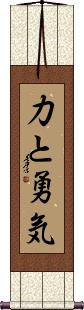
力と勇気 may not be the most common Japanese phrase, but this is how to write “strength and courage” or “power and bravery” in Japanese.
Vaillancourt

瓦揚古 is the name Vaillancourt in Chinese (Mandarin).
Vaillancourt

ヴァイヤンコート is the name Vaillancourt in Japanese Katakana.
Note: Because this title is entirely Japanese Katakana, it should be written by a Japanese calligrapher.
The following table may be helpful for those studying Chinese or Japanese...
| Title | Characters | Romaji (Romanized Japanese) | Various forms of Romanized Chinese | |
| Betancourt | 貝坦庫爾 贝坦库尔 | bèi tǎn kù ěr bei4 tan3 ku4 er3 bei tan ku er beitankuer | pei t`an k`u erh peitankuerh pei tan ku erh |
|
| Betancourt | ベタンコート | betankooto / betankoto | ||
| Bettencourt | 貝當古 贝当古 | bèi dāng gǔ bei4 dang1 gu3 bei dang gu beidanggu | pei tang ku peitangku |
|
| Bettencourt | ベッテンコート | bettenkooto bettenkoto | ||
| Bravery Courage | 勇敢 | yuu kan / yuukan / yu kan | yǒng gǎn / yong3 gan3 / yong gan / yonggan | yung kan / yungkan |
| Bravery Courage | 勇 | isamu / yu- | yǒng / yong3 / yong | yung |
| Learning leads to Knowledge, Study leads to Benevolence, Shame leads to Courage | 好學近乎知力行近乎仁知恥近乎勇 好学近乎知力行近乎仁知耻近乎勇 | hào xué jìn hū zhī lì xíng jìn hū rén zhī chǐ jìn hū yǒng hao4 xue2 jin4 hu1 zhi1 li4 xing2 jin4 hu1 ren2 zhi1 chi3 jin4 hu1 yong3 hao xue jin hu zhi li xing jin hu ren zhi chi jin hu yong | hao hsüeh chin hu chih li hsing chin hu jen chih ch`ih chin hu yung hao hsüeh chin hu chih li hsing chin hu jen chih chih chin hu yung |
|
| Courage to do what is right | 見義勇為 见义勇为 | jiàn yì yǒng wéi jian4 yi4 yong3 wei2 jian yi yong wei jianyiyongwei | chien i yung wei chieniyungwei |
|
| Courage and Strength | 勇力 | yuu ri / yuuri / yu ri | yǒng lì / yong3 li4 / yong li / yongli | yung li / yungli |
| Bravery Courage | 勇氣 勇气 / 勇気 | yuuki / yuki | yǒng qì / yong3 qi4 / yong qi / yongqi | yung ch`i / yungchi / yung chi |
| Courageous Spirit | 骨氣 骨气 | gǔ qì / gu3 qi4 / gu qi / guqi | ku ch`i / kuchi / ku chi | |
| Coursey | 庫爾西 库尔西 | kù ěr xī ku4 er3 xi1 ku er xi kuerxi | k`u erh hsi kuerhhsi ku erh hsi |
|
| Coursey | コースィー | koosii / kosi | ||
| Courson | 庫爾森 库尔森 | kù ěr sēn ku4 er3 sen1 ku er sen kuersen | k`u erh sen kuerhsen ku erh sen |
|
| Courson | クールソン | kuuruson / kuruson | ||
| Court | 科特 | kē tè / ke1 te4 / ke te / kete | k`o t`e / kote / ko te | |
| Court | コート | kooto / koto | ||
| Courteney | 柯特妮 | kē tè nī ke1 te4 ni1 ke te ni keteni | k`o t`e ni koteni ko te ni |
|
| Courteney | コートニー | kootonii / kotoni | ||
| Courtesy Etiquette | 禮儀 礼仪 | lǐ yì / li3 yi4 / li yi / liyi | li i / lii | |
| Courtesy Etiquette | 礼儀 / 禮儀 礼仪 | rei gi / reigi | lǐ yì / li3 yi4 / li yi / liyi | li i / lii |
| Courtesy Politeness | 禮貌 礼貌 | lǐ mào / li3 mao4 / li mao / limao | ||
| Courtland | 科特蘭 科特兰 | kē tè lán ke1 te4 lan2 ke te lan ketelan | k`o t`e lan kotelan ko te lan |
|
| Courtland | コートランド | kootorando / kotorando | ||
| Courtney | 考特尼 | kǎo tè ní kao3 te4 ni1 kao te ni kaoteni | k`ao t`e ni kaoteni kao te ni |
|
| Courtney-Ann | コートニーアン | koutonii an koutoniian kotoni an | ||
| Courtney | コートニー | kootonii / kotoni | ||
| Courtney-Ann | 考特尼安 | kǎo tè ní ān kao3 te4 ni1 an1 kao te ni an kaotenian | k`ao t`e ni an kaotenian kao te ni an |
|
| Courville | 庫維爾 库维尔 | kù wéi ěr ku4 wei2 er3 ku wei er kuweier | k`u wei erh kuweierh ku wei erh |
|
| Courville | クールヴィル | kuuruviru / kuruviru | ||
| Encourage | 勸 劝 | kan | quàn / quan4 / quan | ch`üan / chüan |
| Fidelity Honor Courage | 信義尊嚴勇氣 信义尊严勇气 | xìn yì zūn yán yǒng qì xin4 yi4 zun1 yan2 yong3 qi4 xin yi zun yan yong qi xinyizunyanyongqi | hsin i tsun yen yung ch`i hsinitsunyenyungchi hsin i tsun yen yung chi |
|
| Fierce and courageous training defeats the strong and protects the body. | 剛勇之猛練勝強而保體 刚勇之猛练胜强而保体 | gāng yǒng zhī měng liàn shèng qiáng ér bǎo tǐ gang1 yong3 zhi1 meng3 lian4 sheng4 qiang2 er2 bao3 ti3 gang yong zhi meng lian sheng qiang er bao ti | kang yung chih meng lien sheng ch`iang erh pao t`i kang yung chih meng lien sheng chiang erh pao ti |
|
| Courage To Do What Is Right | 義を見てせざるは勇なきなり | giomitesezaruhayuunakinari giomitesezaruhayunakinari | ||
| Honor Courage | 尊嚴勇氣 尊严勇气 | zūn yán yǒng qì zun1 yan2 yong3 qi4 zun yan yong qi zunyanyongqi | tsun yen yung ch`i tsunyenyungchi tsun yen yung chi |
|
| Honor Courage Commitment | 榮譽勇氣責任 荣誉勇气责任 | róng yù yǒng qì zé rèn rong2 yu4 yong3 qi4 ze2 ren4 rong yu yong qi ze ren rongyuyongqizeren | jung yü yung ch`i tse jen jungyüyungchitsejen jung yü yung chi tse jen |
|
| Honor Courage Commitment | 名譽, 勇気, 決意 名誉, 勇気, 決意 | meiyo yuuki ketsui meiyoyuukiketsui meiyo yuki ketsui | ||
| Indomitable Courage | 不屈勇氣 不屈勇气 | fukutsu-yūki | bù qū yǒng qì bu4 qu1 yong3 qi4 bu qu yong qi buquyongqi | pu ch`ü yung ch`i puchüyungchi pu chü yung chi |
| Inspire with redoubled courage | 勇気百倍 | yuuki hyaku bai yuukihyakubai yuki hyaku bai | ||
| Lacour | 拉庫爾 拉库尔 | lā kù ěr la1 ku4 er3 la ku er lakuer | la k`u erh lakuerh la ku erh |
|
| Lacour | ラクール | rakuuru / rakuru | ||
| McCourt | 麥考特 麦考特 | mài kǎo tè mai4 kao3 te4 mai kao te maikaote | mai k`ao t`e maikaote mai kao te |
|
| McCourt | マコート | makooto / makoto | ||
| Strength and Courage | 力量和勇氣 力量和勇气 | lì liàng hé yǒng qì li4 liang4 he2 yong3 qi4 li liang he yong qi liliangheyongqi | li liang ho yung ch`i lilianghoyungchi li liang ho yung chi |
|
| Strength and Courage | 力と勇氣 力と勇気 | riki to yu ki rikitoyuki | ||
| Vaillancourt | 瓦揚古 瓦扬古 | wǎ yáng gǔ wa3 yang2 gu3 wa yang gu wayanggu | wa yang ku wayangku |
|
| Vaillancourt | ヴァイヤンコート | vaiyankooto vaiyankoto | ||
| In some entries above you will see that characters have different versions above and below a line. In these cases, the characters above the line are Traditional Chinese, while the ones below are Simplified Chinese. | ||||

Successful Chinese Character and Japanese Kanji calligraphy searches within the last few hours...



