Many custom options...


And formats...



Demo in Chinese / Japanese...
Buy a Demo calligraphy wall scroll here!
Personalize your custom “Demo” project by clicking the button next to your favorite “Demo” title below...
Switched to secondary search mode due to lack of results using primary.
These secondary results may not be very accurate. Try a different but similar meaning word or phrase for better results. Or...
Look up Demo in my Japanese Kanji & Chinese Character Dictionary(My dictionary is a different system then the calligraphy search you just tried)
If you want a special phrase, word, title, name, or proverb, feel free to contact me, and I will translate your custom calligraphy idea for you.
1. Cacodemon
2. Democratic Republic of the Congo
3. Demon
7. Demon Slayer
8. Demontae
9. Demonte
10. Demoss
11. Demostenes
12. Nicodemo
13. Ghost Demon
14. Red Demon
Cacodemon

カコデーモン is the name Cacodemon in Japanese Katakana.
Note: Because this title is entirely Japanese Katakana, it should be written by a Japanese calligrapher.
Democratic Republic of the Congo
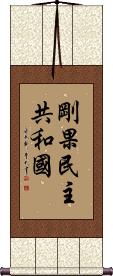
剛果民主共和國 is the Chinese title for the Democratic Republic of the Congo (formerly Zaire).
Democratic Republic of the Congo
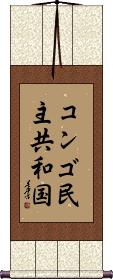
コンゴ民主共和国 is the Japanese name for the Democratic Republic of the Congo (formerly Zaire).
Note: Because this selection contains some special Japanese Katakana characters, it should be written by a Japanese calligrapher.
Demon
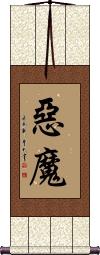
惡魔 is a common way to say demon, fiend, evil spirit, devil, or Satan in Chinese, Japanese Kanji, and old Korean Hanja.
This is a strange choice for a wall scroll, so consider this entry for reference only.
Frightful Demon / Asura
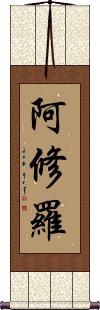
This demon title comes from the ancient Sanskrit word Asura.
阿修羅 is often used in Buddhism when describing various demons. Sometimes defined as “Fighting and battling a giant demon.”
In the context of Buddhism: This title originally meant a spirit, spirits, or even the gods (perhaps before 1700 years ago). It now generally indicates titanic demons, enemies of the gods, with whom, especially Indra, they wage constant war. They are defined as “not devas,” “ugly,” and “without wine.” There are four classes of asuras, separated according to their manner of rebirth. They can be egg-born, womb-born, transformation-born, and spawn- or water-born. Their abode is in the ocean, north of Sumeru but certain of the weaker dwell in a western mountain cave. They have realms, rulers, and palaces, as have the devas.
In terms of power, Asuras rank above humans but below most other deities. They live near the coastal foot of Mount Sumeru (on the northern side). Their domain is partially or wholly in the ocean.
Demon / Ghost / Apparition
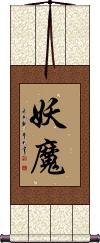
妖魔 means demon in Chinese and perhaps slanted toward ghost in Japanese.
Demon / Raksha
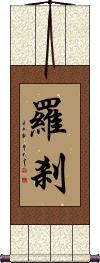
羅剎 is the Chinese version of demon that comes from the ancient Sanskrit word raksha, raksasa (rākṣasa), raksas (rakṣas), or raksasi (rākṣasī).
This title regards malignant spirits and demons. These demons are described in ancient texts as terrifying, with black bodies, red hair, and green eyes, and as devourers of men. FYI: Sometimes the second character is written in the form shown to the right.
Demon Slayer
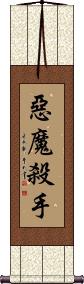
惡魔殺手 means Demon Slayer in Chinese.
The first word, 惡魔, means demon, fiend, evil māras, and can refer to the ancient demon enemies of Buddhism.
The second word, 殺手, means slayer, killer, murderer, hitman, or in the context of sports or video games, a formidable player.
Demon Slayer
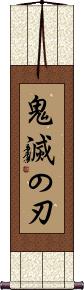
鬼滅の刃 means Demon Slayer in Japanese.
This term, 鬼滅の刃 or “Kimetsu no Yaiba,” is mostly used in the context of Japanese manga or anime.
Demontae

德蒙泰 is the name Demontae in Chinese (Mandarin).
Demontae

デモネ is the name Demontae in Japanese Katakana.
Note: Because this title is entirely Japanese Katakana, it should be written by a Japanese calligrapher.
Demonte
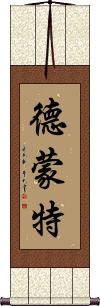
德蒙特 is the name Demonte in Chinese (Mandarin).
Demonte
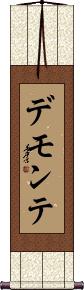
デモンテ is the name Demonte in Japanese Katakana.
Note: Because this title is entirely Japanese Katakana, it should be written by a Japanese calligrapher.
Demoss

德莫斯 is the name Demoss in Chinese (Mandarin).
Demoss

デモス is the name Demoss in Japanese Katakana.
Note: Because this title is entirely Japanese Katakana, it should be written by a Japanese calligrapher.
Demostenes
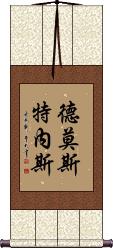
德莫斯特內斯 is the transliteration to Mandarin Chinese for the Latin / Spanish name Demóstenes.
Demostenes
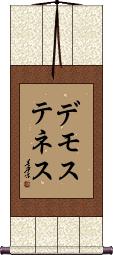
デモステネス is the name Demostenes in Japanese (Katakana).
Note: Because this title is entirely Japanese Katakana, it should be written by a Japanese calligrapher.
Nicodemo
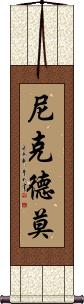
This is a common Mandarin Chinese transliteration for the male Portuguese/Latin name Nicodemo.
Ghost Demon
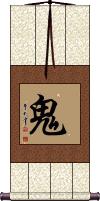
鬼 can mean ghost, ogre, demon, or “spirit of a deceased person,” in Chinese, Japanese Kanji, and old Korean Hanja.
In some context, it can also mean sly, crafty, ogre-like person (i.e. fierce, relentless, merciless, etc.)
This can also be the “ghost” constellation (one of the 28 mansions in Chinese folklore).
An extended list of meanings includes departed; dead; a disembodied spirit; dead person; evil being; hungry ghost.
Red Demon
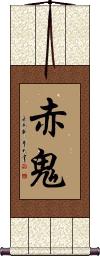
赤鬼 is the title of the red-horned demon or red ogre.
In the Buddhist context, these are the red demons of purgatory. These demons are unique, as one will have the head of a bull, another with that of a horse, etc.
These search terms might be related to Demo:
The following table may be helpful for those studying Chinese or Japanese...
| Title | Characters | Romaji (Romanized Japanese) | Various forms of Romanized Chinese | |
| Cacodemon | カコデーモン | kakodeemon / kakodemon | ||
| Democratic Republic of the Congo | 剛果民主共和國 刚果民主共和国 | gāng guǒ mín zhǔ gòng hé guó gang1 guo3 min2 zhu3 gong4 he2 guo2 gang guo min zhu gong he guo gangguominzhugongheguo | kang kuo min chu kung ho kuo kangkuominchukunghokuo |
|
| Democratic Republic of the Congo | コンゴ民主共和国 | kongominshukyouwakoku kongominshukyowakoku | ||
| Demon | 惡魔 恶魔 | aku ma / akuma | è mó / e4 mo2 / e mo / emo | o mo / omo |
| Frightful Demon Asura | 阿修羅 阿修罗 | ashura | ē xiū luó e1 xiu1 luo2 e xiu luo exiuluo | o hsiu lo ohsiulo |
| Demon Ghost Apparition | 妖魔 | you ma / youma / yo ma | yāo mó / yao1 mo2 / yao mo / yaomo | |
| Demon Raksha | 羅剎 / 羅刹 罗刹 | luó chà / luo2 cha4 / luo cha / luocha | lo ch`a / locha / lo cha | |
| Demon Slayer | 惡魔殺手 恶魔杀手 | wù mó shā shǒu wu4 mo2 sha1 shou3 wu mo sha shou wumoshashou | ||
| Demon Slayer | 鬼滅の刃 | ki metsu no yaiba / oni metsu no ha | ||
| Demontae | 德蒙泰 | dé méng tài de2 meng2 tai4 de meng tai demengtai | te meng t`ai temengtai te meng tai |
|
| Demontae | デモネ | demone | ||
| Demonte | 德蒙特 | dé méng tè de2 meng2 te4 de meng te demengte | te meng t`e temengte te meng te |
|
| Demonte | デモンテ | demonte | ||
| Demoss | 德莫斯 | dé mò sī de2 mo4 si1 de mo si demosi | te mo ssu temossu |
|
| Demoss | デモス | demosu | ||
| Demostenes | 德莫斯特內斯 德莫斯特内斯 | dé mò sī tè nèi sī de2 mo4 si1 te4 nei4 si1 de mo si te nei si demositeneisi | te mo ssu t`e nei ssu temossuteneissu te mo ssu te nei ssu |
|
| Demostenes | デモステネス | demosutenesu | ||
| Nicodemo | 尼克德莫 | ní kè dé mò ni1 ke4 de2 mo4 ni ke de mo nikedemo | ni k`o te mo nikotemo ni ko te mo |
|
| Ghost Demon | 鬼 | oni | guǐ / gui3 / gui | kuei |
| Red Demon | 赤鬼 | akaoni | chì guǐ / chi4 gui3 / chi gui / chigui | ch`ih kuei / chihkuei / chih kuei |
| In some entries above you will see that characters have different versions above and below a line. In these cases, the characters above the line are Traditional Chinese, while the ones below are Simplified Chinese. | ||||

Successful Chinese Character and Japanese Kanji calligraphy searches within the last few hours...



