Many custom options...


And formats...



Elit in Chinese / Japanese...
Buy an Elit calligraphy wall scroll here!
Personalize your custom “Elit” project by clicking the button next to your favorite “Elit” title below...
Switched to secondary search mode due to lack of results using primary.
These secondary results may not be very accurate. Try a different but similar meaning word or phrase for better results. Or...
Look up Elit in my Japanese Kanji & Chinese Character Dictionary(My dictionary is a different system then the calligraphy search you just tried)
If you want a special phrase, word, title, name, or proverb, feel free to contact me, and I will translate your custom calligraphy idea for you.
1. Adelita
2. Angelita
3. Carmelita
4. Fidelity / Personal Integrity / Honor
Adelita
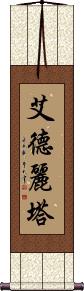
艾德麗塔 is the name Adelita in Chinese (Mandarin).
Adelita
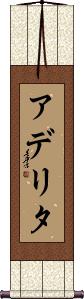
アデリタ is the name Adelita in Japanese (Katakana).
Note: Because this title is entirely Japanese Katakana, it should be written by a Japanese calligrapher.
Angelita
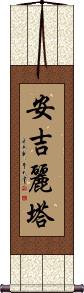
安吉麗塔 is the name Angelita in Chinese (Mandarin).
Angelita
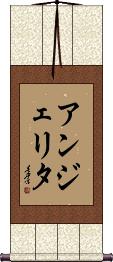
アンジェリタ is the name Angelita in Japanese (Katakana).
Note: Because this title is entirely Japanese Katakana, it should be written by a Japanese calligrapher.
Carmelita
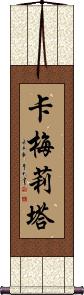
卡梅莉塔 is the name Carmelita in Chinese (Mandarin).
Carmelita
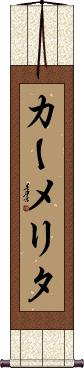
カーメリタ is the name Carmelita in Japanese (Katakana).
Note: Because this title is entirely Japanese Katakana, it should be written by a Japanese calligrapher.
Fidelity / Personal Integrity / Honor
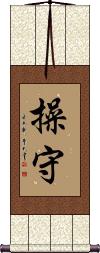
操守 is the Chinese and Japanese Kanji for personal integrity, constancy, fidelity, and honor/honour.
The original meaning of the first character is chastity, fidelity, honor, and/or faith.
The second character means to defend, guard, keep watch, and be observant.
So, this is about being observant of and guarding your integrity and honor.
Fidelity Honor Courage
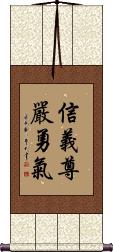
信義尊嚴勇氣 means fidelity, honor, and courage in Chinese.
This is a word list that was requested by a customer. Word lists are not common in Chinese, but we've put this one in the best order/context to make it as natural as possible.
We used the “honor” that leans toward the definition of “dignity” since that seemed the best match for the other two words.
Please note: These are three two-character words. You should choose the single-column format when you get to the options when you order this selection. The two-column option would split one word or be arranged with four characters on one side and two on the other.
Faithful / Honorable / Trustworthy / Fidelity / Loyalty
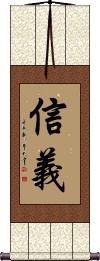
信義 is a word often used to describe a person with an honest and loyal reputation.
Simply put, this applies to somebody you can trust (with your life).
In Chinese, this is often defined as good faith, honor, trust, and justice.
In Korean, this word means fidelity, truthfulness, or faithfulness.
In Japanese: faith, fidelity, and loyalty. It's also a Japanese male given name when pronounced “Nobuyoshi.”
Honesty / Fidelity
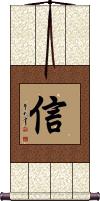
信 is another character that expresses the idea of honesty.
It can also mean truth, faith, belief in, fidelity, sincerity, trust, and/or confidence.
Some have included this in the list for the Bushido, although “makoto” is probably more common/popular.
Note: In some contexts, this character can mean a letter (mail), news, or envoy. However, alone, it will generally be read with the honesty-meaning.
See our page with just Code of the Samurai / Bushido here
See Also: Loyalty Trustworthiness Trustworthy
The following table may be helpful for those studying Chinese or Japanese...
| Title | Characters | Romaji (Romanized Japanese) | Various forms of Romanized Chinese | |
| Adelita | 艾德麗塔 艾德丽塔 | ài dé lì tǎ ai4 de2 li4 ta3 ai de li ta aidelita | ai te li t`a aitelita ai te li ta |
|
| Adelita | アデリタ | aderita | ||
| Angelita | 安吉麗塔 安吉丽塔 | ān jí lì tǎ an1 ji2 li4 ta3 an ji li ta anjilita | an chi li t`a anchilita an chi li ta |
|
| Angelita | アンジェリタ | anjerita | ||
| Carmelita | 卡梅莉塔 | kǎ méi lì tǎ ka3 mei2 li4 ta3 ka mei li ta kameilita | k`a mei li t`a kameilita ka mei li ta |
|
| Carmelita | カーメリタ | kaamerita / kamerita | ||
| Fidelity Personal Integrity Honor | 操守 | soushu / soshu | cāo shǒu / cao1 shou3 / cao shou / caoshou | ts`ao shou / tsaoshou / tsao shou |
| Fidelity Honor Courage | 信義尊嚴勇氣 信义尊严勇气 | xìn yì zūn yán yǒng qì xin4 yi4 zun1 yan2 yong3 qi4 xin yi zun yan yong qi xinyizunyanyongqi | hsin i tsun yen yung ch`i hsinitsunyenyungchi hsin i tsun yen yung chi |
|
| Faithful Honorable Trustworthy Fidelity Loyalty | 信義 信义 | shingi | xìn yì / xin4 yi4 / xin yi / xinyi | hsin i / hsini |
| Honesty Fidelity | 信 | shin | xìn / xin4 / xin | hsin |
| In some entries above you will see that characters have different versions above and below a line. In these cases, the characters above the line are Traditional Chinese, while the ones below are Simplified Chinese. | ||||

Successful Chinese Character and Japanese Kanji calligraphy searches within the last few hours...



