Many custom options...


And formats...



Not what you want?
Try other similar-meaning words, fewer words, or just one word.
Five Element in Chinese / Japanese...
Buy a Five Element calligraphy wall scroll here!
Personalize your custom “Five Element” project by clicking the button next to your favorite “Five Element” title below...
Five Element Dojo

This is the title “5 Element Dojo” in Japanese Kanji.
Sometimes, the five elements are expressed in Japanese as 五大 (Godai) (earth, water, fire, wind, void) instead of the Chinese/Traditional 五行 (Gogyo) (wood, fire, water, earth, metal), so you might want 五大道場 instead. Let me know when ordering if that is the case.
Five Elements
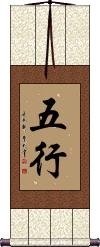
五行 is the title of the five elements: wood, fire, water, earth, and metal.
The first character means five, and the second character is simply element(s).
According to ancient Chinese science, all matter in the world is comprised of these elements. One idea presented with the five elements is that when energy is added, the matter is believed to expand. When energy is removed, matter contracts. Oddly, this concept is not far from Einstein's theories and modern science. Just a few thousand years before Einstein.
More info: Wikipedia - Five Elements (Wu Xing).
Five Elements
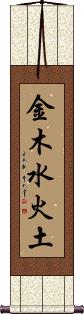
金木水火土 is a list of the Chinese characters for the five elements in a comfortable order (meaning that they “feel right” to a Chinese person who views this arrangement).
The order is metal, wood, water, fire, and earth.
Note that sometimes the metal element is translated as gold. And earth refers to soil versus the whole planet earth.
Five Elements Tai Chi Fist
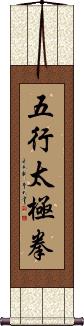
五行太極拳 is a certain school or style of Tai Chi (Taiji).
The characters literally mean “Five Elements Tai Chi Fist.”
Notes:
In Taiwan, it would be Romanized as “Wu Hsing Tai Chi Chuan” - see the standard Mandarin method above in the gray box (used in mainland China and the official Romanization used by the Library of Congress).
The last three characters are sometimes translated as “Grand Ultimate Fist,” so the whole thing can be “Five Elements Grand Ultimate Fist” if you wish.
I have not confirmed the use of this title in Korean but if it is used, it's probably only by martial arts enthusiasts. The pronunciation is correct, as shown above for Korean.
Earth
(Used in Japanese version of five elements)
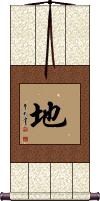
地 is the single-character element and title of the planet Earth in Chinese, old Korean Hanja, and Japanese Kanji.
Because this is a single character, the definition is a little ambiguous and can have many meanings depending on the context in which it is used. These meanings include: earth, ground, land, soil, dirt, place, territory, bottom (of a package, book, etc.), earth (one of the Japanese five elements), the region in question, the local area, skin, texture, fabric, material, weave, base, background, one's true nature, narrative (i.e. descriptive part of a story), real life, actuality, etc.
In Japanese, this Kanji can be pronounced several ways, including chi, ji, tsushi, or tsuchi.
地 is also an element of the Japanese version of the five elements (the original Chinese version uses a different version of earth).
Chou
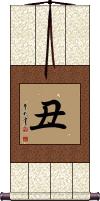
丑 can refer to the astrological time of the ox, or a Chinese surname, Chou.
丑 represents the 2nd earthly branch. In daily time, 1:00-3:00 AM, or the 12th/last month in the Chinese calendar.
In an ancient year-naming scheme, this can represent the year of the Ox (one of twelve animals paired with one of five element characters yielding a 60-year cycle).
Sky / Ether / Void / Emptiness / Unreality
(Used in Japanese version of five elements)
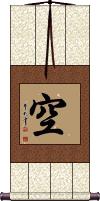
空 is a single character that means empty, void, hollow, vacant, vacuum, blank, nonexistent, vacuity, voidness, emptiness, non-existence, immateriality, unreality, the false or illusory nature of all existence, and being unreal.
In the Buddhist context, this relates to the doctrine that all phenomena and the ego have no reality but are composed of a certain number of skandhas or elements, which disintegrate. The void, the sky, space. The universal, the absolute, complete abstraction without relativity. The doctrine further explains that all things are compounds, or unstable organisms, possessing no self-essence, i.e. are dependent, or caused, come into existence only to perish. The underlying reality, the principle of eternal relativity, or non-infinity, i.e. śūnya, permeates all phenomena making possible their evolution.
From Sanskrit and/or Pali, this is the translation to Chinese and Japanese of the title śūnya or śūnyatā.
In Japanese, when pronounced as “ron” (sounds like “roan”) this can be a given name. It should be noted that this Kanji has about 5 different possible pronunciations in Japanese: kuu, kara, sora, ron, and uro. 空 is also an element in the Japanese version of the five elements.
Not the results for five element that you were looking for?
Below are some entries from our dictionary that may match your five element search...
| Characters If shown, 2nd row is Simp. Chinese |
Pronunciation Romanization |
Simple Dictionary Definition | ||||||||||||||||||||||||||||||||||||||||||||||||||||||||||||
塵 尘 see styles |
chén chen2 ch`en chen chiri ちり |
dust; dirt; earth (1) dust; (2) trash; garbage; rubbish; dirt; (3) (usu. as 塵ほども...ない) negligible amount; tiny bit; (4) hustle and bustle (of life); worldly cares; impurities of the world; (5) (abbreviation) {sumo} (See 塵手水) ritual gestures indicating that a fight will be clean guṇa, in Sanskrit inter alia means 'a secondary element', 'a quality', 'an attribute of the five elements', e.g. 'ether has śabda or sound for its guṇa and the ear for its organ'. In Chinese it means 'dust, small particles; molecules, atoms, exhalations'. It may be intp. as an atom, or matter, which is considered as defilement; or as an active, conditioned principle in nature, minute, subtle, and generally speaking defiling to pure mind; worldly, earthly, the world. The six guṇas or sensation-data are those of sight, sound, smell, taste, touch, and thought. |
||||||||||||||||||||||||||||||||||||||||||||||||||||||||||||
五智 see styles |
wǔ zhì wu3 zhi4 wu chih gochi ごち |
(place-name, surname) Gochi The five kinds of wisdom of the 眞言宗 Shingon School. Of the six elements 六大 earth, water, fire, air (or wind), ether (or space) 曇空, and consciousness (or mind 識 ), the first five form the phenomenal world, or Garbhadhātu, the womb of all things 胎藏界, the sixth is the conscious, or perceptive, or wisdom world, the Vajradhātu 金剛界, sometimes called the Diamond realm. The two realms are not originally apart, but one, and there is no consciousness without the other five elements. The sixth element, vijñāna, is further subdivided into five called the 五智 Five Wisdoms: (1) 法界體性智 dharmadhātu-prakṛti-jñāna, derived from the amala-vijñāna, or pure 識; it is the wisdom of the embodied nature of the dharmadhātu, defined as the six elements, and is associated with Vairocana 大日, in the centre, who abides in this samādhi; it also corresponds to the ether 空 element. (2) 大圓鏡智 adarśana-jñāna, the great round mirror wisdom, derived from the ālaya-vijñāna, reflecting all things; corresponds to earth, and is associated with Akṣobhya and the east. (3) 平等性智 samatā-jñāna, derived from mano-vijñāna, wisdom in regard to all things equally and universally; corresponds to fire, and is associated with Ratnasaṃbhava and the south. (4) 妙觀察智 pratyavekṣaṇa-jñāna, derived from 意識, wisdom of profound insight, or discrimination, for exposition and doubt-destruction; corresponds to water, and is associated with Amitābha and the west. (5) 成所作智 kṛtyānuṣṭhāna-jñāna, derived from the five senses, the wisdom of perfecting the double work of self-welfare and the welfare of others; corresponds to air 風 and is associated with Amoghasiddhi and the north. These five Dhyāni-Buddhas are the 五智如來. The five kinds of wisdom are the four belonging to every Buddha, of the exoteric cult, to which the esoteric cult adds the first, pure, all-refecting, universal, all-discerning, and all-perfecting. |
||||||||||||||||||||||||||||||||||||||||||||||||||||||||||||
地大 see styles |
dì dà di4 da4 ti ta chihiro ちひろ |
(personal name) Chihiro Earth as one of the 四大 four elements, 地 earth, 水大 water, 火大 fire, and 風大 air (i. e. air in motion, wind); to these 空大 space (Skt. ākāśa) is added to make the 五大 five elements; 識 vijñāna, perception to make the six elements; and 見 darśana, views, concepts, or reasonings to make the seven elements. The esoteric sect use the five fingers, beginning with the little finger, to symbolize the five elements. |
||||||||||||||||||||||||||||||||||||||||||||||||||||||||||||
已生 see styles |
yǐ shēng yi3 sheng1 i sheng ishō |
部多 bhūta. Become, the moment just come into existence, the present moment; being, existing; a being, ghost, demon; a fact; an element, of which the Hindus have five— earth, water, fire, air, ether; the past. | ||||||||||||||||||||||||||||||||||||||||||||||||||||||||||||
法界 see styles |
fǎ jiè fa3 jie4 fa chieh hokkai; houkai / hokkai; hokai ほっかい; ほうかい |
(1) {Buddh} universe; (2) {Buddh} realm of thought; (3) {Buddh} underlying principle of reality; manifestation of true thusness; (4) (ほうかい only) (abbreviation) (See 法界悋気) being jealous of things that have nothing to do with one; being jealous of others who are in love with each other dharmadhātu, 法性; 實相; 達磨馱都 Dharma-element, -factor, or-realm. (1) A name for "things" in general, noumenal or phenomenal; for the physical universe, or any portion or phase of it. (2) The unifying underlying spiritual reality regarded as the ground or cause of all things, the absolute from which all proceeds. It is one of the eighteen dhātus. These are categories of three, four, five, and ten dharmadhātus; the first three are combinations of 事 and 理 or active and passive, dynamic and static; the ten are: Buddha-realm, Bodhisattva-realm, pratyekabuddha-realm, śrāvaka, deva, Human, asura, Demon, Animal, and Hades realms-a Huayan category. Tiantai has ten for meditaton, i.e. the realms of the eighteen media of perception (the six organs, six objects, and six sense-data or sensations), of illusion, sickness, karma, māra, samādhi, (false) views, pride, the two lower Vehicles, and the Bodhisattva Vehicle. |
||||||||||||||||||||||||||||||||||||||||||||||||||||||||||||
空大 see styles |
kōng dà kong1 da4 k`ung ta kung ta takatomo たかとも |
(given name) Takatomo Space, one of the five elements (earth, water, fire, wind, space); v. 五大. |
||||||||||||||||||||||||||||||||||||||||||||||||||||||||||||
不動佛 不动佛 see styles |
bù dòng fó bu4 dong4 fo2 pu tung fo Fudō Butsu |
不動如來; 阿閦鞞 or 阿閦婆, Akṣobhya, one of the 五智如來 Five Wisdom, or Dhyāni-Buddhas, viz., Vairocana, Akṣobhya, Ratnasambhava, Amitābha, and Amoghasiddhi. He is especially worshipped by the Shingon sect, as a disciple of Vairocana. As Amitābha is Buddha in the western heavens, so Akṣobhya is Buddha in the eastern heaven of Abhirati, the realm of joy, hence he is styled 善快 or 妙喜, also 無瞋恚 free from anger. His cult has existed since the Han dynasty, see the Akṣobhya-Tathāgatasya-vyūha. He is first mentioned in the prajnapāramitā sutra, then in the Lotus, where he is the first of the sixteen sons of Mahābhijñā-jñānabhibhu. His dhyāni-bodhisattva is Vajrapāṇi. His appearance is variously described, but he generally sits on a lotus, feet crossed, soles upward, left hand closed holding robe, right hand fingers extended touching ground calling it as color is pale gold, some say blue a vajra is before him. His esoteric word is Hum; his element the air, his human form Kanakamuni, v. 拘. Jap. Ashuku, Fudo, and Mudo; Tib. mi-bskyod-pa, mi-'khrugs-pa (mintug-pa); Mong. Ülü küdelükci. v. 不動明王. | ||||||||||||||||||||||||||||||||||||||||||||||||||||||||||||
金剛界 金刚界 see styles |
jīn gāng jiè jin1 gang1 jie4 chin kang chieh kongoukai / kongokai こんごうかい |
(1) {Buddh} (See 胎蔵界・たいぞうかい・1) Vajradhatu; Diamond Realm; (2) (abbreviation) {Buddh} (See 金剛界曼荼羅・こんごうかいまんだら) Vajradathu Mandala; Diamond Realm Mandala vajradhātu, 金界 The 'diamond', or vajra, element of the universe; it is the 智 wisdom of Vairocana in its indestructibility and activity; it arises from the garbhadhātu 胎藏界q.v., the womb or store of the Vairocana 理 reason or principles of such wisdom, v. 理智. The two, garbhadhātu and vajradhātu, are shown by the esoteric school, especially in the Japanese Shingon, in two maṇḍalas, i.e. groups or circles, representing in various portrayals the ideas arising from the two, fundamental concepts. vajradhātu is intp. as the 智 realm of intellection, and garbhadhātu as the 理 substance underlying it, or the matrix; the latter is the womb or fundamental reason of all things, and occupies the eastern position as 'cause' of the vajradhātu, which is on the west as the resultant intellectual or spiritual expression. But both are one as are Reason and Wisdom, and Vairocana (the illuminator, the 大日 great sun) presides over both, as source and supply. The vajradhātu represents the spiritual world of complete enlightenment, the esoteric dharmakāya doctrine as contrasted with the exoteric nirmāṇakāya doctrine. It is the sixth element 識 mind, and is symbolized by a triangle with the point downwards and by the full moon, which represents 智 wisdom or understanding; it corresponds to 果 fruit, or effect, garbhadhātu being 因 or cause. The 金剛王五部 or five divisions of the vajradhātu are represented by the Five dhyāni-buddhas, thus: centre 大日Vairocana; east 阿閦 Akṣobhya; south 寶生Ratnasambhava; west 阿彌陀 Amitābha; north 不 空 成就 Amoghasiddhi, or Śākyamuni. They are seated respectively on a lion, an elephant, a horse, a peacock, and a garuda. v. 五佛; also 胎. |
||||||||||||||||||||||||||||||||||||||||||||||||||||||||||||
五智如來 五智如来 see styles |
wǔ zhì rú lái wu3 zhi4 ru2 lai2 wu chih ju lai gochi nyorai |
五智五佛; 五佛; 五如來 The five Dhyāni-Buddhas, or Wisdom-Tathāgatas of the Vajradhātu 金剛界, idealizations of five aspects of wisdom; possibly of Nepalese origin. The Wisdom Buddha represents the dharmakāya or Buddha-mind, also the Dharma of the triratna, or trinity. Each evolves one of the five colours, one of the five senses, a Dhyani-bodhisattva in two forms onegracious, the other fierce, and a Mānuṣi-Buddha; each has his own śakti, i. e. feminine energy or complement; also his own bīja, or germ-sound 種子or 印 seal, i. e. 眞言 real or substantive word, the five being for 大日 aṃ, for 阿閦 hūṃ, for 寶生 ? hrīḥ, for 彌陀 ? aḥ, for 不 空 ? āḥ. The five are also described as the emanations or forms of an Ādi-Buddha, Vajrasattva; the four are considered by others to be emanations or forms of Vairocana as theSupreme Buddha. The five are not always described as the same, e. g. they may be 藥師 (or 王) Bhaiṣajya, 多寶 Prabhūtaratna, Vairocana, Akṣobhya, andeither Amoghasiddhi or Śākyamuni. Below is a classified list of the generally accepted five with certain particulars connected with them, butthese differ in different places, and the list can only be a general guide. As to the Dhyāni-bodhisattvas, each Buddha evolves three forms 五佛生五菩薩, 五金剛, 五忿怒, i. e. (1) a bodhisattva who represents the Buddha's dharmakāya, or spiritual body; (2) a vajra ordiamond form who represents his wisdom in graciousness; and (3) a fierce or angry form, the 明王 who represents his power against evil. (1) Vairocanaappears in the three forms of 轉法輪菩薩 Vajra-pāramitā Bodhisattva, 遍照金剛 Universally Shining Vajrasattva, and 不動明王 Ārya-Acalanātha Rāja; (2) Akṣobhya's three forms are 虛空藏 Ākāśagarbha, 如意 complete power, and 軍荼利明王 Kuṇḍalī-rāja; (3 ) Ratnasaṃbhava's are 普賢 Samantabhadra, 薩埵Sattvavajra, and 孫婆 or 降三世明王 Trailokyavijayarāja; (4) Amitābha's are 觀世音 Avalokiteśvara, 法金剛 Dharmarāja, and 馬頭明王 Hayagrīva, thehorse-head Dharmapāla; (5) Amoghasiddhi's are 彌勒 Maitreya, 業金剛Karmavajra, and 金剛夜叉 Vajrayakṣa. The above Bodhisattvas differ from those in the following list:
Arrival of the five wise Buddhas |
||||||||||||||||||||||||||||||||||||||||||||||||||||||||||||
不空成就如來 不空成就如来 see styles |
bù kōng chéng jiù rú lái bu4 kong1 cheng2 jiu4 ru2 lai2 pu k`ung ch`eng chiu ju lai pu kung cheng chiu ju lai Fukū jōshū nyorai |
Amoghasiddhi. The Tathāgata of unerring performance, the fifth of the five wisdom or dhyāni-buddhas of the diamond-realm. He is placed in the north; his image is gold-colored, left hand clenched, right fingers extended pointing to breast. Also, 'He is seated in 'adamantine' pose (legs closely locked) '(Getty), soles apparent, left hand in lap, palm upwards, may balance a double vajra, or sword; right hand erect in blessing, fingers extended. Symbol, double vajra; color, green (Getty); word, ah!; blue-green lotus; element, earth; animal, garuḍa; Śakti (female personification), Tārā; Mānuṣi-Buddha (human or savior Buddha), Maitreya. T., dongrub; J., Fukū jō-jū. |
The following table may be helpful for those studying Chinese or Japanese...
| Title | Characters | Romaji (Romanized Japanese) | Various forms of Romanized Chinese | |
| Five Element Dojo | 五行道場 | go gyou dou jou gogyoudoujou go gyo do jo | ||
| Five Elements | 五行 | gogyou / gogyo | wǔ xíng / wu3 xing2 / wu xing / wuxing | wu hsing / wuhsing |
| Five Elements | 金木水火土 | jīn mù shuǐ huǒ tǔ jin1 mu4 shui3 huo3 tu3 jin mu shui huo tu jinmushuihuotu | chin mu shui huo t`u chinmushuihuotu chin mu shui huo tu |
|
| Five Elements Tai Chi Fist | 五行太極拳 五行太极拳 | go gyou tai kyoku ken gogyoutaikyokuken go gyo tai kyoku ken | wǔ xíng tài jí quán wu3 xing2 tai4 ji2 quan2 wu xing tai ji quan wuxingtaijiquan | wu hsing t`ai chi ch`üan wuhsingtaichichüan wu hsing tai chi chüan |
| Earth | 地 | chi / ji / tsushi / tsuchi | dì / di4 / di | ti |
| Chou | 丑 | chuu / chu | chǒu / chou3 / chou | ch`ou / chou |
| Sky Ether Void Emptiness Unreality | 空 | kuu / kara / sora / ron ku / kara / sora / ron | kōng / kong1 / kong | k`ung / kung |
| In some entries above you will see that characters have different versions above and below a line. In these cases, the characters above the line are Traditional Chinese, while the ones below are Simplified Chinese. | ||||

Successful Chinese Character and Japanese Kanji calligraphy searches within the last few hours...



