Many custom options...


And formats...



Fold in Chinese / Japanese...
Buy a Fold calligraphy wall scroll here!
Personalize your custom “Fold” project by clicking the button next to your favorite “Fold” title below...
Inspire with redoubled courage
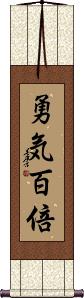
勇気百倍 means to inspire someone with fresh courage or redoubled courage in Japanese.
The Kanji breakdown:
勇気 (yuuki) courage; bravery; valour; valor; nerve; boldness.
百 (hyaku) 100; hundred.
倍 (bai) twice; double; 2-times; 2-fold.
Zen Heart / Zen Mind
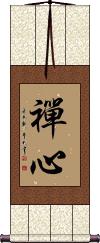
禪心 represents an image of your meditation coming from and filling your heart.
The meaning of the first character is “meditation” and the second character is usually defined as “heart” or sometimes “mind.”
There is a two-fold meaning here, as a good meditation session must start with a centered heart or mind. Yet at the same time, meditation serves to cleanse, focus, and center the heart and mind.
This in-stock artwork might be what you are looking for, and ships right away...

Not the results for fold that you were looking for?
Below are some entries from our dictionary that may match your fold search...
| Characters If shown, 2nd row is Simp. Chinese |
Pronunciation Romanization |
Simple Dictionary Definition |
四諦 四谛 see styles |
sì dì si4 di4 ssu ti shitai したい |
More info & calligraphy: Four Noble Truths (Buddhism){Buddh} (See 苦集滅道) The Four Noble Truths catvāri-ārya-satyāni; 四聖諦; 四眞諦. The four dogmas, or noble truths, the primary and fundamental doctrines of Śākyamuni, said to approximate to the form of medical diagnosis. They are pain or 'suffering, its cause, its ending, the way thereto; that existence is suffering, that human passion (taṇhā, 欲 desire) is the cause of continued suffering, that by the destruction of human passion existence may be brought to an end; that by a life of holiness the destruction of human passion may be attained'. Childers. The four are 苦, 聚 (or 集), 滅, and 道諦, i. e. duḥkha 豆佉, samudaya 三牟提耶, nirodha 尼棲陀, and mārga 末加. Eitel interprets them (1) 'that 'misery' is a necessary attribute of sentient existence'; (2) that 'the 'accumulation' of misery is caused by the passions'; (3) that 'the 'extinction' of passion is possible; (4) mārga is 'the doctrine of the 'path' that leads to the extinction of passion'. (1) 苦 suffering is the lot of the 六趣 six states of existence; (2) 集 is the aggregation (or exacerbation) of suffering by reason of the passions; (3) 滅 is nirvana, the extinction of desire and its consequences, and the leaving of the sufferings of mortality as void and extinct; (4) 道 is the way of such extinction, i. e. the 八正道 eightfold correct way. The first two are considered to be related to this life, the last two to 出世間 a life outside or apart from the world. The four are described as the fundamental doctrines first preached to his five former ascetic companions. Those who accepted these truths were in the stage of śrāvaka. There is much dispute as to the meaning of 滅 'extinction' as to whether it means extinction of suffering, of passion, or of existence. The Nirvana Sutra 18 says that whoever accepts the four dogmas will put an end to births and deaths 若能見四諦則得斷生死 which does not of necessity mean the termination of existence but that of continued transmigration. v. 滅. |
八正道 see styles |
bā zhèng dào ba1 zheng4 dao4 pa cheng tao hasshōdō はっしょうどう |
More info & calligraphy: The Noble Eightfold Path(Buddhist term) noble eightfold path (八正道分) Āryamārga. The eight right or correct ways, the "eightfold noble path" for the arhat to nirvāṇa; also styled 八道船, 八正門, 八由行, 八游行, 八聖道支, 八道行, 八直行, 八直道. The eight are: (1) 正見Samyag-dṛṣṭi, correct views in regard to the Four Axioms, and freedom from the common delusion. (2) 正思 Samyak-saṁkalpa, correct thought and purpose. (3) 正語 Samyag-vāc, correct speech, avoidance of false and idle talk. (4) 正業 Samyak-karmānta, correct deed, or conduct, getting rid of all improper action so as to dwell in purity. (5) 正命 Smnyag-ājīva, correct livelihood or occupation, avoiding the five immoral occupations. (6) 正精進 Samyag-vyāyāma, correct zeal, or energy in uninterrupted progress in the way of nirvāṇa. (7) 正念 Samyak-smṛti, correct remembrance, or memory, which retains the true and excludes the false. (8) 正定 Samyak-samadhi, correct meditation, absorption, or abstraction. The 正 means of course Buddhist orthodoxy, anything contrary to this being 邪 or heterodox, and wrong. |
倍 see styles |
bèi bei4 pei bai ばい |
(two, three etc) -fold; times (multiplier); double; to increase or multiply (noun - becomes adjective with の) (1) double; twice (as much); (counter) (2) times (as much); -fold; (counter) (3) (e.g. 40倍 = 1 in 40) 1-nth; 1 to n; 1 in n; (surname) Bai Double, double-fold, a fold; to turn from or against, to revolt. |
叉 see styles |
chǎ cha3 ch`a cha sha また |
to diverge; to open (as legs) (1) crotch; crutch; groin; thigh; (2) fork (in a tree, road, river, etc.); tines (of a fork) A fork, forked; to fold, folded. |
抄 see styles |
chāo chao1 ch`ao chao shou / sho しょう |
to make a copy; to plagiarize; to search and seize; to raid; to grab; to go off with; to take a shortcut; to make a turning move; to fold one's arms (1) (obsolete) excerpt; extract; (2) annotation; (3) shou (unit of volume, approx. 1.8 ml); (female given name) Shou extract and annotate from a text |
折 see styles |
zhé zhe2 che sagari さがり |
to break; to fracture; to snap; to suffer loss; to bend; to twist; to turn; to change direction; convinced; to convert into (currency); discount; rebate; tenth (in price); classifier for theatrical scenes; to fold; accounts book (1) opportunity; chance; occasion; time; (n,ctr) (2) fold; pleat; crease; (3) small food box (wooden or cardboard); (personal name) Sagari Tear open, break down.; To snap, break; decide; compound; fold. |
摺 折 see styles |
zhé zhe2 che narai ならい |
document folded in accordion form; to fold (surname) Narai |
欄 栏 see styles |
lán lan2 lan ran らん |
fence; railing; hurdle; column or box (of text or other data) (n,n-suf) (1) section (e.g. in a newspaper); column; page; (n,n-suf) (2) field (in a form, web page, etc.); blank; (3) (orig. meaning) handrail; railing; banister; balustrade; (surname) Ran A rail, handrail; pen, fold. |
牢 see styles |
láo lao2 lao rou / ro ろう |
(literary) pen; fold (for livestock); prison; jail; firm; secure; fast prison; jail; gaol A gaol, fold, pen; secure, firm. |
疊 叠 see styles |
dié die2 tieh tatami たたみ |
to pile up; (bound form) repeated; to fold; classifier: stack, pile (of thin objects); classifier for repeated sections in a musical composition (out-dated kanji) tatami mat; Japanese straw floor coverings; (surname) Tatami |
蓰 see styles |
xǐ xi3 hsi |
(grass); increase five fold |
襉 裥 see styles |
jiǎn jian3 chien |
(dialect) fold or pleat (in clothing) |
襞 see styles |
bì bi4 pi hida; hida ひだ; ヒダ |
creases; folds or pleats in a garment (1) (kana only) fold; pleat; gathers; tuck; (2) (kana only) folds (e.g. of a mountain); crease; (3) (kana only) (hidden) detail; nuance; shade; wrinkle (e.g. in logic); (4) (kana only) lamella; gill (of a mushroom) |
重 see styles |
zhòng zhong4 chung munenori むねのり |
heavy; serious; to attach importance to (1) (abbreviation) (See 重箱) jūbako; multi-tiered food box; (prefix noun) (2) heavy; (prefix noun) (3) serious; extreme; (suf,ctr) (4) (counter for layers in the ichi-ni-san counting system) (See 重・え) -fold; -ply; (personal name) Munenori Heavy, weighty, grave, serious; to lay stress upon, regard respectfully; again, double, repeated. |
三倍 see styles |
sān bèi san1 bei4 san pei sanbai さんばい |
triple three-fold; three times |
三田 see styles |
sān tián san1 tian2 san t`ien san tien minda みんだ |
3 annual hunting bouts; 3 qi points (surname) Minda The three "fields" of varying qualities of fertility, i.e. bodhisattvas, śrāvakas, and icchantis, respectively producing a hundred-fold, fifty-fold, onefold. 涅槃經 33. |
三自 see styles |
sān zì san1 zi4 san tzu sanji |
abbr. for 三自愛國教會|三自爱国教会[San1 zi4 Ai4 guo2 Jiao4 hui4], Three-Self Patriotic Movement Three divisions of the eight-fold noble path, the first to the third 自調 self-control, the fourth and fifth 自淨 self-purification, the last three 自度 self-development in the religious life and in wisdom. Also 自體, 自相, 自用 substance, form, and function. |
三身 see styles |
sān shēn san1 shen1 san shen sanmi さんみ |
{Buddh} trikaya (three bodies of the Buddha); (surname) Sanmi trikāya. 三寶身 The threefold body or nature of a Buddha, i.e. the 法, 報, and 化身, or dharmakāya, sambhogakāya, and nirmāṇakāya. The three are defined as 自性, 受用, and 變化, the Buddha-body per se, or in its essential nature; his body of bliss, which he "receives" for his own "use" and enjoyment; and his body of transformation, by which he can appear in any form; i.e. spiritual, or essential; glorified; revealed. While the doctrine of the trikāya is a Mahāyāna concept, it partly results from the Hīnayāna idealization of the earthly Buddha with his thirty-two signs, eighty physical marks, clairvoyance, clairaudience, holiness, purity, wisdom, pity, etc. Mahāyāna, however, proceeded to conceive of Buddha as the Universal, the All, with infinity of forms, yet above all our concepts of unity or diversity. To every Buddha Mahāyāna attributed a three-fold body: that of essential Buddha; that of joy or enjoyment of the fruits of his past saving labours; that of power to transform himself at will to any shape for omnipresent salvation of those who need him. The trinity finds different methods of expression, e.g. Vairocana is entitled 法身, the embodiment of the Law, shining everywhere, enlightening all; Locana is 報身; c.f. 三賓, the embodiment of purity and bliss; Śākyamuni is 化身 or Buddha revealed. In the esoteric sect they are 法 Vairocana, 報 Amitābha, and 化 Śākyamuni. The 三賓 are also 法 dharma, 報 saṅgha, 化 buddha. Nevertheless, the three are considered as a trinity, the three being essentially one, each in the other. (1) 法身 Dharmakāya in its earliest conception was that of the body of the dharma, or truth, as preached by Śākyamuni; later it became his mind or soul in contrast with his material body. In Mādhyamika, the dharmakāya was the only reality, i.e. the void, or the immateria1, the ground of all phenomena; in other words, the 眞如 the tathāgatagarbha, the bhūtatathatā. According to the Huayan (Kegon) School it is the 理or noumenon, while the other two are氣or phenomenal aspects. "For the Vijñānavāda... the body of the law as highest reality is the void intelligence, whose infection (saṃkleҫa) results in the process of birth and death, whilst its purification brings about Nirvāṇa, or its restoration to its primitive transparence" (Keith). The "body of the law is the true reality of everything". Nevertheless, in Mahāyāna every Buddha has his own 法身; e.g. in the dharmakāya aspect we have the designation Amitābha, who in his saṃbhogakāya aspect is styled Amitāyus. (2) 報身Sambhogakāya, a Buddha's reward body, or body of enjoyment of the merits he attained as a bodhisattva; in other words, a Buddha in glory in his heaven. This is the form of Buddha as an object of worship. It is defined in two aspects, (a) 自受用身 for his own bliss, and (b) 他受用身 for the sake of others, revealing himself in his glory to bodhisattvas, enlightening and inspiring them. By wisdom a Buddha's dharmakāya is attained, by bodhisattva-merits his saṃbhogakāya. Not only has every Buddha all the three bodies or aspects, but as all men are of the same essence, or nature, as Buddhas, they are therefore potential Buddhas and are in and of the trikāya. Moreover, trikāya is not divided, for a Buddha in his 化身 is still one with his 法身 and 報身, all three bodies being co-existent. (3) 化身; 應身; 應化身 nirmāṇakāya, a Buddha's transformation, or miraculous body, in which he appears at will and in any form outside his heaven, e.g. as Śākyamuni among men. |
二重 see styles |
èr chóng er4 chong2 erh ch`ung erh chung futae ふたえ |
double; repeated twice (noun - becomes adjective with の) (1) double; two-fold; two layers; duplex; (prefix) (2) diplo-; dipl-; (3) (abbreviation) (See 二重まぶた・ふたえまぶた) double-edged eyelid; double eyelid; creased eyelid; (surname) Futae two levels |
倍數 倍数 see styles |
bèi shù bei4 shu4 pei shu haishu |
multiple; multiplier; factor -fold, -times (with numerals) |
千倍 see styles |
qiān bèi qian1 bei4 ch`ien pei chien pei senbai せんばい |
(adj-na,adj-no,n) thousand-fold thousandfold |
合攏 合拢 see styles |
hé lǒng he2 long3 ho lung |
to close (flower, eyes, suitcase etc); to bring together; (insect or bird when not flying) to fold (its wings) |
大教 see styles |
dà jiào da4 jiao4 ta chiao daikyō |
The great teaching. (1) That of the Buddha. (2) Tantrayāna. The mahātantra, yoga, yogacarya, or tantra school which claims Samantabhadra as its founder. It aims at ecstatic union of the individual soul with the world soul, Iśvara. From this result the eight great powers of Siddhi (aṣṭa-mahāsiddhi), namely, ability to (1) make one's body lighter (laghiman); (2) heavier (gaiman); (3) smaller (aṇiman); (4) larger (mahiman) than anything in the world ; (5) reach any place (prāpti) ; (6) assume any shape (prākāmya) ; (7) control all natural laws (īśitva) ; (8) make everything depend upon oneself; all at will (v.如意身 and 神足). By means of mystic formulas (Tantras or dhāraṇīs), or spells (mantras), accompanied by music and manipulation of the hands (mūdra), a state of mental fixity characterized neither by thought nor the annihilation of thought, can be reached. This consists of six-fold bodily and mental happiness (yoga), and from this results power to work miracles. Asaṅga compiled his mystic doctrines circa A.D. 500. The system was introduced into China A.D. 647 by Xuanzang's translation of the Yogācārya-bhūmi-śāstra 瑜伽師地論 ; v. 瑜. On the basis of this, Amoghavajra established the Chinese branch of the school A.D. 720 ; v. 阿目. This was popularized by the labours of Vajrabodhi A.D. 732 ; v. 金剛智. |
對摺 对折 see styles |
duì zhé dui4 zhe2 tui che |
to sell at a 50% discount; to fold in two |
山折 see styles |
yamaori やまおり |
mountain fold (origami); (surname) Yamaori |
抄手 see styles |
chāo shǒu chao1 shou3 ch`ao shou chao shou |
to fold one's arms; copyist; (dialect) wonton |
折り see styles |
ori おり |
(1) opportunity; chance; occasion; time; (n,ctr) (2) fold; pleat; crease; (3) small food box (wooden or cardboard) |
折る see styles |
oru おる |
(transitive verb) (1) to break; to fracture; to break off; to snap off; to pick (e.g. flowers); (transitive verb) (2) to fold; to bend; (transitive verb) (3) to make (origami); (transitive verb) (4) (See 筆を折る) to interrupt; to end |
折れ see styles |
ore おれ |
(See 折れる・おれる・2) fold; bend; broken part |
折疊 折叠 see styles |
zhé dié zhe2 die2 che tieh |
to fold; collapsible; folding (bicycle, antenna, bed etc) |
Click here for more fold results from our dictionary
The following table may be helpful for those studying Chinese or Japanese...
| Title | Characters | Romaji (Romanized Japanese) | Various forms of Romanized Chinese | |
| Inspire with redoubled courage | 勇気百倍 | yuuki hyaku bai yuukihyakubai yuki hyaku bai | ||
| Zen Heart Zen Mind | 禪心 禅心 | zen shin / zenshin | chán xīn / chan2 xin1 / chan xin / chanxin | ch`an hsin / chanhsin / chan hsin |
| In some entries above you will see that characters have different versions above and below a line. In these cases, the characters above the line are Traditional Chinese, while the ones below are Simplified Chinese. | ||||

Successful Chinese Character and Japanese Kanji calligraphy searches within the last few hours...



