Many custom options...


And formats...



Not what you want?
Try other similar-meaning words, fewer words, or just one word.
Foundation Kanji in Chinese / Japanese...
Buy a Foundation Kanji calligraphy wall scroll here!
Personalize your custom “Foundation Kanji” project by clicking the button next to your favorite “Foundation Kanji” title below...
See also: Selections of just Japanese Kanji Calligraphy
The Foundation of Good Conduct
Quote from Confucius
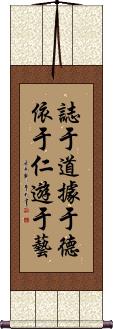
This proverb, 志于道据于德依于仁游于艺, from the Analects of Confucius translates as:
Resolve yourself in the Dao/Tao/Way.
Rely on Virtue.
Reside in benevolence.
Revel in the arts.
According to Confucius, these are the tenets of good and proper conduct.
This was written over 2500 years ago. The composition is in ancient Chinese grammar and phrasing. A modern Chinese person would need a background in Chinese literature to understand this without the aid of a reference.
Shaolin Chan
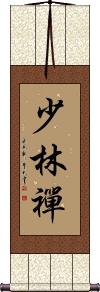
少林禪 translates as “Little Forest Meditation.”
少林禪 is part of a movement to provide spiritual and mental health by integrating the practices of martial arts and meditation.
More information at Shaolin Chan Foundation.
Aikikai
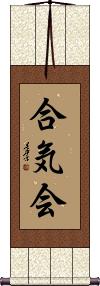
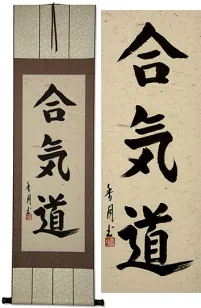
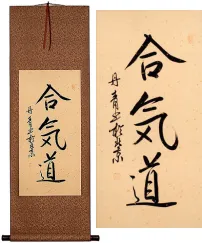
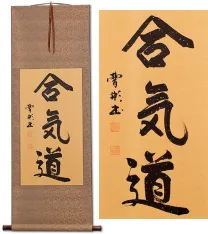
合気会 or “Aikikai” is the original school of Aikido.
Several organizations use this title. The first was established in Japan in 1940 (The Aikikai Foundation or 財団法人合気会).
The only difference between this title and Aikido is the last character, “kai” which means club, group, fraternity, organization, or assembly.
Note: 合気会 may be romanized with a dash like this: Aiki-Kai.
Live Strong
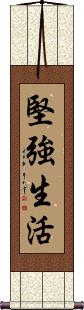
While hard to translate directly, 堅強生活 is the best way to write “Live Strong” in Chinese. If you are a cancer survivor or support Lance Armstrong's ideas, this is a nice selection for a wall scroll.
The first two characters mean strong or staunch. The last two mean living or life (daily existence). While the Chinese version is the reverse order of “Live Strong” it is the only way to write it in a natural form that is grammatically correct.
Note that we are in no way affiliated or connected to Lance or his foundation. This translation is offered because of multiple requests from customers whose philosophies or ideas match those of the Live Strong idea.
Christianity / Christian
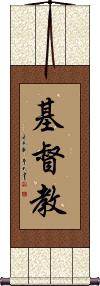
基督教 is the Chinese, Japanese and Korean word for “Christianity.”
Just as in English, this word is often used to mean “Protestant” but includes Catholics in the true definition.
It is the word used to refer to the whole “Christian religion” or “Christian Faith,” and therefore, it can be translated as “Christianity.” However, used as an adjective in regard to a person, it would translate as “Christian.” But more like saying, “His religion is Christianity,” rather than a noun form.
If you break it apart, the characters mean Base/Foundation Leading/Supervising Religion/Teaching. It makes more sense in Japanese, Chinese, and Korean. The first two characters together are translated as “Christ.” So you can also say this means “Christ's Religion” or “Christ's Teachings” when directly translated, or in reverse, “The Religion of Christ” or “The Teaching of Christ.”
Notes: The last character has a slight difference in one stroke - however, in calligraphic form, this will not be apparent. This entry can easily be read by any Korean person who knows Hanja characters (Chinese characters used in Korean).
See Also: Jesus Christ | God of Abraham
Christ
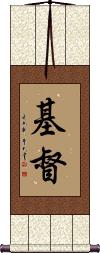
基督 is how to write “Christ” in Chinese characters, Korean Hanja, and Japanese Kanji.
This is the word used in the Chinese Union Bible (the only readily-available translation of the Bible into Chinese that I know of - published about 100 years ago). For Chinese Christians, this is the most common way to refer to Jesus Christ.
This is also the way that “Christ” is written in Japanese. But since the Japanese language is very flexible about the sounds that can be assigned to various Kanji, these characters have been assigned a pronunciation that sounds a lot like “Christ” or actually closer to the original “Christos.” In Japanese (if you don't know how the Romaji shown above in the gray box works), it sounds like “key ree sue toe” using English words/sounds. Say those four words fast, and you'll get it.
It should be noted that only Japanese Christians will be familiar with this word.
This is best defined, read, and understood with the characters together, but if you take this word for Christ apart, the first character means “fundamentals” or “foundation.” The second character can mean “leader” or “boss.”
This in-stock artwork might be what you are looking for, and ships right away...



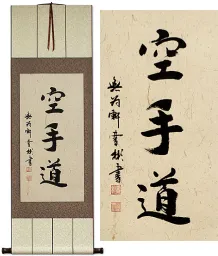
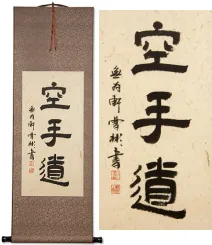
Not the results for foundation kanji that you were looking for?
Below are some entries from our dictionary that may match your foundation kanji search...
| Characters If shown, 2nd row is Simp. Chinese |
Pronunciation Romanization |
Simple Dictionary Definition |
日本漢字能力検定協会 see styles |
nihonkanjinouryokukenteikyoukai / nihonkanjinoryokukentekyokai にほんかんじのうりょくけんていきょうかい |
(org) Japan Kanji Aptitude Testing Foundation; JKATF; (o) Japan Kanji Aptitude Testing Foundation; JKATF |
The following table may be helpful for those studying Chinese or Japanese...
| Title | Characters | Romaji (Romanized Japanese) | Various forms of Romanized Chinese | |
| The Foundation of Good Conduct | 誌于道據于德依于仁遊于藝 志于道据于德依于仁游于艺 | zhì yú dào jù yú dé yī yú rén yóu yú yì zhi4 yu2 dao4 ju4 yu2 de2 yi1 yu2 ren2 you2 yu2 yi4 zhi yu dao ju yu de yi yu ren you yu yi | chih yü tao chü yü te i yü jen yu yü i | |
| Shaolin Chan | 少林禪 少林禅 | sho rin zen shorinzen | shǎo lín chán shao3 lin2 chan2 shao lin chan shaolinchan | shao lin ch`an shaolinchan shao lin chan |
| Aikikai | 合気会 / 合氣會 合気会 | ai ki kai / aikikai | ||
| Live Strong | 堅強生活 坚强生活 | jiān qiáng shēng huó jian1 qiang2 sheng1 huo2 jian qiang sheng huo jianqiangshenghuo | chien ch`iang sheng huo chienchiangshenghuo chien chiang sheng huo |
|
| Christianity Christian | 基督教 | kirisutokyou kirisutokyo | jī dū jiào ji1 du1 jiao4 ji du jiao jidujiao | chi tu chiao chituchiao |
| Christ | 基督 | kirisuto | jī dū / ji1 du1 / ji du / jidu | chi tu / chitu |
| In some entries above you will see that characters have different versions above and below a line. In these cases, the characters above the line are Traditional Chinese, while the ones below are Simplified Chinese. | ||||

Successful Chinese Character and Japanese Kanji calligraphy searches within the last few hours...



