Many custom options...


And formats...



Not what you want?
Try other similar-meaning words, fewer words, or just one word.
Go No Sen in Chinese / Japanese...
Buy a Go No Sen calligraphy wall scroll here!
Personalize your custom “Go No Sen” project by clicking the button next to your favorite “Go No Sen” title below...
Switched to secondary search mode due to lack of results using primary.
These secondary results may not be very accurate. Try a different but similar meaning word or phrase for better results. Or...
Look up Go No Sen in my Japanese Kanji & Chinese Character Dictionary(My dictionary is a different system then the calligraphy search you just tried)
If you want a special phrase, word, title, name, or proverb, feel free to contact me, and I will translate your custom calligraphy idea for you.
4. 4. Right Action / Perfect Conduct
6. 5. Right Living / Right Livelihood / Perfect Livelihood
7. In the Abyss of Infinite Bitterness - Turn to the Shore
9. AJ
10. Madder
11. Akiyama
13. Angel
15. Any success can not compensate for failure in the home
16. No man knows what he owes to his parents until he comes to have children of his own
17. Ascend
18. Beautiful Life / Life in Perfect Harmony
19. Belief / Trust
20. Better to Choose Nothing, Rather than Make a Poor Choice
22. Without a big net, how can you catch fish?
23. Bond
24. Born To Be Wild
25. Boxing
30. Bruce Lee
31. No Trouble / Freedom from Problems
32. The Buddha is in Each Sentient Being
33. Camellia
34. Mark the boat to find the lost sword / Ignoring the changing circumstances of the world
35. Chess
36. Do not shed a tear until you see the coffin
37. Confidence / Faithful Heart
38. The Confident Helmsman Inspires Confidence in the Passengers
39. Confucius: Golden Rule / Ethic of Reciprocity
40. Corinthians 13:4
43. The Great Path has No Gate
44. Dana: Almsgiving and Generosity
45. Daoism / Taoism
46. Daodejing / Tao Te Ching - Chapter 33
47. Daodejing / Tao Te Ching - Chapter 27
49. Honorable Death - No Surrender
50. Demon Slayer
53. Benevolent and Skilled Doctor
54. Double Happiness Guest Book
55. Drain the pond to get all the fish
57. Drink
58. Equality
60. Sky / Ether / Void / Emptiness / Unreality
61. Example is Better than Precept
62. Faith Hope Love
63. Fear No Evil
64. Fear No Man / Fear Nothing
66. Fire and Water Have No Mercy
67. Flying / Flight / Rising Upward
68. A Bright Future
69. Flower Open / Blooming Flower
70. Flowers Bloom and Flowers Fall
71. Flowers Bloom and Flowers Wither
72. Flowers Fall / The End Comes
73. Flower in the Mirror, Moon on Water
77. Four Noble Truths: Desire and Attachment
78. Put out a burning wood cart with a cup of water
79. Courage To Do What Is Right
80. Go-Dan / 5th Degree Black Belt
81. Goddess of Mercy and Compassion
83. Gojutsu
84. Go Kan Ryu
86. Go With The Flow
87. Guanxi
88. Gung Ho
1 Corinthians 13:4-8
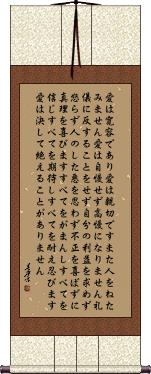
Here is 1st Corinthians 13:4-8 (just the first sentence of verse 8) in Japanese.
In the familiar NIV, this would read:
Love is patient, love is kind. It does not envy, it does not boast, it is not proud.
It does not dishonor others, it is not self-seeking, it is not easily angered, it keeps no record of wrongs.
Love does not delight in evil but rejoices with the truth.
It always protects, always trusts, always hopes, always perseveres.
Love never fails...
The Japanese text is from the 新改訳聖書 (Shinkaiyaku) or New Japanese Bible. Popular among most Protestant denominations in modern Japan.
Note: Because this selection contains some special Japanese Hiragana characters, it should be written by a Japanese calligrapher.
1 Corinthians 13:5
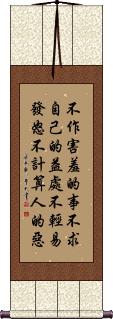
Here is 1 Corinthians 13:5 in Chinese.
The text with punctuation:
不作害羞的事。不求自己的益处。不轻易发怒。不计算人的恶。
Hand-painted calligraphy does not retain punctuation.
This translation is from the Chinese Union Bible.
You may know it from the KJV as:
Doth not behave itself unseemly, seeketh not her own, is not easily provoked, thinketh no evil.
Ten perfect Mahayana rules
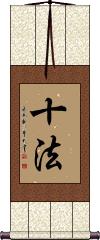
十法 is the title of the ten perfect or perfecting Mahāyāna rules.
The order of rules is as follows:
1. right belief.
2. right conduct.
3. right spirit.
4. the joy of the bodhi mind.
5. joy in the dharma.
6. joy in meditation.
7. pursuing the correct dharma.
8. obedience to, or accordance with dharma.
9. departing from pride, desire, etc.
10. comprehending the inner teaching of Buddha and taking no pleasure in attaining such knowledge or noting the ignorance of others.
This title is only used in the context of Buddhism. Japanese and Chinese people who are not familiar with Buddhism will not recognize this title.
4. Right Action / Perfect Conduct
Samyak Karmanta / Samma Kammanta
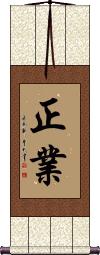
正業 is one of the Noble Eightfold Paths of Buddhism. Right Action, along with Right Speech and Right Living, constitute the path to Virtue.
The five precepts of Right Action are...
1. Refrain from destroying living beings (no murder or any form of taking a life).
2. Refrain from stealing.
3. Refrain from sexual misconduct (adultery, rape, etc.).
4. Refrain from false speech (lying or trickery).
5. Refrain from intoxicants that lead to heedlessness (no drugs or alcohol).
This concept can be summarized as “Avoidance of actions that conflict with moral discipline.”
Note: In Japanese, when read by a non-Buddhist, this will mean “the right job/vocation.”
This term is exclusively used by devout Buddhists. It is not a common term, and is remains an unknown concept to most Japanese and Chinese people.
See Also: Buddhism | Enlightenment | Noble Eightfold Path
Five Codes of Tang Soo Do
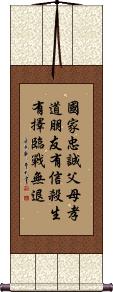
国家忠诚父母孝道朋友有信杀生有择临战无退 are the five codes of Tang Soo Do.
I suggest you have this arranged in five columns when you get to the options page for your custom calligraphy wall scroll.
Here are my translations of each of the five codes:
國家忠誠 Be loyal to your country.
父母孝道 In regards to parents, behave in a filial way.
朋友有信 Be faithful in friendship.
殺生有擇 When fighting for life and death, make noble choices.
臨戰無退 No retreat in battle.
Note: “Tang Soo Do” is a romanization of 唐手道. It's 당수도 in Korean Hangul. It can also be romanized as “Tangsudo” or “Dangsudo.”
5. Right Living / Right Livelihood / Perfect Livelihood
Samyag Ajiva / Samma Ajiva
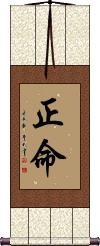
正命 (right living) is one of the Noble Eightfold Paths of Buddhism.
Right Living, along with Right Speech and Right Action, constitute the path to Virtue.
Right Living means that a Buddhist should only take a job or pursue a career in a field that does no harm. Buddhists should not work in the arms trade, as pimps or in the field of prostitution, as a butcher or in a shop that kills or sells meat, in a laboratory that does animal research, or in any other business that involves scheming or unethical behavior.
Another definition: Avoidance of professions that are harmful to sentient beings, such as slaughterer, hunter, dealer in weaponry or narcotics, etc.
This term is exclusively used by devout Buddhists. It is not a common term, and is remains an unknown concept to most Japanese and Chinese people.
See Also: Buddhism | Enlightenment | Noble Eightfold Path
In the Abyss of Infinite Bitterness - Turn to the Shore
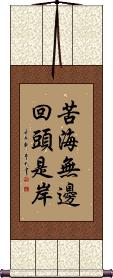
苦海無邊, 回頭是岸 can be translated almost directly as “The sea of bitterness has no bounds, turn your head to see the shore.”
Often this proverb refers to how Buddhist enlightenment can allow one to shed off the abyss of worldly suffering. But it can apply to other religions. If you find yourself trapped in the hardship of this worldly life, take a new turn, and seek a path to salvation.
Heart of Aikido
Aikido no Kokoro
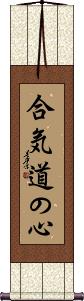
合気道の心 is often translated as “The Spirit of Aikido,” but it is more directly translated as “Heart of Aikido.”
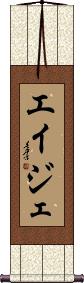
エイジェ is the name AJ in Japanese.
This is kind of a funky name, as there are no letters or initials in Japanese. But, this sounds just like AJ.
Note: Because this title is entirely Japanese Katakana, it should be written by a Japanese calligrapher.
Madder
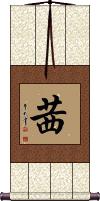
茜 is the name for Rubia cordifolia, Indian madder, munjeet, Japanese madder, Rubia argyi, rose madder or red madder.
This is a flowering plant that since ancient times, the root has been used to create red, pink, and other red-hued dyes.
In Japan, this can be the surname or given names Sen, Sei, or Akane.
Akiyama
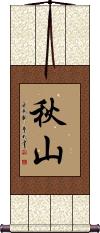
This is the surname and place name Akiyama in Japanese.
It can be read in Chinese but would be understood to be a Japanese name (no meaning in Chinese).
All Hopes Fulfilled
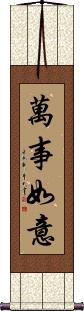
萬事如意 is a Chinese and old Korean proverb that means to have all one's wishes.
When speaking to someone, it's a way to say best wishes, all the best, may all your hopes be fulfilled, or may everything go well.
On your wall as calligraphy, it's meant to inspire all your wishes, hopes, dreams, and life to go well or come true.
Angel
(Name Version 1)
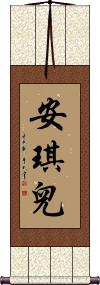
安琪兒 is the most common transliteration to Mandarin Chinese for the name Angel.
It is supposed to sound like Angel but to be honest, this one misses the mark.
I would go with the meaning of Angel if I were you.
Antiwar / Anti-War
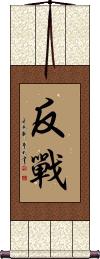
反戰 means antiwar, as in what a pacifist believes in.
China does plenty of saber-rattling but thankfully doesn't go to war very often, and Japan has embraced a pacifist ideology. Therefore, it's rare to need this word. However, this is the kind of word that war protesters would write on their signs.
 There is a modern Japanese version of the second character which has become the standard in Japan after WWII. If you want your calligraphy written in the modern Japanese form, please click on the Kanji shown to the right instead of the button above. Note: Most Japanese and all Chinese people will recognize the form shown in the upper left.
Any success can not compensate for failure in the home
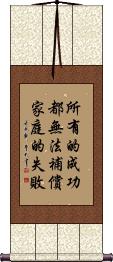
所有的成功都無法補償家庭的失敗 is a Chinese proverb that can be translated into English as “No success can compensate for failure in the home.”
Also, the word “home” can be exchanged with “family.”
No man knows what he owes to his parents until he comes to have children of his own
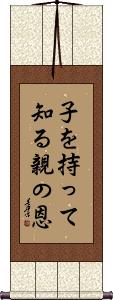
子を持って知る親の恩 literally translates as: Only after you have a baby, you would appreciate your parents (feel the way they do, etc).
This is a bit like the “walk a mile in another man's shoes” saying. Basically, it's about you cannot fully understand the plight of others until you experience it yourself. It also shows appreciation for the plight of parents.
This Japanese proverb can also be translated a few more ways:
No man knows what he owes to his parents till he comes to have children of his own.
One knows not what one owes to one's parents till one comes to have children of one's own.
Only after you have a baby, you will appreciate your parents or feel the way they do.
Only after becoming a parent yourself do you realize how much you owe [how indebted you are] to your own parents.
Note: Because this selection contains some special Japanese Hiragana characters, it should be written by a Japanese calligrapher.
Ascend
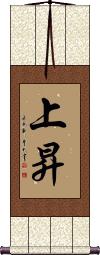
上昇 means to rise up, to go up, or to ascend in Chinese, Japanese Kanji, and old Korean Hanja.
If you are rising, ascending, or climbing, this is the word for you.
In the older Buddhist context, this means to ascend, with the implication that the destination is the heavenly realm.
Beautiful Life / Life in Perfect Harmony
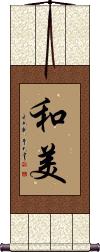
和美 is a word that means “harmonious” or, “in perfect harmony.”
The deeper meaning or more natural translation would be something like, “beautiful life.”
The first character means peace and harmony.
The second character means beautiful. But in this case, when combined with the first character, beautiful refers to being satisfied with what you have in your life. This can be having good relations, good feelings, comfort, and having enough (with no feeling of wanting).
Note: In Japanese, this is often used as the name "Wami." This title is probably more appropriate if your audience is Chinese.
Belief / Trust
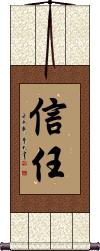
信任 means belief or trust in Chinese characters, old Korean Hanja, and Japanese Kanji.
It can also mean having confidence in or credence.
Better to Choose Nothing, Rather than Make a Poor Choice
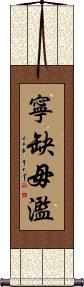
寧缺毋濫 is a Chinese proverb that can be translated as “Better to have nothing (than substandard choice).”
It basically suggests that one should prefer to go without something rather than accept a shoddy option.
See Also: A Deliberate Inaction is Better Than a Blind Action
Beyond / Exceed / Surpass
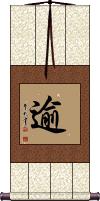
逾 means: to exceed; to go beyond; to transcend; to cross over; to jump over.
You'll see this character used in Buddhism (same meaning).
Technically, this single character is a Japanese word but is seldom used as a single Kanji in modern Japanese.
Without a big net, how can you catch fish?
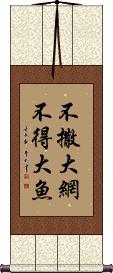
不撒大網不得大魚 is a Chinese proverb that literally translates as: [if one does] not cast a big net, [one can] not get big fish.
Figuratively, this means: One cannot make great accomplishments without making great efforts or taking great pains.
This is sort of the fishing version of, “No pain, no gain.”
Bond
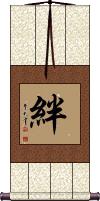
This Kanji represents a bond, as in the bond between mother and daughter, father and son, family ties, or a family bond.
絆 is the kind of character that says, no matter what happens (difficult times), we have this bond that cannot be broken.
If you go to the Japanese dictionary, the definition is the bonds (between people), (emotional) ties, relationship, connection, link, tether, or fetters.
Read this before ordering...
This Kanji is best if your audience is Japanese. While this is also a Chinese character, it has a completely different meaning in Chinese (it means to hinder or stumble in Chinese).
it’s
a very rare character in Korean Hanja but does mean bond in Korean (used in Korean words for certain kinds of glue and sticking plaster).
Born To Be Wild
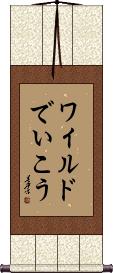
This is the Japanese version of “Born To Be Wild” (title of the Steppenwolf song).
The more literal meaning in Japanese for this phrase is “Let's go wild.”
Note: Because this title is entirely Japanese Hiragana and Katakana, it should be written by a Japanese calligrapher.
Boxing
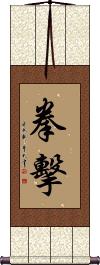
拳擊 is the term used in Chinese to refer to the original Olympic sport of combat and fighting.
If you like to strap on your boxing gloves and go a few rounds or are just a fan of boxing, this could make a nice wall scroll for you.
Note that Japanese use the same first character (which means fist) but a different Kanji for the second. Please see our Japanese boxing entry for that version.
The Brave Have No Fears
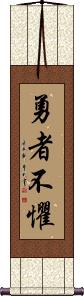
This proverb means “Brave people [are] without fear,” or “The brave are without fear.”
勇者不懼 is a proverb credited to Confucius. It's one of three phrases in a set of things he said.
This phrase is originally Chinese but has penetrated Japanese culture as well (many Confucian phrases have) back when Japan borrowed Chinese characters into their language.
This phrase has also been converted into modern Japanese grammar when written as 勇者は懼れず. If you want this version just click on those characters.
See Also: No Fear
Bravery / Courage
Courage in the face of Fear
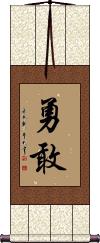
勇敢 is about courage or bravery in the face of fear.
You do the right thing even when it is hard or scary. When you are courageous, you don't give up. You try new things. You admit mistakes. This kind of courage is the willingness to take action in the face of danger and peril.
勇敢 can also be translated as braveness, valor, heroic, fearless, boldness, prowess, gallantry, audacity, daring, dauntless, and/or courage in Japanese, Chinese, and Korean. This version of bravery/courage can be an adjective or a noun. The first character means bravery and courage by itself. The second character means “daring” by itself. The second character emphasizes the meaning of the first but adds the idea that you are not afraid of taking a dare, and you are not afraid of danger.
勇敢 is more about brave behavior and not so much the mental state of being brave. You'd more likely use this to say, “He fought courageously in the battle,” rather than “He is very courageous.”
Bravery / Courage
Single Character for Courage
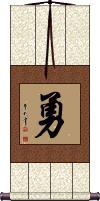
勇 can be translated as bravery, courage, valor, or fearless in Chinese, Japanese and Korean.
勇 is the simplest form to express courage or bravery, as there is also a two-character form that starts with this same character.
勇 can also be translated as brave, daring, fearless, plucky, or heroic.
This is also a virtue of the Samurai Warrior
See our page with just Code of the Samurai / Bushido here
Death Before Dishonor
Better to be broken jade than unbroken pottery
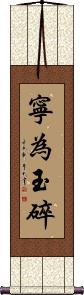
寧為玉碎 is the short version of a longer Chinese proverb which means “rather be shattered piece of jade than an unbroken piece of pottery.”
寧為玉碎 says the “rather be a broken piece of jade” part (the second half is implied - everyone in China knows this idiom).
A little more explanation:
Death is implied with the “broken” meaning. Jade is one of the most precious materials in Chinese history, and in this case, is compared with one's honor and self-worth. Pottery is just something you eat off of; it has no deep value, just as a person who has lost their honor or had none to begin with.
Thus, this means “better to die with honor than to live in shame” or words to that effect.
This is often translated in English as “Death Before Dishonor,” the famous military slogan.
I would also compare this to the English proverb, “Better to die on your feet than to live on your knees.”
Death Before Dishonor
Better to be broken jade than unbroken pottery
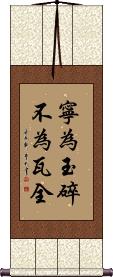
寧為玉碎不為瓦全 is the long version of a Chinese proverb that means “rather be shattered piece of jade than an unbroken piece of pottery.”
A little more explanation:
Death is implied with the “broken” meaning. Jade is one of the most precious materials in Chinese history, and in this case, is compared with one's honor and self-worth. Pottery is just something you eat off of, it has no deep value, just as a person who has lost their honor, or had none to begin with.
Thus, this means “better to die with honor than to live in shame” or words to that effect.
寧為玉碎不為瓦全 is often translated in English as “Death Before Dishonor,” the famous military slogan.
I would also compare this to the English proverb, “Better to die on your feet than to live on your knees.”
This is an idiom. It therefore doesn’t directly say exactly what it means. If you think about the English idiom, "The grass is always greener," it does not directly say "jealousy" or "envy" but everyone knows that it is implied.
Brother and Sister
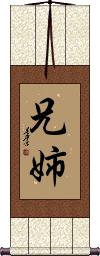
兄姉 means “brother and sister,” in Japanese.
There's no perfect way to say it in calligraphy, but this is probably the best way.
Bruce Lee
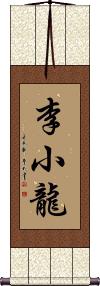
李小龍 is the real full name of Bruce Lee.
 Many people have no idea that Bruce Lee had a “real” Chinese name. In Mandarin and Cantonese, he is known as “Lǐ XiǎoLóng” and “Léi SíuLùng” respectively.
He kept his family name pronunciation (Li = Lee). 李 is a common family name that also means “plum.”
His given name 小龍 (Xiao-Long), literally means “little dragon.” 李小龍 is why you often see the character for dragon associated with Bruce Lee on various posters etc.
For a pronunciation lesson, the “X” in Romanized Mandarin is pronounced like a “sh” sound but with your tongue at the bottom of your mouth. The vowel sound in “Long” is like the English “oh,” not like the “ah” sound in the English word “long.”
If you are a big Bruce Lee fan, you should know this information, and you should have this wall scroll hanging in your room or martial arts studio.
Note: Japanese use these same Chinese characters / Kanji to write Bruce Lee's real name (with different pronunciation - which is a bit like how the name “Bruce Lee” sounds in English).
See Also: Kung Fu | Martial Arts
No Trouble / Freedom from Problems
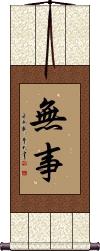
無事 is a Zen Buddhist term meaning no problem and no trouble.
無事 is the Zen state of perfect freedom from troubles and leaving secular affairs behind.
Sometimes this is used to describe the state of satori and complete tranquility of mind.
Written as 無事に with an extra Hiragana at the end, this becomes an adverb to describe something in the condition of safety, peace, quietness, and without troubles.
無事 (Buji) can also be a given name in Japan.
This has more meaning in the Japanese Zen Buddhist community than in China or Korea, where it can mean “be free” or “nothing to do or worry about.”
The Buddha is in Each Sentient Being
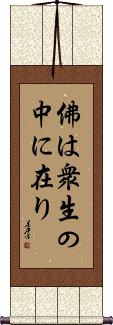
佛は衆生の中に在り is “Butsu wa shujo no naka ni ari” and means that the Buddha (potential for Buddhahood) exists in all beings in the universe.
So yes, your dog has the potential to be a Buddha (but only in a future reincarnation as a human). But all things, from the tiny cricket to the humpback whale have Buddha nature within them. If one takes the time to look and contemplate, one will see the Buddha in all things.
In Japan, sometimes the Buddha character is written 仏 instead of 佛, so you might see the whole phrase written as 仏は衆生の中に在り.
Note: Because this selection contains some special Japanese Hiragana characters, it should be written by a Japanese calligrapher.
Camellia
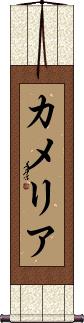
カメリア is the name Camellia in Japanese.
This sounds like Camellia, but does not mean the camellia plant or leaf.
Instead of these characters, you may want to go with the name of the plant. Of course, camellia also means tea, as varieties of camellia plants provide the leaves for many kinds of Chinese and Japanese teas.
Note: Because this title is entirely Japanese Katakana, it should be written by a Japanese calligrapher.
Mark the boat to find the lost sword / Ignoring the changing circumstances of the world
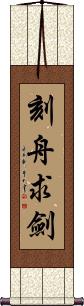
刻舟求劍 is an originally-Chinese proverb that serves as a warning to people that things are always in a state of change.
Thus, you must consider that and not depend on the old ways or a way that may have worked in the past but is no longer valid.
This idiom/proverb comes from the following story:
A man was traveling in a ferry boat across a river. With him, he carried a treasured sword. Along the way, the man became overwhelmed and intoxicated by the beautiful view and accidentally dropped his prized sword into the river. Thinking quickly, he pulled out a knife and marked on the rail of the boat where exactly he had lost his sword.
When the boat arrived on the other side of the river, the man jumped out of the boat and searched for his sword right under where he'd made the mark. Of course, the boat had moved a great distance since he made the mark, and thus, he could not find the sword.
While this man may seem foolhardy, we must take a great lesson from this parable: Circumstances change, so one should use methods to handle the change. In modern China, this is used in business to mean that one should not depend on old business models for a changing market.
This proverb dates back to the Spring and Autumn period (770–476 BC) of the territory now known as China. It has spread and is somewhat known in Japan and Korea.
Chess
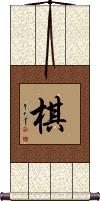
棋 is the most simple or generic way to write “chess” in Asia.
棋 is part of other more specific words for board games of strategy such as the western version of chess, Chinese chess, Weiqi, or Go.
In Japanese, this single character is pronounced “Go” and often refers to the game known in the west as “Go” (not just the 5-in-a-row version but also the complicated encirclement game of strategy known in China as Weiqi).
In Chinese, this can be more ambiguous as to which game of chess you speak.
If you like any version of chess, or games of intense strategy, this can be the character to hang on the wall in your game room.
Chess
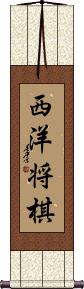
西洋将棋 is the Japanese title for the game of Chess (western style as opposed to Chinese Chess, Weiqi, or Japanese Go).
Chess
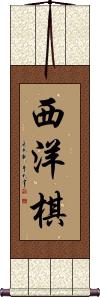
西洋棋 is the Chinese title for the game of Chess (western style as opposed to Chinese Chess, Weiqi, or Japanese Go).
Do not shed a tear until you see the coffin
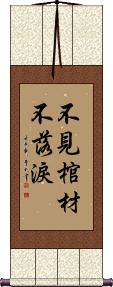
不見棺材不落淚 is a cautionary tale that suggests you are unknowingly (though it should be obvious)on a bad course.
It further suggests that you will not realize your folly until the worst has happened.
This can also be a warning of inaction until it's too late to take action. Again, not realizing your error until it's too late.
In an alternate interpretation, some will suggest this means doing something bad and not looking back - Then the worst happens.
It should be noted that this is one of the oddest selections for a wall scroll in our whole Asian calligraphy database. All of our translators are convinced that no Chinese person would ever hang this on their wall.
Confidence / Faithful Heart
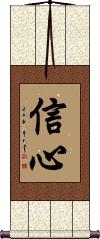
信心 is a Chinese, Japanese, and Korean word that means confidence, faith, or belief in somebody or something.
The first character means faith, and the second can mean heart or soul. Therefore, you could say this means “faithful heart” or “faithful soul.”
In Korean especially, this word has a religious connotation.
In the old Japanese Buddhist context, this was a word for citta-prasāda (clear or pure heart-mind).
In modern Japan (when read by non-Buddhists), this word is usually understood as “faith,” “belief,” or “devotion.”
See Also: Self-Confidence
The Confident Helmsman Inspires Confidence in the Passengers
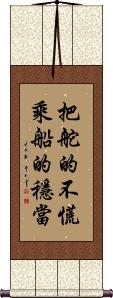
把舵的不慌乘船的稳当 is a Chinese proverb that literally translates as: [If the] helmsman is not nervous, the passengers [will feel] secure.
Figuratively, this means: If the leader appears confident, his/her followers will gain confidence also.
This is a great suggestion that a confident leader inspires confidence in his/her troops or followers. Of course, a nervous leader will create fear in troops or followers.
Confucius: Golden Rule / Ethic of Reciprocity
Do not do to others what you do not want done to yourself
Some may think of this as a “Christian trait,” but actually, it transcends many religions.
This Chinese teaching dates back to about 2,500 years ago in China. Confucius had always taught the belief in being benevolent (ren), but this idea was hard to grasp for some of his students, as benevolence could be kind-heartedness or an essence of humanity itself.
When answering Zhong Gong's question as to what "ren" actually meant, Confucius said:
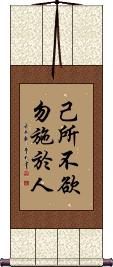
己所不欲勿施于人 or "When you go out, you should behave as if you were in the presence of a distinguished guest; when people do favors for you, act as if a great sacrifice was made for you. Whatever you wouldn't like done to you, do not do that thing to others. Don't complain at work or home.”
Hearing this, Zhong Gong said humbly, “Although I am not clever, I will do what you say.”
From this encounter, the Chinese version of the “Golden Rule” or “Ethic of Reciprocity” came to be.
The characters you see above express, “Do not do to others whatever you do not want to be done to yourself.”
See Also: Confucius Teachings | Benevolence
Corinthians 13:4
All you need to know about LOVE
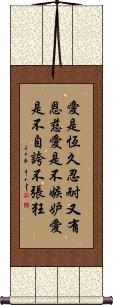
愛是恆久忍耐又有恩慈愛是不嫉妒愛是不自誇不張狂 is 1st Corinthians 13:4 in Chinese.
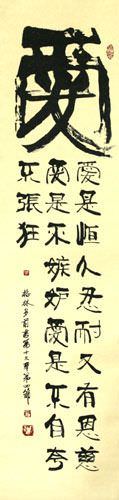
With large “love” character added.
In English, this reads:
1st Corinthians 13:4 (KJV) Charity suffereth long, and is kind; charity envieth not; charity vaunteth not itself, is not puffed up...
1st Corinthians 13:4 (NIV) Love is patient, love is kind. It does not envy, it does not boast, it is not proud.
1st Corinthians 13:4 (Basic English) Love is never tired of waiting; love is kind; love has no envy; love has no high opinion of itself, love has no pride.
The Chinese translation follows the love meaning, rather than the King James' use of “charity.” I was a little confused when writing this description with the significant differences between the NIV vs. KJV translations. After speaking to a Greek scholar about this, it would seem that the KJV has an almost errant translation with the use of “charity” in place of “love.”
We used the most popular Christian Chinese Bible, which is the Chinese Union Version (CUV). The CUV was first published in 1919. We use this so that the Chinese translation would be as accurate and standard as possible. Any Chinese Christian worth their salt will easily be able to identify this verse when they see these characters.
If you want a big “love” character written above the verse on your artwork, just make a note in the “special instructions” tab when you are customizing your artwork. There is no extra charge for that service on this special verse.
Corinthians 13:4

愛は忍耐強い。愛は情け深い。ねたまない。愛は自慢せず、高ぶらない。is 1st Corinthians 13:4 in Japanese.
In English, this reads:
1st Corinthians 13:4 (KJV) Charity suffereth long, and is kind; charity envieth not; charity vaunteth not itself, is not puffed up...
1st Corinthians 13:4 (NIV) Love is patient, love is kind. It does not envy, it does not boast, it is not proud.
1st Corinthians 13:4 (Basic English) Love is never tired of waiting; love is kind; love has no envy; love has no high opinion of itself, love has no pride.
If you want a big “love” character written above the verse on your artwork, just make a note in the “special instructions” tab when you are customizing your artwork. There is no extra charge for that service on this special verse.
Note: Because this selection contains some special Japanese Hiragana characters, it should be written by a Japanese calligrapher.
Bravery / Courage
Courageous Energy
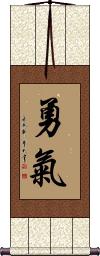
勇氣 is one of several ways to express bravery and courage in Chinese, Japanese, and Korean.
This version is the most spiritual. This is the essence of bravery from deep within your being. This is the mental state of being brave versus actual brave behavior. You'd more likely use this to say, “He is very courageous,” rather than “He fought courageously in the battle.”
The first character also means bravery or courage when it's seen alone. With the second character added, an element of energy or spirit is added. The second character is the same “chi” or “qi” energy that Kung Fu masters focus on when they strike. For this reason, you could say this means “spirit of courage” or “brave spirit.”
This is certainly a stronger word than just the first character alone.
Beyond bravery or courage, dictionaries also translate this word as valor/valour, nerve, audacity, daring, pluck, plucky, gallantry, guts, gutsy, and boldness.
This is also one of the 8 key concepts of tang soo do.
 While the version shown to the left is commonly used in Chinese and Korean Hanja (and ancient Japanese Kanji), please note that the second character is written with slightly fewer strokes in modern Japanese. If you want the modern Japanese version, please click on the character to the right. Both styles would be understood by native Chinese, Japanese, and many (but not all) Korean people. You should make your selection based on the intended audience for your calligraphy artwork. Or pick the single-character form of bravery/courage which is universal.
Courtesy / Politeness
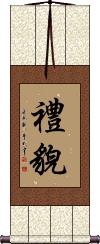
禮貌 is a Chinese and old Korean word that means courtesy or politeness.
Courtesy is being polite and having good manners. When you speak and act courteously, you give others a feeling of being valued and respected. Greet people pleasantly. Bring courtesy home. Your family needs it most of all. Courtesy helps life to go smoothly.
If you put the words "fēi cháng bù" in front of this, it is like adding "very much not." it’s a great insult in China, as nobody wants to be called "extremely discourteous" or "very much impolite."
The Great Path has No Gate
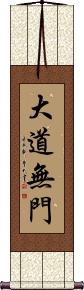
大道無門 is a Buddhist proverb that means “The Great Way has no entrance,” “The Great Way is gateless,” or “The Great Path lacks a gate.”
This can be translated in many other ways.
This concept was authored within a long sacred text by 無門慧開 (known as Wúmén Huìkāi in Chinese or Mumon Ekai in Japanese). He was a Chinese Chan Master (in Japanese, a Zen Master) who lived between 1183 and 1260 AD. His most famous work was a 48-koan collection titled “The Gateless Barrier” or “The Gateless Gate” (無門關 Wú Mén Guān in Chinese, or 無門関 Mu Mon Kan in Japanese). This calligraphy title is a notable line from this collection.
I like this reference to the source of this proverb: The Gateless Gate 無門關
Dana: Almsgiving and Generosity
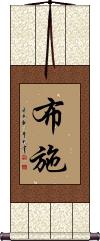
布施 is the Buddhist practice of giving known as Dāna or दान from Pali and Sanskrit.
Depending on the context, this can be alms-giving, acts of charity, or offerings (usually money) to a priest for reading sutras or teachings.
Some will put Dāna in these two categories:
1. The pure or unsullied charity, which looks for no reward here but only in the hereafter.
2. The sullied almsgiving whose object is personal benefit.
The first kind is, of course, the kind that a liberated or enlightened person will pursue.
Others will put Dāna in these categories:
1. Worldly or material gifts.
2. Unworldly or spiritual gifts.
You can also separate Dāna into these three kinds:
1. 財布施 Goods such as money, food, or material items.
2. 法布施 Dharma, as an act to teach or bestow the Buddhist doctrine onto others.
3. 無畏布施 Courage, as an act of facing fear to save someone or when standing up for someone or standing up for righteousness.
The philosophies and categorization of Dāna will vary among various monks, temples, and sects of Buddhism.
Breaking down the characters separately:
布 (sometimes written 佈) means to spread out or announce, but also means cloth. In ancient times, cloth or robs were given to the Buddhist monks annually as a gift of alms - I need to do more research, but I believe there is a relationship here.
施 means to grant, to give, to bestow, to act, to carry out, and by itself can mean Dāna as a single character.
Dāna can also be expressed as 檀那 (pronounced “tán nà” in Mandarin and dan-na or だんな in Japanese). 檀那 is a transliteration of Dāna. However, it has colloquially come to mean some unsavory or unrelated things in Japanese. So, I think 布施 is better for calligraphy on your wall to remind you to practice Dāna daily (or whenever possible).
Daoism / Taoism
Literally: The Way or Road
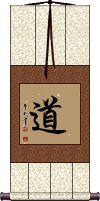
道 is the character “dao” which is sometimes written as “tao” but pronounced like “dow” in Mandarin.
道 is the base of what is known as “Taoism.” If you translate this literally, it can mean “the way” or “the path.”
Dao is believed to be that which flows through all things and keeps them in balance. It incorporates the ideas of yin and yang (e.g. there would be no love without hate, no light without dark, no male without female.)
The beginning of Taoism can be traced to a mystical man named
Lao Zi (604-531 BC), who followed, and added to the teachings of Confucius.
More about Taoism / Daoism here.
Note that this is pronounced “dou” and sometimes “michi” when written alone in Japanese but pronounced “do” in word compounds such as Karate-do and Bushido. It's also “do” in Korean.
Alternate translations and meanings: road, way, path; truth, principle province.
Important Japanese note: In Japanese, this will generally be read with the road, way, or path meaning. Taoism is not as popular or well-known in Japan so Daoist/Taoist philosophy is not the first thing a Japanese person will think of when they read this character.
See our Taoism Page
Daodejing / Tao Te Ching - Chapter 33
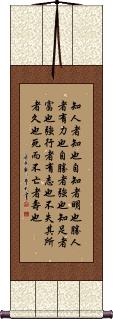
This is referred to as passage or chapter 33 of the Dao De Jing (often Romanized as “Tao Te Ching”).
These are the words of the philosopher Laozi (Lao Tzu).
To know others is wisdom;
To know oneself is acuity/intelligence.
To conquer others is power,
To conquer oneself is strength.
To know contentment is to have wealth.
To act resolutely is to have purpose.
To stay one's ground is to be enduring.
To die and yet not be forgotten is to be long-lived.
To understand others is to be knowledgeable;
To understand yourself is to be wise.
To conquer others is to have strength;
To conquer yourself is to be strong.
To know when you have enough is to be rich.
To go forward with strength is to have ambition.
To not lose your place is to be long-lasting.
To die but not be forgotten -- that's true long life.
He who is content is rich;
He who acts with persistence has will;
He who does not lose his roots will endure;
He who dies physically but preserves the Dao
will enjoy a long after-life.
Notes:
During our research, the Chinese characters shown here are probably the most accurate to the original text of Laozi. These were taken for the most part from the Mawangdui 1973 and Guodan 1993 manuscripts which pre-date other Daodejing texts by about 1000 years.
Grammar was a little different in Laozi’s time. So you should consider this to be the ancient Chinese version. Some have modernized this passage by adding, removing, or swapping articles and changing the grammar (we felt the oldest and most original version would be more desirable). You may find other versions printed in books or online - sometimes these modern texts are simply used to explain to Chinese people what the original text really means.
This language issue can be compared in English by thinking how the King James (known as the Authorized version in Great Britain) Bible from 1611 was written, and comparing it to modern English. Now imagine that the Daodejing was probably written around 403 BCE (2000 years before the King James Version of the Bible). To a Chinese person, the original Daodejing reads like text that is 3 times more detached compared to Shakespeare’s English is to our modern-day speech.
Extended notes:
While on this Biblical text comparison, it should be noted, that just like the Bible, all the original texts of the Daodejing were lost or destroyed long ago. Just as with the scripture used to create the Bible, various manuscripts exist, many with variations or copyist errors. Just as the earliest New Testament scripture (incomplete) is from 170 years after Christ, the earliest Daodejing manuscript (incomplete) is from 100-200 years after the death of Laozi.
The reason that the originals were lost probably has a lot to do with the first Qin Emperor. Upon taking power and unifying China, he ordered the burning and destruction of all books (scrolls/rolls) except those pertaining to Chinese medicine and a few other subjects. The surviving Daodejing manuscripts were either hidden on purpose or simply forgotten about. Some were not unearthed until as late as 1993.
We compared a lot of research by various archeologists and historians before deciding on this as the most accurate and correct version. But one must allow that it may not be perfect, or the actual and original as from the hand of Laozi himself.
Daodejing / Tao Te Ching - Chapter 27
The Mastery of Effortless Skill

Chapter 27 of the Daodejing reveals a profound truth about mastery: the highest skill leaves no trace, requires no force, and appears almost invisible.
善行無轍跡,
善言無瑕謫,
善數不用籌策,
善閉無關鍵而不可開,
善結無繩約而不可解。
是以聖人常善救人,
故無棄人;
常善救物,
故無棄物。
是謂襲明。
故善人者,不善人之師;
不善人者,善人之資。
不貴其師,不愛其資,
雖智大迷,
是謂要妙。
The sage moves through life with such natural harmony that nothing seems imposed; doors need no locks, knots require no rope, and actions leave no mark behind.
This is the essence of wúwéi (effortless action), where true ability arises from deep alignment with the Tao rather than deliberate effort.
At its heart, this chapter teaches compassion without exception. The sage “abandons no one and nothing,” recognizing value in all people and all things. Even those who seem flawed or unrefined are not rejected, but understood as part of a greater whole with each person both a student and a teacher in the unfolding of life.
Laozi reminds us that wisdom is not about perfection or control, but about subtle awareness. The truly skilled individual does not rely on tools, rules, or rigid structures; instead, they embody an intuitive understanding that makes their actions naturally complete.
In this way, excellence becomes quiet, effortless, and beyond imitation.
This teaching also reflects a deeper philosophical insight: Opposites are interdependent. The “good” person learns from the “not good,” and the “not good” provides the material for growth. To reject either is to misunderstand the balance of existence itself.
As calligraphy, Daodejing Chapter 27 serves as a reminder to cultivate inner mastery rather than outward display. It is a meditation on refinement, humility, and the quiet power of skill perfected through harmony with the natural order.
Note: The Chinese text used here is based on the early Mawangdui silk manuscript tradition (2nd century BCE). The Guodian manuscripts do NOT preserve Chapter 27 in full form.
Death Before Surrender
Rather die than compromise
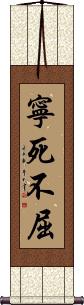
寧死不屈 is often translated as “Death Before Dishonor.”
The literal translation is more like, “Better die than compromise.” The last two characters mean “not to bend” or “not to bow down.” Some might even say that it means “not to surrender.” Thus, you could say this proverb means “Better to die than live on my knees” or simply “no surrender” (with the real idea being that you would rather die than surrender).
Death Before Surrender
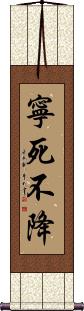
寧死不降 is an ancient Chinese proverb that can be translated as “Rather die than surrender,” “Prefer death over surrender,” “To prefer death to surrender,” or simply “No surrender.”
This is probably the closest proverb to the English proverb “Better to die on your feet than to live on your knees.”
Honorable Death - No Surrender
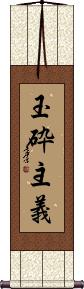
This ancient Japanese proverb can be translated as “The principle of honorable death and no surrender,” or simply “No surrender.”
If you directly translate this, you get something that means “Doctrine of suicide,” or “Ideology of honorable death.”
玉砕主義 is a specifically-Japanese proverb that embraces the long history of honorable suicide or self-sacrifice for honor in Japanese culture.
Demon Slayer
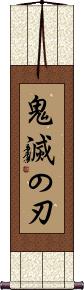
鬼滅の刃 means Demon Slayer in Japanese.
This term, 鬼滅の刃 or “Kimetsu no Yaiba,” is mostly used in the context of Japanese manga or anime.
Die Without Regret
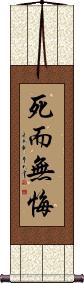
死而無悔 is how to say “die with no regrets” in Mandarin Chinese.
This proverb comes from the Analects of Confucius.
See Also: No Regrets
Divine Protection
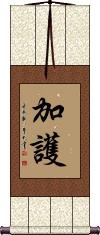
加護 is Japanese for “divine protection” or “the saving grace of God.”
Please consider this blessing to be Japanese only. This can have the same meaning in the context of Buddhism in Chinese, but it's also a nickname for “intensive care” at Chinese hospitals.
Note: My Japanese translator says this is not commonly used in Japanese. I added this because a customer asked for it. There is no better Japanese phrase to express this idea - so this is it if you want it.
Benevolent and Skilled Doctor
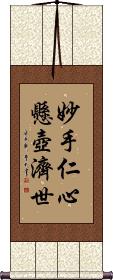
妙手仁心悬壶济世 is a phrase that celebrates the benevolence, skill, and service to his/her patients.
Here's a breakdown of the characters:
妙手 miào shǒu admirable skill in curing disease (when used in reference to doctors).
仁心 rén xīn kindheartedness, charity, benevolent heart.
悬壶济世 xuán hú jì shì practice medicine or pharmacy to help the people or the public.
Benevolent and Skilled Doctor
Short version
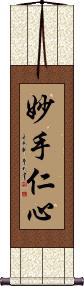
妙手仁心 is a phrase that celebrates the benevolence, skill, and service to his/her patients.
Here's a breakdown of the characters:
妙手 miào shǒu is an admirable skill in curing disease (when referring to doctors).
仁心 rén xīn kindheartedness, charity, benevolent heart.
Double Happiness Guest Book
Customize a special Asian guest book for your wedding
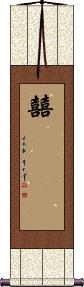
Start customizing a “Double Happiness Guest Book Wall Scroll” Here!
The paper panel length can be whatever you choose from 68cm to 135cm (27” to 53”).
If you don't mention what paper length you want in the special instructions tab (on the next page), we'll make it about 100cm (40”).
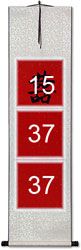
The medium-size scroll with a 33cm x 100cm (13” x 40”) paper panel can usually handle up to 89 signatures. That breaks down to 37 signatures per empty square and 15 signatures around the 囍 character. If you switch to a 135cm paper panel, add another 37 potential signatures.
We can splice two 135cm papers together, but that would be a crazy-long scroll. These are only estimates, your mileage may vary.
With silk panels, this will yield a wall scroll about 155cm (61”) long. That's enough for up to 89 signatures. Of course, that depends on if your guests just sign a brief salutation and name, or more verbose good wishes. Customer feedback is that 126 people can sign the 135cm long paper on a medium-sized scroll. If we go bigger than that, there will be a minor paper seam and an extra charge. Email me with your specifications if you need something special.
Most customers pick the festive red paper with gold flecks and white or ivory silk. Red is a good luck color in Chinese culture, thus the most popular choice. But, you can do any color combination that you want.
There is a long history of Chinese-character-use outside of mainland China. This Double Happiness character is also seen at weddings in Korea, Vietnam, Hong Kong, and Taiwan, as well as in Chinese communities in Thailand, Indonesia, and elsewhere. While Japan borrowed Chinese characters into their language, you won't see 囍 as often at Japanese weddings.
Drain the pond to get all the fish
Kill the goose that lays the golden eggs
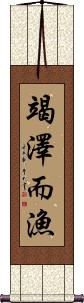
In 632 BC, Duke Wen of the Kingdom of Jin was about to lead an army against the forces of the Kingdom of Chu.
The Duke asked one of his advisers, Jiu Fan, how they could win the impending battle, as they were drastically outnumbered.
Jiu Fan said, “All is fair in war,” and suggested a plan of dishonorable tactics (cheating).
The Duke was unsure of this advice, so he asked another adviser, Yong Ji, who replied, “If you catch fish by draining the pond, you can certainly get all the fish. But there will be no fish the following year. You can cheat this one time in battle, but such tactics can only be used once, as the enemy will be wise in future encounters.”
The Duke heard the words of his wiser adviser but cheated to gain victory in the battle. However, he rewarded Yong Ji more than Jiu Fan at the victory celebration, stating that while Jiu Fan's advice gained one victory, the wise words of Yong Ji would last forever.
This Chinese idiom/proverb is still used, over 2600 years later to remind people not to burn bridges, cheat, or dishonor themselves in exchange for a short-term gain while sacrificing the future.
竭澤而漁 is very similar to the meaning of the English phrase, “Kill the goose that lays the golden eggs.”
Diligent Study Proverb
Drill a hole in the wall to get light to read by.
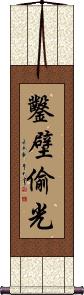
鑿壁偷光 is a Chinese proverb that means “Bore a hole in the wall to make use of the neighbor's light to study.”
This is a nice gift for a very studious person.
Kuang Heng was born during the Western Han period. He has been very fond of reading ever since he was young. However, he could not attend school since his family was poor, and he had to borrow books from people to learn.
To borrow these books, he normally did chores for people who had them. When he became older, he had to work in the field from sunrise to sunset since his family's financial situation did not improve. Thus, he tried to study at night, but he had no lamp.
One day, he noticed the light from the neighbor's house coming through a crack in the wall. This made him very happy, so he dug a larger hole from the crack and read in the light that shone through. This diligent study eventually made him an accomplished person.
Drink
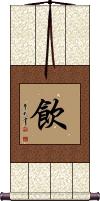
飲 is how to formally write “drink” (the verb for taking a drink or drinking) in Chinese and Japanese.
This is different than the noun for a drink. There are other ways to say/write drink, but they are more for oral/spoken language. This more formal version is appropriate if you want to write the word “drink.”
This is kind of an odd selection for a wall scroll but no bad meaning.
 In Korean Hanja, this character is generally written in the variant shown to the right.

 This can be pronounced in Japanese but this is seldom seen as a lone Kanji, and thus is not appropriate if your audience is Japanese. They will, at least, use a second Hiragana character in Japanese, as shown to the right. This is "nomi."
 The common oral character looks like the one shown to the right. But this is not appropriate for a wall scroll.
 In some cases (often in ancient Chinese) the character shown to the right is used to mean drink. But this word refers to anything you consume in your mouth. This character is most often used to mean "eat" in modern Chinese.
Equality
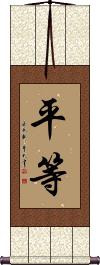
In Chinese, 平等 is the word that describes equality among all humans.
Yes, this is equality that means equality no matter of religion, whether you are rich or poor, gay or straight, black white or yellow.
In Japanese and Korean, this can be defined as equality, impartiality, and evenness (basically the same as the Chinese meaning).
Learning is Eternal
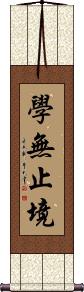
This Chinese philosophy tells of how we continue to learn throughout our lives.
This proverb can be translated in a few ways such as “Study has no end,” “Knowledge is infinite,” “No end to learning,” “There's always something new to study,” or “You live and learn.”
The deeper meaning: Even when we finish school we are still students of the world gaining more knowledge from our surroundings with each passing day.
See Also: An Open Book Benefits Your Mind | Wisdom | Learn From Wisdom
Sky / Ether / Void / Emptiness / Unreality
(Used in Japanese version of five elements)
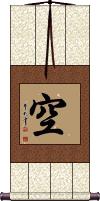
空 is a single character that means empty, void, hollow, vacant, vacuum, blank, nonexistent, vacuity, voidness, emptiness, non-existence, immateriality, unreality, the false or illusory nature of all existence, and being unreal.
In the Buddhist context, this relates to the doctrine that all phenomena and the ego have no reality but are composed of a certain number of skandhas or elements, which disintegrate. The void, the sky, space. The universal, the absolute, complete abstraction without relativity. The doctrine further explains that all things are compounds, or unstable organisms, possessing no self-essence, i.e. are dependent, or caused, come into existence only to perish. The underlying reality, the principle of eternal relativity, or non-infinity, i.e. śūnya, permeates all phenomena making possible their evolution.
From Sanskrit and/or Pali, this is the translation to Chinese and Japanese of the title śūnya or śūnyatā.
In Japanese, when pronounced as “ron” (sounds like “roan”) this can be a given name. It should be noted that this Kanji has about 5 different possible pronunciations in Japanese: kuu, kara, sora, ron, and uro. 空 is also an element in the Japanese version of the five elements.
Example is Better than Precept
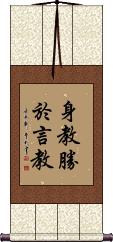
Tell somebody how to do something and they might get it.
Show them how to do it, and they will master it in no time.
身教勝於言教 can also be translated as “Behavior teaches more than words.”
See Also: Wisdom
Faith Hope Love
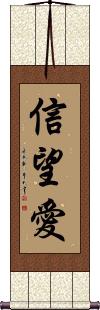
信望愛 is a Chinese list of words meaning faith, hope, and love.
This is not a typical phrase in Chinese but rather just random words strung together. There's no bad meaning, it's just not typical Chinese grammar.
Faith Hope Love
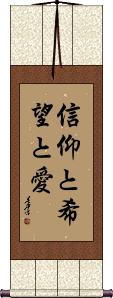
信仰と希望と愛 is a Japanese list of words (not really a phrase) meaning faith, hope, and love.
Some have associated this word list with Corinthians 13:13, though there are no specific religious connotations in this word list, and it's not directly from that Japanese Bible verse.
Note: Because this selection contains some special Japanese Hiragana characters, it should be written by a Japanese calligrapher.
Fear No Evil
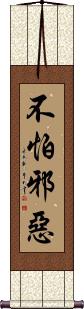
不怕邪惡 literally means “no fear of evil” in Chinese.
Chinese grammar and word order are a little different than English. 不怕邪惡 is the best way to write something that means “fear no evil” in Chinese.
The first character means “not,” “don't” or “no.”
The second means “fear.”
The last two mean “evil” but can also be translated as sinister, vicious, wickedness, or just “bad.”
Fear No Evil
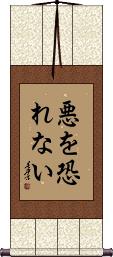
悪を恐れない is “Fear No Evil” in Japanese.
Japanese grammar and phrase construction is different than English, so this literally reads, “Evil Fear Not.”
The “evil” Kanji can also be translated as “wickedness.”
Note: Because this selection contains some special Japanese Hiragana characters, it should be written by a Japanese calligrapher.
Fear No Man / Fear Nothing
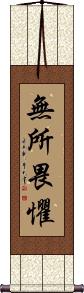
無所畏懼 means “fear nothing,” but it's the closest thing in Chinese to the phrase “fear no man” which many of you have requested.
This would also be the way to say “fear nobody” and can be translated simply as “undaunted.”
Fearless / Daring
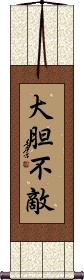
大胆不敵 is a Japanese word that can mean a few things depending on how you read it.
Popular translations include fearless, audacity (the attitude of a) daredevil, or daring.
The first two Kanji create a word that means: bold, fearless, or daring; audacious.
The last two Kanji create a word meaning: no match for, cannot beat, daring, fearless, intrepid, bold, or tough.
As with many Japanese words, the two similar-meaning words work together to multiply the meaning and intensity of the whole 4-Kanji word.
Fire and Water Have No Mercy
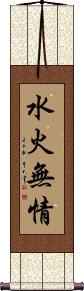
水火無情 is a Chinese proverb that means “fire [and] water have-not mercy.”
This serves to remind us that the forces of nature are beyond human control.
Some may also translate this as “implacable fate.”
Flying / Flight / Rising Upward
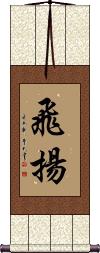
飛揚 means flight, flying, or to rise upwards in Chinese and Japanese Kanji.
飛揚 is not the most common title for a wall scroll but if you have a personal reason or this idea is important to you, then go for it.
This can also be the personal name “Hiyou” in Japanese.
A Bright Future
Incredible 10,000-Mile Flight of the Peng
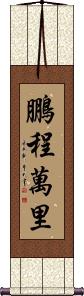
鵬程萬里 is an ancient Chinese proverb used in modern times to wish someone a long and successful career.
It's really about the 10,000 Flight of the Peng (Peng, also known as Roc is a mythical fish that can turn into a bird and take flight).
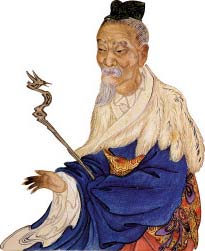
莊子
Zhuangzi or Chuang Tzu
Breaking down each character:
1. Peng or Roc (a kind of bird).
2. Journey (in this case, a flight).
3. 10,000 (Ten Thousand).
4. Li is a unit of distance often referred to as a “Chinese Mile,” though the real distance is about half a kilometer.
Direct Translation: “Peng's Journey [of] 10,000 Li.”
Literal meaning: “The 10,000-Li Flying Range Of The Roc.”
Perceived meaning: “To have a bright future” or “To go far.”
This proverb/idiom comes from the book of Zhuangzi or Chuang Tzu. It tells the tale of a huge fish that could turn into a gigantic bird. This bird was called a “peng” and was many miles long. This legendary size allowed the Peng to fly from the Northern Sea to the Southern Sea in a single bound.
Wishing someone “a Peng's Journey of 10,000 Li” will imply that they can travel far without stopping and will have great success, a long career, and a prosperous future.
Flower Open / Blooming Flower
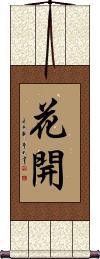
These two characters mean “flower open.”
花開 is also associated with Springtime, the beginning of something, or youth.
花開 is often followed by 花落 or “flower falls” (closes and loses its petals) which means “Things come and go” or “Youth comes and goes.”
If you like flowers and Springtime, this is a great selection for you. However, if you want the companion “flower falls” (flower withers), we offer that as a companion wall scroll or all together as a four-character phrase.
See Also: Flowers Fall
Flowers Bloom and Flowers Fall
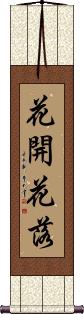
花開花落 is a complete proverb that lightly speaks of the cycle of life, or how things come and go in life.
This is used as a metaphor to suggest that youth is a temporary state that in time will pass.
This can also be used to suggest that fortunes can come and go (everything is temporary).
Note: There are two very similar versions of this proverb. The other uses a word that means wither instead of fall.
Flowers Bloom and Flowers Fall
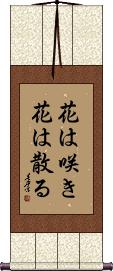
花は咲き花は散る is a Japanese proverb about the cycle of life, or how things come and go in life.
This can be used to suggest that youth, fortune, and life can come and go (everything is temporary).
Note: Because this selection contains some special Japanese Hiragana characters, it should be written by a Japanese calligrapher.
Flowers Bloom and Flowers Wither
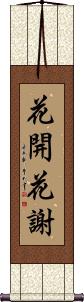
花開花謝 is a complete proverb that lightly speaks of the cycle of life, or how things come and go in life.
This is used as a metaphor to suggest that youth is a temporary state, which in time, will pass.
This proverb can be used to suggest that fortunes can come and go (everything is temporary).
Note: There are two very similar versions of this proverb. The other uses a word that means fall instead of wither.
Flowers Fall / The End Comes
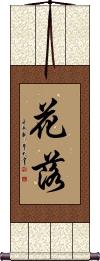
花落 means flower fall (closes and loses its petals).
It suggests nearing the end of something. A time that some might call “The sunset of life.” 花落 often follows 花開 or “flower open” to talk of the cycle of life.
We offer this as a possible companion to a “flower open” scroll (to be placed side by side or at either side of a doorway to say “things come and go” - a cool metaphor for a doorway). If placed in a doorway, it could be used to suggest to your guests that things bloom when they arrive through your door but wither when they leave (a great compliment).
See Also: Flowers Bloom
Flower in the Mirror, Moon on Water
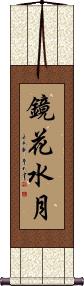
鏡花水月 is an old Asian proverb that means “flowers in a mirror and the moon reflected in the lake” or “flowers reflected on a mirror and the moon reflected on the water's surface.”
Literally, 鏡花水月 reads “Mirror Flower, Water Moon.”
Figuratively this can be used to represent a lot of different ideas. It can be used to express an unrealistic rosy view or viewing things through rose-tinted spectacles. So you can use it to relay an idea about something that is visible but has no substance,
something that can be seen but not touched, or something beautiful but unattainable such as dreams or a mirage.
This expression is used to describe things like the subtle and profound beauty of poems that cannot be described in words.
鏡 = Mirror (or lens)
花 = Flower(s)
水 = Water
月 = Moon
Can also be written 水月鏡花 (just a slight change in word/character order).
Flying Tigers AVG
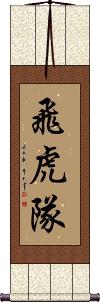
飛虎隊 is the full Chinese title of the “Flying Tigers Group.”
These were the American pilots that volunteered to go to China and fight the Japanese before the entry of the USA into World War Two. These fighter pilots were so esteemed in China that fallen American pilots could always find refuge in villages and safe passage and escape to areas of China that were not occupied by Japan at that time. Chinese villagers helped such fallen pilots with full knowledge that when the Japanese occupation forces found out, all the men, women, and children in the village would be massacred by Japanese troops (there are more than a few known cases of such massacres).
The Flying Tigers successfully kept supply lines to the Chinese resistance open and divided Japanese forces at a crucial time while America prepared to join WWII officially.
A wall scroll like this honors the men who risked or gave their lives as noble volunteers and is a reminder of the best moment in the history of Sino-American relations.
These three characters literally mean “flying tiger(s) group/team/squad.”
Note: Hanging these characters on your wall will not make you any friends with Japanese people who are aware or this history (most Japanese have no idea, as Japan’s involvement in WWII has all but been erased from school textbooks in Japan).
Forever In My Heart
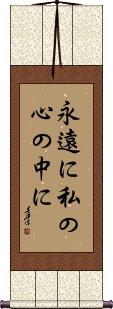
永遠に私の心の中に means “forever in my heart” or “always in my heart” in Japanese.
The character breakdown:
永遠 (eien) eternity; perpetuity; immortality; permanence.
に (ni) indicates the location of a person or thing.
私の (watashi no) my; mine.
心の中 (kokoro no naka) the middle of one's mind; the midst of one's heart.
に (ni) indicates the location of a person or thing (makes this “in” the middle of one's heart).
Note: There’s more than one way to say "Forever in My Heart" in Japanese, so you’ll find another version in our database. This is the very verbose version.
Note: Because this selection contains some special Japanese Hiragana characters, it should be written by a Japanese calligrapher.
Forgive and Forget
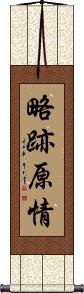
略跡原情 is a Chinese proverb that means “to overlook past faults,” or “forgive and forget.”
It's more literally, “Abridge or make small the scars from your past emotions.” You should let it go.
The character breakdown:
略 (lüè) abbreviation; omission; abridge.
跡 (jī) ruins; scar; traces.
原 (yuán) former.
情 (qíng) feeling; emotion.
Forgive and Forget
Confucian Proverb
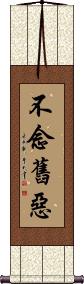
不念舊惡 is a Chinese proverb that can be translated as “Do not recall old grievances,” or more simply as “Forgive and forget.”
The character breakdown:
不 (bù) not; no; don't.
念 (niàn) read aloud.
舊 (jiù) old; former.
惡 (è) wicked deeds; grievances; sins.
This proverb comes from the Analects of Confucius.
Four Noble Truths: Desire and Attachment
Samudaya
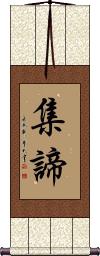
集諦 represents the idea that the core of suffering is often the concept of desire or attachment.
This can be carnal desire, monetary desire, or the attachment you have to something that you are unwilling to part with (such as a fancy car). 集諦 is a simplification of the second noble truth which is an exploration into the root causes of suffering - it's deeper than I can go in a few sentences.
This term is exclusively used by devout Buddhists. It is not a common term, and is remains an unknown concept to most Chinese, Japanese and Korean people.
See Also: Buddhism | Enlightenment
Put out a burning wood cart with a cup of water
An utterly inadequate measure
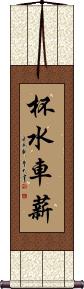
杯水車薪 is a warning against a futile effort.
This proverb literally refers to one who is “trying to put out a burning cart of wood with a cup of water,” or “throw a cup of water on a cartload of wood.” The lesson to be learned is about using the right measure or tool for the job and not wasting your effort if you are inadequately equipped for the task at hand - in other words the postscript should be “go get a bucket or a fire hose.”
Courage To Do What Is Right
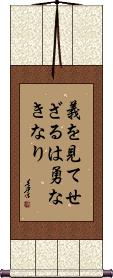
義を見てせざるは勇なきなり is a Japanese proverb that means “Knowing what is right and not doing is a want of courage.”
I've also seen it translated as:
To see what is right, yet fail to do so, is a lack of courage.
To know righteousness, but take no action is cowardice.
You are a coward if you knew what was the right thing to do, but you did not take action.
Knowing what is right without practicing it betrays one's cowardice.
Note: Because this selection contains some special Japanese Hiragana characters, it should be written by a Japanese calligrapher.
Go-Dan / 5th Degree Black Belt
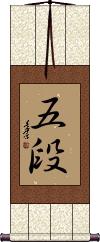
五段 represents the 5th Rank or 5th Degree (5th Degree of black belt) in Japanese martial arts.
This can also be the 5th rank in other fields such as chess play (Japanese “Go”) etc.
Goddess of Mercy and Compassion
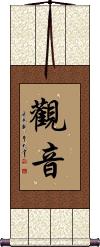
觀音/観音 is the Buddhist deity known as the Goddess of Mercy or Bodhisattva of Compassion.
In Chinese, the proper name of this being is Guan Yin. There is some debate as to whether Guan Yin is female. The argument comes from some scripture that suggests Buddhist deities take on the male form. Others say that Guan Yin has no sex. And still, others are okay with the female representation of Guan Yin.
This bodhisattva is also known or Romanized in the following ways:
Mandarin Chinese: Guan Yin, Kuan Yin, Kwan Yin.
Japanese: Kannon, Kwannon.
Sanskrit: Bodhisattva Avalokitesvara.
Korean: Gwan-eum.
Vietnamese: Quan Âm.
Thai: Kuan Eim.
English: Bodhisattva of Mercy and Salvation, Goddess of Compassion, Buddha of Mercy, et al.
Note: The first character has a slight variation in Japanese. If your audience is specifically Japanese, you may want to select that version.
See Also: Buddhism | Goddess | Namo Amitabha | Bodhisattva
God Son / God Child
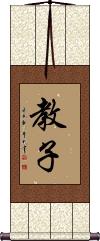
教子 is the title for a child which you have a sworn duty to raise should the child's parents die.
This title suggests it's talking about a son (male child), but this title is universal and can mean God Child (with no gender specified).
Gojutsu

Go Kan Ryu
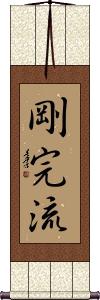
剛完流 is the title of the Gokan-Ryu or “Go Kan Ryu” martial art.
The Book of Five Rings
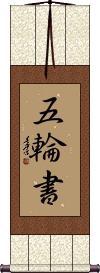
五輪書 is the Japanese title for “The Book of Five Rings.”
五輪書 is a martial arts treatise by Miyamoto Musashi written around 1643.
Technically, these three characters are “Go Rin Sho” but an unwritten “の” or “no” which is a possessive article like the English “of” is verbally added by most Japanese. Therefore, many write this in Romaji as “Go Rin No Sho.”
Go With The Flow
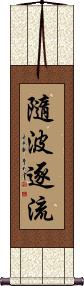
隨波逐流 is a Chinese proverb that means to drift with the waves and go with the flow.
This can be positive or negative, as it can also be used to mean following the crowd blindly.
Go With The Flow
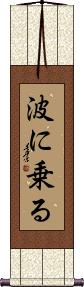
波に乗る is a Japanese proverb that means to go with the flow or to go with the times.
Note: Because this selection contains some special Japanese Hiragana characters, it should be written by a Japanese calligrapher.
Guanxi
The Chinese Concept of Relationship and Exchange of Favors
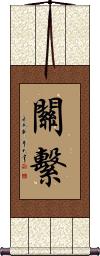
The dictionary definition is:
Relations/relationship, to concern, to affect, to have to do with, or connection.
But there's more to it...
In China, the relationship that you have with certain people can open doors for you. Having guanxi with someone also means they would never defraud you but are honor-bound to treat you fairly (of course, this goes both ways). Sometimes it is suggested that guanxi is the exchange of favors. 關繫 / 関繫 / 關係 is more about having a relationship that allows you to ask for and expect favors without shame.
There is no concept in western culture that exactly matches guanxi, but perhaps having a social or professional network is similar.
Note that there are some variations common within Chinese, Japanese Kanji, and Korean Hanja for this word... Japanese tend to use a Chinese alternate form as shown to the right for
the first character.
 There's also another alternate form of that first character (currently used as the official Simplified form in mainland China) which looks like the character shown to the right. It's basically the central radical of the alternate version shown above but without the “door radical” around it. In more free-flowing calligraphy styles, this version would be the likely choice for a calligrapher.
 In Modern Japanese, they use the character shown to the right.
They also tend to use this same form in Korean Hanja (I've only checked this word in my Korean dictionary, but it has not been confirmed by a translator's review).
 If that was not confusing enough, there is another alternate form of that second character. See right.
An Asian calligrapher of any nationality may use these forms at their discretion. However, They would tend to stick to the most common form used in their respective languages.
If you have any preference on any of these issues, please give us a special note with your order, and we'll make sure it's done the way you want.
Gung Ho
Working Together
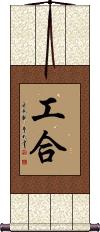
工合 is one of those Asian words that is used more in English than in the original Chinese.
Gung Ho was originally used to speak of Carlson's Raiders, a group of “Gung Ho” U.S. Marines who went on an island-hopping campaign of death during WWII.
A movie called Gung Ho came out in the mid-1940s and was later re-released in the 1950s depicting the 2nd Marine Raider Battalion, and brought this word to the mainstream.
It is still sometimes used today within the U.S. Marine Corps brotherhood to refer to a unit or group that works well together or is otherwise efficient and motivated (has good morals).
In 1986, there was a movie called Gung Ho about a Japanese company taking over an American automotive factory. They completely ignored the fact that this was a Chinese title.
It should be noted that this title actually means a condition, state, manner, or the health of something in Japanese.
Language and pronunciation notes:
Like many Asian words absorbed into common use in English, this one is drastically mispronounced. The official Romanization is “gong he” but that doesn't tell you enough. The vowel sound on the first character is like the English word “own,” now just add the g-sounds to the beginning and end. The second character is misleading, as you might think it is like the English word “he.” In reality, the vowel sound is more like the “u” in “up.”
It should also be noted that the current generation in China no longer uses or recognizes this as a common word or slogan.
Note: This can be pronounced and is a word in Japanese, though seldom used. Japanese will use a variation of "具合" instead. But still, not common.
Industrious / Hard Working
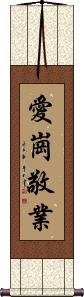
愛崗敬業 is used to refer to someone who puts forth maximum effort and achieves much.
We might call this kind of person a “go-getter” in English.
See Also: Dedication | Tenacious | Devotion
This in-stock artwork might be what you are looking for, and ships right away...
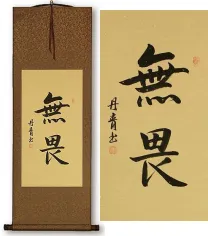
Gallery Price: $108.00
Your Price: $59.88
Gallery Price: $108.00
Your Price: $59.88

Gallery Price: $200.00
Your Price: $69.88

Gallery Price: $106.00
Your Price: $58.88

Gallery Price: $61.00
Your Price: $33.88
Gallery Price: $79.00
Your Price: $43.88

Successful Chinese Character and Japanese Kanji calligraphy searches within the last few hours...



