Many custom options...


And formats...



Gods in Chinese / Japanese...
Buy a Gods calligraphy wall scroll here!
Personalize your custom “Gods” project by clicking the button next to your favorite “Gods” title below...
Soldier of the Gods
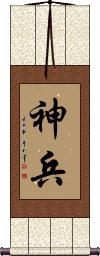
神兵 is a Japanese, Chinese, and Korean title that means “soldier dispatched by a god,” or “soldier under the protection of the gods.”
神兵 is used more in Japanese (especially in animation) than the other languages.
Deities / Gods
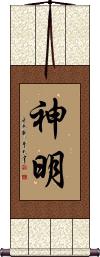
In Chinese, Japanese Kanji, and old Korean Hanja, 神明 title refers to deities or gods (can be the singular or plural form).
Depending on the context, this could also mean “divine.”
Specifically, in Japanese, this can refer to Amaterasu (as an enshrined deity).
In some Buddhist contexts, this also means deity but can also refer to “intelligence” (as in all-knowing).
This in-stock artwork might be what you are looking for, and ships right away...
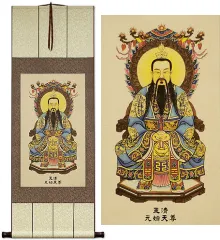
Gallery Price: $304.00
Your Price: $168.88
Not the results for gods that you were looking for?
Below are some entries from our dictionary that may match your gods search...
| Characters If shown, 2nd row is Simp. Chinese |
Pronunciation Romanization |
Simple Dictionary Definition |
明 see styles |
míng ming2 ming meishuu / meshu めいしゅう |
More info & calligraphy: Light / Bright(1) (ant: 暗) brightness; (2) discernment; insight; an eye (for); (3) (See 明を失う) eyesight; vision; (prefix) (4) (abbreviation) (See 明治) nth year in the Meiji era (1868.9.8-1912.7.30); (surname) Meishuu vidyā, knowledge. ming means bright, clear, enlightenment, intp. by 智慧 or 聰明 wisdom, wise; to understand. It represents Buddha-wisdom and its revelation; also the manifestation of a Buddha's light or effulgence; it is a term for 眞言 because the 'true word' can destroy the obscurity of illusion; the 'manifestation' of the power of the object of worship; it means also dhāraṇīs or mantras of mystic wisdom. Also, the Ming dynasty A. D. 1368-1644. |
供養 供养 see styles |
gòng yǎng gong4 yang3 kung yang kuyou / kuyo くよう |
More info & calligraphy: Offering / Puja(noun, transitive verb) memorial service for the dead; holding a service To make offerings of whatever nourishes, e. g. food, goods, incense, lamps, scriptures, the doctrine, etc., any offering for body or mind. |
天地 see styles |
tiān dì tian1 di4 t`ien ti tien ti amachi あまち |
More info & calligraphy: Heaven and Earth(1) heaven and earth; the universe; the world; nature; (2) (てんち only) land; world; realm; sphere; (3) (てんち only) top and bottom; (4) (あめつち only) gods of heaven and earth; (surname) Amachi heaven and earth |
神伝 see styles |
shinden しんでん |
More info & calligraphy: Divine Transmission |
神兵 see styles |
shinpei / shinpe しんぺい |
More info & calligraphy: Soldier of the Gods |
神明 see styles |
shén míng shen2 ming2 shen ming jinmei / jinme じんめい |
More info & calligraphy: Deities / Gods(1) deity; god; (2) (See 天照大神) Amaterasu (as an enshrined deity); (surname) Jinmei The spirits of heaven and earth, the gods; also the intelligent or spiritual nature. |
神道 see styles |
shén dào shen2 dao4 shen tao jindou / jindo じんどう |
More info & calligraphy: ShintoShinto; Shintoism; (surname) Jindō The spirit world of devas, asuras, and pretas. Psychology, or the doctrines concerning the soul. The teaching of Buddha. Shinto, the Way of the Gods, a Japanese national religion. |
因陀羅 因陀罗 see styles |
yīn tuó luó yin1 tuo2 luo2 yin t`o lo yin to lo Indara |
More info & calligraphy: IndraIndra, 因坻; 因提; 因提梨; 因達羅; 天帝; 天主帝; 帝釋天; originally a god of the atmosphere, i. e. of thunder and rain; idem Śakra; his symbol is the vajra, or thunderbolt, hence he is the 金剛手; he became 'lord of the gods of the sky', 'regent of the east quarter', 'popularly chief after Brahmā, Viṣṇu, and Śiva, '(M.W.); in Buddhism he represents the secular power, and is inferior to a Buddhist saint. Cf. 忉利 and 印. |
阿修羅 阿修罗 see styles |
ā xiū luó a1 xiu1 luo2 a hsiu lo ashura あしゅら |
More info & calligraphy: Frightful Demon / Asura{Buddh} Asura; demigod; anti-god; titan; demigods that fight the Devas (gods) in Hindu mythology; (female given name) Ashura asura, 修羅 originally meaning a spirit, spirits, or even the gods, it generally indicates titanic demons, enemies of the gods, with whom, especially Indra, they wage constant war. They are defined as 'not devas', and 'ugly', and 'without wine'. Other forms are 阿須羅 (or 阿蘇羅, or 阿素羅); 阿修倫 (or羅須倫 or 阿修輪 or 羅須輪); 阿素洛; 阿差. Four classes are named according to their manner of rebirth-egg, born, womb-born, transformation-born, and spawn- or water-born. Their abode is in the ocean, north of Sumeru, but certain of the weaker dwell in a western mountain cave. They have realms, rulers, and palaces, as have the devas. The 阿修羅道 is one of the six gatis, or ways of reincarnation. The 修羅場 or 修羅巷 is the battlefield of the asuras against Indra. The 阿修羅琴 are their harps. |
幣 币 see styles |
bì bi4 pi minematsu みねまつ |
money; coins; currency; silk (archaism) reward; present; gift; offering to the gods; (personal name) Minematsu |
柱 see styles |
zhù zhu4 chu mihashira みはしら |
pillar; CL:根[gen1] (1) pillar; post; (2) support; prop; mainstay; (suf,ctr) (3) counter for buddhas, gods, nobles, etc.; (personal name) Mihashira Pillar, post, support. |
牲 see styles |
shēng sheng1 sheng suminori すみのり |
domestic animal; sacrificial animal (1) (archaism) offering (to the gods, emperor, etc.); (2) gift; (3) sacrifice; (personal name) Suminori |
社 see styles |
shè she4 she yashiro やしろ |
(bound form) society; organization; agency; (old) god of the land (Shinto) shrine; (p,s,f) Yashiro Gods of the land; a village, clan, society. |
祭 see styles |
jì ji4 chi matsuri まつり |
to offer a sacrifice to (gods or ancestors); (in classical novels) to recite an incantation to activate a magic weapon; to wield (something magic); (bound form) ceremony; (Tw) (bound form) (celebratory) festival festival; feast; (surname, female given name) Matsuri Sacrifice, sacrificial. |
胙 see styles |
zuò zuo4 tso himorogi ひもろぎ |
to grant or bestow; sacrificial flesh offered to the gods (old); blessing; title of a sovereign (old) (archaism) offerings of food (to the gods) |
膰 see styles |
fán fan2 fan himorogi ひもろぎ |
cooked meat used in sacrifice (archaism) offerings of food (to the gods) |
臘 腊 see styles |
là la4 la rou / ro ろう |
ancient practice of offering sacrifices to the gods in the 12th lunar month; the 12th lunar month; (bound form) (of meat, fish etc) cured in winter, esp. in the 12th lunar month (1) {Buddh} offering ceremony held on the third day of the dog after the winter solstice; (2) twelfth month of the lunisolar calendar; (3) (See 臈) year in the Buddhist order (after the completion of the first meditation retreat) Dried flesh; to sacrifice to the gods three days after the winter solstice; the end of the year; a year; a monastic year, i.e. the end of the annual summer retreat, also called 戒臘; 夏臘; 法臘. |
贄 贽 see styles |
zhì zhi4 chih nie にえ |
gifts to superiors (1) (archaism) offering (to the gods, emperor, etc.); (2) gift; (3) sacrifice; (surname) Nie |
餽 馈 see styles |
kuì kui4 k`uei kuei |
(literary) to make an offering to the gods; variant of 饋|馈[kui4] |
饌 馔 see styles |
zhuàn zhuan4 chuan sen せん |
food; delicacies (1) (obsolete) food offering to the gods; (2) (obsolete) prepared food eating |
七有 see styles |
qī yǒu qi1 you3 ch`i yu chi yu shichiu |
七生 The seven stages of existence in a human world, or in any 欲界 desire-world. Also (1) in the hells, (2) as animals, (3) hungry ghosts, (4) gods, (5) men, (6) karma 業, and (7) in the intermediate stage. |
三神 see styles |
mitsugami みつがみ |
(1) {Shinto} the three gods of creation; (2) five-grain guardian gods; (surname) Mitsugami |
上る see styles |
agaru あがる |
(v5r,vi) (1) to ascend; to go up; to climb; (2) to ascend (as a natural process, e.g. the sun); to rise; (3) to go to (the capital); (4) to be promoted; (5) to add up to; (6) to advance (in price); (7) to swim up (a river); to sail up; (8) to come up (on the agenda); (irregular okurigana usage) (v5r,vi) (1) to rise; to go up; to come up; to ascend; to be raised; (2) to enter (esp. from outdoors); to come in; to go in; (3) to enter (a school); to advance to the next grade; (4) to get out (of water); to come ashore; (5) to increase; (6) to improve; to make progress; (7) to be promoted; to advance; (8) to be made (of profit, etc.); (9) to occur (esp. of a favourable result); (10) to be adequate (to cover expenses, etc.); (11) to be finished; to be done; to be over; (12) (of rain) to stop; to lift; (13) to stop (working properly); to cut out; to give out; to die; (14) to win (in a card game, etc.); (15) to be spoken loudly; (16) to get stage fright; (17) to be offered (to the gods, etc.); (18) (humble language) to go; to visit; (19) (honorific or respectful language) to eat; to drink; (20) to be listed (as a candidate); (21) to serve (in one's master's home); (22) to go north; (suf,v5r) (23) indicates completion; (place-name) Agaru |
上供 see styles |
shàng gòng shang4 gong4 shang kung jōgu |
to make offerings (to gods or ancestors); to offer gifts to superiors in order to win their favor To offer up an offering to Buddha, or to ancestors. |
下方 see styles |
xià fāng xia4 fang1 hsia fang shimogata しもがた |
underneath; below; the underside; world of mortals; to descend to the world of mortals (of gods) (noun - becomes adjective with の) (See 上方・じょうほう) lower region; lower part; region below; (place-name) Shimogata |
下界 see styles |
xià jiè xia4 jie4 hsia chieh gekai げかい |
lower bound (math.); world of mortals; (of gods) to descend to the world of mortals (1) the earth below; the ground below; (2) {Buddh} this world (as opposed to heaven) The lower, or human world 人界. |
不拜 see styles |
bù bài bu4 bai4 pu pai fuhai |
Lay Buddhists may not pay homage to the gods or demons of other religions; monks and nuns may not pay homage to kings or parents. |
二業 二业 see styles |
èr yè er4 ye4 erh yeh nigyou / nigyo にぎょう |
(archaism) restaurants and geisha establishments Two classes of karma. (1) (a) 引業 leads to the 總報, i.e. the award as to the species into which one is to be born, e.g. men, gods, etc.; (6) 滿業 is the 別報 or fulfillment in detail, i.e. the kind or quality of being e.g. clever or stupid, happy or unhappy, etc. (2) (a) 善業 and (b) 惡業 Good and evil karma, resulting in happiness or misery. (3) (a) 助業 Aids to the karma of being reborn in Amitābha's Pure—land e. g. offerings, chantings, etc.; (b) 正業 thought and invocation of Amitābha with undivided mind, as the direct method. |
二神 see styles |
futogami ふとがみ |
(1) (See 伊邪那岐,伊邪那美) pair of gods (esp. Izanagi and Izanami); two gods; (2) yin and yang; (surname) Futogami |
二福 see styles |
èr fú er4 fu2 erh fu nifuku |
The bliss of the gods, and the bliss of the saints 聖; v. also 福. |
Click here for more gods results from our dictionary
The following table may be helpful for those studying Chinese or Japanese...
| Title | Characters | Romaji (Romanized Japanese) | Various forms of Romanized Chinese | |
| Soldier of the Gods | 神兵 | shin pei / shinpei | shén bīng shen2 bing1 shen bing shenbing | shen ping shenping |
| Deities Gods | 神明 | jin myou / jinmyou / jin myo | shén míng shen2 ming2 shen ming shenming | |

Successful Chinese Character and Japanese Kanji calligraphy searches within the last few hours...



