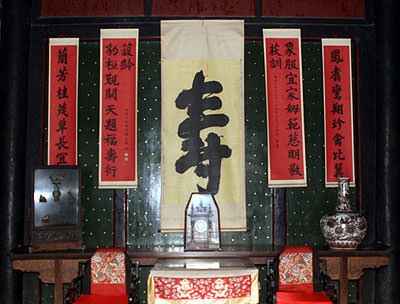
Many custom options...


And formats...



Goes in Chinese / Japanese...
Buy a Goes calligraphy wall scroll here!
Personalize your custom “Goes” project by clicking the button next to your favorite “Goes” title below...
1. Life Goes On
3. Rise and Fall / Ups and Downs
5. You May Learn from Victory, You Will Learn from Failure
6. No Limits
7. Traveler
8. Andi
9. Andy
10. Yuna
11. Morality of Deed
12. Hakko-Ryu
13. Forgiveness
14. Flower Open / Blooming Flower
16. Comparison Leads to Truth and Enlightenment
17. Morality of Mind
18. Reincarnation / Transmigration of Souls
19. Black Belt
20. The one who retreats 50 paces mocks the one to retreats 100
21. Heaven
22. Great Aspirations / Ambition
23. Year-In Year-Out Have Abundance
25. Guanxi
Life Goes On
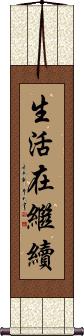
生活在繼續 means “No matter what happens, life goes on” or “For better or worse, life goes on.”
生活在繼續 is kind of modern Chinese proverb, but the meaning is generational.
生活 = to live; life; livelihood.
在 = (used before a verb to indicate an action in progress).
繼續 = to continue; to proceed with; to go on with.
Life Goes On
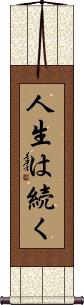
人生は続く is a Japanese phrase that expresses, “Life Goes On.”
The first two characters mean “life” (literally “human life”).
The third character is a particle that connects the ideas in this phrase.
The last two characters mean “to continue,” “to last,” “to go on,” and “to occur again and again.”
Note: Because this selection contains some special Japanese Hiragana characters, it should be written by a Japanese calligrapher.
Pride Goes Before a Fall
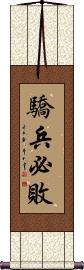
This literally means an arrogant army is bound to lose.
The meaning is similar to “pride goes before a fall.”
Others may translate this as “defeat is inevitable for an overconfident army,” “being arrogant and overconfident inevitably leads to defeat,” or “pride comes before a fall.”
Rise and Fall / Ups and Downs
Eiko-Seisui
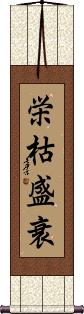
This Japanese proverb can be translated as “flourish and wither, prosper and perish,” “life is full of fortune and misfortune,” or simply “vicissitudes of life.”
栄枯盛衰 / 榮枯盛衰 is about the rise and fall of human affairs or the ups and downs of life. Prosperity comes and goes, everything is fleeting and temporary, but like waves, another swell of prosperity may come.
Here's how the Kanji break down in this proverb:
栄 = prosper; thrive; flourish; boom.
枯 = wither; die.
盛 = prosperous; flourishing; thriving; successful; energetic; vigorous; enthusiastic.
衰 = become weaker; decline; get weak; die down; subside; abate; fail.
 Notes: The original version of the first character looks like the image to the right. In modern Japan, they simplified that Kanji a bit into the version shown above. If you have a preference for which style is used for your calligraphy, please let me know when you place your order.
Apparently, with that original version of the first character, this is also used in Korean Hanja. However, I have not confirmed that
it’s
used in the same way or is widely-known in Korean.
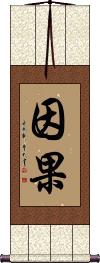
Karma - Cause and Effect
You May Learn from Victory, You Will Learn from Failure
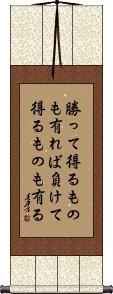
You may learn when everything goes right but the lessons learned when everything goes wrong are more vivid and lead to long-lasting wisdom.
Another way to look at this: One cannot always depend on past successes to guarantee future success but one can always learn from lessons drawn from failure.
Note: Because this selection contains some special Japanese Hiragana characters, it should be written by a Japanese calligrapher.
No Limits
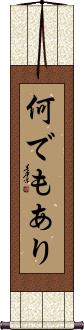
何でもあり is a Japanese phrase meaning, no holds barred, anything goes, or no limits.
Note: Because this selection contains some special Japanese Hiragana characters, it should be written by a Japanese calligrapher.
Traveler
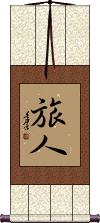
旅人 is a Japanese title for traveller/traveler, wayfarer, nomad, a person who goes from place to place, pilgrim, etc.
Andi
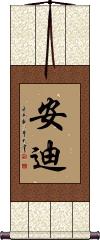
安迪 is the transliteration to Mandarin Chinese for the name Andi or Andy.
Because transliteration goes by sound, these are both “spelled” the same in Chinese.
Andy
安迪 is the transliteration to Mandarin Chinese for the name Andy or Andi.
Because transliteration goes by sound, these are both “spelled” the same in Chinese.
Yuna
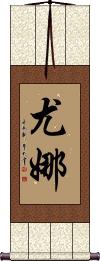
玉娜 is another common Mandarin Chinese transliteration for the female Italian name Yuna.
This version of Yuna is used by/for the Malaysian singer Yunalis binti Mat Zara'a who goes by the single name, Yuna.
Morality of Deed
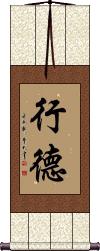
The idea of “morality of deed” goes along with 行德 or “wu de” (martial morality or virtues of the warrior).
Here, the first character is a representation of the actions or deeds that you engage in.
The second character refers to morality or virtue.
This translates better in English in the opposite order, as the Chinese order is literally “deed morality.”
See Also: Morality of Mind | Martial Morality
Hakko-Ryu
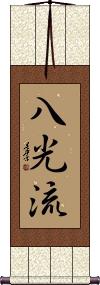
八光流 (Hakkō-Ryū) is a style of jujutsu associated with Daito-Ryu.
The title Hakko-Ryu comes from the Japanese phrase which translates as “The Style of the Eighth Light,” or more literally, “Eighth Light Style.”
The 光 character is associated with brightness or brilliance. It can be used to describe someone of great talent or potential. So the meaning goes far beyond just light.
Forgiveness (from the top down)
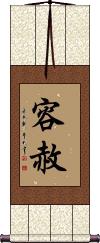
容赦 is the kind of forgiveness that a king might give to his subjects for crimes or wrong-doings.
容赦 is a rather high-level forgiveness. Meaning that it goes from a higher level to a lower (not the reverse).
Alone, the first character can mean “to bear,” “to allow,” and/or “to tolerate,” and the second can mean “to forgive,” “to pardon,” and/or “to excuse.”
When you put both characters together, you get forgiveness, pardon, mercy, leniency, or going easy (on someone).
See Also: Benevolence
Flower Open / Blooming Flower
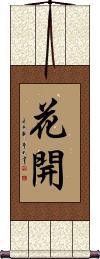
These two characters mean “flower open.”
花開 is also associated with Springtime, the beginning of something, or youth.
花開 is often followed by 花落 or “flower falls” (closes and loses its petals) which means “Things come and go” or “Youth comes and goes.”
If you like flowers and Springtime, this is a great selection for you. However, if you want the companion “flower falls” (flower withers), we offer that as a companion wall scroll or all together as a four-character phrase.
See Also: Flowers Fall
Tooth for a tooth
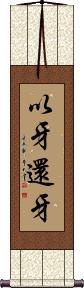
以牙還牙 is a phrase that often goes with “An eye for an eye,” even in Chinese. Revenge seems to cross all languages, cultures, and even species (animals are known to take revenge too).
If a Chinese person uses just one part of the full proverb, it will be this “tooth for a tooth” one. Although, we are more likely to say “eye for an eye” alone in English.
Chinese people may also read this with the meaning of “Bite me, and I will bite you back.” However, it literally means “tooth for a tooth” or “you take my tooth, I take yours.”
Comparison Leads to Truth and Enlightenment
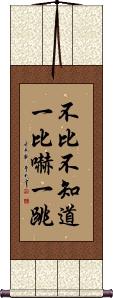
不比不知道一比吓一跳 is a Chinese proverb that literally means: [If one not does] not make comparisons, [one will] not know [the truth] when [one] compares, [one will be] greatly surprised.
This goes to the idea that if you do not know bad times, you cannot know what good times are.
...And...
You can not know light without experiencing darkness.
Another way to translate this would be: If you wish to be enlightened, you need to make comparisons and analyze every aspect (of a situation, issue, or problem).
Morality of Mind
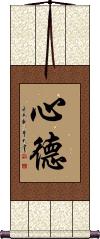
The idea of 心德 or “morality of mind” goes along with 行德 or “wu de” (martial morality or virtues of the warrior).
Here, the first character is a representation of your heart or mind.
The second character refers to morality or virtue.
This can also be translated as “morality of heart,” “virtue of heart,” or “virtue of the mind.”
Since ancient times in Asia, the idea of your mind (where your soul resides and your thought originates) has been associated with the heart. Just as in western culture, where we say “it comes from the heart” or “heartfelt emotions,” there is a belief that your heart and mind are one and the same (medical science now begs to differ).
See Also: Morality of Deed | Martial Morality
Reincarnation / Transmigration of Souls
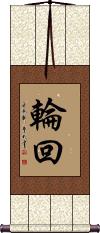
輪回 is a universal word in Japanese and Chinese that expresses the Buddhist idea of “reincarnation,” “transmigration of souls,” or “the eternal cycle of birth and death.”
In some contexts, this can also mean “karma,” and others will say it represents “samsara.”
The first character means wheel, ring, turn, circle, loop, or rotate.
The second character can be thought of as a suffix meaning “-times.” This second character can also refer to something that revolves, returns, goes back, or is a counter of the number of occurrences of some event.
Together the sum supersedes the parts, and it means reincarnation. But knowing the essence of each character may help you understand some of the meaning behind the word.
 Shown to the right is the more common way to write the second character in Japanese.
it’s
an alternate form of this character in Chinese (so neither way is technically wrong in either language). If you select a Japanese calligrapher, expect that is will look like the Kanji to the right.
Shown to the right is the more common way to write the second character in Japanese.
it’s
an alternate form of this character in Chinese (so neither way is technically wrong in either language). If you select a Japanese calligrapher, expect that is will look like the Kanji to the right.
Black Belt
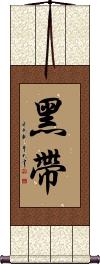
黑帶 is “black belt” in Chinese.
Many will argue whether rank systems that include a “black belt” are used in pure Chinese martial arts systems. The argument goes that it's more a Japanese idea merged into the western versions of Chinese martial arts. However, in Wushu (often referred to as Kung Fu), it's said that all students started with white belts. Over the years of training, the white belt would get dirty until finally appearing black with filth. Thus, more advanced students had darker belts.
If you want this title in Chinese, this would be the form.
 Often, the second character is written like the image to the right. If you like this version, click on this character instead of the button above.
The one who retreats 50 paces mocks the one to retreats 100
The pot calls the kettle black
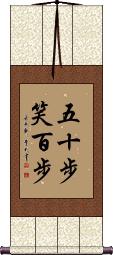
五十步笑百步 is a Chinese proverb that means the one who retreats 50 paces mocks the one who retreats 100 paces.
During the Warring States Period of what is now China (475 - 221 B.C.), the King of Wei was in love with war. He often fought with other kingdoms just for spite or fun.
One day, the King of Wei asked the philosopher Mencius, “I love my people, and all say I do the best for them. I move the people from famine-stricken areas to places of plenty and transport grains from rich areas to the poor. Nobody goes hungry in my kingdom, and I treat my people far better than other kings. But why does the population of my kingdom not increase, and why does the population of other kingdoms not decrease?”
Mencius answered, “Since you love war, I will make this example: When going to war, and the drums beat to start the attack, some soldiers flee for their lives in fear. Some run 100 paces in retreat, and others run 50 steps. Then the ones who retreated 50 paces laugh and taunt those who retreated 100 paces, calling them cowards mortally afraid of death. Do you think this is reasonable?
The King of Wei answered, “Of course not! Those who run 50 paces are just as timid as those who run 100 paces.”
Mencius then said, “You are a king who treats his subjects better than other kings treat their people, but you are so fond of war that your people suffer from great losses in battle. Therefore, your population does not grow. While other kings allow their people to starve to death, you send your people to die in war. Is there any difference?”
This famous conversation led to the six-character proverb shown here. It serves as a warning to avoid hypocrisy. It goes hand-in-hand with the western phrase, “The pot calls the kettle black,” or the Biblical phrase, “Before trying to remove a splinter from your neighbor's eye, first remove the plank from your own eye.”
Heaven
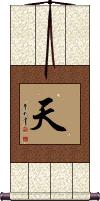
天 means “heaven” or “sky” in Chinese, Japanese Kanji, and old Korean Hanja.
The context determines if you are talking about heaven or the sky above (often they are the same concept).
When combined with other characters, words like “today” and “tomorrow” are created. While sometimes the character for “sun” is used to mean “day,” often “sky” represents “day” in Asian languages.
Example: 今天 (this sky) = “today,” 明天 (next sky) = “tomorrow” in modern Chinese and Japanese.
In Chinese culture, regardless of which religion, it's almost always assumed that God (and any other deities) live up above the sky. The concept of God living in the sky is likely the reason heaven is associated with this character.
The equation goes something like this: God's domain is the sky, thus, the sky is heaven.
Note: As a single character, this is a little ambiguous, so you might want to choose our Kingdom of Heaven selection instead.
Great Aspirations / Ambition
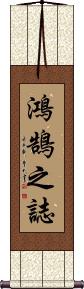
鴻鵠之誌 is a Chinese proverb that implies that having grand ambitions also means that others will not understand your great expectations and ideas.
Though the actual words come from a longer saying of Confucius, which goes, “The little swallows living under the eaves wouldn't understand the lofty ambitions of a swan (who flies far and wide).”
This Confucius quote has led to this idiomatic expression in China that means “think big.” What you'd be saying is “The lofty ambitions of a swan.”
Note that Chinese people sometimes refer to the little swallow as one who does not “think big” but is, instead, stuck in a rut or just leading a mundane life. Therefore, it's a compliment to be called a swan but not a good thing to be called a swallow.
Year-In Year-Out Have Abundance
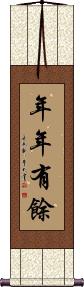
年年有餘 is a common proverb or wish of prosperity you'll hear around the time of Chinese New Year.
Directly translated character by character, it means “Year Year Have Surplus.” A more natural English translation including the deeper meaning would be “Every Year may you Have Abundance in your life.”
On a side note, this phrase often goes with a gift of something related to fish. This is because the last character, “yu” which means surplus or abundance, has exactly the same pronunciation in Mandarin as the word for “fish.”
This is also one of the most common titles for traditional paintings that feature koi fish.
In China, this phrase might make an odd wall scroll - a customer asked especially for this common phrase which is why it appears here. See my other abundance-related words if you want a wall scroll that will seem more comfortable in Chinese culture.
Note: This can be pronounced in Korean, but it's not a commonly used term.
See Also: Prosperity | Good Fortune
Wing Chun Fist Maxims (Part 1)
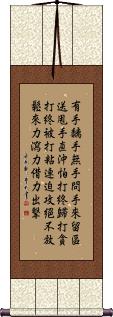
A customer asked me to split these Wing Chun maxims into two parts, so he could order a couplet. I thought this was a good idea, so it's been added here.
1 有手黐手,無手問手
2 來留區送, 甩手直沖
3 怕打終歸打, 貪打終被打
4 粘連迫攻, 絕不放鬆
5 來力瀉力, 借力出擊
A couplet is a set of two wall scrolls that start and finish one phrase or idea. Often, couplets are hung with the first wall scroll on the right side, and the second on the left side of a doorway or entrance. The order in Chinese is right-to-left, so that's why the first wall scroll goes on the right as you face the door.
Of course, couplets can also be hung together on a wall. Often they can be hung to flank an altar, or table with incense, or even flanking a larger central wall scroll. See an example here from the home of Confucius
Be sure to order both parts 1 and 2 together. One without the other is like Eve without Adam.
Guanxi
The Chinese Concept of Relationship and Exchange of Favors
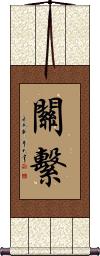
The dictionary definition is:
Relations/relationship, to concern, to affect, to have to do with, or connection.
But there's more to it...
In China, the relationship that you have with certain people can open doors for you. Having guanxi with someone also means they would never defraud you but are honor-bound to treat you fairly (of course, this goes both ways). Sometimes it is suggested that guanxi is the exchange of favors. 關繫 / 関繫 / 關係 is more about having a relationship that allows you to ask for and expect favors without shame.
There is no concept in western culture that exactly matches guanxi, but perhaps having a social or professional network is similar.
Note that there are some variations common within Chinese, Japanese Kanji, and Korean Hanja for this word... Japanese tend to use a Chinese alternate form as shown to the right for
the first character.
 There's also another alternate form of that first character (currently used as the official Simplified form in mainland China) which looks like the character shown to the right. It's basically the central radical of the alternate version shown above but without the “door radical” around it. In more free-flowing calligraphy styles, this version would be the likely choice for a calligrapher.
 In Modern Japanese, they use the character shown to the right.
They also tend to use this same form in Korean Hanja (I've only checked this word in my Korean dictionary, but it has not been confirmed by a translator's review).
 If that was not confusing enough, there is another alternate form of that second character. See right.
An Asian calligrapher of any nationality may use these forms at their discretion. However, They would tend to stick to the most common form used in their respective languages.
If you have any preference on any of these issues, please give us a special note with your order, and we'll make sure it's done the way you want.
This in-stock artwork might be what you are looking for, and ships right away...

Gallery Price: $322.00
Your Price: $178.88
The following table may be helpful for those studying Chinese or Japanese...
| Title | Characters | Romaji (Romanized Japanese) | Various forms of Romanized Chinese | |
| Life Goes On | 生活在繼續 生活在继续 | shēng huó zài jì xù sheng1 huo2 zai4 ji4 xu4 sheng huo zai ji xu shenghuozaijixu | sheng huo tsai chi hsü shenghuotsaichihsü |
|
| Life Goes On | 人生は続く | jin sei ha tsudu ku jinseihatsuduku | ||
| Pride Goes Before a Fall | 驕兵必敗 骄兵必败 | kyouheihippai / kyohehippai kyoheihipai / kyohehipai | jiāo bīng bì bài jiao1 bing1 bi4 bai4 jiao bing bi bai jiaobingbibai | chiao ping pi pai chiaopingpipai |
| Rise and Fall Ups and Downs | 栄枯盛衰 / 榮枯盛衰 荣枯盛衰 | ei ko sei sui eikoseisui | ||
| Karma - Cause and Effect | 因果 | inga | yīn guǒ / yin1 guo3 / yin guo / yinguo | yin kuo / yinkuo |
| You May Learn from Victory, You Will Learn from Failure | 勝って得るものも有れば負けて得るものも有る | katte erumono mo areba makete erumono mo aru | ||
| No Limits | 何でもあり | nan de mo a ri nandemoari | ||
| Traveler | 旅人 | ryojin / tabibito / tabinin | ||
| Andi | 安迪 | ān dí / an1 di2 / an di / andi | an ti / anti | |
| Andy | 安迪 | ān dí / an1 di2 / an di / andi | an ti / anti | |
| Yuna | 尤娜 | yóu nà / you2 na4 / you na / youna | yu na / yuna | |
| Morality of Deed | 行德 | xíng dé / xing2 de2 / xing de / xingde | hsing te / hsingte | |
| Hakko-Ryu | 八光流 | hakkou ryuu hakkouryuu hako ryu | ||
| Forgiveness (from the top down) | 容赦 | you sha / yousha / yo sha | róng shè / rong2 she4 / rong she / rongshe | jung she / jungshe |
| Flower Open Blooming Flower | 花開 花开 | huā kāi / hua1 kai1 / hua kai / huakai | hua k`ai / huakai / hua kai | |
| Tooth for a tooth | 以牙還牙 以牙还牙 | yǐ yá huán yá yi3 ya2 huan2 ya2 yi ya huan ya yiyahuanya | i ya huan ya iyahuanya |
|
| Comparison Leads to Truth and Enlightenment | 不比不知道一比嚇一跳 不比不知道一比吓一跳 | bù bǐ bù zhī dào yī bǐ xià yì tiào bu4 bi3 bu4 zhi1 dao4 yi1 bi3 xia4 yi4 tiao4 bu bi bu zhi dao yi bi xia yi tiao | pu pi pu chih tao i pi hsia i t`iao pu pi pu chih tao i pi hsia i tiao |
|
| Morality of Mind | 心德 | xīn dé / xin1 de2 / xin de / xinde | hsin te / hsinte | |
| Reincarnation Transmigration of Souls | 輪回 / 輪廻 轮回 | rin ne / rinne | lún huí / lun2 hui2 / lun hui / lunhui | |
| Black Belt | 黑帶 黑带 | hēi dài / hei1 dai4 / hei dai / heidai | hei tai / heitai | |
| The one who retreats 50 paces mocks the one to retreats 100 | 五十步笑百步 | wù shí bù xiào bǎi bù wu4 shi2 bu4 xiao4 bai3 bu4 wu shi bu xiao bai bu wushibuxiaobaibu | wu shih pu hsiao pai pu wushihpuhsiaopaipu |
|
| Heaven | 天 | ten | tiān / tian1 / tian | t`ien / tien |
| Great Aspirations Ambition | 鴻鵠之誌 鸿鹄之志 | hóng hú zhī zhì hong2 hu2 zhi1 zhi4 hong hu zhi zhi honghuzhizhi | hung hu chih chih hunghuchihchih |
|
| Year-In Year-Out Have Abundance | 年年有餘 年年有馀 | nián nián yǒu yú nian2 nian2 you3 yu2 nian nian you yu niannianyouyu | nien nien yu yü niennienyuyü |
|
| Wing Chun Fist Maxims (Part 1) | 有手黐手無手問手來留區送甩手直沖怕打終歸打貪打終被打粘連迫攻絕不放鬆來力瀉力借力出擊 有手黐手无手问手来留区送甩手直冲怕打终归打贪打终被打粘连迫攻绝不放松来力泻力借力出击 | |||
| Guanxi | 關繫 / 関繫 / 關係 关系 / 関係 | kankei | guān xì / guan1 xi4 / guan xi / guanxi | kuan hsi / kuanhsi |
| In some entries above you will see that characters have different versions above and below a line. In these cases, the characters above the line are Traditional Chinese, while the ones below are Simplified Chinese. | ||||

Successful Chinese Character and Japanese Kanji calligraphy searches within the last few hours...