Many custom options...

Tan Paper and Copper Silk Love Wall Scroll
Red Paper and Ivory Silk Love Wall Scroll
Orange Paper Love Scroll
Crazy Blue and Gold Silk Love Scroll


And formats...

Love Vertical Portrait
Love Horizontal Wall Scroll
Love Vertical Portrait

Not what you want?

Try other similar-meaning words, fewer words, or just one word.

Gu Si Ting in Chinese / Japanese...

Buy a Gu Si Ting calligraphy wall scroll here!

Personalize your custom “Gu Si Ting” project by clicking the button next to your favorite “Gu Si Ting” title below...

Switched to secondary search mode due to lack of results using primary.
These secondary results may not be very accurate. Try a different but similar meaning word or phrase for better results. Or...

Look up Gu Si Ting in my Japanese Kanji & Chinese Character Dictionary(My dictionary is a different system then the calligraphy search you just tried)

If you want a special phrase, word, title, name, or proverb, feel free to contact me, and I will translate your custom calligraphy idea for you.

 gù
Gu Scroll

顧 is the Chinese surname Gu.

顧 means, “to look after” or “consider.”

Other characters can be surnames and romanize as Gu, so make sure you are not looking for 谷 (valley/grain), 古 (ancient), or 辜 (guilt).

 gu
Gu Scroll

グ is the name Gu in Japanese Katakana.

This is probably not what you are looking for, as Gu is more commonly a Chinese surname. Unless your non-Chinese parents named you Gu, this is not what you want.


Note: Because this title is entirely Japanese Katakana, it should be written by a Japanese calligrapher.

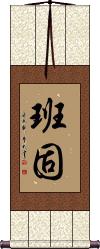
 bān gù
 hanko
Hanko Scroll

班固 is the Japanese surname Hanko.

Note: In Chinese, this title refers to Ban Gu, an Eastern Han dynasty historian who wrote the Dynastic History of Western Han.

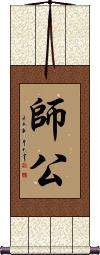
 shī gōng
 shi kou
Si Gung Scroll

This is a term for “teacher” that is primarily used in Wing Chun martial arts schools.

In very old Buddhist context this can be “thaumaturge” meaning a worker of wonders and/or performer of miracles.

Unselfish: Perfectly Impartial
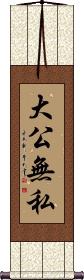
 dà gōng wú sī
Unselfish: Perfectly Impartial Scroll

大公無私 is a Chinese proverb that comes from an old story from some time before 476 BC. About a man named Qi Huangyang, who was commissioned by the king to select the best person for a certain job in the Imperial Court.

Qi Huangyang selected his enemy for the job. The king was very confused by the selection, but Qi Huangyang explained that he was asked to find the best person for the job, not necessarily someone that he liked or had a friendship with.

Later, Confucius commented on how unselfish and impartial Qi Huangyang was by saying, “Da Gong Wu Si” which, if you look it up in a Chinese dictionary, is generally translated as “Unselfish” or “Just and Fair.”

If you translate each character, you'd have something like

“Big/Deep Justice Without Self.”

Direct translations like this leave out a lot of what the Chinese characters really say. Use your imagination, and suddenly you realize that “without self” means “without thinking about yourself in the decision” - together, these two words mean “unselfish.” The first two characters serve to drive the point home that we are talking about a concept that is similar to “blind justice.”

One of my Chinese-English dictionaries translates this simply as “just and fair.” So that is the short and simple version.

Note: This can be pronounced in Korean, but it's not a commonly used term.


See Also:  Selflessness | Work Unselfishly for the Common Good | Altruism


The following table may be helpful for those studying Chinese or Japanese...

Title CharactersRomaji (Romanized Japanese)Various forms of Romanized Chinese
Gu
gù / gu4 / guku
Gugu
Hanko班固hankobān gù / ban1 gu4 / ban gu / bangupan ku / panku
Si Gung師公
师公
shi kou / shikou / shi koshī gōng / shi1 gong1 / shi gong / shigongshih kung / shihkung
Unselfish: Perfectly Impartial大公無私
大公无私
dà gōng wú sī
da4 gong1 wu2 si1
da gong wu si
dagongwusi
ta kung wu ssu
takungwussu
In some entries above you will see that characters have different versions above and below a line.
In these cases, the characters above the line are Traditional Chinese, while the ones below are Simplified Chinese.


Dictionary

Lookup Gu Si Ting in my Japanese & Chinese Dictionary


Successful Chinese Character and Japanese Kanji calligraphy searches within the last few hours...


A Moment of Time is as Precious as GoldAadilAaliyahAartiAbbiAbbyAbdulAbdullahAbdulrahmanAbigaelAbubakarAdelaAdrianAdrianaAdrielAdvance BravelyAgusteAhmedAinsleyAishaAkashAkemiAkilaAlaricAlexanderAlexandraAlexandriaAlieAlinaAlishaAlways Try to Do BetterAlyciaAminaAmirAnasAnatoliAndreasAndyAngelAngelaAnikAnilaAnniAnoukAnshuAnshulAnushkaArcherArdenArdiAreebArelyArenAriaArielaArielleArifArleyArminArmstrongArnoldAryanArzooAscendAsheAstridAthenaAuraAyeshaAylahAzamAzariahAzharAzisAzizBanzaiBe Like Water My FriendBe True to YourselfBeatriceBeatrizBeckBellaBenoitBensonBentoBest FriendsBest Friends ForeverBetter to Be Happy Than RichBhumikaBibiBijayBlaineBlakeBlissBodenBogdanBramBrazilBrendaBrennanBrielleBrodyBrother and Sister BondBryantCaitlynCalebCaliCallumCalmCamilleCapucineCarmenCarsonCarterCasanovaCathCaydenChandChaosCharlieCharmaineChavezChelseaChop Wood Carry WaterChrist My SaviorChristelleChristieCindyClarissaClarityClintonCompassionConstantineContentmentCoriCosmoCourageCourtneyCraigCraneCyrineCyrusDaisyDaito Ryu Aiki JujutsuDaltonDamarisDanaDaniaDanieleDanielleDaodejing Chapter 9DaphneDarrenDarrylDavidDeanDeath Before DishonorDemetriDenaDestinyDevonteDexterDillonDionDollyDominicDominickDragaDragon Crane TigerDrewDrunken MonkeyDuarteEddieEdwinElaineEleanorElenaEliaEliakimElianaElieElijahElinaElisaEllieEllisEloiseElsaEmiliaEmmanuelErenEricaErnestoErrolEstherEverything Happens for a ReasonEvieEwanFabian

All of our calligraphy wall scrolls are handmade.

When the calligrapher finishes creating your artwork, it is taken to my art mounting workshop in Beijing where a wall scroll is made by hand from a combination of silk, rice paper, and wood.
After we create your wall scroll, it takes at least two weeks for air mail delivery from Beijing to you.

Allow a few weeks for delivery. Rush service speeds it up by a week or two for $10!

When you select your calligraphy, you'll be taken to another page where you can choose various custom options.


A nice Chinese calligraphy wall scroll

The wall scroll that Sandy is holding in this picture is a "large size"
single-character wall scroll.
We also offer custom wall scrolls in small, medium, and an even-larger jumbo size.

A professional Chinese Calligrapher

Professional calligraphers are getting to be hard to find these days.
Instead of drawing characters by hand, the new generation in China merely type roman letters into their computer keyboards and pick the character that they want from a list that pops up.

There is some fear that true Chinese calligraphy may become a lost art in the coming years. Many art institutes in China are now promoting calligraphy programs in hopes of keeping this unique form of art alive.

Trying to learn Chinese calligrapher - a futile effort

Even with the teachings of a top-ranked calligrapher in China, my calligraphy will never be good enough to sell. I will leave that to the experts.

A high-ranked Chinese master calligrapher that I met in Zhongwei

The same calligrapher who gave me those lessons also attracted a crowd of thousands and a TV crew as he created characters over 6-feet high. He happens to be ranked as one of the top 100 calligraphers in all of China. He is also one of very few that would actually attempt such a feat.


Check out my lists of Japanese Kanji Calligraphy Wall Scrolls and Old Korean Hanja Calligraphy Wall Scrolls.

Some people may refer to this entry as Gu Si Ting Kanji, Gu Si Ting Characters, Gu Si Ting in Mandarin Chinese, Gu Si Ting Characters, Gu Si Ting in Chinese Writing, Gu Si Ting in Japanese Writing, Gu Si Ting in Asian Writing, Gu Si Ting Ideograms, Chinese Gu Si Ting symbols, Gu Si Ting Hieroglyphics, Gu Si Ting Glyphs, Gu Si Ting in Chinese Letters, Gu Si Ting Hanzi, Gu Si Ting in Japanese Kanji, Gu Si Ting Pictograms, Gu Si Ting in the Chinese Written-Language, or Gu Si Ting in the Japanese Written-Language.