Many custom options...


And formats...



Not what you want?
Try other similar-meaning words, fewer words, or just one word.
How Am I Want to Be in Chinese / Japanese...
Buy a How Am I Want to Be calligraphy wall scroll here!
Personalize your custom “How Am I Want to Be” project by clicking the button next to your favorite “How Am I Want to Be” title below...
1. How can you catch tiger cubs without entering the lair of the tiger?
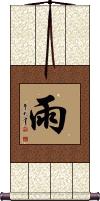
2. Rain
6. Child
7. Drink
8. Jade
9. Shit / Manure / Dung / Feces / Excrement / Poop
10. Never Give Up
11. Wellness
12. Shit / Defecate / Excrement / Feces / Poop
13. Double Happiness Guest Book
14. Walking 100 Miles: Stopping at 90 miles, is the same as stopping half-way
How can you catch tiger cubs without entering the lair of the tiger?
Nothing ventured, nothing gained
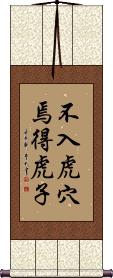
While perhaps no longer politically correct, this Chinese proverb is a reminder that you must take risks if you want rewards.
不入虎穴焉得虎子 is similar to the English proverb, “Nothing ventured, nothing gained.”
The literal word order of the Chinese is, “If (you) don't enter the tiger's lair/cave, how can (you) get/obtain tiger cubs?.”
How can you catch tiger cubs without entering the lair of the tiger?
Nothing ventured, nothing gained
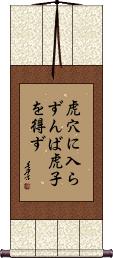
虎穴に入らずんば虎子を得ず is the Japanese version of an ancient Chinese proverb. 虎穴に入らずんば虎子を得ず is a reminder that you must take risks if you want the reward.
虎穴に入らずんば虎子を得ず is similar to the English proverb, “Nothing ventured, nothing gained.”
Note: Because this selection contains some special Japanese Hiragana characters, it should be written by a Japanese calligrapher.
Rain
Pursuit of Happiness
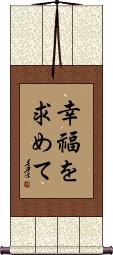
幸福を求めて is “Pursuit of Happiness” or “In Search of Happiness” in Japanese.
Here's how the characters break down:
幸福 (koufuku) happiness; blessedness; joy; well-being.
を (o) particle
求め (motome) to want; to seek; to pursue; to request
て (te) particle
Note: Because this selection contains some special Japanese Hiragana characters, it should be written by a Japanese calligrapher.
See Also: Follow Your Dreams
Be Like Water
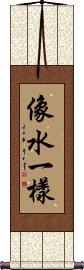
像水一樣 is a short quote from a much longer statement by Bruce Lee.
He summarized how people should be flexible to all circumstances, attacks, or situations. In the end, he exclaims, “Be like water, my friend.” 像水一樣 is the “Be like water” part alone since that seems to be what most people want.
Pledge of Lifelong Love
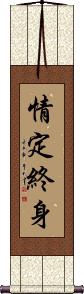
情定終身 is a pledge of eternal love in Chinese.
This can also be a colloquial way to refer to the act of exchanging marriage vows.
If you and your mate want to express how committed you are to your life-long love, this will be a great piece of calligraphy for your wall. Also, a nice phrase to celebrate an anniversary.
Child
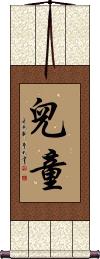
兒童 is how to write “child” in Chinese.
There are several ways to write child or offspring in Chinese, but this is the best form for calligraphy, or written (versus oral) form.
If children are essential to you, this might be the scroll you want. Or if you are a child at heart, this also works.
 In Japanese, they use a slightly-morphed version of the original Chinese first character. If you want the special Japanese version, please click on the Kanji image shown to the right, instead of the button above. Note: Japanese people would still be able to understand the Chinese version and vice versa.
See Also: Family
Drink
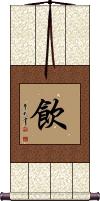
飲 is how to formally write “drink” (the verb for taking a drink or drinking) in Chinese and Japanese.
This is different than the noun for a drink. There are other ways to say/write drink, but they are more for oral/spoken language. This more formal version is appropriate if you want to write the word “drink.”
This is kind of an odd selection for a wall scroll but no bad meaning.
 In Korean Hanja, this character is generally written in the variant shown to the right.

 This can be pronounced in Japanese but this is seldom seen as a lone Kanji, and thus is not appropriate if your audience is Japanese. They will, at least, use a second Hiragana character in Japanese, as shown to the right. This is "nomi."
 The common oral character looks like the one shown to the right. But this is not appropriate for a wall scroll.
 In some cases (often in ancient Chinese) the character shown to the right is used to mean drink. But this word refers to anything you consume in your mouth. This character is most often used to mean "eat" in modern Chinese.
Jade
(precious stone)
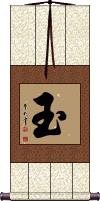
玉 is how to write jade in Chinese, Korean Hanja, and Japanese Kanji. This refers to the semi-precious stone that can be almost white or a vivid green.
Note: In Japanese, this character can mean jewel, ball, sphere or coin depending on context.
If your name is Jade, you may want to choose this to represent your name by meaning rather than pronunciation.
Shit / Manure / Dung / Feces / Excrement / Poop
NOT APPROPRIATE FOR
CUSTOM CALLIGRAPHY
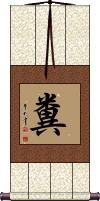
Seems a lot of you want to know how to write “shit” in Chinese, Japanese Kanji, and old Korean Hanja. 糞 is the single-character version of shit, which is used to express the ideas of manure, dung, and bullshit. Yes, at least in Chinese, they use this in much the same way as shit or bullshit is used in English.
Please don't try to order this, it's here only for reference. 糞 is not appropriate for custom calligraphy!
Never Give Up
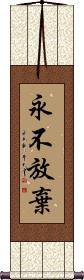
The first character means “eternal” or “forever,” and the second means “not” (together, they mean “never”). The last two characters mean “give up” or “abandon.” Altogether, you can translate this proverb as “never give up” or “never abandon.”
Depending on how you want to read this, 永不放棄 is also a statement that you will never abandon your hopes, dreams, family, or friends.
Wellness
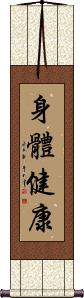
身體健康 is how to express “wellness” in Chinese. The meaning is not much different than the idea of “good health.” The first two characters alone are often translated as “health.” Some will also translate this title as “physical health.”
If you want to fill your room with a feeling of wellness, this is the wall scroll for you.
This is also the ancient way to express wellness in Japanese Kanji and old Korean Hanja. The modern Japanese form is 身体健康 (the only difference is the second Kanji). Let me know if you need your calligraphy written in modern Japanese.
Shit / Defecate / Excrement / Feces / Poop
NOT APPROPRIATE FOR
CUSTOM CALLIGRAPHY
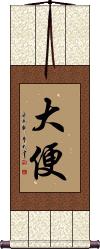
Seems a lot of you want to know how to write “shit” in Chinese, Japanese Kanji, and old Korean Hanja. Well, here it is.
Do not, under any circumstances, try to order this selection for a wall scroll. None of the calligraphers that I work with would dare to lower themselves to such a level and actually write “shit” for you. 大便 is only here for reference. 大便 is not appropriate for custom calligraphy!
大便 is thousands of years old and was absorbed into both Japanese and Korean (if you note, the pronunciation is very similar in all three languages).
This version is sometimes used as a verb (when used with some other words).
Double Happiness Guest Book
Customize a special Asian guest book for your wedding
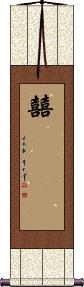
Start customizing a “Double Happiness Guest Book Wall Scroll” Here!
The paper panel length can be whatever you choose from 68cm to 135cm (27” to 53”).
If you don't mention what paper length you want in the special instructions tab (on the next page), we'll make it about 100cm (40”).
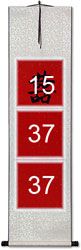
The medium-size scroll with a 33cm x 100cm (13” x 40”) paper panel can usually handle up to 89 signatures. That breaks down to 37 signatures per empty square and 15 signatures around the 囍 character. If you switch to a 135cm paper panel, add another 37 potential signatures.
We can splice two 135cm papers together, but that would be a crazy-long scroll. These are only estimates, your mileage may vary.
With silk panels, this will yield a wall scroll about 155cm (61”) long. That's enough for up to 89 signatures. Of course, that depends on if your guests just sign a brief salutation and name, or more verbose good wishes. Customer feedback is that 126 people can sign the 135cm long paper on a medium-sized scroll. If we go bigger than that, there will be a minor paper seam and an extra charge. Email me with your specifications if you need something special.
Most customers pick the festive red paper with gold flecks and white or ivory silk. Red is a good luck color in Chinese culture, thus the most popular choice. But, you can do any color combination that you want.
There is a long history of Chinese-character-use outside of mainland China. This Double Happiness character is also seen at weddings in Korea, Vietnam, Hong Kong, and Taiwan, as well as in Chinese communities in Thailand, Indonesia, and elsewhere. While Japan borrowed Chinese characters into their language, you won't see 囍 as often at Japanese weddings.
Walking 100 Miles: Stopping at 90 miles, is the same as stopping half-way
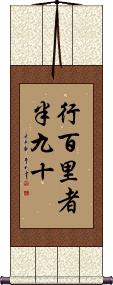
行百里者半九十 is an old Chinese proverb that speaks to the act of giving up. This phrase suggests that no matter how close you are to finishing your task or journey, giving up just before you finish is just as bad as giving up halfway.
50% finished or 90% finished, the result is the same: “You are not finished.”
You can take what you want from this proverb, but I think it suggests that you should finish what you start, and especially finish that last 10% of your journey or project so that you can honestly say “it's finished.”
Some notes: The character, 里, that I am translating as “mile” is an ancient “Chinese mile” which is actually about half a kilometer - it just doesn't sound right to say “When walking 100 half-kilometers...”
Qi Gong / Chi Kung
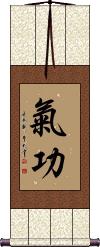
氣功 or Qigong is the title of a technique that is somewhere between medical practice, meditation, and in some cases, religion.
The definition is blurred depending on which school of Qigong you are following. In some cases, it is even incorporated with martial arts.
Some people (even Chinese people) mix this title with Tai Chi (Tai Qi) exercises.
Lately, in China, people will claim to practice Tai Chi rather than Qigong because the Qigong title was recently used as a cover for an illegal pseudo-religious movement in China with the initials F.G. or F.D. (I can not write those names here for fear of our website being banned in China).
You can learn those names and more here: Further info about Qigong
If you are wondering why I wrote “Qi Gong” and “Chi Kung” as the title of this calligraphy entry, I should teach you a little about the various ways in which Chinese can be Romanized. One form writes this as “Chi Kung” or “Chikung” (Taiwan). In the mainland and elsewhere, it is Romanized as “Qi Gong” or “Qigong.” The pronunciation is the same in Taiwan, mainland, and Singapore Mandarin. Neither Romanization is exactly like English. If you want to know how to say this with English rules, it would be something like “Chee Gong” (but the “gong” has a vowel sound like the “O” in “go”).
Romanization is a really confusing topic and has caused many Chinese words to be mispronounced in the west. One example is “Kung Pao Chicken,” which should actually be more like “Gong Bao” with the “O” sounding like “oh” for both characters. Neither the Romanization system in Taiwan nor the Mainland is perfect, in my opinion, and leads to many misunderstandings.
In modern Japan, you may see this written as 気功, but the original 氣功 is still recognized. If you need the Japanese version, please contact me.
This in-stock artwork might be what you are looking for, and ships right away...

Gallery Price: $61.00
Your Price: $33.88

The following table may be helpful for those studying Chinese or Japanese...
| Title | Characters | Romaji (Romanized Japanese) | Various forms of Romanized Chinese | |
| How can you catch tiger cubs without entering the lair of the tiger? | 不入虎穴焉得虎子 | bú rù hǔ xué yān dé hǔ zǐ bu2 ru4 hu3 xue2 yan1 de2 hu3 zi3 bu ru hu xue yan de hu zi buruhuxueyandehuzi | pu ju hu hsüeh yen te hu tzu pujuhuhsüehyentehutzu |
|
| How can you catch tiger cubs without entering the lair of the tiger? | 虎穴に入らずんば虎子を得ず | koketsu ni haira zun ba tora ko o e zu | ||
| Rain | 雨 | ame | yǔ / yu3 / yu | yü |
| Pursuit of Happiness | 幸福を求めて | koufuku o motome te koufukuomotomete kofuku o motome te | ||
| Be Like Water | 像水一樣 | xiàng shuǐ yí yàng xiang4 shui3 yi2 yang4 xiang shui yi yang xiangshuiyiyang | hsiang shui i yang hsiangshuiiyang |
|
| Pledge of Lifelong Love | 情定終身 情定终身 | qíng dìng zhōng shēn qing2 ding4 zhong1 shen1 qing ding zhong shen qingdingzhongshen | ch`ing ting chung shen chingtingchungshen ching ting chung shen |
|
| Child | 兒童 儿童 | jidou / jido | ér tóng / er2 tong2 / er tong / ertong | erh t`ung / erhtung / erh tung |
| Drink | 飲 / 飮 饮 | no / in | yǐn / yin3 / yin | |
| Jade | 玉 | tama / gyoku | yù / yu4 / yu | yü |
| Shit Manure Dung Feces Excrement Poop | 糞 粪 | kuso | fèn / fen4 / fen | |
| Never Give Up | 永不放棄 永不放弃 | yǒng bù fàng qì yong3 bu4 fang4 qi4 yong bu fang qi yongbufangqi | yung pu fang ch`i yungpufangchi yung pu fang chi |
|
| Wellness | 身體健康 身体健康 | shin tai ken kou shintaikenkou shin tai ken ko | shēn tǐ jiàn kāng shen1 ti3 jian4 kang1 shen ti jian kang shentijiankang | shen t`i chien k`ang shentichienkang shen ti chien kang |
| Shit Defecate Excrement Feces Poop | 大便 | dai ben / daiben | dà biàn / da4 bian4 / da bian / dabian | ta pien / tapien |
| Double Happiness Guest Book | 囍 喜喜 | xǐ / xi3 / xi | hsi | |
| Walking 100 Miles: Stopping at 90 miles, is the same as stopping half-way | 行百里者半九十 | xíng bǎi lǐ zhě bàn jiǔ shí xing2 bai3 li3 zhe3 ban4 jiu3 shi2 xing bai li zhe ban jiu shi xingbailizhebanjiushi | hsing pai li che pan chiu shih hsingpailichepanchiushih |
|
| Qi Gong Chi Kung | 氣功 气功 | ki kou / kikou / ki ko | qì gōng / qi4 gong1 / qi gong / qigong | ch`i kung / chikung / chi kung |
| In some entries above you will see that characters have different versions above and below a line. In these cases, the characters above the line are Traditional Chinese, while the ones below are Simplified Chinese. | ||||

Successful Chinese Character and Japanese Kanji calligraphy searches within the last few hours...



