Many custom options...


And formats...



Not what you want?
Try other similar-meaning words, fewer words, or just one word.
I Feel Alone in Chinese / Japanese...
Buy an I Feel Alone calligraphy wall scroll here!
Personalize your custom “I Feel Alone” project by clicking the button next to your favorite “I Feel Alone” title below...
Switched to secondary search mode due to lack of results using primary.
These secondary results may not be very accurate. Try a different but similar meaning word or phrase for better results. Or...
Look up I Feel Alone in my Japanese Kanji & Chinese Character Dictionary(My dictionary is a different system then the calligraphy search you just tried)
If you want a special phrase, word, title, name, or proverb, feel free to contact me, and I will translate your custom calligraphy idea for you.
1. Adventure
3. Alone with only your shadow for company
5. Sorry / Feel Apologetic / Regret
6. No man knows what he owes to his parents until he comes to have children of his own
8. Awareness
10. Ba Ji Quan
11. Bat
12. Be Like Water
13. Best
14. Better to be Happy than Rich
15. Broken Hearted
16. Brown
18. Che Guevara
19. Color
21. The Confident Helmsman Inspires Confidence in the Passengers
22. Cooperation / Collaboration
24. Daoism / Taoism
25. Daodejing / Tao Te Ching - Chapter 54
26. Darkness
27. Defense / Defend
28. Desire / Longing / Craving
29. Religious Devotion / Faith in God / Religious Faith
30. Dharma / The Law
31. Diligence
32. The Five Animals
33. Dynasty
34. Empress
35. Fate / Opportunity / Chance
36. Fight for a Goal
37. Five Elements
38. Forgiveness
39. Gabriela
40. Gaman
41. Gentleness
42. Good Health / Healthy / Vigor
44. Grandfather
46. Happy / Laughter / Cheerful Bliss
47. Happiness / Joy
49. Speed
50. Hitori
51. Feel at Ease Anywhere / The World is My Home
55. I Miss You
56. Immovable Mind
57. Independence
60. Inspiration
61. Inspire
63. Happy
66. Kenpo / Kempo / Quan Fa / Chuan Fa
67. Kill / Slaughter / Murder / Butcher
68. Kirin / Giraffe / Mythical Creature
69. Knight
72. Laugh / Smile
73. Lingering Mind
74. Listen
75. Lonely
78. Love and Hate
82. Sensei / Master / Teacher / Mister
83. Mother and Son
84. Mountain Travels Poem by Dumu
85. North American Opossum / Possum
87. Ocean
88. Opportunity
89. Orna
91. Peace and Love
92. Peace of Mind
93. Phenomenon
95. Pride
96. Purified Spirit / Enlightened Attitude
98. Reiki
Adventure
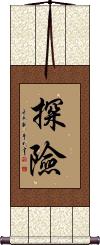
If you lead a life of adventure (like I do), a 探險 wall scroll is for you.
Alone, the first character can mean “to explore,” “to search out,” or “to scout.” The second character holds the meanings of “dangerous” and “rugged.” Together these two characters create the word that means “adventure” or “to explore.”
探険 is a modern Japanese Kanji version, but it more precisely means exploration or expedition rather than adventure. 探險 is the old/ancient Japanese version used before WWII. Let us know if you want the modern Japanese version instead.
See Also: Bon Voyage | Travel
Alone / A Lone Person
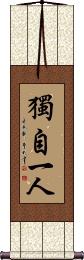
Alone / A Lone Person
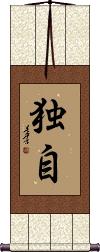
獨自 is a Japanese word that means “alone” in the context of a person by himself/herself.
This can be translated as individual, solo, on one's own, or by oneself.
See Also: I Miss You
Alone with only your shadow for company
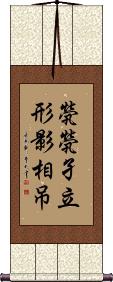
煢煢孑立形影相吊 is a Chinese proverb about the state of being as alone as you possibly can be.
It can be translated as “Alone with only your shadow for comfort/company.”
See Also: I Miss You
Alone / Solitary Existence
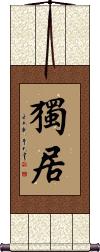
獨居 is a Chinese word that can be translated as to live alone, to live a solitary existence, solitude, solitary life, dwelling alone.
You might use a word like this regarding a hermit.
 In modern Japan, and Simplified Chinese, they use the version of the first character shown to the right. If you want this version please click on the character to the right instead of the button above.
Sorry / Feel Apologetic / Regret
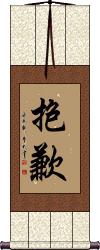
抱歉 is the feeling of being or feeling sorry or apologetic.
The idea of being regretful. Not quite the same thing as sorrow.
Note: This is a strange thing to write on a wall scroll for Chinese people - but you can bend the rules if you want in the west.
No man knows what he owes to his parents until he comes to have children of his own
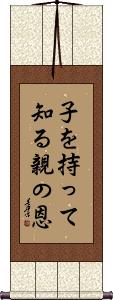
子を持って知る親の恩 literally translates as: Only after you have a baby, you would appreciate your parents (feel the way they do, etc).
This is a bit like the “walk a mile in another man's shoes” saying. Basically, it's about you cannot fully understand the plight of others until you experience it yourself. It also shows appreciation for the plight of parents.
This Japanese proverb can also be translated a few more ways:
No man knows what he owes to his parents till he comes to have children of his own.
One knows not what one owes to one's parents till one comes to have children of one's own.
Only after you have a baby, you will appreciate your parents or feel the way they do.
Only after becoming a parent yourself do you realize how much you owe [how indebted you are] to your own parents.
Note: Because this selection contains some special Japanese Hiragana characters, it should be written by a Japanese calligrapher.
Great Expectations
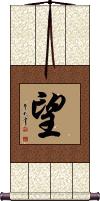
望 holds the ideas of ambition, hope, desire, aspiring to, expectations, looking towards, to gaze (into the distance), and in some contexts, full moon rising.
望 is one of those single characters that is vague but in that vagueness, it also means many things.
望 is a whole word in Chinese and old Korean but is seldom seen alone in Japanese. Still, it holds the meanings noted above in all three languages.
Awareness
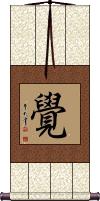
覺 can mean to feel; to figure out; thinking; awake; aware; bodhi; knowing; understanding; enlightenment; illumination; apprehend; perceive; realize.
覺 is a character that is impossible to define in a single word.
This term is often associated with Buddhism where it's understood to be: Illumination, enlightenment, or awakening in regard to the real in contrast to the seeming. However, it can also refer to enlightenment in regard to morality and evil.
Notes:
In Japanese, this can be the personal name Satoru.
In certain context, and only when pronounced as "jiao" in Chinese, it can refer to a nap, sleep or the state of sleeping. However, as a single character on a wall scroll, everyone will read this with the awareness or enlightenment context.
By no means is this the only way to write enlightenment. In fact, you should only choose this character if you are looking more for a word meaning awareness.
See Also: Enlightenment | Wisdom | Knowledge
Awesome / Awe-Inspiring
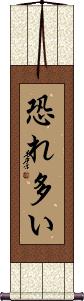
恐れ多い is a Japanese word for something awe-inspiring or awesome (in some odd context, it can refer to August).
恐れ多い is probably not appropriate for a calligraphy wall scroll unless you have a specific reason.
The word awesome is misused a lot in English or used too casually. This Japanese word is the real form of awesome, and it kind of means numerous fears and anxiety that you would feel in response to encountering something truly awesome (such as God, a tornado, a tsunami, etc.).
Note: Because this selection contains some special Japanese Hiragana characters, it should be written by a Japanese calligrapher.
Ba Ji Quan
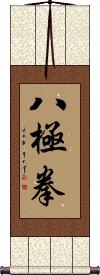
八極拳 is “Ba Ji Quan” or “Eight Extremes Fist.”
Some also translate this as “Eight Extremities Fist,” though I don't feel that's accurate.
八極拳 (Bājíquán) is a Chinese martial art that features explosive, short-range power and is famous for its elbow strikes. It originated in the Hebei Province in Northern China but spread to Taiwan and other places.
The full title is 開門八極拳 (Kāimén Bājíquán), which means Open-Door Bajiquan.
Other romanizations include: BaJiQuan, Pa Chi Ch`üan, or Pa Chi Chuan.
In Japan, this is known as Hakkyokuken.
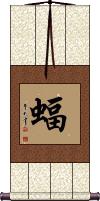
蝠 is the simplest way to write bat in Chinese and old Korean Hanja.
This also means bat in Japanese but is almost never written alone like this (it's often part of other titles for vampire bats or fruit bats).
In Chinese culture, the bat is a good luck charm, as the pronunciation is very similar to the word for “good luck” or “good fortune.” The character for bat (蝠) even looks like the good luck (福) character.
Be Like Water
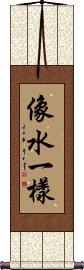
像水一樣 is a short quote from a much longer statement by Bruce Lee.
He summarized how people should be flexible to all circumstances, attacks, or situations. In the end, he exclaims, “Be like water, my friend.” 像水一樣 is the “Be like water” part alone since that seems to be what most people want.
Best
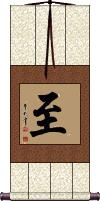
至 is a little strange as calligraphy, but 至 would be the character that means “best” or “extreme” in Chinese and Korean.
The problem is, this is seldom used alone. It's mostly used in combination with other characters to make words like “best friend,” “best food,” and “best love.”
I do not recommend this character for a wall scroll. It's better if you find a more specific term that fits your circumstances.
Note: This can be pronounced in Japanese and has a similar meaning but it is rarely if ever used in modern Japanese.
Better to be Happy than Rich
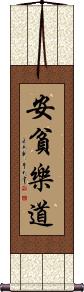
安貧樂道 means “It's better to be happy than rich” in Chinese.
Even if you are poor, you should still feel satisfied in your life...
...Satisfaction, happiness and the meaning of your life come from within yourself and not from money or riches of the world.
In Chinese, there are a lot of four-character proverbs which express some very old philosophies.
Though there are only four characters on this scroll, in Chinese, the meanings often surpass the dictionary definition of each character.
In this case, you should not set your expectations too high for the money or riches you wish to have. One who sets their expectations too high is almost always disappointed. Instead, you should cherish what you have, seek to improve yourself from within, and not measure your worth by the size of your bank account.
Broken Hearted
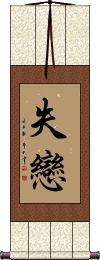
In Chinese, this can mean losing one's love; to breaking up (in a romantic relationship); to feel jilted.
In Japanese Kanji, this means disappointing love, broken heart, unrequited love, or being lovelorn.
失戀 is also valid in old Korean Hanja, which means unrequited love, unreturned love, a disappointment in love, or a broken heart.
Note: In modern Japan, they will tend to write the more simple 失恋 form instead of 失戀. If you order this from the Japanese master calligrapher, expect the more simple modern version to be written (unless you give us instructions to use the older or more traditional version).
Brown
Single character for brown color
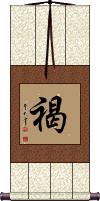
褐 is the most simple way to express brown in Chinese.
It also means brown in Japanese but this character is not often written alone in Japanese (they would tend to write 褐色 (brown color) to refer to brown or the color of tanned skin.
In some contexts, this can refer to gray or a dark color, or coarse hemp cloth.
In the Buddhist context, it can refer to a coarse serge (cheaply sewn clothing) hence poverty.
Note: In Taiwanese Mandarin, this is spoken with the 2nd or rising tone instead of the 4th or falling tone used in the mainland.
Calm / Tranquility
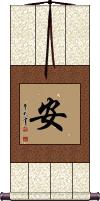
安 is used in a lot of compound words in the CJK world.
Alone, this character has a broad span of possible meanings. These meanings include relaxed, quiet, rested, contented, calm, still, to pacify, peaceful, at peace, soothing, or soothed.
安 and even the pronunciation was borrowed from Chinese and absorbed into both Japanese Kanji and Korean Hanja. In all these languages, this character is pronounced like “an.”
Che Guevara
Latin American / Cuban Revolutionary
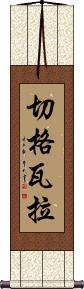
切格瓦拉 is the name “Che Guevara,” as written (transliterated) in Mandarin Chinese.
 Once revered by Chinese people as a Socialist rebel, he's now just a historical figure that school children briefly learn about in China.
切格瓦拉 is because China used to be a truly-Communist/Socialist nation, and thus, other Communists and Socialists were heroes.
In modern China, with its free-market economy, those former heroes fade a little.
We are not offering the “Che” character alone, as few would associate it with Che Guevara, so you need the full name to be clear (minus Ernesto, which is his real first name).
Color
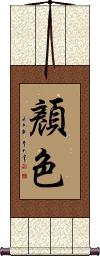
顏色 is kind of a weird selection for a wall scroll, but we added it to our database at the request of a customer.
顏色 means “color” in Chinese. However, in Japanese, it would mean complexion, countenance, or expression. The last character is used alone in Japanese (and sometimes in Chinese with/as an adjective/modifier) to mean “color.”
Mercy / Compassion / Love
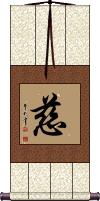
慈 is the simplest way to express the idea of compassion.
This can also mean love for your fellow humans, humanity, or living creatures. Sometimes this is extended to mean charity.
This term is often used in a Buddhist or Christian context. The concept was also spoken of by Laozi (Lao Tzu) in the Dao De Jing (Tao Te Ching).
慈 is considered the direct translation of the Sanskrit word मैत्री (maitrī) Pali word मेत्ता (mettā). In this context, it means benevolence, loving kindness, and goodwill.
This Chinese character is understood in Japanese but is usually used in compound words (not seen alone). Also used in old Korean Hanja, so it's very universal.
See Also: Mercy | Benevolence | Forgiveness | Kindness
The Confident Helmsman Inspires Confidence in the Passengers
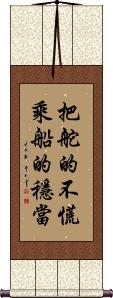
把舵的不慌乘船的稳当 is a Chinese proverb that literally translates as: [If the] helmsman is not nervous, the passengers [will feel] secure.
Figuratively, this means: If the leader appears confident, his/her followers will gain confidence also.
This is a great suggestion that a confident leader inspires confidence in his/her troops or followers. Of course, a nervous leader will create fear in troops or followers.
Cooperation / Collaboration
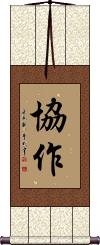
協作 is a Chinese, Japanese, and old Korean word that means cooperation or collaboration.
Cooperation is working together and sharing the load. When we cooperate, we join with others to do things that cannot be done alone. We are willing to follow the rules which keep everyone safe and happy. Together we can accomplish great things.
The first character means “united” or “to coordinate.” The second character means “to do,” “to make,” or “to compose.” Knowing this, you can understand why together, these characters create a word that can be defined as “cooperation” in Chinese, Japanese, and Korean.
It is implied that you are cooperating to create some project or product.
See Also: Partnership
Bravery / Courage
Courageous Energy
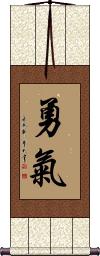
勇氣 is one of several ways to express bravery and courage in Chinese, Japanese, and Korean.
This version is the most spiritual. This is the essence of bravery from deep within your being. This is the mental state of being brave versus actual brave behavior. You'd more likely use this to say, “He is very courageous,” rather than “He fought courageously in the battle.”
The first character also means bravery or courage when it's seen alone. With the second character added, an element of energy or spirit is added. The second character is the same “chi” or “qi” energy that Kung Fu masters focus on when they strike. For this reason, you could say this means “spirit of courage” or “brave spirit.”
This is certainly a stronger word than just the first character alone.
Beyond bravery or courage, dictionaries also translate this word as valor/valour, nerve, audacity, daring, pluck, plucky, gallantry, guts, gutsy, and boldness.
This is also one of the 8 key concepts of tang soo do.
 While the version shown to the left is commonly used in Chinese and Korean Hanja (and ancient Japanese Kanji), please note that the second character is written with slightly fewer strokes in modern Japanese. If you want the modern Japanese version, please click on the character to the right. Both styles would be understood by native Chinese, Japanese, and many (but not all) Korean people. You should make your selection based on the intended audience for your calligraphy artwork. Or pick the single-character form of bravery/courage which is universal.
Daoism / Taoism
Literally: The Way or Road
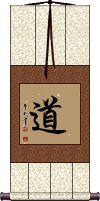
道 is the character “dao” which is sometimes written as “tao” but pronounced like “dow” in Mandarin.
道 is the base of what is known as “Taoism.” If you translate this literally, it can mean “the way” or “the path.”
Dao is believed to be that which flows through all things and keeps them in balance. It incorporates the ideas of yin and yang (e.g. there would be no love without hate, no light without dark, no male without female.)
The beginning of Taoism can be traced to a mystical man named
Lao Zi (604-531 BC), who followed, and added to the teachings of Confucius.
More about Taoism / Daoism here.
Note that this is pronounced “dou” and sometimes “michi” when written alone in Japanese but pronounced “do” in word compounds such as Karate-do and Bushido. It's also “do” in Korean.
Alternate translations and meanings: road, way, path; truth, principle province.
Important Japanese note: In Japanese, this will generally be read with the road, way, or path meaning. Taoism is not as popular or well-known in Japan so Daoist/Taoist philosophy is not the first thing a Japanese person will think of when they read this character.
See our Taoism Page
Daodejing / Tao Te Ching - Chapter 54
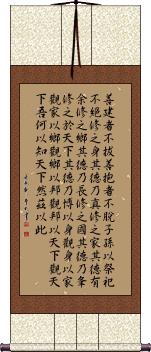
This is the Mawangdui version of Daodejing chapter 54.
By its virtue alone can one generation after another carry on the ancestral sacrifice.
Apply it to yourself, and by its power, you will be freed from dross.
Apply it to your household, and your household shall thereby have abundance.
Apply it to the village, and the village will be made secure.
Apply it to the kingdom, and the kingdom shall thereby be made to flourish.
Apply it to an empire, and the empire shall thereby be extended.
Therefore just as through oneself, one may contemplate Oneself;
So through the household one may contemplate the Household;
And through the village, one may contemplate the Village;
And through the kingdom, one may contemplate the Kingdom;
And through the empire, one may contemplate the Empire.
How do I know that the empire is so? By this.
What is firmly rooted cannot be pulled out;
What is tightly held in the arms will not slip loose;
Through this, the offering of sacrifice by descendants will never come to an end.
Cultivate it in your person, and its virtue will be genuine;
Cultivate it in the family, and its virtue will be more than sufficient;
Cultivate it in the hamlet, and its virtue will endure;
Cultivate it in the state, and its virtue will abound;
Cultivate it in the empire, and its virtue will be pervasive.
Hence look at the person through the person;
Look at the family through the family;
Look at the hamlet through the hamlet;
Look at the state through the state;
Look at the empire through the empire.
How do I know that the empire is like that?
By means of this.
Darkness
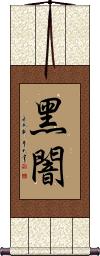
黑闇 is the two-character Chinese word for darkness.
The first character alone means black or dark.
The second character has several possible meanings, depending on context; They include: to shut the door, unilluminated, dark, gloomy, hidden, or secret.
Together, these two characters will, in most cases, be translated as dark or darkness.
Defense / Defend
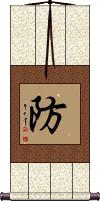
防 is a single Chinese character and Korean Hanja that means to protect, defend, guard against, prevent, ward off, or counter.
防 means the same thing in Japanese, though seldom seen alone as a single Kanji. When written alone, it could be the Japanese surname Fusegi.
Desire / Longing / Craving
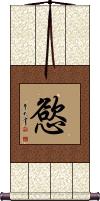
慾 means desire, longing, appetite, wish, covetousness, greed, passion, desire, avarice, and craving.
慾 is universal in Chinese, Japanese Kanji, and Korean Hanja.
The context in which this character is used determines whether the meaning is good or bad. As a single character on a wall scroll, you get to decide what the definition is to you (hopefully more toward desire than greed).
 Please note that Japanese use a simplified version of this character - it also happens to be the same simplification used in mainland China. Click on the character to the right if you want the Japanese/Simplified version of desire.
Religious Devotion / Faith in God / Religious Faith
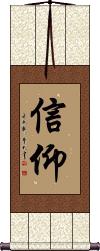
信仰 means firm belief, faith, persuasion, conviction, and sometimes religion or creed in Chinese, Japanese Kanji, and old Korean Hanja.
This clearly fits the religious connotation of the English word “devotion.”
This is often used to refer to a person of faith or a religious person.
This can be directly translated as “firm belief,” “creed,” “conviction,” or simply as “religious,” depending on context.
Some will also use this to mean “trust in God” in Japanese (though the term for God is not actually in this title).
It should be noted that this word is a little strange alone on a wall scroll.
While this can be pronounced in Japanese, it’s not a great selection for a wall scroll if your audience is Japanese.
See Also: Faith | Trust | Devotion | Trust | Trust in God
Dharma / The Law
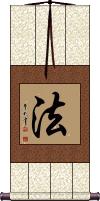
法 is the simple way to write “law” or in a Buddhist context “Dharma.”
This can also mean method, way, or Buddhist teaching. It's also an abbreviation for the country of France.
The Buddhist context exists in Chinese and Korean Hanja but I have not yet confirmed that this means more than “law” when used alone in Japanese.
Diligence
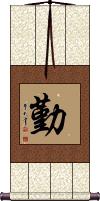
勤 is a single character that means diligence or “sense of duty” in Chinese and Korean (also understood in Japanese but not commonly seen as a stand-alone Kanji).
As a single character on a wall scroll, this will only be seen with this meaning. However, it can also mean industrious, hardworking, frequent, regular, constant, energy, zeal, fortitude, or virility.
In Buddhism, this can represent vīrya (viriya), the idea of energy, diligence, enthusiasm, or effort. It can be defined as an attitude of gladly engaging in wholesome activities, and it functions to cause one to accomplish wholesome or virtuous actions. Some Buddhists may even define this as “manliness” (a definition from a hundred years ago, before equality).
If you or someone you know is a hard worker (or needs a reminder to be diligent), then this is the wall scroll to have in your/their office.
The Five Animals
Dragon Snake Tiger Leopard Crane
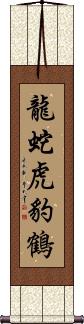
龍蛇虎豹鶴 is a list of the Chinese characters for the five animals of Shaolin Kung Fu in a comfortable order (meaning that they are in the proper order and will “feel right” to a Chinese person who views this arrangement).
Dynasty
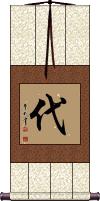
代 is the word used to designate dynasties in Asia.
代 alone can mean generation; age; period; historical era; eon; world; society; reign; era. 代 comes after the name of the dynasty, for example, the Tang Dynasty is the “Tang Dai” in Chinese.
Some have suggested that the word dynasty comes from the Chinese word “dai” (as “dai” sounds like the first syllable of a dynasty). However, the word dynasty is derived from the Greek word δυναστεία (dunasteia) meaning lordship and/or domination.
Sometimes this word is used in a different context where it can mean to represent or substitute. In this case, it can mean representative of; on behalf of; acting for, e.g. to offer incense in place of another.
In ancient Japan, this could also be a “shiro” (a unit of land area equal to one-fiftieth of a tan or about 20 square miles).
Empress
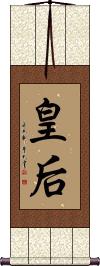
皇后 is the title of empress/emperess, the female form of the emperor.
皇后 is used in Chinese, Japanese Kanji, and old Korean Hanja.
While the emperor's reign was for life, if he died, his wife would hold his power. In this case, a woman was the ultimate ruler of the greater part of East Asia (now China) until her death and the succession of the emperor's firstborn son to lead the empire. Numerous times in various Chinese dynasties, an empress took power in this way.
The first character means emperor by itself.
The second character alone can mean “wife of an emperor or king” (the first character clarifies that we are talking about an empress and not a queen). It can also mean sovereign or last offspring, depending on context.
Note: In some books, this word is translated as queen. While only incorrect if you get technical (because an empress is theoretically a higher level than a queen), the meaning is very similar.
皇后 is sometimes used for the title of queen, but more technically, this is the wife of the emperor (a higher level than a queen).
Fate / Opportunity / Chance
The Buddhist idea of Fate
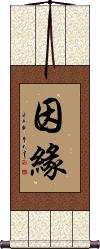
因緣 is the Buddhist concept of a chance meeting or an opportunity that presents itself by fate.
Sometimes this is used to describe a cosmic chain of events or cause and effect.
It also is used to describe predestined relationships between people - and sometimes married couples (although if you want one about marriage, try this: Fate / Destiny of Lovers.
因緣 can also be translated as origin, karma, destiny, affinity, connection, and relation. This all depends on context - seen alone on a wall scroll, this will be read with a “fate/chance” meaning by a Chinese person or a Korean person who can read Hanja.
The more complex definition of this word would be, “Direct causes and indirect conditions, which underlie the actions of all things.”
This concept is known as nidana in the original Sanskrit. Also sometimes presented as hetupratyaya (or “hetu and prataya”), which I believe is Pali.
Note: Japanese will tend to use this version of the second Kanji: 
If you order this from the Japanese master calligrapher, expect that you’ll get this version. However, this word often carries a negative connotation in Japanese (bad things happen), as it is used that way in a certain Japanese idiom. Therefore, this may not be the best choice if Japanese is your target language.
See Also: Buddhism | Opportunity
Fight for a Goal
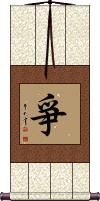
爭 is the way to express the idea of fighting for a goal.
This can also mean struggling or arguing. 爭 is okay for a Chinese audience, and while it is a word in Korean, this character is seldom seen alone in Korean grammar.
Five Elements
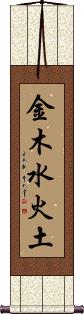
金木水火土 is a list of the Chinese characters for the five elements in a comfortable order (meaning that they “feel right” to a Chinese person who views this arrangement).
The order is metal, wood, water, fire, and earth.
Note that sometimes the metal element is translated as gold. And earth refers to soil versus the whole planet earth.
Forgiveness (from the top down)
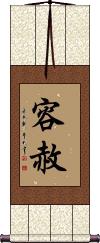
容赦 is the kind of forgiveness that a king might give to his subjects for crimes or wrong-doings.
容赦 is a rather high-level forgiveness. Meaning that it goes from a higher level to a lower (not the reverse).
Alone, the first character can mean “to bear,” “to allow,” and/or “to tolerate,” and the second can mean “to forgive,” “to pardon,” and/or “to excuse.”
When you put both characters together, you get forgiveness, pardon, mercy, leniency, or going easy (on someone).
See Also: Benevolence
Gabriela
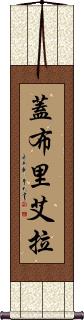
This is an alternate transliteration to Mandarin Chinese for the name Gabriela.
There are more common versions of Gabriela but we like this one the best because we feel it sounds more like the original pronunciation of Gabriela.
Gaman
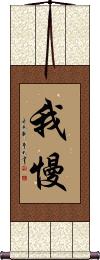
Gaman is a Zen Buddhist term from Japan that means “enduring the seemingly unbearable with patience and dignity.”
This title can also be translated as patience, perseverance, tolerance, or self-denial.
我慢 is also a Chinese Buddhist term with a different pronunciation. It comes from Sanskrit abhimāna or ātma-mada. Chinese Buddhism defines this very differently as “Egoism exalting self and depreciating others,” “self-intoxication,” or “pride.” Alone, the first character means “Me, I, or Self,” and the second character in a Buddhist context comes from Sanskrit māna and means pride, arrogance, self-conceit, looking down on others, superciliousness, etc.
I’m currently working with Japanese and Chinese translators to try and reconcile the true meaning or any commonality of this word between languages. For now, please only consider this if your audience is Japanese.
Gentleness
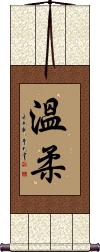
溫柔 or “gentleness” is moving wisely, touching softly, holding carefully, speaking quietly, and thinking kindly.
When you feel mad or hurt, use your self-control. Instead of harming someone, talk things out peacefully. You are making the world a safer, gentler place.
Good Health / Healthy / Vigor
Also suggests being at peace
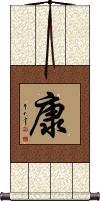
康 is a single character that means good health or vigor in Chinese, Japanese Kanji, and old Korean Hanja.
康 can also mean peaceful, at ease, or abundant in some contexts.
Please note that this is rarely seen alone in Japanese Kanji. In Japanese, it is used both for health-related compound words and to denote the kouhou through koushou eras of Japan.
In Korean, this can also be the family name “Kang” (caution: not the only family name romanized as Kang in Korean).
House of Good Fortune
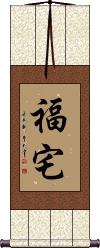
福宅 is perhaps the Chinese equivalent of “This blessed house” or perhaps “home sweet home.”
This phrase literally means “Good fortune house” or “Good luck household.” It makes any Chinese person who sees it feel that good things happen in the home in which this calligraphy is hung.
Grandfather
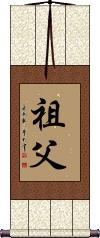
祖父 is a title for grandfather in Japanese.
In Chinese, this is specifically paternal grandfather.
This title alone is not normal for a calligraphy wall scroll.
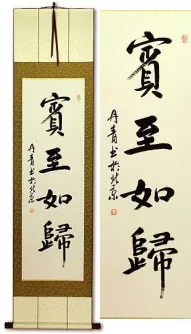
Make Guests Feel at Home
Home away from home
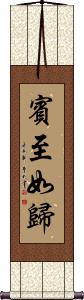
This Chinese phrase suggests that a good host will make guests feel like they are returning home or are as comfortable as they would be at their own homes.
賓至如歸 is also the Chinese equivalent of “a home away from home,” and is used by Chinese hotels, guest houses, and inns to suggest the level of their hospitality that will make you feel at home during your stay.
Happy / Laughter / Cheerful Bliss
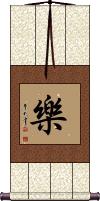
樂 is a single-character form of happiness or bliss that holds the ideas of laughing and having a good time.
This can also be translated as happy, glad, enjoyable, fun, and sometimes, music.
This a really good character if your audience is Chinese.
This is not a word seen alone very often in Korean.
 In Japanese, this character is written like the image shown to the right. If you order this from the Japanese master calligrapher, it will look like this instead of the character shown above.
Note: In Japanese, this has a meaning of comfort, ease, and enjoyment.
See Also: Joyfulness
Happiness / Joy
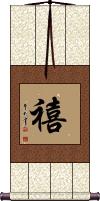
禧 is the type of happiness known in the west as “joy.”
The radical on the right side of this character is often seen alone (with the same meaning - and we do recommend that version because it's more universal).
Heart / Mind / Spirit
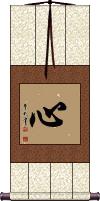
心 would often be translated as “heart.”
However, because it was believed in Chinese culture for thousands of years that your consciousness and thoughts came from the big red organ in the middle of your chest, it also means “mind” or “spirit” and sometimes even “soul.”
In Korean, beyond heart, mind, and spirit, this character can mean moral, nature, mind, affections, intentions, core, and center. In fact, it is used in Chinese to mean “center” as well but only with another character in front of it. For instance, “medical center” or even “shopping center.” Separately and alone, it will not be read with that “center” meaning unless thought of as “the center of your soul.”
Speed
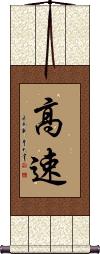
高速 means “high speed” or “in high gear” in Chinese and Japanese Kanji.
In old Korean Hanja, it also means “high speed” but can also be a nickname for “rapid transit.”
高速 is the best selection if you want to say “speed” in regard to your race car, race boat, or lifestyle. You need this word, which literally means “high speed,” as the Asian word for “speed” alone does not suggest whether you mean fast or slow.
Hitori
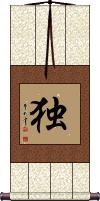
This is the Japanese given name 独 which romanizes as Hitori or Doku.
Originally this was written as 獨 but was simplified/modernized in Japan at some point.
独 can also be an abbreviation for Germany.
The actual meaning is alone, independent, single, sole, only, or solitary.
This is also a Simplified Chinese character, but most Chinese calligraphers would prefer to write the Traditional Chinese of 獨 instead of 独.
Feel at Ease Anywhere / The World is My Home
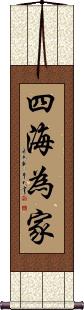
四海為家 literally reads, “Four Seas Serve-As [my/one's] Home.”
Together, 四海 which literally means “four seas” is understood to mean “the whole world” or “the seven seas.” It's presumed to be an ancient word from back when only four seas were known - so it equates to the modern English term, “seven seas.”
This can be translated or understood in a few different ways:
To regard the four corners of the world all as home.
To feel at home anywhere.
To roam about unconstrained.
To consider the entire country, or the world, to be one's own.
Honesty / Fidelity
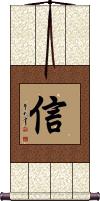
信 is another character that expresses the idea of honesty.
It can also mean truth, faith, belief in, fidelity, sincerity, trust, and/or confidence.
Some have included this in the list for the Bushido, although “makoto” is probably more common/popular.
Note: In some contexts, this character can mean a letter (mail), news, or envoy. However, alone, it will generally be read with the honesty-meaning.
See our page with just Code of the Samurai / Bushido here
See Also: Loyalty Trustworthiness Trustworthy
House of Red Delights
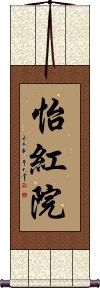
怡紅院 is from “The Story of the Stone” by Cao Xueqin.
For some reason, this phrase was translated as “House of Green Delights” when the novel was published in English. The translator took some liberties and believed that “green” had a more positive feel than red to a western audience. Therefore, the phrase shown to the right is “House of Red Delights” (which is the most original and correct way).
Hurricane / Typhoon
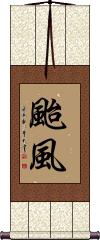
颱風/台風 is the most common way to write hurricane or typhoon in Chinese, old Korean Hanja, and Japanese Kanji. Sometimes used to refer to a big tornado as well.
The first character alone also means typhoon, but the second character means wind and acts to emphasize the meaning.

 Note: Sometimes the first character is written in the form shown to the right.
Hurricane / Typhoon
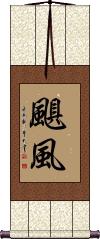
颶風 is the second more common way to write hurricane or typhoon in Chinese and Japanese Kanji. Sometimes used to refer to a big tornado as well.
The first character alone also means hurricane, but the second character means wind and acts to emphasize the meaning.
I Miss You
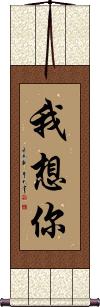
我想你 is the Chinese way to say “I miss you.”
It is said in the same word order in both English and Chinese.
Immovable Mind
fudoshin
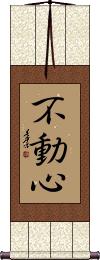
不動心 is one of the five spirits of the warrior (budo) and is often used as a Japanese martial arts tenet.
Under that context, places such as the Budo Dojo define it this way: An unshakable mind and an immovable spirit is the state of fudoshin. It is courage and stability displayed both mentally and physically. Rather than indicating rigidity and inflexibility, fudoshin describes a condition that is not easily upset by internal thoughts or external forces. It is capable of receiving a strong attack while retaining composure and balance. It receives and yields lightly, grounds to the earth, and reflects aggression back to the source.
Other translations of this title include unwavering mind, immovable mind, unwavering composure, imperturbability, steadfastness, keeping a cool head in an emergency, or keeping one's calm (during a fight).
The first two Kanji alone mean immobility, firmness, fixed, steadfastness, motionless, and idle.
The last Kanji means heart, mind, soul, or essence.
Together, these three Kanji create a title defined as “immovable mind” within the context of Japanese martial arts. However, in Chinese, it would mean “motionless heart,” and in Korean Hanja, “wafting heart” or “floating heart.”
Independence
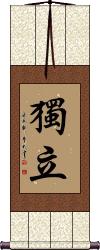
Besides meaning “to be independent,” this can also mean “to stand alone,” self-reliance or self-support.
Modern Japanese use a simplified version of the first character of independence.
it’s
the same simplified version currently used in mainland China, so understood by most Chinese and all Japanese people. Click on the character to the right if you want the simplified/Japanese version.
Independent Spirit
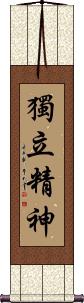
獨立精神 means independent spirit in Chinese.
The first two characters mean independent, independence, or to stand alone.
The last two characters mean spirit, spiritual, vigor, vitality, drive, mind, consciousness, thought, essence, heart, or soul.
With this information, you can make your translation combination such as “independent heart,” “stand-alone spirit,” or more creatively, “the drive to stand alone” in English. There are a lot of ways to interpret 獨立精神.
Indomitable / Unyielding
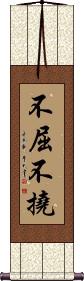
不屈不撓 means “Indomitable” or “Unyielding.”
不屈不撓 is a long word by Chinese standards. At least, it is often translated as a single word into English. It's actually a proverb in Chinese.
If you want to break it down, you can see that the first and third characters are the same. Both mean “not” (they work as a suffix to make a negative or opposite meaning to whatever character follows).
The second character means “bendable.”
The last means “scratched” or “bothered.”
So this really means “Won't be bent, can't be bothered.” I have also seen it written as “Will not crouch, will not submit.” This comes from the fact that the second character can mean “to crouch” and the last can mean “to submit” (as in “to give in” such as “submitting to the rule of someone else”). This may explain better why these four characters mean “indomitable.”
Notes:
Some will translate this as “indomitable spirit”; however, technically, there is no character to suggest the idea of “spirit” in this word.
Other translations include indefatigability, indomitableness, or unremitting tenacity.
The first two characters can be stand-alone words in Chinese.
In Japanese, this is considered two words (with very similar meanings). It's more common to see the word order flipped to 不撓不屈 in Japanese.
The same characters are used in old Korean Hanja. Just like in Japanese, the words are swapped to 不撓不屈 creating a word pronounced “불요불굴” in Korean.
See 不撓不屈
Inspiration
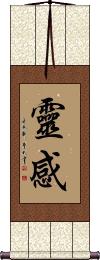
靈感 is the Chinese word closest to hitting the mark for the English word inspiration.
In a more extended context, I have even seen this translated as “brain wave.”
The first character means alert, departed soul, efficacious, quick, effective, or intelligent.
The second character means to feel, to move, to touch, or to affect.
The combined meaning of these two characters changes a bit, but I think it's nice to know the individual meanings to give you a better understanding of where a word comes from.
You could describe this word as “the thought that pops into your head just before you patent the greatest widget ever invented that everyone in the world will want.”
At least, that's the idea.
This term can also mean “intelligent thought” if you translate it directly from each character. If you are looking for inspiration or need to be inspired, this is the word for you.
 When the first character was absorbed into Japanese from Chinese, an alternate form became the standard in Japan. The Kanji shown to the right is the form currently used in Japan. This is still considered an alternate form in China to this day.
it’s
readable by both Chinese and Japanese people but if your audience is Japanese, I recommend the Kanji shown to the right - just click on that Kanji to order that version.
When the first character was absorbed into Japanese from Chinese, an alternate form became the standard in Japan. The Kanji shown to the right is the form currently used in Japan. This is still considered an alternate form in China to this day.
it’s
readable by both Chinese and Japanese people but if your audience is Japanese, I recommend the Kanji shown to the right - just click on that Kanji to order that version.
Inspire
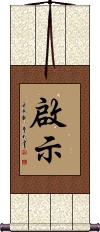
Beyond inspire or inspiration, 啟示 is a Chinese word that can mean enlightenment or revelation.
This is used as the Biblical revelation in the Chinese Bible, so it can also mean apocalypse depending on context.
Separately, the first character can mean: to open; to start; to initiate; to enlighten; to awaken; to state; to inform.
The second character alone can mean: to show; to reveal; to indicate; to proclaim.
Joushiki Wo Koeru
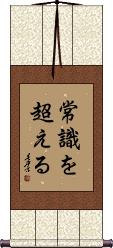
This Japanese phrase, “常識を超える” or “Jōshiki Wo Koeru” means “beyond common sense.”
常識 alone can be translated as “common sense,” “good sense,” “common knowledge”,“general knowledge,” “common practice,” “accepted practice,” or “social etiquette.”
The rest of the phrase indicates exceeding, overtaking, surpassing, transcending, or an idea of going beyond something.
More ways to translate this whole phrase:
Over what was known.
Surpassing common sense.
Beyond the ordinary.
Going beyond conventional knowledge.
Beyond conventional wisdom.
Note: Because this selection contains some special Japanese Hiragana characters, it should be written by a Japanese calligrapher.
Happy
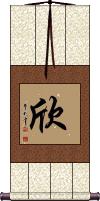
欣 is the type of happiness that you feel on the inside. It is the feeling of being released and delighted as well as being in a state of contentment. 欣 is more the internal happiness that perhaps only shows by the smile on your face. It can also be translated as “to take pleasure in” or “to rejoice.”
Note: 欣 is often used in compound words - especially in Korean Hanja.
As Japanese Kanji, this is so rare, that most Japanese people are not aware of its existence.
See Also: Happiness
Justice / Righteousness
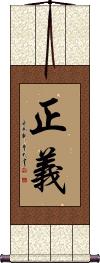
正義 means justice or righteousness in Chinese, Japanese Kanji, and old Korean Hanja.
Practicing justice and righteousness is being fair.
It solves problems, so everyone wins. You don't prejudge. You see people as individuals. You don't accept it when someone acts like a bully, cheats, or lies. Being a champion for justice takes courage. Sometimes when you stand for justice, you stand alone.
Note: This is also considered to be one of the Seven Heavenly Virtues.
Happy / Open Heart

In mordern times, 開心 means to feel happy, to rejoice, or to have a great time, but directly translates as open heart.
In the Buddhist context, beyond opening the heart, it can mean to develop the mind, to initiate into truth, or awaken the mind.
開 = Open.
心 = Heart/Mind.
Not commonly used in Japanese where it might be read as open-mindeness.
Kenpo / Kempo / Quan Fa / Chuan Fa
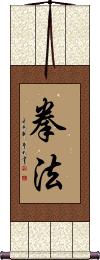
拳法 is a form of martial arts that can be translated in several ways.
Some will call it “fist principles,” “the way of the fist,” or even “law of the fist.” The first character literally means fist. The second can mean law, method, way, principle, or Buddhist teaching.
Kempo is really a potluck of martial arts. Often a combination of Chinese martial arts such as Shaolin Kung Fu with Japanese martial arts such as Karate, Jujutsu (Jujitsu), Aikido, and others. You may see the term “Kempo Karate,” which basically means Karate with other disciplines added. In this way, Kempo becomes an adjective rather than a title or school of martial arts.
These facts will long be argued by various masters and students of Kempo. Even the argument as to whether it should be spelled “kenpo” or “Kempo” ensues at dojos around the world (the correct Romaji should actually be “kenpou” if you precisely follow the rules).
The benefit of Kempo is that the techniques are easier to learn and master than pure Kung Fu (wu shu). Students are often taught basic Karate moves, kicks, and punches before augmenting the basic skills with complex Kung Fu techniques. This allows students of Kempo to achieve a level where they can defend themselves or fight in a relatively short amount of time (a few years rather than a decade or more).
Because the definition of this word is so fluid, I should make some notes here:
1. Purists in Okinawa will claim that “Okinawa Kenpo” or “Ryukyu Hon Kenpo” is the original and true version of this martial art from the old kingdom. It is actually little or no connection between Okinawa Kenpo and the way the word is used elsewhere.
2. In Chinese, where these characters are pronounced “quan fa” (sometimes Romanized as “chuan fa” because the Chinese-pinyin “q” actually sounds like an English “ch” sound), these characters do not hold the connotation of being a mixed martial art. It is simply defined as “the law of the fist.”
3. My Japanese dictionary oddly defines Kenpo as the “Chinese art of self-defense.” I personally don't feel this is the most common way that people perceive the word but just something you should know.
Kill / Slaughter / Murder / Butcher
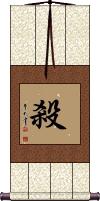
殺 is how to write “to kill” or “killing.”
殺 is an absolutely shocking word to have on a wall scroll. It will bewilder, scare, and perhaps offend any Chinese, Korean, or Japanese person who sees it. I do not in any way recommend this for a piece of calligraphy artwork. This entry is only here because our calligraphy search engine received so many requests for “kill.”
Note: In Korean Hanja, this character is not often used alone - see the other two-character entry for “kill.”
Kirin / Giraffe / Mythical Creature
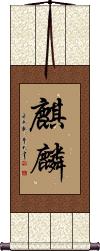
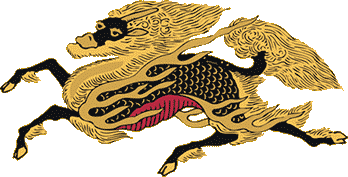
麒麟 is the title of a mythical beast of Asia.
The animal is thought to be related to the giraffe, and in some ways, it is a giraffe. However, it is often depicted with the horns of a dragon or deer and sometimes with the body like a horse, but many variations exist.
In Japanese, it is pronounced “Kirin” as in “Kirin Ichiban” beer.
Notes:
1. This is sometimes spelled as “kylin.”
2. In Japanese, this is the only Kanji word for giraffe. Therefore in Japan, this word needs context to know whether you are talking about the mythical creature or the long-necked giraffe of Africa.
3. Apparently, this was the first word used for regular giraffes in China (some were brought from Africa to China during the Ming Dynasty - probably around the year 1400). Though the mythical creature may have existed before, the name “qilin” was given to the “new giraffe.” This is because, more than 600 years ago, giraffes somewhat matched the mythical creature's description when Chinese people saw them for the first time. Later, to avoid such an ambiguous title, a three-character word was devised to mean a “giraffe of Africa.” The characters for “qilin” shown here are only for the mythological version in modern Chinese.
4. More information about the qilin / kirin from Wikipedia.
5. This creature is sometimes translated as the “Chinese Unicorn,” although it is generally portrayed with two horns. I think this is done more for the fantasy aspect of the unicorn and because most westerners don't know what a qilin or kirin is (this avoids a long explanation by the translator).
6. In Korean, this can mean kirin or simply giraffe (usually, the mythological creature is what they would think of when seeing these characters alone on a wall scroll).
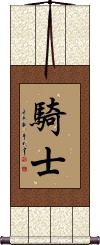
Knight
Perception of Knowledge
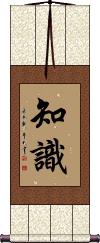
知識 has the very strong meaning of “knowledge” and, in some contexts, “learning.”
The first character represents “to know” or “to realize.”
The second character alone refers to the ability to “recognize” or “realize” and can also be used to mean “knowing.”
See Also: Wisdom | Learn From Wisdom
Koi Fish / Nishiki Goi
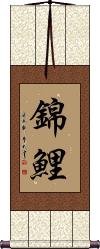
If you like or collect and maintain koi fish, 錦鯉 is the wall scroll for you.
Technically, this is a certain and revered species of “koi fish” in Japan, but it is the most normal selection for a wall scroll (more normal than the actual Kanji for “koi” or “fish” alone.
This literally means “brocade carp” or “embroidered carp.” This term is also used to mean the same thing in China (which is the origin of koi fish breeding and cultivation, several generations before they became popular in Japan).
For those of you that don't know, the Kanji for “koi” (which is pronounced “goi” in this entry) really means “carp.” If you want the word that means “koi fish,” it would just be the generic word for “carp fish.” That would include both colorful carp and the more mundane gray carp (the ones people eat if they don't mind lots of bones).
Laugh / Smile
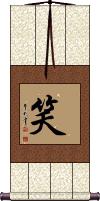
笑 simply means to laugh or smile.
Notes: In some contexts, it can mean “ridicule” in Korean Hanja. 笑 is not often seen alone in Japanese, though it is understood.
Lingering Mind
Zanshin
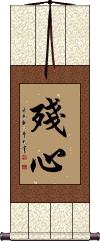
First off, 殘心 should only be used in the context of Japanese martial arts. In Chinese, it's a rather sad title (like a broken heart). In Chinese, the first character alone means destroyed, spoiled, ruined, injured, cruel, oppressive, savage, incomplete, or disabled. However, in Japanese, it's remainder, leftover, balance, or lingering.
The second character means heart, mind, soul, or essence in both languages.
殘心 is one of the five spirits of the warrior (budo) and is often used as a Japanese martial arts tenet. Under that context, places such as the Budo Dojo define it this way: The spirit of zanshin is the state of the remaining or lingering spirit. It is often described as a sustained and heightened state of awareness and mental follow-through. However, true zanshin is a state of focus or concentration before, during, and after the execution of a technique, where a link or connection between uke and nage is preserved. Zanshin is the state of mind that allows us to stay spiritually connected, not only to a single attacker but to multiple attackers and even an entire context; a space, a time, an event.
 In modern Japan (and Simplified Chinese), they use a different version of the first character, as seen to the right. Click on this character to the right instead of the button above if you want this modern Japanese version of lingering mind / zanshin.
Listen
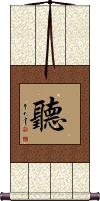
聽 means to listen, hear, and obey (depending on context).
聽 is a stand-alone word in Chinese but is usually seen in compound words in Korean. Therefore, this title is best for a Chinese audience.
 The ancient form of this character is shown in the upper left. However, there is a modern Japanese Kanji version shown to the right. If you want this modern Japanese version, please let us know when you place your order.
Lonely
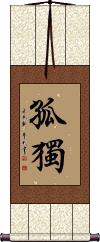
孤獨 means lonely, solitude, loneliness, and lonesome.
In some contexts, it can mean reclusive, isolated, single, or solo.
孤獨 is a Japanese word but not a good selection for a wall scroll.
In Chinese, this will relay a rather sad feeling to anyone who reads this calligraphy on your wall.
The version shown to the left is the Traditional Chinese and ancient Japanese version. In modern Japan and China they often use a different more simplified version of the second character (as shown to the right). If you want this Japanese/Simplified version, please click on the character shown to the right instead of the button above.
Lost / Dazed and Confused
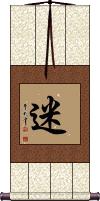
迷 is one of those characters that can mean a lot of different things depending on context. When written alone, as a single character on a wall scroll, it opens up the possibilities and allows you to decide what it means to you.
The key definition is “to be lost.” This could be physically or mentally lost. It can be someone lost in their thoughts, lost in an ocean, or just confused about where they are. The reason for the confused state may be due to internal or external reasons.
Here are some entries from various Asian dictionaries...
Chinese: lost, confused, bewilder, crazy about, fan, enthusiast, mystery.
Japanese: lost, astray, perplexed, in doubt, err, illusion.
Korean: lost, bewildered, fascinated, deluded.
Lonely Soul / Lost Soul
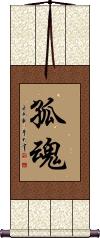
孤魂 is a Chinese title that means “lonely soul.”
In the context of being a soul without a mate or all alone, this can be translated as a “lost soul.”
Love and Hate
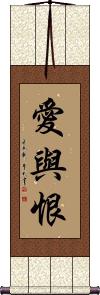
Whether you want to make a joke about what marriage really is or just feel that the world is full of love and hate, this selection is for you.
愛與恨 happens to literally translate. So the first character is love. The middle character is a connecting particle-like “and” in English. The last character is hate.
Upon request, we can omit the “and” character and just put a dot to separate love and hate if you prefer.
Loyalty to Duty or Master
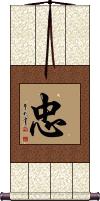
忠 is the simplest way to write the word loyalty in Chinese and Japanese.
A single character like this leaves the meaning open. But alone, a Chinese or Japanese person would think of loyalty to duty or loyalty to one's master (in ancient times). I suppose that it could be loyalty to your boss or company in this day in age.
忠 can also mean fidelity or faithfulness.
This can also be romanized as “chung.”
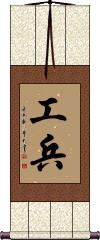
Military Engineering
Missing / Yearning
I miss you
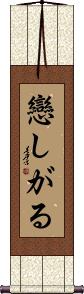
戀しがる is the most common Japanese verb for missing someone or yearning for someone (it could also be missing a place).
戀しがる is the shortest way to say, “I miss you” or “I yearn for you” in Japanese.
Breaking down the characters:
恋し (koishi) yearned for; longed for; missed (acts as an adjective in Japanese).
がる (garu) to feel, behavior (this represents emotion and turns the whole word into a verb in Japanese).
Note: Because this selection contains some special Japanese Hiragana characters, it should be written by a Japanese calligrapher.
Sensei / Master / Teacher / Mister
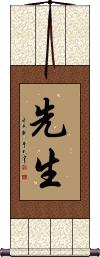
先生 is sensei, which is associated in the west with a master or instructor of karate, aikido, judo, and other Japanese martial arts.
In reality, this is a term of respect for almost any professional or skilled person (doctor, lawyer, teacher, etc.). Sometimes, it is used for musicians and artists who have achieved a certain level of fame, skill, or accomplishment.
It should be noted that this is also a courtesy title in Chinese but more like calling someone “mister” or “gentleman.” It doesn't have the “master” or “teacher” meaning in Chinese - see our Chinese “Master / Sifu / Shi Fu” entry if your audience is Chinese.
In Korean Hanja, this means teacher, instructor, schoolmaster, or schoolmistress.
This entry is for educational purposes. 先生 is kind of a strange thing to put on a wall scroll. It's a title that is used more orally to show respect rather than something written in calligraphy. If you feel it is appropriate in your circumstances, we will create a piece of sensei Japanese calligraphy artwork for you.
Mother and Son
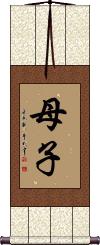
母子 simply means “mother and son,” or the essence of the relationship and bond between mother and son.
母子 is really a single word that expresses this idea (showing how important or significant this bond is).
This is not the most common choice for a wall scroll, it is acceptable if you feel this term is important to you.
See Also: Mother and Daughter
Mountain Travels Poem by Dumu

This poem was written almost 1200 years ago during the Tang dynasty.
It depicts traveling up a place known as Cold Mountain, where some hearty people have built their homes. The traveler is overwhelmed by the beauty of the turning leaves of the maple forest that surrounds him just as night overtakes the day, and darkness prevails. His heart implores him to stop, and take in all of the beauty around him.
First, before you get to the full translation, I must tell you that Chinese poetry is a lot different than what we have in the west. Chinese words simply don't rhyme in the same way that English or other western languages do. Chinese poetry depends on rhythm and a certain beat of repeated numbers of characters.
I have done my best to translate this poem keeping a certain feel of the original poet. But some of the original beauty of the poem in its original Chinese will be lost in translation.
Far away on Cold Mountain, a stone path leads upwards.
Among white clouds, people's homes reside.
Stopping my carriage I must, as to admire the maple forest at nights fall.
In awe of autumn leaves showing more red than even flowers of early spring.
Hopefully, this poem will remind you to stop, and “take it all in” as you travel through life.
The poet's name is “Du Mu” in Chinese that is: 
 .
.
The title of the poem, “Mountain Travels” is: 

You can have the title, poet's name, and even “Tang Dynasty” written as an inscription on your custom wall scroll if you like.
More about the poet:
Dumu lived from 803-852 AD and was a leading Chinese poet during the later part of the Tang dynasty.
He was born in Chang'an, a city in central China and the former capital of the ancient Chinese empire in 221-206 BC. In present-day China, his birthplace is currently known as Xi'an, the home of the Terracotta Soldiers.
He was awarded his Jinshi degree (an exam administered by the emperor's court which leads to becoming an official of the court) at the age of 25 and went on to hold many official positions over the years. However, he never achieved a high rank, apparently because of some disputes between various factions, and his family's criticism of the government. His last post in the court was his appointment to the office of Secretariat Drafter.
During his life, he wrote scores of narrative poems, as well as a commentary on the Art of War and many letters of advice to high officials.
His poems were often very realistic and often depicted everyday life. He wrote poems about everything, from drinking beer in a tavern to weepy poems about lost love.
The thing that strikes you most is the fact even after 1200 years, not much has changed about the beauty of nature, toils, and troubles of love and beer drinking.
North American Opossum / Possum
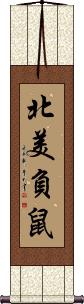
北美負鼠 is the full title for North American Opossum (aphesis spelling: Possum). The first two characters mean “North American” as an adjective. The third character means “carries” and refers to the marsupial pouch. The last character means “rat.” You could say the literal translation is “marsupial rat.”
Chinese opossums vary from the North American variety. If you were to use the last two characters alone, it may suggest the species native to China.
See Also: Year of the Rat
Better Late Than Never
It's Never Too Late Too Mend
Long ago in what is now China, there were many kingdoms throughout the land. This time period is known as “The Warring States Period” by historians because these kingdoms often did not get along with each other.
Sometime around 279 B.C. the Kingdom of Chu was a large but not particularly powerful kingdom. Part of the reason it lacked power was the fact that the King was surrounded by “yes men” who told him only what he wanted to hear. Many of the King's court officials were corrupt and incompetent which did not help the situation.
The King was not blameless himself, as he started spending much of his time being entertained by his many concubines.
One of the King's ministers, Zhuang Xin, saw problems on the horizon for the Kingdom, and warned the King, “Your Majesty, you are surrounded by people who tell you what you want to hear. They tell you things to make you happy and cause you to ignore important state affairs. If this is allowed to continue, the Kingdom of Chu will surely perish, and fall into ruins.”
This enraged the King who scolded Zhuang Xin for insulting the country and accused him of trying to create resentment among the people. Zhuang Xin explained, “I dare not curse the Kingdom of Chu but I feel that we face great danger in the future because of the current situation.” The King was simply not impressed with Zhuang Xin's words.
Seeing the King's displeasure with him and the King's fondness for his court of corrupt officials, Zhuang Xin asked permission from the King that he may take leave of the Kingdom of Chu, and travel to the State of Zhao to live. The King agreed, and Zhuang Xin left the Kingdom of Chu, perhaps forever.
Five months later, troops from the neighboring Kingdom of Qin invaded Chu, taking a huge tract of land. The King of Chu went into exile, and it appeared that soon, the Kingdom of Chu would no longer exist.
The King of Chu remembered the words of Zhuang Xin and sent some of his men to find him. Immediately, Zhuang Xin returned to meet the King. The first question asked by the King was “What can I do now?”
Zhuang Xin told the King this story:
A shepherd woke one morning to find a sheep missing. Looking at the pen saw a hole in the fence where a wolf had come through to steal one of his sheep. His friends told him that he had best fix the hole at once. But the Shepherd thought since the sheep is already gone, there is no use fixing the hole.
The next morning, another sheep was missing. And the Shepherd realized that he must mend the fence at once. Zhuang Xin then went on to make suggestions about what could be done to reclaim the land lost to the Kingdom of Qin, and reclaim the former glory and integrity of the Kingdom of Chu.
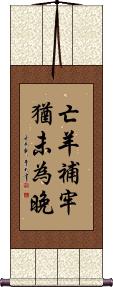
The Chinese idiom shown above came from this reply from Zhuang Xin to the King of Chu almost 2,300 years ago.
It translates roughly into English as...
“Even if you have lost some sheep, it's never too late to mend the fence.”
This proverb, 亡羊补牢犹未为晚, is often used in modern China when suggesting in a hopeful way that someone change their ways, or fix something in their life. It might be used to suggest fixing a marriage, quitting smoking, or getting back on track after taking an unfortunate path in life among other things one might fix in their life.
I suppose in the same way that we might say, “Today is the first day of the rest of your life” in our western cultures to suggest that you can always start anew.
Note: This does have Korean pronunciation but is not a well-known proverb in Korean (only Koreans familiar with ancient Chinese history would know it). Best if your audience is Chinese.
Ocean
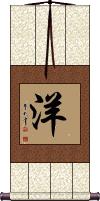
This is the Chinese and old Korean Hanja word for ocean. This can be pronounced in Japanese, and has the same meaning but is rarely seen alone in Japanese.
Besides ocean or sea, this character can also mean foreign, wide, or vast.
It's more common for Chinese people to use a different word “hai” for ocean or sea.
Opportunity
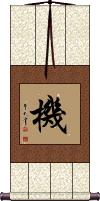
機 is an odd one - I've seen this on coffee cups and posters with the meaning of “opportunity.”
機 is a correct definition but this character also means “machine.” In fact, if you put the character for “flying” in front of this character, you have the Chinese word for “airplane” (literally: flying machine). Alone, on a wall scroll, it will be generally understood as “opportunity” but I want you to know this extra information before you make your selection. Note that in Japanese and Korean, this has a similar meaning but can also mean machine or loom.
See Also: Success
Orna
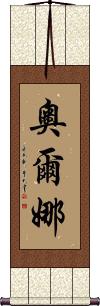
奧爾娜 is a secondary way to transliterate the name Orna into Mandarin Chinese.
While this is not the most popular way, we feel the pronunciation is closer with proper emphasis on the “r” sound within “Orna.”
Patience / Perseverance
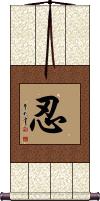
忍 contains the ideas of patience, equanimity, perseverance, forbearance, and endurance. Alone, this single character can be a bit ambiguous or flexible. It can also mean to endure, to bear, to put up with, or to conceal. If you want to simply decide what this character means to you within the general meaning but keep it a mystery to others, this is a good choice.
If you want to be more direct, you may want to choose one of our other selections that mean perseverance or patience (you will see this character within those larger words/phrases).
There is a secondary meaning in Japanese since this is the first character of the word ninja. Note that when writing this as Kanji, Japanese will tend to write it in the form shown to the right. If you select our Japanese master calligrapher, please expect this Kanji form (yes, it's just one stroke that is slightly different in location, crossing another stroke in the Japanese Kanji form).
See Also: Perseverance | Patience | Tenacious
Peace and Love
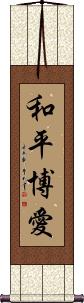
和平博愛 is the Chinese and Japanese way to express “Peace and Love.”
These are two separate words, so the calligrapher will put a slight space between the first two characters, which mean peace, and the last two, which represent universal love. This space is not shown on the sample character images for this phrase.
A special note: Word lists may seem okay in English but feel strange in Chinese and Japanese. We don't offer too many of them but this one is often-requested and feels okay in Chinese and Japanese, though a bit uncommon in Korean.
Peace of Mind
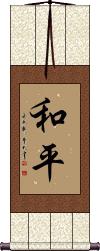
和平 is the Chinese order for these two characters, which means peace but can also be translated as amicability, specifically, or mildness. 和平 is often translated as a simple way to say “peace of mind.” This combination is used in Korean Hanja to mean “peace and harmony.”
Alone, the first character means peace and harmony.
The second character means balance when read by itself.
Note: 和平 are often seen in the opposite order in Japanese with the same meaning (You'll sometimes find them in this order in Japan, so either way is OK).
Phenomenon
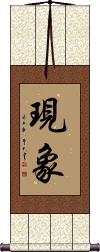
I must first say that 現象 is an odd thing to put on a wall scroll in Asian cultures. It won't make a lot of sense alone unless you have a special or personal meaning that you attach to it for yourself.
These two characters mean phenomenon in Chinese, Japanese, and Korean Hanja. They can also be translated as “a happening,” depending on context.
The sum of these characters is a little different than their individual meanings. But I will break it down anyway...
The first character means present, existing, actual, apparent, now, or current.
The second character alone means pattern after, imitate, image, shape, sign (of the times), form, appearance, to be like, to resemble, to take after, to seem, or elephant.
Mantis / Praying Mantis
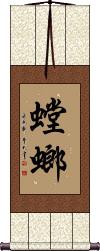
螳螂 is mantis or “praying mantis,” as it's often titled in English.
Technically speaking, this especially applies to the narrow-winged mantis (Tenodera angustipennis)
It is best to use this very common two-character Asian title for the mantis, as the second character alone can mean mantis or dragonfly (totally ambiguous).
This title is antiquated in Japanese, as they tend to write カマキリ (kama kiri) in Katakana to mean praying mantis.
 Note: There is an alternate form of this title which uses the character shown to the right instead of the first character shown above. This is uncommon in both Japan and China (if you really want it anyway, please let us know).
Pride
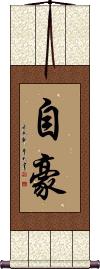
自豪 is used to convey “feeling a sense of pride.”
This can be the pride you feel in yourself or the sense of pride in belonging to a certain group, team, or organization.
Purified Spirit / Enlightened Attitude
A Japanese martial arts title/concept
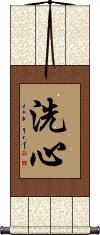
The first Kanji alone means to wash, bathe, primness, cleanse or purify.
The second Kanji means heart, mind, soul, or essence.
Together, these two Kanji create a word defined as “purified spirit” or “enlightened attitude” within Japanese martial arts.
洗心 is one of the five spirits of the warrior (budo) and is often used as a Japanese martial arts tenet. Under that context, it's often defined as a spirit that protects and harmonizes the universe. Senshin is a spirit of compassion that embraces and serves all humanity and whose function is to reconcile discord in the world. It holds all life to be sacred. It is the Buddha mind.
This title will only be familiar to Japanese who practice certain martial arts. Others may not recognize this word at all.
洗心 does not show up as a word in too many Chinese dictionaries, but it can be read and has the same meaning in Chinese.
 There is an issue with the first character. The original, and probably most correct version is shown above. However, many dojo documents and other sources have used a more simple first character. Arguments ensue about which version is correct. If you want to be correct in the Japanese language, use the "Select and Customize" button above. If you want to match the Kanji used by your dojo, click the Kanji shown to the right. There is a slightly different meaning with this first character which means before, ahead, previous, future, precedence.
Radiance / Rays of Light
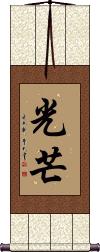
光芒 is the Chinese, Japanese Kanji, and old Korean Hanja for radiance meaning rays of light, brilliant rays, beams of light, etc.
光芒 is the radiance you feel when the sun hits your face in the morning, bringing you warmth while kickstarting your vitamin D production.
Reiki
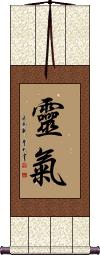
靈氣 is the title of a healing practice now found globally but with origins in Japan.
Special note: Outside of the context of the healing practice of Reiki, this means “aura” or “spiritual essence that surrounds all living things.” A Japanese person unfamiliar with the practice will take the “aura” meaning.
Reiki is a technique for stress reduction and relaxation that also heals. It can be compared to massage but is based on the idea that an unseen “life force energy” flows through us and is what causes us to be alive. If your life force energy is low, you'll be more likely to get sick or feel stressed. If your life force energy is abundant and flowing well, you become more capable of being happy and healthy.
There is a lot of information available if you want to Google this term - my job is to offer the calligraphy while you can decide if it is right for you.
Note: We are showing the ancient (traditional) form of the Reiki Kanji. I have seen Reiki written with the slightly simplified version and this more classic form. If you want the form of Reiki with the two strokes in the shape of an X on the second character and the modern first character, simply click on the Kanji characters to the right.
Note: 靈氣 is also a Chinese word, but in Chinese, these characters create a word that refers to a smart person or someone with high aspirations. It is not read as a healing method in Chinese.
In Korean Hanja, this can be read as a “mysterious atmosphere” by a Korean who is not familiar with the practice of Reiki (still has a cool meaning in Korean).
Reiki - Master Symbol
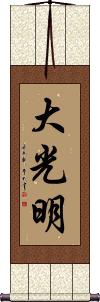
大光明 is the master symbol “Daikomyo” or “Dai Ko Myo,” which is usually associated with the healing practice of Reiki.
This title can be translated as “Great Bright Light.” This symbol, as used in Reiki, alludes to “Enlightened Nature” or the radiance of a purified soul or deity.
Pronunciations in Chinese and Korean are included above but this title has no meaning except when used by a Reiki practitioner. In fact, this title is not that well known by those outside the Reiki community in Japan.
In Chinese, this would be interpreted as “Great Bright Future” (the second two characters alone create a word that means “bright future” in Chinese).
This in-stock artwork might be what you are looking for, and ships right away...
Gallery Price: $100.00
Your Price: $49.77


Successful Chinese Character and Japanese Kanji calligraphy searches within the last few hours...



