Many custom options...


And formats...



Not what you want?
Try other similar-meaning words, fewer words, or just one word.
I Really Love You in Chinese / Japanese...
Buy an I Really Love You calligraphy wall scroll here!
Personalize your custom “I Really Love You” project by clicking the button next to your favorite “I Really Love You” title below...
1. Best Love / Most Sincere Love
3. Appreciation and Love for Your Parents
4. Unicorn
Best Love / Most Sincere Love
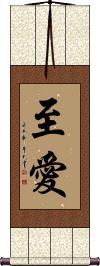
至愛 can mean the best love or most sincere love of your life.
This could be a romantic love such as your love for your spouse or a boyfriend/girlfriend.
It can also apply to the extreme love you have for your children or a parent and maybe a really good friend.
See Also: I Love You
Best Love / Most Sincere Love
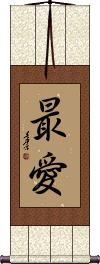
最愛 is a Japanese word that means the best love, beloved, or most sincere love of your life.
This could be a romantic love such as your love for your spouse or a boyfriend/girlfriend.
It can also apply to the extreme love you have for your children or a parent and maybe a really good friend.
Love and Hate
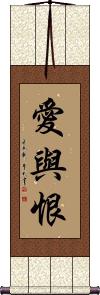
Whether you want to make a joke about what marriage really is or just feel that the world is full of love and hate, this selection is for you.
愛與恨 happens to literally translate. So the first character is love. The middle character is a connecting particle-like “and” in English. The last character is hate.
Upon request, we can omit the “and” character and just put a dot to separate love and hate if you prefer.
Love and Hate
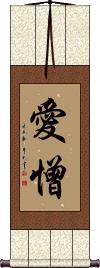
愛憎 is a weird selection for a calligraphy wall scroll. But if you really want it, we'll do it.
This version is most appropriate if your audience is Japanese or Korean (for Koreans who can read the ancient Korean Hanja).
The first character means love or affection.
The second character means hate, dislike, detest, or loathe.
Appreciation and Love for Your Parents
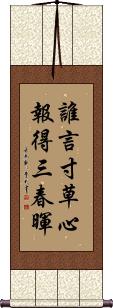
誰言寸草心報得三春暉 is the last line of a famous poem. It is perceived as a tribute or ode to your parents or mother from a child or children that have left home.
The poem was written by Meng Jiao during the Tang Dynasty (about 1200 years ago). The Chinese title is “You Zi Yin” which means “The Traveler's Recite.”
The last line as shown here speaks of the generous and warm spring sunlight which gives the grass far beyond what the little grass can could ever give back (except perhaps by showing its lovely green leaves and flourishing). The metaphor is that the sun is your mother or parents, and you are the grass. Your parents raise you and give you all the love and care you need to prepare you for the world. A debt that you can never repay, nor is repayment expected.
The first part of the poem (not written in the characters to the left) suggests that the thread in a loving mother's hands is the shirt of her traveling offspring. Vigorously sewing while wishing them to come back sooner than they left.
...This part is really hard to translate into English that makes any sense but maybe you get the idea. We are talking about a poem that is so old that many Chinese people would have trouble reading it (as if it was the King James Version of Chinese).
Unicorn
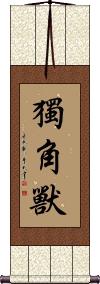
獨角獸 is the Chinese name for the western unicorn (a horse with a spiral horn emerging from the head).
獨角獸 is an unusual title for a Chinese wall scroll, but it's OK if you really love unicorns.
Chinese have their own ancient unicorn-like creature called a “qilin” (or kirin in Japanese).
Unicorn
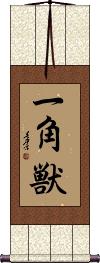
一角獣 is the Japanese name for the western unicorn (a horse with a spiral horn emerging from the head). This can also refer to a narwhal, depending on context.
一角獣 is an unusual title for a Japanese wall scroll but it's OK if you really love unicorns.
Japanese have their own ancient unicorn-like creature called a “kirin” (or qilin in the original Chinese).
Zendo / The Zen Way
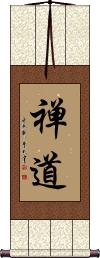
禪道 is a title used in certain contexts but is not widely known by the general population of China or Japan.
In Japanese, you will see this title romanized as “zendo,” which is the brand name of a board game, and also a title used by some martial arts studios and karate dojos. Oddly, many translate this as “zen fist,” although there is no “fist” in the title. If you literally translated this title, it would be “meditation way” or “meditation method.”
In Chinese, this would be “chan dao” with the same literal meaning as the Japanese title. It's used in China by just a handful of martial arts styles/studios.
You should only order this title if you really understand the meaning, and it has some personal connection to you (such as practicing a martial art style that uses this title, or if you love the board game Zendo). Many who see your wall scroll will not be familiar with this title, and you'll have some explaining to do.
 The first character can also be written in a more complex traditional way as shown to the right. Let us know in the special instructions for your calligraphy project if you want this style.
 If you order this from the Japanese master calligrapher, the first character will automatically be written with an extra dot on top. This is the variant form of the original Chinese character which is commonly used in modern Japan Kanji. See sample to the right.
Daodejing / Tao Te Ching - Excerpt
Excerpt from Chapter 67
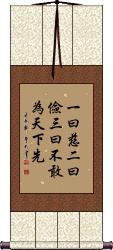
一曰慈二曰儉三曰不敢為天下先 is an excerpt from the 67th Chapter of Lao Tzu's (Lao Zi's) Te-Tao Ching (Dao De Jing).
This is the part where the three treasures are discussed. In English, we'd say these three treasures are compassion, frugality, and humility. Some may translate these as love, moderation, and lack of arrogance. I have also seen them translated as benevolence, modesty, and “Not presuming to be at the forefront in the world.” You can mix them up the way you want, as translation is not really a science but rather an art.
I should also explain that the first two treasures are single-character ideas, yet the third treasure was written out in six characters (there are also some auxiliary characters to number the treasures).
If Lao Tzu's words are important to you, then a wall scroll with this passage might make a great addition to your home.
A Journey of 1000 Miles Feels Like One
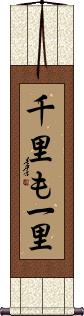
千里も一里 is a Japanese proverb that states “A journey of a thousand miles feels like only one mile.” It is understood that in the proverb, this applies when going to see the one you love.
Note that the “mile” or 里 used in this proverb is an old Chinese “li” (pronounced “ri” in Japanese). It's not actually a mile, as the measurement is really closer to 500 meters (it would take 3 of these to get close to a western mile). Still, 1000里 (333 miles) is a long way.
This in-stock artwork might be what you are looking for, and ships right away...
Gallery Price: $108.00
Your Price: $59.88

Gallery Price: $61.00
Your Price: $33.88

Gallery Price: $61.00
Your Price: $33.88
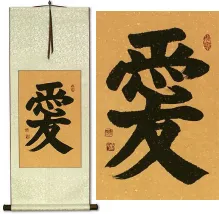
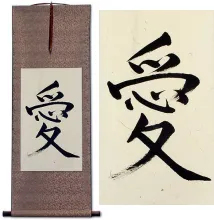
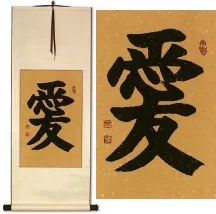
Gallery Price: $87.50
Your Price: $39.00

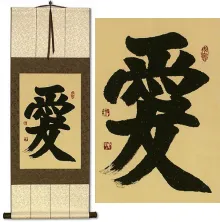

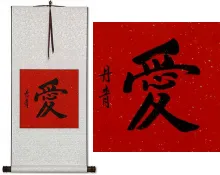
Gallery Price: $65.00
Your Price: $39.88
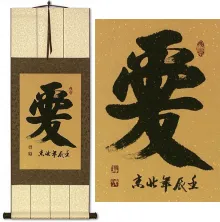

Gallery Price: $200.00
Your Price: $122.88
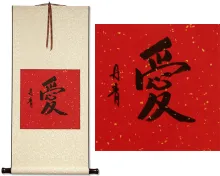
Gallery Price: $65.00
Your Price: $39.88
The following table may be helpful for those studying Chinese or Japanese...
| Title | Characters | Romaji (Romanized Japanese) | Various forms of Romanized Chinese | |
| Best Love Most Sincere Love | 至愛 至爱 | zhì ài / zhi4 ai4 / zhi ai / zhiai | chih ai / chihai | |
| Best Love Most Sincere Love | 最愛 | moai | ||
| Love and Hate | 愛與恨 爱与恨 | ài yǔ hèn ai4 yu3 hen4 ai yu hen aiyuhen | ai yü hen aiyühen |
|
| Love and Hate | 愛憎 爱憎 | ai zou / aizou / ai zo | ài zèng / ai4 zeng4 / ai zeng / aizeng | ai tseng / aitseng |
| Appreciation and Love for Your Parents | 誰言寸草心報得三春暉 谁言寸草心报得三春晖 | shuí yán cùn cǎo xīn bào dé sān chūn huī shui2 yan2 cun4 cao3 xin1 bao4 de2 san1 chun1 hui1 shui yan cun cao xin bao de san chun hui | shui yen ts`un ts`ao hsin pao te san ch`un hui shui yen tsun tsao hsin pao te san chun hui |
|
| Unicorn | 獨角獸 独角兽 | dú jiǎo shòu du2 jiao3 shou4 du jiao shou dujiaoshou | tu chiao shou tuchiaoshou |
|
| Unicorn | 一角獣 | ikkakujuu / ikakuju | ||
| Zendo The Zen Way | 禅道 / 禪道 禅道 | zen dou / zendou / zen do | chán dào / chan2 dao4 / chan dao / chandao | ch`an tao / chantao / chan tao |
| Daodejing Tao Te Ching - Excerpt | 一曰慈二曰儉三曰不敢為天下先 一曰慈二曰俭三曰不敢为天下先 | yī yuē cí èr yuē jiǎn sān yuē bù gǎn wéi tiān xià xiān yi1 yue1 ci2 er4 yue1 jian3 san1 yue1 bu4 gan3 wei2 tian1 xia4 xian1 yi yue ci er yue jian san yue bu gan wei tian xia xian | i yüeh tz`u erh yüeh chien san yüeh pu kan wei t`ien hsia hsien i yüeh tzu erh yüeh chien san yüeh pu kan wei tien hsia hsien |
|
| A Journey of 1000 Miles Feels Like One | 千里も一里 | sen ri mo ichi ri senrimoichiri | ||
| In some entries above you will see that characters have different versions above and below a line. In these cases, the characters above the line are Traditional Chinese, while the ones below are Simplified Chinese. | ||||

Successful Chinese Character and Japanese Kanji calligraphy searches within the last few hours...



