Many custom options...


And formats...



Not what you want?
Try other similar-meaning words, fewer words, or just one word.
I Stand Alone in Chinese / Japanese...
Buy an I Stand Alone calligraphy wall scroll here!
Personalize your custom “I Stand Alone” project by clicking the button next to your favorite “I Stand Alone” title below...
Independent Spirit
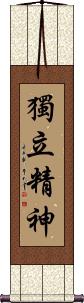
獨立精神 means independent spirit in Chinese.
The first two characters mean independent, independence, or to stand alone.
The last two characters mean spirit, spiritual, vigor, vitality, drive, mind, consciousness, thought, essence, heart, or soul.
With this information, you can make your translation combination such as “independent heart,” “stand-alone spirit,” or more creatively, “the drive to stand alone” in English. There are a lot of ways to interpret 獨立精神.
Independence
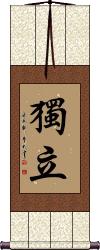
Besides meaning “to be independent,” this can also mean “to stand alone,” self-reliance or self-support.
 Modern Japanese use a simplified version of the first character of independence.
it’s
the same simplified version currently used in mainland China, so understood by most Chinese and all Japanese people. Click on the character to the right if you want the simplified/Japanese version.
Modern Japanese use a simplified version of the first character of independence.
it’s
the same simplified version currently used in mainland China, so understood by most Chinese and all Japanese people. Click on the character to the right if you want the simplified/Japanese version.
Justice / Righteousness
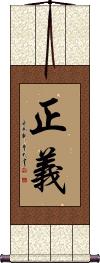
正義 means justice or righteousness in Chinese, Japanese Kanji, and old Korean Hanja.
Practicing justice and righteousness is being fair.
It solves problems, so everyone wins. You don't prejudge. You see people as individuals. You don't accept it when someone acts like a bully, cheats, or lies. Being a champion for justice takes courage. Sometimes when you stand for justice, you stand alone.
Note: This is also considered to be one of the Seven Heavenly Virtues.
Listen
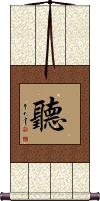
聽 means to listen, hear, and obey (depending on context).
聽 is a stand-alone word in Chinese but is usually seen in compound words in Korean. Therefore, this title is best for a Chinese audience.
 The ancient form of this character is shown in the upper left. However, there is a modern Japanese Kanji version shown to the right. If you want this modern Japanese version, please let us know when you place your order.
Diligence
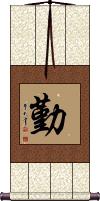
勤 is a single character that means diligence or “sense of duty” in Chinese and Korean (also understood in Japanese but not commonly seen as a stand-alone Kanji).
As a single character on a wall scroll, this will only be seen with this meaning. However, it can also mean industrious, hardworking, frequent, regular, constant, energy, zeal, fortitude, or virility.
In Buddhism, this can represent vīrya (viriya), the idea of energy, diligence, enthusiasm, or effort. It can be defined as an attitude of gladly engaging in wholesome activities, and it functions to cause one to accomplish wholesome or virtuous actions. Some Buddhists may even define this as “manliness” (a definition from a hundred years ago, before equality).
If you or someone you know is a hard worker (or needs a reminder to be diligent), then this is the wall scroll to have in your/their office.
Indomitable / Unyielding
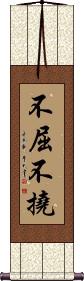
不屈不撓 means “Indomitable” or “Unyielding.”
不屈不撓 is a long word by Chinese standards. At least, it is often translated as a single word into English. It's actually a proverb in Chinese.
If you want to break it down, you can see that the first and third characters are the same. Both mean “not” (they work as a suffix to make a negative or opposite meaning to whatever character follows).
The second character means “bendable.”
The last means “scratched” or “bothered.”
So this really means “Won't be bent, can't be bothered.” I have also seen it written as “Will not crouch, will not submit.” This comes from the fact that the second character can mean “to crouch” and the last can mean “to submit” (as in “to give in” such as “submitting to the rule of someone else”). This may explain better why these four characters mean “indomitable.”
Notes:
Some will translate this as “indomitable spirit”; however, technically, there is no character to suggest the idea of “spirit” in this word.
Other translations include indefatigability, indomitableness, or unremitting tenacity.
The first two characters can be stand-alone words in Chinese.
In Japanese, this is considered two words (with very similar meanings). It's more common to see the word order flipped to 不撓不屈 in Japanese.
The same characters are used in old Korean Hanja. Just like in Japanese, the words are swapped to 不撓不屈 creating a word pronounced “불요불굴” in Korean.
See 不撓不屈
This in-stock artwork might be what you are looking for, and ships right away...
Not the results for i stand alone that you were looking for?
Below are some entries from our dictionary that may match your i stand alone search...
| Characters If shown, 2nd row is Simp. Chinese |
Pronunciation Romanization |
Simple Dictionary Definition |
獨立 独立 see styles |
dú lì du2 li4 tu li |
More info & calligraphy: IndependenceSee: 独立 |
コラム see styles |
goramu ゴラム |
More info & calligraphy: Collum |
孑立 see styles |
jié lì jie2 li4 chieh li |
to be alone; to stand in isolation |
一戸建 see styles |
ikkodate いっこだて |
(irregular okurigana usage) detached house; stand-alone house; single-family home |
自立型 see styles |
jiritsugata じりつがた |
{comp} stand-alone |
一戸建て see styles |
ikkodate いっこだて |
detached house; stand-alone house; single-family home |
孑立無依 孑立无依 see styles |
jié lì wú yī jie2 li4 wu2 yi1 chieh li wu i |
to stand alone; to have no one to rely on |
煢煢孑立 茕茕孑立 see styles |
qióng qióng jié lì qiong2 qiong2 jie2 li4 ch`iung ch`iung chieh li chiung chiung chieh li |
to stand all alone |
スタンドアロン see styles |
sutandoaron スタンドアロン |
(n,adj-f) (computer terminology) standalone; stand-alone |
スタンドアローン see styles |
sutandoaroon スタンドアローン |
(n,adj-f) (computer terminology) standalone; stand-alone |
Variations: |
dokuritsugata どくりつがた |
(adj-no,n) freestanding; stand-alone |
Variations: |
ikkodate いっこだて |
detached house; stand-alone house; single-family home |
Variations: |
shawaabuusu; shawaa buusu / shawabusu; shawa busu シャワーブース; シャワー・ブース |
shower stall (without bathtub) (wasei: shower booth); enclosed shower; stand-alone shower |
Variations: |
sutandoaron; sutandoaroon スタンドアロン; スタンドアローン |
(can be adjective with の) {comp} standalone; stand-alone |
The following table may be helpful for those studying Chinese or Japanese...
| Title | Characters | Romaji (Romanized Japanese) | Various forms of Romanized Chinese | |
| Independent Spirit | 獨立精神 独立精神 | dú lì jīng shén du2 li4 jing1 shen2 du li jing shen dulijingshen | tu li ching shen tulichingshen |
|
| Independence | 獨立 独立 | dokuritsu | dú lì / du2 li4 / du li / duli | tu li / tuli |
| Justice Righteousness | 正義 正义 | sei gi / seigi | zhèng yì / zheng4 yi4 / zheng yi / zhengyi | cheng i / chengi |
| Listen | 聽 听 / 聴 | chou / ki / cho / ki | tīng / ting1 / ting | t`ing / ting |
| Diligence | 勤 | kin | qín / qin2 / qin | ch`in / chin |
| Indomitable Unyielding | 不屈不撓 不屈不挠 | fu kutsu fu tou fukutsufutou fu kutsu fu to | bù qū bù náo bu4 qu1 bu4 nao2 bu qu bu nao buqubunao | pu ch`ü pu nao puchüpunao pu chü pu nao |
| In some entries above you will see that characters have different versions above and below a line. In these cases, the characters above the line are Traditional Chinese, while the ones below are Simplified Chinese. | ||||

Successful Chinese Character and Japanese Kanji calligraphy searches within the last few hours...



