Many custom options...


And formats...



Not what you want?
Try other similar-meaning words, fewer words, or just one word.
Infinity Symbol in Chinese / Japanese...
Buy an Infinity Symbol calligraphy wall scroll here!
Personalize your custom “Infinity Symbol” project by clicking the button next to your favorite “Infinity Symbol” title below...
2. Infinity / Infinite / Unlimited / Unbounded
3. Infinity / Infinite / Endless / Boundless
6. Eternity / Always and Forever
To Infinity and Beyond
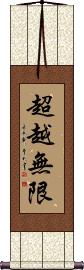
超越無限 means “to infinity and beyond,” in Chinese.
This is how the slogan/phrase from Toy Story's Buzz Lightyear was translated from the movie into Chinese.
To Infinity and Beyond
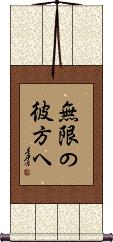
無限の彼方へ means “to infinity and beyond,” in Japanese.
This is how the slogan/phrase from Toy Story's Buzz Lightyear was translated from the movie into Japanese.
Note: Because this selection contains some special Japanese Hiragana characters, it should be written by a Japanese calligrapher.
Infinity / Infinite / Unlimited / Unbounded
Japanese = Infinity / Chinese = No limits
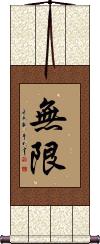
無限 is the Chinese and Japanese word meaning infinity, unlimited or unbounded.
無限 literally translates as “without limits” or “without [being] bound.”
The first character means “never” or “not,” like the prefix “un-.”
The second means “limited,” “restricted,” or “bound.”
Please note that the Japanese definition leans more toward “infinity” and the Chinese is more about being “boundless” or “without limits.”
In Korean, this means infinity, infinitude, or boundlessness. But in Korean, this term has many interpretations or contexts, so your intended meaning might be vague or ambiguous.
Infinity / Infinite / Endless / Boundless
(Chinese / Korean)
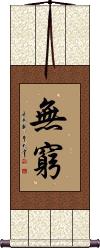
無窮 is the Chinese and Korean word meaning infinity, eternity, infinitude, infinite or endless.
無窮 literally translates as “without [ever becoming] exhausted/poor,” and in that context, can mean “inexhaustible” or “boundless” but this is usually read as “without end.” Some extended definitions include eternity, infinitude, or immortality.
In certain contexts, it can mean “immortality.”
The first character means “never” or “not.” The second means “exhausted,” “finished,” or “ending.”
Note: 無窮 is a Japanese word but rarely used in modern Japan.
Eternity / Forever
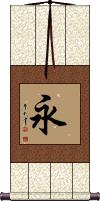
永 is the simplest form of eternity or “always and forever.”
永 can sometimes mean forever, always, perpetual, infinite, or “without end,” depending on context.
Note: Not often seen as a single Kanji in Japanese. Best if your audience is Chinese.
See Also: Forever | Ever Lasting
Eternal / Eternity
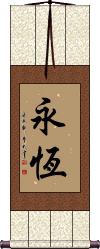
永恆 is the Chinese word for eternity.
The first character means always, forever, and perpetual. The second character holds the meaning of permanent. Together, they create a word that means eternal, eternally, or infinite time.
See Also: Immortality
Eternity / Always and Forever
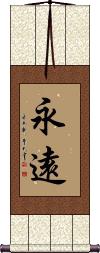
永遠 is the Chinese, Korean and Japanese word for forever.
If we take this word apart, the first character means always, forever, or perpetual. While the second character means far or distant.
See Also: Immortality
Sky / Ether / Void / Emptiness / Unreality
(Used in Japanese version of five elements)
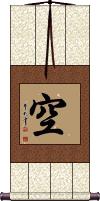
空 is a single character that means empty, void, hollow, vacant, vacuum, blank, nonexistent, vacuity, voidness, emptiness, non-existence, immateriality, unreality, the false or illusory nature of all existence, and being unreal.
In the Buddhist context, this relates to the doctrine that all phenomena and the ego have no reality but are composed of a certain number of skandhas or elements, which disintegrate. The void, the sky, space. The universal, the absolute, complete abstraction without relativity. The doctrine further explains that all things are compounds, or unstable organisms, possessing no self-essence, i.e. are dependent, or caused, come into existence only to perish. The underlying reality, the principle of eternal relativity, or non-infinity, i.e. śūnya, permeates all phenomena making possible their evolution.
From Sanskrit and/or Pali, this is the translation to Chinese and Japanese of the title śūnya or śūnyatā.
In Japanese, when pronounced as “ron” (sounds like “roan”) this can be a given name. It should be noted that this Kanji has about 5 different possible pronunciations in Japanese: kuu, kara, sora, ron, and uro. 空 is also an element in the Japanese version of the five elements.
Enso - Japanese Zen Circle
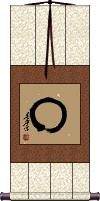
〇 is the famous Enso symbol, which you will see widely used by Japanese Zen Buddhists.
In a twist, I am starting to see Enso used more and more by Chinese Buddhists.
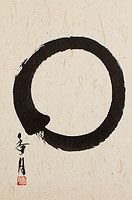
Here is the typical appearance of Enso artwork by Japanese calligrapher Kougetsu.
Enso is not a Japanese Kanji character. It falls more into the category of a symbol. There is some debate, but many consider Enso to be a religious symbol.
Some call this “The Circle of Enlightenment.” Others call it the “Infinity Circle.” If you actually took the meanings of the two Kanji (円相) that make up the word “En-so,” you could read it as “Mutual Circle” or “Circle of Togetherness.” I think the Enso symbol can simply mean different things to different people. Therefore, you should let it have the meaning that you perceive.
The appearance of your Enso will be determined by the artist's personal style, feeling, mood, etc.
This in-stock artwork might be what you are looking for, and ships right away...

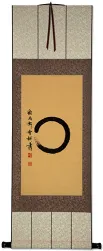

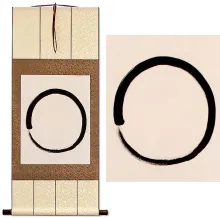


Gallery Price: $200.00
Your Price: $124.88

Gallery Price: $200.00
Your Price: $98.88
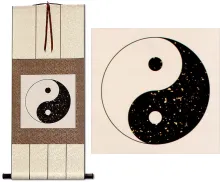

Gallery Price: $40.00
Your Price: $16.88
The following table may be helpful for those studying Chinese or Japanese...
| Title | Characters | Romaji (Romanized Japanese) | Various forms of Romanized Chinese | |
| To Infinity and Beyond | 超越無限 超越无限 | chāo yuè wú xiàn chao1 yue4 wu2 xian4 chao yue wu xian chaoyuewuxian | ch`ao yüeh wu hsien chaoyüehwuhsien chao yüeh wu hsien |
|
| To Infinity and Beyond | 無限の彼方へ | mugen no kanata e mugennokanatae | ||
| Infinity Infinite Unlimited Unbounded | 無限 无限 | mu gen / mugen | wú xiàn / wu2 xian4 / wu xian / wuxian | wu hsien / wuhsien |
| Infinity Infinite Endless Boundless | 無窮 无穷 | mu kyuu / mukyuu / mu kyu | wú qióng / wu2 qiong2 / wu qiong / wuqiong | wu ch`iung / wuchiung / wu chiung |
| Eternity Forever | 永 | ei | yǒng / yong3 / yong | yung |
| Eternal Eternity | 永恆 永恒 | yǒng héng yong3 heng2 yong heng yongheng | yung heng yungheng |
|
| Eternity Always and Forever | 永遠 永远 | ei-en | yǒng yuǎn yong3 yuan3 yong yuan yongyuan | yung yüan yungyüan |
| Sky Ether Void Emptiness Unreality | 空 | kuu / kara / sora / ron ku / kara / sora / ron | kōng / kong1 / kong | k`ung / kung |
| Enso - Japanese Zen Circle | 〇 | en sou / ensou / en so | ||
| In some entries above you will see that characters have different versions above and below a line. In these cases, the characters above the line are Traditional Chinese, while the ones below are Simplified Chinese. | ||||

Successful Chinese Character and Japanese Kanji calligraphy searches within the last few hours...



