Many custom options...


And formats...



Joined in Chinese / Japanese...
Buy a Joined calligraphy wall scroll here!
Personalize your custom “Joined” project by clicking the button next to your favorite “Joined” title below...
Soul Mates at Heart
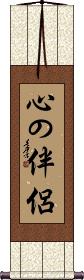
心の伴侶 is a Japanese-only title for soulmates.
心 means heart, soul, mind, core, or center. In ancient times, the heart was believed to be the mind or center of your soul and being.
の is a possessive article that connects everything here.
伴侶 means mates, companions, partners, and spouses.
This Japanese version of soulmates is about two partners, coupled or joined by their hearts.
The Karma/Fate/Destiny that Brings Lovers Together
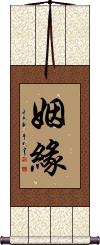
姻緣 means “Destiny that brings lovers together.” It can also be translated technically as “Predestined matrimonial affinity” (wow, talk about taking the romance out of this word - that was from the Oxford C-E dictionary).
This speaks to the fate (or karma) that brings a husband and wife together. I would translate this as “Together by fate” or “Joined by destiny” but in the context of marriage. You could use this for non-married lovers, but the first character has a suggestion that this refers to those that are married.
Love Binds Us Together
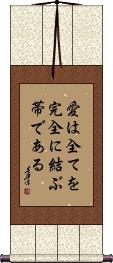
愛は全てを完全に結ぶ帯である is a Japanese phrase that suggests we (or a couple) are bound together by love.
I searched the web and found all of these English translation variations for this phrase:
Have love; The only way in which you may be completely joined together.
Love is the sash that perfectly binds us together.
Love is what binds us together
Love binds all things together in perfect unity.
This same Japanese phrase is used as part of Colossians 3:14 in at least one version of the Japanese Bible.
A few Biblical versions include:
...Charity, which is the bond of perfectness. (KJV)
...Love, which binds them all together in perfect unity. (NIV)
Note: Because this selection contains some special Japanese Hiragana characters, it should be written by a Japanese calligrapher.
Work Unselfishly for the Common Good
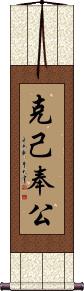
克己奉公 is a Chinese proverb that is often used to express how one should act as a government official. Most of us wish our public officials would hold themselves to higher standards. I wish I could send this scroll, along with the meaning to every member of Congress, and the President (or if I was from the UK, all the members of Parliament, and the PM)
This can also mean: “Place Strict Standards on Oneself in Public Service.”
The story behind this ancient Chinese idiom:
Cai Zun was born in China a little over 2000 years ago. In 24 AD, he joined an uprising led by Liu Xiu, who later became the emperor of the Eastern Han Dynasty.
Later, the new emperor put Cai Zun in charge of the military court. Cai Zun exercised his power in strict accordance with military law, regardless of the offender's rank or background. He even ordered the execution of one of the emperor's close servants after the servant committed a serious crime.
Cai Zun led a simple life but put great demands on himself to do all things honorably. The emperor rewarded him for his honest character and honorable nature by promoting him to the rank of General and granting him the title of Marquis.
Whenever Cai Zun would receive an award, he would give credit to his men and share the reward with them.
Cai Zun was always praised by historians who found many examples of his selfless acts that served the public interest.
Sometime long ago in history, people began to refer to Cai Zun as “ke ji feng gong.”
See Also: Unselfish | Selflessness | Altruism
These search terms might be related to Joined:
Brought Together From 1000 Miles Away by Fate
Growing Old Together
Live Together and Help Each Other
Love Binds Us Together
Regardless of the Weather, We Overcome Troubles Together
Solidarity / Working Together as One
The Karma/Fate/Destiny That Brings Lovers Together
There is One Single Thread Binding My Way Together
Together Forever
Together Forever in Love
United Arab Emirates
United Kingdom
United States Marine Corps
United States of America (USA)
Unity / United / Solidarity / Cooperation
Work Together With One Heart
Work Together With One Mind
Working Together as One / Cooperation
Not the results for joined that you were looking for?
Below are some entries from our dictionary that may match your joined search...
| Characters If shown, 2nd row is Simp. Chinese |
Pronunciation Romanization |
Simple Dictionary Definition |
赤い糸 see styles |
akaiito / akaito あかいいと |
More info & calligraphy: The Red String |
廾 see styles |
gǒng gong3 kung |
hands joined |
沓 see styles |
tà ta4 t`a ta kutsu くつ |
again and again; many shoes; boots; footwear; footgear; (place-name, surname) Kutsu Ripple, babble; join. Translit. t, d, etc. |
一統 一统 see styles |
yī tǒng yi1 tong3 i t`ung i tung subaru すばる |
to unify; unified lineage; line; unification; all (of you); (female given name) Subaru to be joined into one. |
合印 see styles |
aijirushi あいじるし aiin / ain あいいん |
(1) identifying mark (esp. a mark of comradeship); (2) mark placed where two pieces of cloth are to be sewn together (or two pieces of wood joined, etc.); (3) verification seal; tally; verification seal; tally |
合標 see styles |
aijirushi あいじるし |
(1) identifying mark (esp. a mark of comradeship); (2) mark placed where two pieces of cloth are to be sewn together (or two pieces of wood joined, etc.); (3) verification seal; tally |
新入 see styles |
shinnyuu / shinnyu しんにゅう |
(noun - becomes adjective with の) newly arrived; newly joined; newly entered; newcomer; (place-name) Shinnyū |
月分 see styles |
yuè fèn yue4 fen4 yüeh fen Getsufun |
month; also written 月份[yue4 fen4] Moon and division, a tr. of candrabhaga, 旃達羅婆伽 The two rivers Candra and Bhaga joined. The Chenab river, Punjab, the Acesines of Alexander. |
板目 see styles |
itame いため |
(1) seam of joined boards; (2) cross grain (of wood); (3) (abbreviation) (See 板目紙) thick card made from several sheets of washi paper |
水烟 see styles |
mizukemuri みずけむり suien すいえん |
mist over a body of water; spray; (1) mist over a body of water; spray; (2) suien (four decorative metal plates joined at right angles forming part of a pagoda finial) |
水煙 水烟 see styles |
shuǐ yān shui3 yan1 shui yen mizukemuri みずけむり suien すいえん |
shredded tobacco for water pipes mist over a body of water; spray; (1) mist over a body of water; spray; (2) suien (four decorative metal plates joined at right angles forming part of a pagoda finial) |
膜拜 see styles |
mó bài mo2 bai4 mo pai makuhai |
to kneel and bow with joined hands at forehead level; to worship To raise the hands to the head in making obeisance. |
連珠 连珠 see styles |
lián zhū lian2 zhu1 lien chu renju れんじゅ |
joined as a string of pearls; in rapid succession; alignment; Renju, a Japanese game, also called Gomoku or five-in-a-row variant of gobang (game) |
二節棍 二节棍 see styles |
èr jié gùn er4 jie2 gun4 erh chieh kun |
nunchaku (weapon with two rods joined by a short chain, used in martial arts) |
互相應 互相应 see styles |
hù xiāng yìng hu4 xiang1 ying4 hu hsiang ying go sōō |
joined with each other |
合い印 see styles |
aijirushi あいじるし aiin / ain あいいん |
(1) identifying mark (esp. a mark of comradeship); (2) mark placed where two pieces of cloth are to be sewn together (or two pieces of wood joined, etc.); (3) verification seal; tally; verification seal; tally |
合い標 see styles |
aijirushi あいじるし |
(1) identifying mark (esp. a mark of comradeship); (2) mark placed where two pieces of cloth are to be sewn together (or two pieces of wood joined, etc.); (3) verification seal; tally |
蘭花指 兰花指 see styles |
lán huā zhǐ lan2 hua1 zhi3 lan hua chih |
hand gesture in traditional dances (joined thumb and middle finger, the rest extended) |
陸続き see styles |
rikutsuzuki りくつづき |
(noun - becomes adjective with の) being joined by land |
伊字三點 伊字三点 see styles |
yī zì sān diǎn yi1 zi4 san1 dian3 i tzu san tien iji santen |
refers to the Sanskrit sign (?) as neither across nor upright, being of triangular shape, and indicating neither unity nor difference, before nor after. The Nirvana Sutra applies the three parts to 法身 dharmakāya, 般若 prajñā and 解脫 vimokṣa, all three being necessary to complete nirvana. It is also associated with the three eyes of Śiva. When considered across they represent fire, when upright, water. At a later period the three were joined (?) in writing. |
合わせ物 see styles |
awasemono あわせもの |
something joined together |
同仇敵愾 同仇敌忾 see styles |
tóng chóu dí kài tong2 chou2 di2 kai4 t`ung ch`ou ti k`ai tung chou ti kai |
anger against a common enemy (idiom); joined in opposition to the same adversary |
如膠似漆 如胶似漆 see styles |
rú jiāo sì qī ru2 jiao1 si4 qi1 ju chiao ssu ch`i ju chiao ssu chi |
stuck together as by glue (of lovers); joined at the hip |
結ばれる see styles |
musubareru むすばれる |
(v1,vi) (1) (See 結ぶ・1) to be tied together; to be fastened; (v1,vi) (2) to be wedded; to be joined in marriage; to be united in marriage |
結びつく see styles |
musubitsuku むすびつく |
(v5k,vi) (1) to be related; to be connected; to be joined together; (2) to result in; to lead to; to bring about |
結び付く see styles |
musubitsuku むすびつく |
(v5k,vi) (1) to be related; to be connected; to be joined together; (2) to result in; to lead to; to bring about |
羅圈兒揖 罗圈儿揖 see styles |
luó quān r yī luo2 quan1 r5 yi1 lo ch`üan r i lo chüan r i |
to bow around with hands joined (to people on all sides) |
藕斷絲連 藕断丝连 see styles |
ǒu duàn sī lián ou3 duan4 si1 lian2 ou tuan ssu lien |
lit. lotus roots may break, but the fiber remains joined (idiom); lovers part, but still long for one another |
訶梨跋摩 诃梨跋摩 see styles |
hē lí bá mó he1 li2 ba2 mo2 ho li pa mo Karihatsuma |
Harivarman, tawny armour, and 師子鎧 lion armour; a Brahman who '900 years' after the Nirvāṇa, appeared in Central India and joined the Sarvāstivādin and Satyasiddhi school by the publication of the Satyasiddhi śāstra (tr. as the 成實論 by Kumārajīva, 407-418). |
鬻牒度僧 see styles |
zhōu dié dù sēng zhou1 die2 du4 seng1 chou tieh tu seng |
Buddhist monks or nuns who joined the order by purchasing ordination certificates. |
Click here for more joined results from our dictionary
The following table may be helpful for those studying Chinese or Japanese...
| Title | Characters | Romaji (Romanized Japanese) | Various forms of Romanized Chinese | |
| Soul Mates at Heart | 心の伴侶 | kokoro no han ryo kokoronohanryo | ||
| The Karma/Fate/Destiny that Brings Lovers Together | 姻緣 姻缘 | yīn yuán / yin1 yuan2 / yin yuan / yinyuan | yin yüan / yinyüan | |
| Love Binds Us Together | 愛は全てを完全に結ぶ帯である | ai ha subete o kanzen ni musubu obi de aru | ||
| Work Unselfishly for the Common Good | 克己奉公 | kè jǐ fèng gōng ke4 ji3 feng4 gong1 ke ji feng gong kejifenggong | k`o chi feng kung kochifengkung ko chi feng kung |
|
| In some entries above you will see that characters have different versions above and below a line. In these cases, the characters above the line are Traditional Chinese, while the ones below are Simplified Chinese. | ||||

Successful Chinese Character and Japanese Kanji calligraphy searches within the last few hours...



