Many custom options...


And formats...



Knock in Chinese / Japanese...
Buy a Knock calligraphy wall scroll here!
Personalize your custom “Knock” project by clicking the button next to your favorite “Knock” title below...
Push or Knock
To weigh one's words
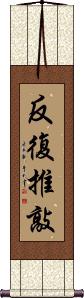
During the Tang Dynasty, a man named Jia Dao (born in the year 779), a well-studied scholar and poet, went to the capital to take the imperial examination.
One day as he rides a donkey through the city streets, a poem begins to form in his mind. A portion of the poem comes into his head like this:
“The bird sits on the tree branch near a pond,
A monk approaches and knocks at the gate...”
At the same time, he wondered if the word “push” would be better than “knock” in his poem.
As he rides down the street, he imagines the monk pushing or knocking. Soon he finds himself making motions of pushing and shaking a fist in a knocking motion as he debates which word to use. He is quite a sight as he makes his way down the street on his donkey with hands and fists flying about as the internal debate continues.
As he amuses people along the street, he becomes completely lost in his thoughts and does not see the mayor's procession coming in the opposite direction. Jia Bao is blocking the way for the procession to continue down the road, and the mayor's guards immediately decide to remove Jia Bao by force. Jia Bao, not realizing that he was in the way, apologizes, explains his poetic dilemma and awaits his punishment for blocking the mayor's way.
The mayor, Han Yu, a scholar and author of prose himself, finds himself intrigued by Jia Dao's poem and problem. Han Yu gets off his horse and addresses Jia Bao, stating, “I think knock is better.” The relieved Jia Bao raises his head and is invited by the mayor to join the procession, and are seen riding off together down the street, exchanging their ideas and love of poetry.
In modern Chinese, this 反復推敲 idiom is used when someone is trying to decide which word to use in their writing or when struggling to decide between two things when neither seems to have a downside.
Merge / Unify
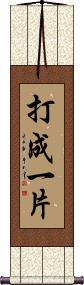
打成一片 is a Chinese and Japanese proverb that means “to merge,” “to integrate,” “to become as one,” “to unify together,” “to knock all into one,” or “to bring things together or into order.”
Fall Down Seven Times, Get Up Eight
Always rising after a fall or repeated failures
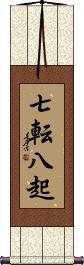
七転八起 is a Japanese proverb that relays the vicissitudes of life, with the meaning “seven times down eight times up.”
Some would more naturally translate it into English as “Always rising after a fall or repeated failures” or compare it to the English, “If at first, you don't succeed, try, try again.”
The first Kanji is literally “7.” The second means “fall down” (sometimes this Kanji means “turn around,” “revolve” or “turn over” but in this case, it holds the meaning of “fall”). The third is “8.” And the last is “get up,” “rouse,” or “rise.”
Basically, if you fail 7 times, you should recover from those events and be prepared to rise an 8th time. This also applies if it is the world or circumstances that knock you down seven times...
...just remember that you have the ability to bounce back from any kind of adversity.
Note: This can be pronounced in two ways. One is “shichi ten hakki” or “shichitenhakki.” The other is “nana korobi ya oki” also written, “nanakorobi-yaoki.”
Special Note: The second character is a Kanji that is not used in China. Therefore, please select a Japanese calligrapher for this title.
These search terms might be related to Knock:
Bash
Blow
Fight / Beat Someone
Hammer
Not the results for knock that you were looking for?
Below are some entries from our dictionary that may match your knock search...
| Characters If shown, 2nd row is Simp. Chinese |
Pronunciation Romanization |
Simple Dictionary Definition |
打成一片 see styles |
dǎ chéng yī piàn da3 cheng2 yi1 pian4 ta ch`eng i p`ien ta cheng i pien tajouippen / tajoippen たじょういっぺん |
More info & calligraphy: Merge / Unify(yoji) {Buddh} (See 座禅・ざぜん) intensive zazen meditation on a subject; knocking all into one To knock all into one, bring things together, or into order. |
叩 see styles |
kòu kou4 k`ou kou tataki たたき |
to knock; to kowtow (surname) Tataki |
咚 see styles |
dōng dong1 tung |
(onom.) boom (of a drum); knock (on the door) |
戧 戗 see styles |
qiāng qiang1 ch`iang chiang |
contrary; pushing against; bump; knock; used as equivalent for 搶|抢[qiang1] |
扣 see styles |
kòu kou4 k`ou kou |
to fasten; to button; button; buckle; knot; to arrest; to confiscate; to deduct (money); discount; to knock; to smash, spike or dunk (a ball); to cover (with a bowl etc); (fig.) to tag a label on sb; (Tw) (loanword) code |
抵 see styles |
dǐ di3 ti tei |
to press against; to support; to prop up; to resist; to withstand; to be equal to; to match; to balance; to offset; to mortgage; to make up for; to compensate for; to arrive at; to reach; to clap (one's hands) lightly (expressing delight) (Taiwan pr. [zhi3]) Knock; arrive; resist, bear; substitute. |
搉 see styles |
què que4 ch`üeh chüeh |
consult; knock; beat |
摷 see styles |
jiǎo jiao3 chiao |
to knock; strike |
撂 see styles |
liào liao4 liao |
to put down; to leave behind; to throw or knock down; to abandon or discard |
撞 see styles |
zhuàng zhuang4 chuang |
to knock against; to bump into; to run into; to meet by accident |
攴 see styles |
pū pu1 p`u pu tomata とまた |
to tap; to knock lightly; old variant of 撲|扑[pu1] (kana only) (See 攴繞) kanji "strike" radical at right (radical 66) |
敂 叩 see styles |
kòu kou4 k`ou kou |
old variant of 叩[kou4]; to knock See: 叩 |
敲 see styles |
qiāo qiao1 ch`iao chiao noboru のぼる |
to hit; to strike; to tap; to rap; to knock; to rip sb off; to overcharge (given name) Noboru To knock, beat, pound, e.g. a drum, gong, or gate. |
槍 枪 see styles |
qiāng qiang1 ch`iang chiang yari やり |
gun; firearm; rifle; spear; thing with shape or function similar to a gun; CL:支[zhi1],把[ba3],桿|杆[gan3],條|条[tiao2],枝[zhi1]; to substitute for another person in a test; to knock; classifier for rifle shots (1) spear; lance; (2) javelin; (3) (shogi) lance; (4) (archaism) jeering; (1) long-handled Chinese spear; lance; pike; (2) weapon; arms; (3) grip of a bow; (surname) Yari |
下工 see styles |
xià gōng xia4 gong1 hsia kung shimoku しもく |
to knock off (at the end of a day's work); to finish work (place-name) Shimoku |
不倒 see styles |
futou / futo ふとう |
(can be adjective with の) impossible to knock over; unbeatable; indestructible; (given name) Futou |
伸す see styles |
nosu のす |
(v5s,vi) (1) (kana only) to stretch; to extend; to lengthen; to spread; (v5s,vi) (2) (kana only) to gain influence; to become stronger; to increase (e.g. in scope); (v5s,vi) (3) (kana only) to go further; to extend one's journey; (transitive verb) (4) (kana only) to smooth out; to roll out; to spread out (something folded); (transitive verb) (5) (kana only) (also written 熨す) to iron out (creases); (transitive verb) (6) (kana only) to knock out; to knock down |
倒す see styles |
taosu たおす kokasu こかす |
(transitive verb) (1) to throw down; to bring down; to blow down; to fell; to knock down; to set (something) down on its side; to turn (something) on its side; (2) to kill; to defeat; to beat; (3) to overthrow; to trip up; to ruin; (4) to leave unpaid; to cheat; (v4s,vt) (archaism) to knock down; to knock over |
内鰐 see styles |
uchiwani うちわに |
knock-kneed; pigeon-toed |
半死 see styles |
bàn sǐ ban4 si3 pan ssu hanshi はんし |
half dead (of torment, hunger, tiredness etc); (tired) to death; (terrified) out of one's wits; (beaten) to within an inch of one's life; (knock) the daylights out of sb half-dead |
叩門 叩门 see styles |
kòu mén kou4 men2 k`ou men kou men |
to knock on a door |
叩關 叩关 see styles |
kòu guān kou4 guan1 k`ou kuan kou kuan |
to knock at the gate (old); to make an approach; to invade; to attack the goal (sports) |
戳搭 see styles |
chuō dā chuo1 da1 ch`o ta cho ta |
to knock; to jab |
打倒 see styles |
dǎ dǎo da3 dao3 ta tao datou / dato だとう |
to overthrow; to knock down; Down with ... ! (noun, transitive verb) overthrow; defeat; bringing down; knockdown |
打門 打门 see styles |
dǎ mén da3 men2 ta men |
to knock on the door; to take a shot on goal (sports) |
払う see styles |
harau はらう |
(transitive verb) (1) to pay (e.g. money, bill); (transitive verb) (2) to brush off; to wipe away; to clear away; to dust off; to cut off (e.g. branches); (transitive verb) (3) to drive away (e.g. one's competitors); (transitive verb) (4) to sell off (something unneeded); to dispose of; (transitive verb) (5) to pay (e.g. attention); to show (e.g. respect, concern); (transitive verb) (6) to make (e.g. effort, sacrifice); to expend; to exert; (transitive verb) (7) to move out (of one's own place); to vacate; (transitive verb) (8) to sweep (e.g. one's legs); to knock aside; (transitive verb) (9) to make a sweeping stroke (in Japanese calligraphy); (transitive verb) (10) to reset (an abacus) |
搭建 see styles |
dā jiàn da1 jian4 ta chien |
to build (esp. with simple materials); to knock together (a temporary shed); to rig up |
搭蓋 搭盖 see styles |
dā gài da1 gai4 ta kai |
to build (esp. with simple materials); to knock together (a temporary shed); to rig up |
摔打 see styles |
shuāi da shuai1 da5 shuai ta |
to knock; to grasp something in the hand and beat it; to toughen oneself up |
撂倒 see styles |
liào dǎo liao4 dao3 liao tao |
to knock down; to mow down |
Click here for more knock results from our dictionary
The following table may be helpful for those studying Chinese or Japanese...
| Title | Characters | Romaji (Romanized Japanese) | Various forms of Romanized Chinese | |
| Push or Knock | 反復推敲 反复推敲 | fǎn fù tuī qiāo fan3 fu4 tui1 qiao1 fan fu tui qiao fanfutuiqiao | fan fu t`ui ch`iao fanfutuichiao fan fu tui chiao |
|
| Merge Unify | 打成一片 | tajou ippen tajouippen tajo ipen | dǎ chéng yī piàn da3 cheng2 yi1 pian4 da cheng yi pian dachengyipian | ta ch`eng i p`ien tachengipien ta cheng i pien |
| Fall Down Seven Times, Get Up Eight | 七転八起 | shichi ten hakki / nana korobi ya oki shichi ten haki / nana korobi ya oki | ||
| In some entries above you will see that characters have different versions above and below a line. In these cases, the characters above the line are Traditional Chinese, while the ones below are Simplified Chinese. | ||||

Successful Chinese Character and Japanese Kanji calligraphy searches within the last few hours...



