Many custom options...


And formats...



Leaders in Chinese / Japanese...
Buy a Leaders calligraphy wall scroll here!
Personalize your custom “Leaders” project by clicking the button next to your favorite “Leaders” title below...
Respect out of fear is never genuine; Reverence out of respect is never false
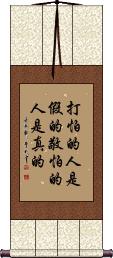
打怕的人是假的敬怕的人是真的 is a proverb that seems to be aimed at world leaders or others in power. Perhaps a suggestion to avoid the practice of “fear-mongering” opting instead for a policy of benevolence and justice.
An example: When the Bush administration told Pakistan they could either join America in the “war on terror,” or expect some bombs to be coming their way, Bush gained this kind of “less-than-genuine respect” from Pakistanis.
Leaders in places like North Korea and even Saudi Arabia reap the same bogus respect from their own citizens.
Note that calligraphers do not like to repeat the same characters in exactly the same way in the same piece of artwork. So expect the characters that are repeated to be written in different forms in the real artwork (unlike the way they are displayed to the left).
Hou De Zai Wu
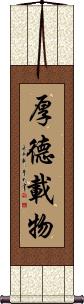
厚德載物 is a Chinese proverb that means “With great virtue, one can take charge of the world.”
Known sometimes by the romanization Hou De Zai Wu, this famous phrase suggests that being ethical is the bridge to leadership. I wish our world leaders followed this.
Art of War: 5 Points of Analysis
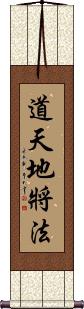
道天地將法 is a list of five key points to analyzing your situation from the first chapter of Sun Tzu's Art of War.
This reads like a 5-part military proverb. Sun Tzu says that to sharpen your skills, you must plan. To plan well, you must know your situation. Therefore, you must consider and discuss the following:
1. Philosophy and Politics: Make sure your way or your policy is agreeable among all of your troops (and the citizens of your kingdom as well). For when your soldiers believe in you and your way, they will follow you to their deaths without hesitation and will not question your orders.
2. Heaven/Sky: Consider climate / weather. This can also mean considering whether God is smiling upon you. In the modern military, this could be waiting for clear skies so that you can have air support for an amphibious landing.
3. Ground/Earth: Consider the terrain in which the battle will take place. This includes analyzing defensible positions, and exit routes, while using varying elevations to your advantage. When you plan an ambush, you must know your terrain and the best location from which to stage that ambush. This knowledge will also help you avoid being ambushed, as you will know where the likely places in which to expect an ambush from your enemy.
4. Leadership: This applies to you as the general and your lieutenants. A leader should be smart and be able to develop good strategies. Leaders should keep their word, and if they break a promise, they should punish themselves as harshly as they would punish subordinates. Leaders should be benevolent to their troops, with almost a fatherly love for them. Leaders must have the ability to make brave and fast decisions. Leaders must have steadfast principles.
5. [Military] Methods: This can also mean laws, rules, principles, models, or systems. You must have an efficient organization in place to manage both your troops and supplies. In the modern military, this would be a combination of how your unit is organized and your SOP (Standard Operating Procedure).
Notes: This is a simplistic translation and explanation. Much more is suggested in the actual text of the Art of War (Bing Fa). It would take a lot of study to master all of these aspects. In fact, these five characters can be compared to the modern military acronyms such as BAMCIS or SMEAC.
CJK notes: I have included the Japanese and Korean pronunciations but in Chinese, Korean and Japanese, this does not make a typical phrase (with subject, verb, and object) it is a list that only someone familiar with Sun Tzu’s writings would understand.
Listen to Both Sides and be Enlightened, Listen to One Side and be in the Dark
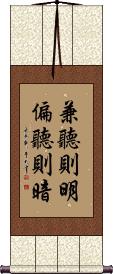
兼聽則明偏聽則暗 is an ancient Chinese proverb about getting all the information from all sides so that you truly understand a situation.
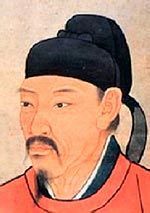
Wei Zheng
A man named Wei Zheng lived between 580-643 AD. He was a noble and wise historian and minister in the court of the early Tang Dynasty. The emperor once asked him, “What should an emperor do to understand the real-world situation, and what makes an emperor out-of-touch with reality?”
Wei Zheng replied, “Listen to both sides and you will be enlightened; listen to only one side and you will be left in the dark.”
Then Wei Zheng went on to cite examples of leaders in history that were victorious after heeding both sides of the story, and other leaders that met their doom because they believed one-sided stories which often came from flattering lips.
Please note that there is an unwritten rule when the same character appears twice in the same phrase, the calligrapher will alter the appearance so that no two characters are exactly alike in the same piece. This calligraphy has two repeating characters that will be written differently than they appear here.
Not the results for leaders that you were looking for?
Below are some entries from our dictionary that may match your leaders search...
| Characters If shown, 2nd row is Simp. Chinese |
Pronunciation Romanization |
Simple Dictionary Definition |
リーダー see styles |
riidaa / rida リーダー |
More info & calligraphy: Reeder |
下來 下来 see styles |
xià lai xia4 lai5 hsia lai |
to come down; (completed action marker); (after verb of motion, indicates motion down and towards us, also fig.); (indicates continuation from the past towards us); to be harvested (of crops); to be over (of a period of time); to go among the masses (said of leaders) |
十師 十师 see styles |
shí shī shi2 shi1 shih shih jisshi |
The ten monks necessary for a full ordination of a monk, i.e. 三師七證 three leaders and seven witnesses. |
四唱 see styles |
sì chàng si4 chang4 ssu ch`ang ssu chang shishō |
The four commanders or leaders; see Lotus Sutra 15. |
導師 导师 see styles |
dǎo shī dao3 shi1 tao shih doushi / doshi どうし |
tutor; teacher; academic advisor (1) {Buddh} officiating priest; presiding priest at a ceremony; (2) (esp. Buddhist) religious teacher; highly-ranked priest; (3) guru; instructor (yoga, etc.) nāyaka; a leader, guide, one who guides men to Buddha's teaching; applied also to Buddhas and bodhisattvas, and to the leaders of the ritual in Buddhist services; v. 天人道師. |
幹部 干部 see styles |
gàn bù gan4 bu4 kan pu kanbu かんぶ |
cadre; official; officer; manager management; (executive) staff; leaders; leadership; top brass; upper echelons |
王丹 see styles |
wáng dān wang2 dan1 wang tan wandan わんだん |
Wang Dan (1969-), Chinese dissident, one of the leaders of the Beijing student democracy movement of 1989 (person) Wan Dan (1965-) |
町衆 see styles |
machishuu / machishu まちしゅう |
(archaism) important local businessmen (in the Muromachi period); local leaders |
酋長 酋长 see styles |
qiú zhǎng qiu2 zhang3 ch`iu chang chiu chang shuuchou / shucho しゅうちょう |
headman (of primitive people); tribal chief; used as translation for foreign leaders, e.g. Indian Rajah or Arab Sheik or Emir chieftain |
リーダ see styles |
riida / rida リーダ |
(noun - becomes adjective with の) (1) leader; (2) reader; reading book; (3) reader (i.e. someone who reads); (4) (abbreviation) microreader; (5) dotted line (in printing); leaders; ellipsis mark |
党首脳 see styles |
toushunou / toshuno とうしゅのう |
party leaders; party executive |
四天王 see styles |
sì tiān wáng si4 tian1 wang2 ssu t`ien wang ssu tien wang shitennou / shitenno してんのう |
(1) {Buddh} the Four Heavenly Kings (Dhrtarastra, Virudhaka, Virupaksa, and Vaisravana); (2) the big four (i.e. four leaders in a given field) (四大天王) catur-mahārājas, or Lokapālas; the four deva-kings. Indra's external 'generals 'who dwell each on a side of Mount Meru, and who ward off from the world the attacks of malicious spirits, or asuras, hence their name 護世四天王 the four deva-kings, guardians of the world. Their abode is the 四天王天 catur-maharāja-kāyikas; and their titles are: East 持國天 Deva who keeps (his) kingdom; colour white; name Dhṛtarsaṣtra. South 增長天 Deva of increase and growth; blue; name Virūḍhaka. West 廣目天 The broad-eyed (also ugly-eyed) deva (perhaps a form of Siva); red; name Virūpākṣa. North 多聞天 The deva who hears much and is well-versed; yellow; name Vaiśravaṇa, or Dhanada; he is a form of Kuvera, the god of wealth. These are the four giant temple guardians introduced as such to China by Amogha; cf. 四天王經. |
政官財 see styles |
seikanzai / sekanzai せいかんざい |
politicians, business leaders and bureaucrats; the worlds of politics, big business and bureaucracy |
朱紅燈 朱红灯 see styles |
zhū hóng dēng zhu1 hong2 deng1 chu hung teng |
Zhu Hongdeng, one of the leaders of the Boxer Rebellion |
目犍連 目犍连 see styles |
mù jiān lián mu4 jian1 lian2 mu chien lien Mokkenren |
目連; 摩訶目犍連 (or 摩訶羅夜那); 大目犍連 (or 大目乾連) ; 沒特伽羅子 (or 沒力伽羅子); 目伽略 (Mahā-) Maudgalyāyana, or Maudgalaputra; explained by Mudga 胡豆 lentil, kidney-bean. One of the ten chief disciples of Śākyamuni, specially noted for miraculous powers; formerly an ascetic, he agreed with Śāriputra that whichever first found the truth would reveal it to the other. Śāriputra found the Buddha and brought Maudgalyāyana to him; the former is placed on the Buddha's right, the latter on his left. He is also known as 拘栗 Kolita, and when reborn as Buddha his title is to be Tamāla-patra-candana-gandha. In China Mahāsthāmaprapta is accounted a canonization of Maudgalyāyana. Several centuries afterwards there were two other great leaders of the Buddhist church bearing the same name, v. Eitel. |
韓愛晶 韩爱晶 see styles |
hán ài jīng han2 ai4 jing1 han ai ching |
Han Aijing (1945-), notorious red guard leader during Cultural Revolution, spent 15 years in prison for imprisoning and torturing political leaders |
領導層 领导层 see styles |
lǐng dǎo céng ling3 dao3 ceng2 ling tao ts`eng ling tao tseng |
ruling class; leaders (of society); oligarchy |
首脳陣 see styles |
shunoujin / shunojin しゅのうじん |
leaders; (the) leadership |
三師七證 三师七证 see styles |
sān shī qī zhèng san1 shi1 qi1 zheng4 san shih ch`i cheng san shih chi cheng sanshi shichishō |
The three superior monks and a minimum of seven witnesses required for an ordination to full orders; except in outlandish places, when two witnesses are valid. |
付和随行 see styles |
fuwazuikou / fuwazuiko ふわずいこう |
(noun/participle) (yoji) participating in something by merely following the leaders |
党首討論 see styles |
toushutouron / toshutoron とうしゅとうろん |
debate between party leaders (in the Japanese Diet) |
吾爾開希 吾尔开希 see styles |
wú ěr kāi xī wu2 er3 kai1 xi1 wu erh k`ai hsi wu erh kai hsi |
Örkesh Dölet (1968-), one of the main leaders of the Beijing student democracy movement of 1989 |
大阪会議 see styles |
oosakakaigi おおさかかいぎ |
(hist) Osaka Conference; meeting held by the leaders of the Meiji Restoration in Osaka to discuss the formation of a representative assembly (January-February, 1875) |
特定銘柄 see styles |
tokuteimeigara / tokutemegara とくていめいがら |
{finc} specified stocks; specified market leaders; designated speculative stocks |
附和随行 see styles |
fuwazuikou / fuwazuiko ふわずいこう |
(noun/participle) (yoji) participating in something by merely following the leaders |
領導集體 领导集体 see styles |
lǐng dǎo jí tǐ ling3 dao3 ji2 ti3 ling tao chi t`i ling tao chi ti |
leadership group; collective of leaders |
首脳会合 see styles |
shunoukaigou / shunokaigo しゅのうかいごう |
summit meeting; meeting of leaders |
首腦會合 see styles |
shunoukaigou / shunokaigo しゅのうかいごう |
(out-dated kanji) summit meeting; meeting of leaders |
将中に将たる see styles |
shouchuunishoutaru / shochunishotaru しょうちゅうにしょうたる |
(expression) to be a leader among leaders |
Variations: |
yamatotakeru; yamatotakeru やまとたける; ヤマトタケル |
(leg) Yamato Takeru; 12th Emperor of Japan, who dressed as a maidservant in a successful plot to kill the leaders of the Kumaso tribe in Kumamoto |
Click here for more leaders results from our dictionary
The following table may be helpful for those studying Chinese or Japanese...
| Title | Characters | Romaji (Romanized Japanese) | Various forms of Romanized Chinese | |
| Respect out of fear is never genuine; Reverence out of respect is never false | 打怕的人是假的敬怕的人是真的 | dǎ pà de rén shì jiǎ de jìng pà de rén shì zhēn de da3 pa4 de ren2 shi4 jia3 de jing4 pa4 de ren2 shi4 zhen1 de da pa de ren shi jia de jing pa de ren shi zhen de | ta p`a te jen shih chia te ching p`a te jen shih chen te ta pa te jen shih chia te ching pa te jen shih chen te |
|
| Hou De Zai Wu | 厚德載物 厚德载物 | hòu dé zài wù hou4 de2 zai4 wu4 hou de zai wu houdezaiwu | hou te tsai wu houtetsaiwu |
|
| Art of War: 5 Points of Analysis | 道天地將法 道天地将法 | dou ten chi shou hou doutenchishouhou do ten chi sho ho | dào tiān dì jiàng fǎ dao4 tian1 di4 jiang4 fa3 dao tian di jiang fa daotiandijiangfa | tao t`ien ti chiang fa taotientichiangfa tao tien ti chiang fa |
| Listen to Both Sides and be Enlightened, Listen to One Side and be in the Dark | 兼聽則明偏聽則暗 兼听则明偏听则暗 | jiān tīng zé míng, piān tīng zé àn jian1 ting1 ze2 ming2, pian1 ting1 ze2 an4 jian ting ze ming, pian ting ze an | chien t`ing tse ming, p`ien t`ing tse an chien ting tse ming, pien ting tse an |
|
| In some entries above you will see that characters have different versions above and below a line. In these cases, the characters above the line are Traditional Chinese, while the ones below are Simplified Chinese. | ||||

Successful Chinese Character and Japanese Kanji calligraphy searches within the last few hours...



