Many custom options...


And formats...



Mile in Chinese / Japanese...
Buy a Mile calligraphy wall scroll here!
Personalize your custom “Mile” project by clicking the button next to your favorite “Mile” title below...
1. A Journey of 1000 Miles Feels Like One
2. A Journey of 1000 Miles Begins with a Single Step
3. Read 10,000 Books, Travel 10,000 Miles
4. Walking 100 Miles: Stopping at 90 miles, is the same as stopping half-way
5. A Journey of 1000 Miles Begins with a Single Step
6. If you have not been a monk, how can you know what it is like to be a vegetarian?
7. Better to Travel 10,000 Miles than Read 10,000 Books
8. No man knows what he owes to his parents until he comes to have children of his own
A Journey of 1000 Miles Feels Like One
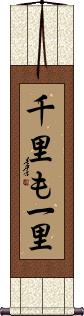
千里も一里 is a Japanese proverb that states “A journey of a thousand miles feels like only one mile.” It is understood that in the proverb, this applies when going to see the one you love.
Note that the “mile” or 里 used in this proverb is an old Chinese “li” (pronounced “ri” in Japanese). It's not actually a mile, as the measurement is really closer to 500 meters (it would take 3 of these to get close to a western mile). Still, 1000里 (333 miles) is a long way.
A Journey of 1000 Miles Begins with a Single Step
senri no michi mo ippo kara
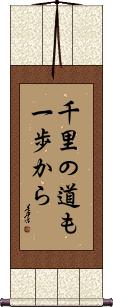
千里の道も一歩から is the Japanese version of an ancient Chinese proverb that means “a journey of a thousand miles begins with a single step.”
Some will also translate this as a 1000-mile road starts with one brick (a small amount).
In this case, the real measurement is an ancient Chinese “li” or 里, which is romanized as “ri” in Japanese. It's about half a kilometer, so three 里 would be a western mile. A journey of 333 miles begins with a single step, just doesn't sound as natural.
Note: Because this selection contains some special Japanese Hiragana characters, it should be written by a Japanese calligrapher.
Read 10,000 Books, Travel 10,000 Miles
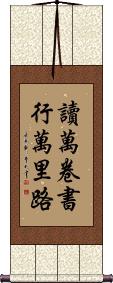
讀萬卷書行萬里路 is a lifelong suggestion for expanding your horizons by gaining knowledge, experience, and seeing the world.
Of course, this was written long ago when it was hard to travel 10,000 miles (at least 1000 years before the invention of the airplane).
With air travel and the business I'm in, I often achieve that lifetime goal on a monthly basis.
However, I am a little behind in the book count.
Note: An ancient Chinese mile (里 or lǐ) referred to in this proverb is about a third of a British/American mile. However, at that time, this was a great distance to travel.
Walking 100 Miles: Stopping at 90 miles, is the same as stopping half-way
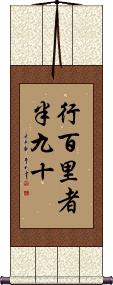
行百里者半九十 is an old Chinese proverb that speaks to the act of giving up. This phrase suggests that no matter how close you are to finishing your task or journey, giving up just before you finish is just as bad as giving up halfway.
50% finished or 90% finished, the result is the same: “You are not finished.”
You can take what you want from this proverb, but I think it suggests that you should finish what you start, and especially finish that last 10% of your journey or project so that you can honestly say “it's finished.”
Some notes: The character, 里, that I am translating as “mile” is an ancient “Chinese mile” which is actually about half a kilometer - it just doesn't sound right to say “When walking 100 half-kilometers...”
A Journey of 1000 Miles Begins with a Single Step
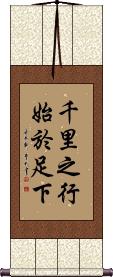
千里之行始於足下 is a Chinese proverb that means “a thousand-mile journey begins with the first step.”
This proverb figuratively means “big accomplishments come from an accumulation of little achievements made one by one.”
If you have not been a monk, how can you know what it is like to be a vegetarian?
Only by experiencing hardship will allow you understand the plight of others
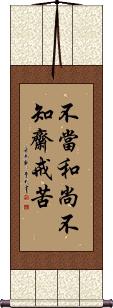
不當和尚不知齋戒苦 literally translates as:
[One who has] not been a monk [does not] know the suffering of [being on a] vegetarian diet.
This is a bit like the “walk a mile in another man's shoes” saying. Basically, it's about you cannot fully understand the plight of others until you experience it yourself.
Better to Travel 10,000 Miles than Read 10,000 Books
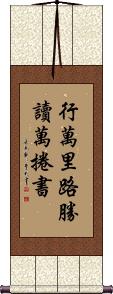
行万里路胜读万卷书 translates a few ways:
To travel ten thousand miles beats reading ten-thousand books.
Better to travel ten thousand li than to read ten thousand books. (a “li” is an ancient Chinese mile)
Traveling thousands of miles is better than reading thousands of books.
No matter how you slice it, this Chinese proverb is claiming that experience is more profound and meaningful than what you can get from a book. Go do it! Don't just read about it.
No man knows what he owes to his parents until he comes to have children of his own
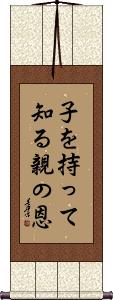
子を持って知る親の恩 literally translates as: Only after you have a baby, you would appreciate your parents (feel the way they do, etc).
This is a bit like the “walk a mile in another man's shoes” saying. Basically, it's about you cannot fully understand the plight of others until you experience it yourself. It also shows appreciation for the plight of parents.
This Japanese proverb can also be translated a few more ways:
No man knows what he owes to his parents till he comes to have children of his own.
One knows not what one owes to one's parents till one comes to have children of one's own.
Only after you have a baby, you will appreciate your parents or feel the way they do.
Only after becoming a parent yourself do you realize how much you owe [how indebted you are] to your own parents.
Note: Because this selection contains some special Japanese Hiragana characters, it should be written by a Japanese calligrapher.
A Bright Future
Incredible 10,000-Mile Flight of the Peng
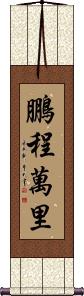
鵬程萬里 is an ancient Chinese proverb used in modern times to wish someone a long and successful career.
It's really about the 10,000 Flight of the Peng (Peng, also known as Roc is a mythical fish that can turn into a bird and take flight).
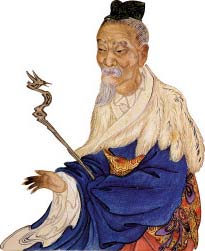
莊子
Zhuangzi or Chuang Tzu
Breaking down each character:
1. Peng or Roc (a kind of bird).
2. Journey (in this case, a flight).
3. 10,000 (Ten Thousand).
4. Li is a unit of distance often referred to as a “Chinese Mile,” though the real distance is about half a kilometer.
Direct Translation: “Peng's Journey [of] 10,000 Li.”
Literal meaning: “The 10,000-Li Flying Range Of The Roc.”
Perceived meaning: “To have a bright future” or “To go far.”
This proverb/idiom comes from the book of Zhuangzi or Chuang Tzu. It tells the tale of a huge fish that could turn into a gigantic bird. This bird was called a “peng” and was many miles long. This legendary size allowed the Peng to fly from the Northern Sea to the Southern Sea in a single bound.
Wishing someone “a Peng's Journey of 10,000 Li” will imply that they can travel far without stopping and will have great success, a long career, and a prosperous future.
The following table may be helpful for those studying Chinese or Japanese...
| Title | Characters | Romaji (Romanized Japanese) | Various forms of Romanized Chinese | |
| A Journey of 1000 Miles Feels Like One | 千里も一里 | sen ri mo ichi ri senrimoichiri | ||
| A Journey of 1000 Miles Begins with a Single Step | 千里の道も一歩から | sen ri no michi mo i-ppo ka ra senrinomichimoi-ppokara sen ri no michi mo i-po ka ra | ||
| Read 10,000 Books, Travel 10,000 Miles | 讀萬卷書行萬里路 读万卷书行万里路 | dú wàn juǎn shū, xíng wàn lǐ lù du2 wan4 juan3 shu1 xing2 wan4 li3 lu4 du wan juan shu xing wan li lu duwanjuanshuxingwanlilu | tu wan chüan shu hsing wan li lu | |
| Walking 100 Miles: Stopping at 90 miles, is the same as stopping half-way | 行百里者半九十 | xíng bǎi lǐ zhě bàn jiǔ shí xing2 bai3 li3 zhe3 ban4 jiu3 shi2 xing bai li zhe ban jiu shi xingbailizhebanjiushi | hsing pai li che pan chiu shih hsingpailichepanchiushih |
|
| A Journey of 1000 Miles Begins with a Single Step | 千里之行始於足下 千里之行始于足下 | qiān lǐ zhī xíng shǐ yú zú xià qian1 li3 zhi1 xing2 shi3 yu2 zu2 xia4 qian li zhi xing shi yu zu xia qianlizhixingshiyuzuxia | ch`ien li chih hsing shih yü tsu hsia chien li chih hsing shih yü tsu hsia |
|
| If you have not been a monk, how can you know what it is like to be a vegetarian? | 不當和尚不知齋戒苦 不当和尚不知斋戒苦 | bù dāng hé shang bù zhī zhāi jiè kǔ bu4 dang1 he2 shang bu4 zhi1 zhai1 jie4 ku3 bu dang he shang bu zhi zhai jie ku | pu tang ho shang pu chih chai chieh k`u pu tang ho shang pu chih chai chieh ku |
|
| Better to Travel 10,000 Miles than Read 10,000 Books | 行萬里路勝讀萬捲書 行万里路胜读万卷书 | xíng wàn lǐ lù shèng dú wàn juǎn shū xing2 wan4 li3 lu4 sheng4 du2 wan4 juan3 shu1 xing wan li lu sheng du wan juan shu | hsing wan li lu sheng tu wan chüan shu | |
| No man knows what he owes to his parents until he comes to have children of his own | 子を持って知る親の恩 | ko wo motte shiru oya no on kowomotteshiruoyanoon | ||
| A Bright Future | 鵬程萬里 鹏程万里 | péng chéng wàn lǐ peng2 cheng2 wan4 li3 peng cheng wan li pengchengwanli | p`eng ch`eng wan li pengchengwanli peng cheng wan li |
|
| In some entries above you will see that characters have different versions above and below a line. In these cases, the characters above the line are Traditional Chinese, while the ones below are Simplified Chinese. | ||||

Successful Chinese Character and Japanese Kanji calligraphy searches within the last few hours...



