Many custom options...


And formats...



Mortality in Chinese / Japanese...
Buy a Mortality calligraphy wall scroll here!
Personalize your custom “Mortality” project by clicking the button next to your favorite “Mortality” title below...
Release / Let Go
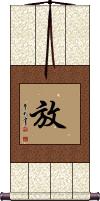
放 means to release, to free, to let go, to let out, to set off (fireworks).
In Japanese, this can also be a place called Hanashi
放 is also used in the context of Buddhism.
In Buddhism, this can represent the release of desire, materialism, suffering, or mortality.
Birth Old-Age Sickness Death
Born to Suffer
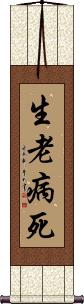
生老病死 means “to be born, to grow old, to get sick and to die” or “birth, aging, sickness, and death.”
This is an old somewhat-morbid Chinese proverb that is also used in Korean and Japanese. It figuratively means the fate of humankind (i.e. mortality) or suggests that we are all born to suffer.
In the Buddhist context, there are the “four inevitables in human life” or “four afflictions that are the lot of every human” known as “四苦” (literally “four afflictions”). Sometimes this proverb is written with that affliction character, 苦, at the end like 生老病死苦.
Not the results for mortality that you were looking for?
Below are some entries from our dictionary that may match your mortality search...
| Characters If shown, 2nd row is Simp. Chinese |
Pronunciation Romanization |
Simple Dictionary Definition |
道 see styles |
dào dao4 tao wataru わたる |
More info & calligraphy: Daoism / Taoism(1) (abbreviation) (See 道・みち・1) road; path; street; route; (2) (See 道・みち・5) way; set of practices; rules for conducting oneself; (3) (abbreviation) (in Japanese schools) (See 道徳教育) moral education; (4) Buddhist teachings; (5) Taoism; (6) administrative region of Japan (Hokkaido); (7) (hist) administrative region of Japan (Tokaido, Tosando, etc.); (8) province (administrative region of Korea); (9) circuit (administrative region of China); (10) (hist) province (Tang-era administrative region of China); (personal name) Wataru mārga. A way, road; the right path; principle, Truth, Reason, Logos, Cosmic energy; to lead; to say. The way of transmigration by which one arrives at a good or bad existence; any of the six gati, or paths of destiny. The way of bodhi, or enlightenment leading to nirvāṇa through spiritual stages. Essential nirvāṇa, in which absolute freedom reigns. For the eightfold noble path v. 八聖道.; The two Ways: (1) (a) 無礙道 or 無間道 The open or unhindered way, or the way of removing all obstacles or intervention, i. e. all delusion; (b) 解脫道 the way of release, by realization of truth. (2) (a) 難行道 The hard way of "works", i. e. by the six pāramitā and the disciplines. (b) 易行道 the easy way salvation, by the invocation of Amitābha. (3) (a) 有漏道 The way of reincarnation or mortality; (b) 無漏 the enlightened way of escape from the miseries of transmigration. (4) (a) 教道 The way of instruction; (b) 證道 the way of realization. (5) The two lower excretory organs. |
四諦 四谛 see styles |
sì dì si4 di4 ssu ti shitai したい |
More info & calligraphy: Four Noble Truths (Buddhism){Buddh} (See 苦集滅道) The Four Noble Truths catvāri-ārya-satyāni; 四聖諦; 四眞諦. The four dogmas, or noble truths, the primary and fundamental doctrines of Śākyamuni, said to approximate to the form of medical diagnosis. They are pain or 'suffering, its cause, its ending, the way thereto; that existence is suffering, that human passion (taṇhā, 欲 desire) is the cause of continued suffering, that by the destruction of human passion existence may be brought to an end; that by a life of holiness the destruction of human passion may be attained'. Childers. The four are 苦, 聚 (or 集), 滅, and 道諦, i. e. duḥkha 豆佉, samudaya 三牟提耶, nirodha 尼棲陀, and mārga 末加. Eitel interprets them (1) 'that 'misery' is a necessary attribute of sentient existence'; (2) that 'the 'accumulation' of misery is caused by the passions'; (3) that 'the 'extinction' of passion is possible; (4) mārga is 'the doctrine of the 'path' that leads to the extinction of passion'. (1) 苦 suffering is the lot of the 六趣 six states of existence; (2) 集 is the aggregation (or exacerbation) of suffering by reason of the passions; (3) 滅 is nirvana, the extinction of desire and its consequences, and the leaving of the sufferings of mortality as void and extinct; (4) 道 is the way of such extinction, i. e. the 八正道 eightfold correct way. The first two are considered to be related to this life, the last two to 出世間 a life outside or apart from the world. The four are described as the fundamental doctrines first preached to his five former ascetic companions. Those who accepted these truths were in the stage of śrāvaka. There is much dispute as to the meaning of 滅 'extinction' as to whether it means extinction of suffering, of passion, or of existence. The Nirvana Sutra 18 says that whoever accepts the four dogmas will put an end to births and deaths 若能見四諦則得斷生死 which does not of necessity mean the termination of existence but that of continued transmigration. v. 滅. |
生老病死 see styles |
shēng lǎo bìng sǐ sheng1 lao3 bing4 si3 sheng lao ping ssu shouroubyoushi / shorobyoshi しょうろうびょうし |
More info & calligraphy: Birth Old-Age Sickness Death(yoji) {Buddh} the four inevitables in human life (birth, aging, sickness, and death) Birth, age, sickness, death, the 四苦 four afflictions that are the lot of every man. The five are the above four and 苦 misery, or suffering. |
世 see styles |
shì shi4 shih toki とき |
life; age; generation; era; world; lifetime; epoch; descendant; noble (counter) (1) counter for generations; (suffix noun) (2) {geol} epoch; (personal name) Toki yuga. An age, 1, 000th part of a kalpa.loka, the world. 世 originally meant a human generation, a period of thirty years; it is used in Buddhism both foryuga, a period of time ever flowing, andloka, the world, worldly, earthly. The world is that which is to be destroyed; it is sunk in the round of mortality, or transmigration; and conceals, or is a veil over reality. |
有 see styles |
yǒu you3 yu yumi ゆみ |
to have; there is; (bound form) having; with; -ful; -ed; -al (as in 有意[you3 yi4] intentional) (1) existence; (n,n-pref) (2) possession; having; (3) (abbreviation) (in company names; written as (有)) (See 有限会社) limited company; (personal name) Yumi bhāva: that which exists, the existing, existence; to have, possess, be. It is defined as (1) the opposite of 無 wu and 空 kong the non-existent; (2) one of the twelve nidānas, existence; the condition which, considered as cause, produces effect; (3) effect, the consequence of cause; (4) anything that can be relied upon in the visible or invisible realm. It means any state which lies between birth and death, or beginning and end. There are numerous categories— 3, 4, 7, 9, 18, 25, and 29. The 三有 are the 三界 trailokya, i. e. 欲, 色 and 無色界 the realms of desire, of form, and of non-form, all of them realms of mortality; another three are 本有 the present body and mind, or existence, 當有 the future ditto, 中有 the intermediate ditto. Other definitions give the different forms or modes of existence. |
一來 一来 see styles |
yī lái yi1 lai2 i lai ichirai |
firstly, ... (一來向) sakṛdāgāmin. Only one more return to mortality, v. 斯 and 四向. |
一道 see styles |
yī dào yi1 dao4 i tao kazumichi かずみち |
together one road; ray (of hope); (given name) Kazumichi One way, the one way; the way of deliverance from mortality, the Mahāyāna. Yidao, a learned monk of the Pure-land sect. |
一門 一门 see styles |
yī mén yi1 men2 i men hitokado ひとかど |
(1) family; clan; kin; (2) sect; school; adherents; followers; disciples; (3) {sumo} group of related sumo stables; (surname) Hitokado The one door out of mortality into nirvāṇa, i.e. the Pure-land door. |
一間 一间 see styles |
yī jiān yi1 jian1 i chien ichima いちま |
one room; (surname) Ichima ekavīcika 翳迦鼻致迦 Still one final stage of mortality before nirvāṇa. Also wrongly styled bījaka 鼻致迦, a seed 一種 which leads to one more reincarnation. |
三乘 see styles |
sān shèng san1 sheng4 san sheng minori みのり |
(surname) Minori Triyāna, the three vehicles, or conveyances which carry living beings across saṁsāra or mortality (births-and-deaths) to the shores of nirvāṇa. The three are styled 小,中, and 大. Sometimes the three vehicles are defined as 聲聞 Śrāvaka, that of the hearer or obedient disciple; 緣覺Pratyeka-buddha, that of the enlightened for self; these are described as 小乘 because the objective of both is personal salvation; the third is 菩薩Bodhisattva, or 大乘 Mahāyāna, because the objective is the salvation of all the living. The three are also depicted as 三車 three wains, drawn by a goat, a deer, an ox. The Lotus declares that the three are really the One Buddha-vehicle, which has been revealed in three expedient forms suited to his disciples' capacity, the Lotus Sūtra being the unifying, complete, and final exposition. The Three Vehicles are differently explained by different exponents, e.g. (1) Mahāyāna recognizes (a) Śrāvaka, called Hīnayāna, leading in longer or shorter periods to arhatship; (b) Pratyeka-buddha, called Madhyamayāna, leading after still longer or shorter periods to a Buddhahood ascetically attained and for self; (c) Bodhisattva, called Mahayana, leading after countless ages of self-sacrifce in saving others and progressive enlightenment to ultimate Buddhahood. (2) Hīnayāna is also described as possessing three vehicles 聲, 緣, 菩 or 小, 中, 大, the 小 and 中 conveying to personal salvation their devotees in ascetic dust and ashes and mental annihilation, the 大 leading to bodhi, or perfect enlightenment, and the Buddha's way. Further definitions of the Triyāna are: (3) True bodhisattva teaching for the 大; pratyeka-buddha without ignorant asceticism for the 中; and śrāvaka with ignorant asceticism for the 小. (4) (a) 一乘 The One-Vehicle which carries all to Buddhahood: of this the 華嚴 Hua-yen and 法華 Fa-hua are typical exponents; (b) 三乘法 the three-vehicle, containing practitioners of all three systems, as expounded in books of the 深密般若; (c) 小乘 the Hīnayāna pure and simple as seen in the 四阿合經 Four Āgamas. Śrāvakas are also described as hearers of the Four Truths and limited to that degree of development; they hear from the pratyeka-buddhas, who are enlightened in the Twelve Nidānas 因緣; the bodhisattvas make the 六度 or six forms of transmigration their field of sacrificial saving work, and of enlightenment. The Lotus Sūtra really treats the 三乘. Three Vehicles as 方便 or expedient ways, and offers a 佛乘 Buddha Vehicle as the inclusive and final vehicle. |
三果 see styles |
sān guǒ san1 guo3 san kuo mika みか |
(female given name) Mika The third of the Hīnayāna 四果 four fruits or results, i. e. non-return to mortality. |
三漏 see styles |
sān lòu san1 lou4 san lou sanro |
The three affluents that feed the stream of mortality, or transmigration: 欲 desire; 有 (material, or phenomenal) existence; 無明 ignorance (of the way of escape). 涅槃經 22. |
三道 see styles |
sān dào san1 dao4 san tao mitsumichi みつみち |
(surname) Mitsumichi (1) The three paths all have to tread; 輪廻三道, 三輪, i.e. (a) 煩惱道 ; 惑道 ; the path of misery, illusion, mortality; (b) 業道 the path of works, action, or doing, productive of karma; (c) 苦道 the resultant path of suffering. As ever recurring they are called the three wheels. (2) 聾, 緣, 菩 śrāvakas, pratyekabuddhas, bodhisattvas, cf. 三乘. |
不來 不来 see styles |
bù lái bu4 lai2 pu lai furai |
Not coming (back to mortality), an explanation of 阿那含 anāgāmin. |
中流 see styles |
zhōng liú zhong1 liu2 chung liu chuuru / churu ちゅうる |
midstream (hist) (See 三流・さんる) banishment (to a somewhat distant province); middle-degree punishment of the three banishment punishments under the ritsuryō system In the midst of the stream, i. e. of 生死 mortality, or reincarnations. |
九結 九结 see styles |
jiǔ jié jiu3 jie2 chiu chieh kyūketsu |
The nine bonds that bind men to mortality: love, hate, pride, ignorance, (wrong)views, possessions (or grasping), doubt, envy, meanness (or selfishness). They are the 六隨眠 plus grasping, envy, and meanness. |
二出 see styles |
èr chū er4 chu1 erh ch`u erh chu nishutsu |
The two modes of escape from mortality, 堅出 the long way called the 聖道門 or 自力敎, i.e. working out one's own salvation; and 橫出 the across or short way of the Pure-land sect or 他力敎 faith in or invocation of another, i.e. Amitābha. |
二教 see styles |
èr jiào er4 jiao4 erh chiao nikyō |
Dual division of the Buddha's teaching. There are various definitions: (1) Tiantai has (a) 顯教 exoteric or public teaching to the visible audience, and (b) 密教 at the same time esoteric teaching to an audience invisible to the other assembly. (2) The 眞言 Shingon School by "exoteric" means all the Buddha's preaching, save that of the 大日經 which it counts esoteric. (3) (a) 漸教 and (b) 頓教 graduated and immediate teaching, terms with various uses, e.g. salvation by works Hīnayāna, and by faith, Mahāyāna, etc.; they are applied to the Buddha's method, to the receptivity of hearers and to the teaching itself. (4) Tiantai has (a) 界内教 and (b) 界外教 teachings relating to the 三界 or realms of mortality and teachings relating to immortal realms. (5) (a) 半字教 and (b) 滿字教 Terms used in the Nirvāṇa sūtra, meaning incomplete word, or letter, teaching and complete word teaching, i.e. partial and complete, likened to Hīnayāna and Mahāyāna. (6) (a) 捃收教 and (b) 扶律談常教 of the Nirvāṇa sūtra, (a) completing those who failed to hear the Lotus; (b) "supporting the law, while discoursing on immortality," i.e. that the keeping of the law is also necessary to salvation. (7) Tiantai's division of (a) 偏教 and (b) 圓教 the partial teaching of the 藏, 通, and schools as contrasted with the perfect teaching of the 圓 school. (8) Tiantai's division of (a) 構教 and (6) 實教 temporary and permanent, similar to the last two. (9) (a) 世間教 The ordinary teaching of a moral life here; (b) 出世間教 the teaching of Buddha-truth of other-worldly happiness in escape from mortality. (10) (a) 了義教 the Mahāyāna perfect or complete teaching, and (b) 不了義教 Hīnayāna incompleteness. (11) The Huayan division of (a) 屈曲教 indirect or uneven teaching as in the Lotus and Nirvāṇa sūtras, and (b) 平道教 direct or levelled up teaching as in the Huayan sūtra. (12) The Huayan division of (a) 化教 all the Buddha's teaching for conversion and general instruction, and (b) 制教 his rules and commandments for the control and development of his order. |
二果 see styles |
èr guǒ er4 guo3 erh kuo nika |
Sakṛdāgāmin; v. 裟 and 斯. The second "fruit" of the four kinds of Hīnayāna arhats, who have only once more to return to mortality. Also the two kinds of fruit or karma: (a) 習氣果 The good or evil characteristics resulting from habit or practice in a former existence; (b) 報果the pain or pleasure resulting (in this life) from the practices of a previous life. |
二際 二际 see styles |
èr jì er4 ji4 erh chi nisai |
The two borders, or states: according to Hīnayāna, nirvana and mortality; according to Mahāyāna the two are one. |
五度 see styles |
wǔ dù wu3 du4 wu tu godo ごど |
five degrees; fifth (basic musical interval, doh to soh) {music} fifth (interval) The five means of transportation over the sea of mortality to salvation; they are the five pāramitās 五波羅蜜— almsgiving, commandment-keeping, patience under provocation, zeal, and meditation. |
五忍 see styles |
wǔ rěn wu3 ren3 wu jen gonin |
The five stages of bodhisattva-kṣānti, patience or endurance according to the 別教: (1) 伏忍the causes of passion and illusion controlled but not finally cut off, the condition of 十住, 十行, and 十廻向; (2) 信忍 firm belief, i. e. from the 初地 to the 三地; (3) 順忍 patient progress towards the end of all mortality, i. e. 四地 to 六地; (4) 無生忍 patience for full apprehension, of the truth of no rebirth, 七地 to 九地; and (5) 寂滅忍 the patience that leads to complete nirvana, 十地 to 妙覺; cf. 五位. |
五性 see styles |
wǔ xìng wu3 xing4 wu hsing goshō |
The five different natures as grouped by the 法相宗 Dharmalakṣana sect; of these the first and second, while able to attain to non-return to mortality, are unable to reach Buddhahood; of the fourth some may, others may not reach it; the fifth will be reborn as devas or men: (1) śrāvakas for arhats; (2) pratyekabuddhas for pratyekabuddha-hood; (3) bodhisattvas for Buddhahood; (4) indefinite; (5) outsiders who have not the Buddha mind. The Sutra of Perfect Enlightenment 圓覺經 has another group, i. e. the natures of (1) ordinary good people; (2) śrāvakas and pratyekabuddhas; (3) bodhisattvas; (4) indefinite; (5) heretics. |
五結 五结 see styles |
wǔ jié wu3 jie2 wu chieh goketsu |
Wujie or Wuchieh Township in Yilan County 宜蘭縣|宜兰县[Yi2 lan2 Xian4], Taiwan The five bonds to mortality: 貧 desire, 恚 hata, 慢 pride, 嫉 envy, 慳 grudging. |
佛滅 佛灭 see styles |
fó miè fo2 mie4 fo mieh butsumetsu |
(佛滅度) Buddha's nirvana; it is interpreted as the extinction of suffering, or delusion, and as transport across the 苦海 bitter sea of mortality, v. 滅. |
內薰 see styles |
nèi xūn nei4 xun1 nei hsün |
Inner censing; primal ignorance, or unenlightenment; perfuming, censing, or acting upon original intelligence causes the common uncontrolled mind to resent the miseries of mortality and to seek nirvana; v. 起信論 Awakening of Faith. |
六度 see styles |
liù dù liu4 du4 liu tu rokudo ろくど |
(surname) Rokudo The six things that ferry one beyond the sea of mortality to nirvana, i. e. the six pāramitās 波羅蜜 (波羅蜜多): (1) 布施 dāna, charity, or giving, including the bestowing of the truth on others; (2) 持戒 śīla, keeping the command rents; (3) 忍辱 kṣānti, patience under insult; (4) 精進 vīrya, zeal and progress; (5) 闡定 dhyāna, meditation or contemplation; (6) 智慧 prajñā; wisdom, the power to discern reality or truth. It is the last that carries across the saṃsāra (sea of incarnate life) to the shores of nirvana. The opposites of these virtues are meanness, wickedness, anger, sloth, a distracted mind, and ignorance. The 唯識論 adds four other pāramitās: (7) 方便 upāya, the use of appropriate means; (8) 願 praṇidhāna, pious vows; (9) 力 bala, power of fulfillment; (10) 智 jñāna knowledge. |
六舟 see styles |
liù zhōu liu4 zhou1 liu chou rokushū |
The six boats, i. e. the six pāramitās 六度 for ferrying to the bank beyond mortality. |
出慧 see styles |
chū huì chu1 hui4 ch`u hui chu hui shutsue |
The wisdom of leaving mortality, or reincarnations; the wisdom of leaving the world. |
出期 see styles |
chū qí chu1 qi2 ch`u ch`i chu chi shutsu go |
The going forth period, i. e. from the sufferings of mortality; the appointed time of going forth; the period of setting forth. |
Click here for more mortality results from our dictionary
The following table may be helpful for those studying Chinese or Japanese...
| Title | Characters | Romaji (Romanized Japanese) | Various forms of Romanized Chinese | |
| Release Let Go | 放 | hana / pang | fàng / fang4 / fang | |
| Birth Old-Age Sickness Death | 生老病死 | shou rou byou shi shouroubyoushi sho ro byo shi | shēng lǎo bìng sǐ sheng1 lao3 bing4 si3 sheng lao bing si shenglaobingsi | sheng lao ping ssu shenglaopingssu |

Successful Chinese Character and Japanese Kanji calligraphy searches within the last few hours...



