Many custom options...


And formats...



Musical in Chinese / Japanese...
Buy a Musical calligraphy wall scroll here!
Personalize your custom “Musical” project by clicking the button next to your favorite “Musical” title below...
Viola
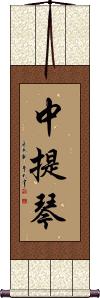
中提琴 is the Chinese title for the stringed musical instrument known in English as the viola.
Music
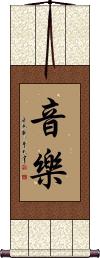
音樂 is how to write music in most Asian languages.
It can also express the idea of a musical movement, depending on context.
 The second character has morphed a bit in Japanese Kanji. If you want the specifically modern Japanese version, please click on the Kanji to the right, instead of the button above. The version shown to the left was used in ancient Japan, prior to the Japanese language reformations after WWII (so technically,
it’s
still Japanese).
The second character has morphed a bit in Japanese Kanji. If you want the specifically modern Japanese version, please click on the Kanji to the right, instead of the button above. The version shown to the left was used in ancient Japan, prior to the Japanese language reformations after WWII (so technically,
it’s
still Japanese).
Opera
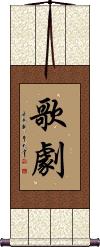
歌劇 is the Chinese, Japanese Kanji, and old Korean Hanja for opera.
This term applies in almost all cases to western opera versus Asian operas or musical plays.
Jikata

This word has a few possible meanings.
It can refer to a room, hall, or place (a dojo or small theater). The dictionary suggests that in some context, this can refer to a special geisha who is talented in certain musical arts.
Ritsu
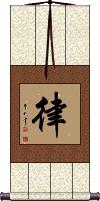
While this character literally means law, regulation or rules, it's also a surname Lü in Chinese and name Ritsu in Japanese.
In more ancient times (and for some people still), this can refer to East Asian criminal code, or vinaya (rules for the monastic community). For Japanese Buddhists, this can be the Ritsu school.
In some context, this can refer to certain musical scales used in Asia.
Harmony / Balance
Cho Wa
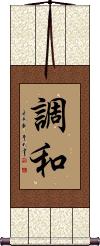
調和 is one of the several ways to express harmony in Chinese and Japanese.
Note: The first character means harmony but also suggests a musical meaning. It can also describe warriors marching in perfect cadence (in step) or to regulate something.
The second character carries the meaning of harmony and peace by itself.
Together, these characters create a word that can be defined as harmonious, to mediate, to reconcile, to compromise; mediation, temper, to mix, blend, blended, season, seasoning (getting the flavors of the food in balance), to placate, or be in harmonious proportion.
The meaning varies depending on the context. However, when hanging as a wall scroll, this will refer to the person (you) being balanced and in harmony while rational and under control simultaneously.
Nguyen / Ruan
Surname
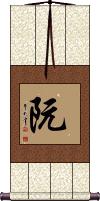
阮 is the original Chinese character that represented the Vietnamese surname Nguyễn before Vietnam stopped using Chinese characters and romanized their language. It is probably the most common surname in all of Vietnam. While romanized as Nguyen, it sounds more like the English word “Win” or “When.” 阮 can also represent the Nguyen Dynasty in Vietnam, which lasted from 1802 to 1945.
阮 is also the Chinese surname Ruan, most Chinese with this surname have ancestors from a small state named Ruan during the Shang Dynasty (1600-1046 BC) located in the southeast of modern-day Gansu Province.
In Japanese, this can be the rare surnames pronounced Min, Gen, Ken, Gan, or En.
Besides a surname, this character also represents an ancient musical instrument.
Geisha
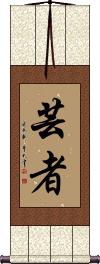
芸者 is the real basis for the way we spell geisha.
However, there are many more ways to refer to a woman that fills the role that westerners think of when they hear the word geisha.
In Japanese, these characters literally mean “artful person.” But in English, it might be better translated as “a person (woman) highly trained/accomplished in the arts.”
However, my Japanese dictionary says “a singing and dancing girl.”
Many will argue as to whether “geisha” = “prostitute” or not. My Japanese friends seem to have the opinion that a geisha is so highly trained in the art of playing musical instruments and dancing that the fact she might also be a prostitute is secondary to her performance on stage.
芸者 is a “Japanese only” term, they use a slightly different first character to express “geisha” in Chinese. Since this is a Japanese term, I have not included the Chinese version.
Ten Commandments
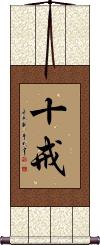
十戒 means Ten Commandments or Ten Precepts.
In the Buddhist context, these are prohibitions consisting of five commandments for the layman:
1. Not to destroy life 不殺生 Pāṇātipātāveramaṇi.
2. Not to steal 不倫盜 Adinnādānāver.
3. Not to commit adultery 不婬慾 Abrahmacaryaver.
4. Not to lie 不妄語 Musāvādāver.
5. Not to take intoxicating liquor 不飮酒 Suramereyya-Majjapamādaṭṭhānāver.
The ten commandments for the monk are the preceding five plus:
6. Not to eat food outside of regulated hours 不非時食 Vikāla-Bhojanāver.
7. Not to use garlands or perfumes 不著華鬘好香塗身 Mālā- Gandha-Vilepana-Dhāraṇa-Maṇḍana-Vibhūṣanaṭṭhānā.
8. Not to sleep on high or broad beds (chastity) 不坐高廣大牀 Uccāsayanā-Mahāsayanā.
9. Not to take part in singing, dancing, musical or theatrical performances 不歌舞倡伎不往觀聽 Nacca-Gīta-Vādita-Visūkadassanāver.
10. To refrain from acquiring uncoined or coined gold, or silver, or jewels 不得捉錢金銀寶物 Jātarūpa-Rajata-Paṭīggahaṇāver.
These original Buddhist commandments date back to about 2500 years ago. The English definitions above are followed by Chinese characters and original Pali pronunciation.
Under the Māhayāna Buddhism, these ten commands for the monk were changed, to accord with the new environment of the monk, to the following: not to kill, not to steal, to avoid all unchastity, not to lie, not to slander, not to insult, not to chatter, not to covet, not to give way to anger, to harbor no skepticism.
This in-stock artwork might be what you are looking for, and ships right away...
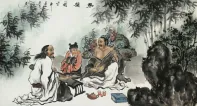
Gallery Price: $200.00
Your Price: $88.88
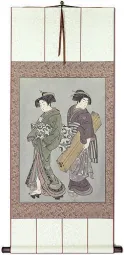
Gallery Price: $144.00
Your Price: $79.88

Gallery Price: $60.00
Your Price: $36.88
The following table may be helpful for those studying Chinese or Japanese...
| Title | Characters | Romaji (Romanized Japanese) | Various forms of Romanized Chinese | |
| Viola | 中提琴 | zhōng tí qín zhong1 ti2 qin2 zhong ti qin zhongtiqin | chung t`i ch`in chungtichin chung ti chin |
|
| Music | 音樂 音乐 / 音楽 | ongaku | yīn yuè / yin1 yue4 / yin yue / yinyue | yin yüeh / yinyüeh |
| Opera | 歌劇 歌剧 | kageki | gē jù / ge1 ju4 / ge ju / geju | ko chü / kochü |
| Jikata | 地方 | jikata | dì fāng / di4 fang1 / di fang / difang | ti fang / tifang |
| Ritsu | 律 | ritsu | lǜ / lu:4 / lu: | lü |
| Harmony Balance | 調和 调和 | chou wa / chouwa / cho wa | tiáo hé / tiao2 he2 / tiao he / tiaohe | t`iao ho / tiaoho / tiao ho |
| Nguyen Ruan | 阮 / 阮 阮 | Min / Gen | ruǎn / ruan3 / ruan | juan |
| Geisha | 芸者 | geisha | yún zhě / yun2 zhe3 / yun zhe / yunzhe | yün che / yünche |
| Ten Commandments | 十戒 | jukkai / jukai | shí jiè / shi2 jie4 / shi jie / shijie | shih chieh / shihchieh |
| In some entries above you will see that characters have different versions above and below a line. In these cases, the characters above the line are Traditional Chinese, while the ones below are Simplified Chinese. | ||||

Successful Chinese Character and Japanese Kanji calligraphy searches within the last few hours...



