Many custom options...


And formats...



Not what you want?
Try other similar-meaning words, fewer words, or just one word.
Nana Koro Bi Ya Ok in Chinese / Japanese...
Buy a Nana Koro Bi Ya Ok calligraphy wall scroll here!
Personalize your custom “Nana Koro Bi Ya Ok” project by clicking the button next to your favorite “Nana Koro Bi Ya Ok” title below...
Switched to secondary search mode due to lack of results using primary.
These secondary results may not be very accurate. Try a different but similar meaning word or phrase for better results. Or...
Look up Nana Koro Bi Ya Ok in my Japanese Kanji & Chinese Character Dictionary(My dictionary is a different system then the calligraphy search you just tried)
If you want a special phrase, word, title, name, or proverb, feel free to contact me, and I will translate your custom calligraphy idea for you.
1. Cold
2. Eight
3. Fall Down Seven Times, Get Up Eight
4. Five
6. Jasiah
7. Jehovah
9. Nana
10. Nana-Dan / 7th Degree Black Belt
12. Nine
13. Peace of Mind
14. Homosexual Male / Gay Male
15. San Soo Kung Fu
16. Seven
17. Ten
18. Three
19. Unicorn
20. Zero
Cold
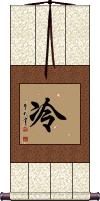
冷 is “cold” in Chinese, Japanese Kanji, and old Korean Hanja.
This can also mean cool, chilled, and unheated.
In Chinese, this can be the surname, Leng.
In Japanese, it can be the given/surname Rei.
冷 is an unusual title for a wall scroll but it's OK if “cold” has a special meaning to you, or your name is Leng or Rei.
Eight
The number eight
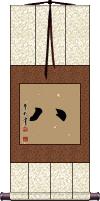
八 is the number eight in Chinese, Japanese Kanji, and old Korean Hanja.
八 is a strange selection for a wall scroll, so it's here mostly for reference. I guess it's OK if the number eight is important to you.
Because this character is rather simple (just two strokes), 捌 instead of 八 is an anti-fraud way to write eight on bank documents.
Fall Down Seven Times, Get Up Eight
Always rising after a fall or repeated failures
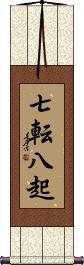
七転八起 is a Japanese proverb that relays the vicissitudes of life, with the meaning “seven times down eight times up.”
Some would more naturally translate it into English as “Always rising after a fall or repeated failures” or compare it to the English, “If at first, you don't succeed, try, try again.”
The first Kanji is literally “7.” The second means “fall down” (sometimes this Kanji means “turn around,” “revolve” or “turn over” but in this case, it holds the meaning of “fall”). The third is “8.” And the last is “get up,” “rouse,” or “rise.”
Basically, if you fail 7 times, you should recover from those events and be prepared to rise an 8th time. This also applies if it is the world or circumstances that knock you down seven times...
...just remember that you have the ability to bounce back from any kind of adversity.
Note: This can be pronounced in two ways. One is “shichi ten hakki” or “shichitenhakki.” The other is “nana korobi ya oki” also written, “nanakorobi-yaoki.”
Special Note: The second character is a Kanji that is not used in China. Therefore, please select a Japanese calligrapher for this title.
Five
The number five
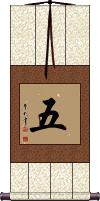
五 is the number five in Chinese, Japanese Kanji, and old Korean Hanja.
This is a strange selection for a wall scroll, so it's here mostly for reference. I guess it's OK if the number five is important to you.
 Because this character is rather simple (just four strokes), there is an anti-fraud way to write three on bank documents. These variants are shown to the right. This version can also refer to a squad of five soldiers, or in Korean, refer to rank.
Idea / Concept
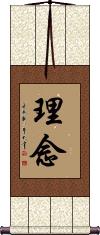
理念/理唸 means idea, notion, concept, principle, theory, philosophy*, or doctrine in Chinese, Japanese Kanji, and old Korean Hanja.
This word is OK for a wall scroll, although it's more commonly used as an oral/informal word in Asia.
* This is not the title for philosophy but rather is about having a certain philosophy or approach to something.
Jasiah
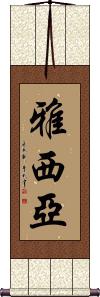
雅西亞 is the name Jasiah in Mandarin Chinese if you pronounce your name with a “Ya” instead of a hard “J” sound at the beginning.
Jehovah
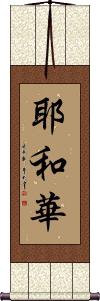
耶和華 is the Mandarin Chinese name for Jehovah.
This is the biblical name for God. Originally this was YHWH or Yahweh from Hebrew, although Yahweh is usually written 雅威 (Ya-wei) in Mandarin. Also, this is not the same as God which is 上帝 (Shang-di).
Man of Character
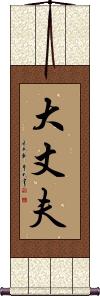
大丈夫 is a Chinese, Korean, and Japanese title that means a manly man, a man of character, a great man, or a fine figure of a man.
In Japanese, this can also be used to mean safe, all right, alright, OK, sure, or “no problem.” Used in Japanese for something that is undoubted or very acceptable.
Nana
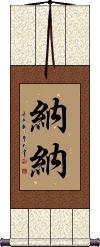
納納 is the name Nana in Chinese (Mandarin).
Nana
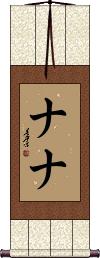
ナナ is the name Nana in Japanese.
Note: Because this title is entirely Japanese Katakana, it should be written by a Japanese calligrapher.
Nana-Dan / 7th Degree Black Belt
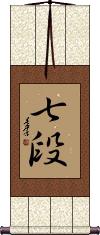
七段 represents the 7th Rank or 7th Degree (7th Degree of black belt) in Japanese martial arts.
This can also be the 7th rank in other fields such as chess play (Japanese “Go”) etc.
Seven Emperors Judo
Nana tei jūdō

七帝柔道 is the Japanese Kanji for the Seven Emperors Judo school of martial arts.
Nine
The number nine
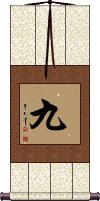
九 is the number nine in Chinese, Japanese Kanji, and old Korean Hanja.
九 is a strange selection for a wall scroll, so it's here mostly for reference. I guess it's OK if the number nine is important to you.
 Because this character is rather simple (just two strokes), there is an anti-fraud way to write nine on bank documents. This version is shown to the right.
Peace of Mind
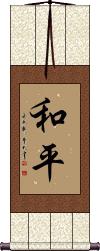
和平 is the Chinese order for these two characters, which means peace but can also be translated as amicability, specifically, or mildness. 和平 is often translated as a simple way to say “peace of mind.” This combination is used in Korean Hanja to mean “peace and harmony.”
Alone, the first character means peace and harmony.
The second character means balance when read by itself.
Note: 和平 are often seen in the opposite order in Japanese with the same meaning (You'll sometimes find them in this order in Japan, so either way is OK).
Homosexual Male / Gay Male
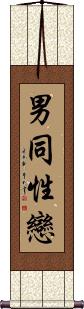
You need the male character in front of the word for homosexual in Chinese to create this word.
It's a much nicer way to say “Gay Male” than English words like Fag, Fairy, Sissy, Puff, Poof, Poofster, Swish, or Pansy. Although I suppose it could be used as a substitute for Nancy Boy, Queer, or Queen (for which, last time I checked, my gay friends said were OK in the right context).
For those of you who think China is a restrictive society - there are at least two gay discos in Beijing, the capital of China. It's at least somewhat socially acceptable to be a gay male in China. However, lesbians seem to be shunned a bit.
I think the Chinese government has realized that the 60% male population means not everybody is going to find a wife (every gay male couple that exists means two more women in the population are available for the straight guys), and the fact that it is biologically impossible for men to give birth, may be seen as helping to decrease the over-population in China.
San Soo Kung Fu
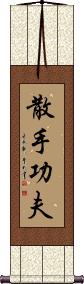
散手功夫 is San Soo Kung Fu.
Sometimes you will see this in the order 功夫散手 (Kung Fu San Soo). Either version is OK.
It's like “Kung Fu of San Soo” vs. “San Soo Kung Fu” if you put it in English terms. San Soo is the adjective either way in Chinese.
Seven
The number seven
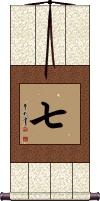
七 is the number 7 in Chinese, Korean Hanja, and Japanese Kanji. I have no idea why you would want this as a calligraphy wall scroll but hundreds of visitors search for this number.
In Japanese, this character can be pronounced several different ways depending on context. It can be shichi / nana-, and a few others when combined with other characters.
There's just one way to pronounce this in Chinese. Korean also has just one pronunciation.
Ten
The number ten
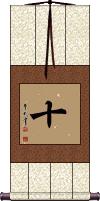
十 is the number ten in Chinese, Japanese Kanji, and old Korean Hanja.
This is a strange selection for a wall scroll, so it's here mostly for reference. I guess it's OK if the number ten is important to you.
 Because this character is rather simple (just two strokes), there is an anti-fraud way to write ten on bank documents. This variant is shown to the right.
Three
The number three
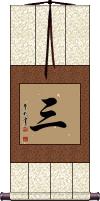
三 is the number three in Chinese, Japanese Kanji, and old Korean Hanja.
This is a strange selection for a wall scroll, so it's here mostly for reference. I guess it's OK if the number three is important to you.

 Because this character is rather simple (just three lines), there is an anti-fraud way to write three on bank documents. These variants are shown to the right.
Unicorn
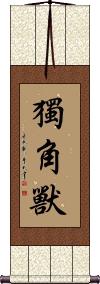
獨角獸 is the Chinese name for the western unicorn (a horse with a spiral horn emerging from the head).
獨角獸 is an unusual title for a Chinese wall scroll, but it's OK if you really love unicorns.
Chinese have their own ancient unicorn-like creature called a “qilin” (or kirin in Japanese).
Unicorn
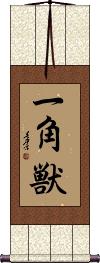
一角獣 is the Japanese name for the western unicorn (a horse with a spiral horn emerging from the head). This can also refer to a narwhal, depending on context.
一角獣 is an unusual title for a Japanese wall scroll but it's OK if you really love unicorns.
Japanese have their own ancient unicorn-like creature called a “kirin” (or qilin in the original Chinese).
Zero
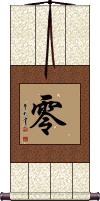
零 is the number zero in Chinese, Japanese Kanji, and old Korean Hanja.
零 is a strange selection for a wall scroll, so it's here mostly for reference. I guess it's OK if zero is important to you.
Note: In modern Japan and China, they will often just write a circle to represent zero in lieu of this character.
This in-stock artwork might be what you are looking for, and ships right away...
Gallery Price: $268.00
Your Price: $148.77
The following table may be helpful for those studying Chinese or Japanese...
| Title | Characters | Romaji (Romanized Japanese) | Various forms of Romanized Chinese | |
| Cold | 冷 | rei | lěng / leng3 / leng | |
| Eight | 八 | hachi | bā / ba1 / ba | pa |
| Fall Down Seven Times, Get Up Eight | 七転八起 | shichi ten hakki / nana korobi ya oki shichi ten haki / nana korobi ya oki | ||
| Five | 五 / 伍 五 | go | wǔ / wu3 / wu | |
| Idea Concept | 理念 / 理唸 理念 | ri nen / rinen | lǐ niàn / li3 nian4 / li nian / linian | li nien / linien |
| Jasiah | 雅西亞 雅西亚 | yǎ xī yà ya3 xi1 ya4 ya xi ya yaxiya | ya hsi ya yahsiya |
|
| Jehovah | 耶和華 耶和华 | yē hé huá ye1 he2 hua2 ye he hua yehehua | yeh ho hua yehhohua |
|
| Man of Character | 大丈夫 | dai jou bu / daijoubu / dai jo bu | dà zhàng fu da4 zhang4 fu5 da zhang fu dazhangfu | ta chang fu tachangfu |
| Nana | 納納 纳纳 | nà nà / na4 na4 / na na / nana | ||
| Nana | ナナ | nana | ||
| Nana-Dan 7th Degree Black Belt | 七段 | nana dan / nanadan | ||
| Seven Emperors Judo | 七帝柔道 | Nana tei jū dō Nanateijūdō | qī dì róu dào qi1 di4 rou2 dao4 qi di rou dao qidiroudao | ch`i ti jou tao chitijoutao chi ti jou tao |
| Nine | 九 / 玖 | kyuu / kyu | jiǔ / jiu3 / jiu | chiu |
| Peace of Mind | 和平 | wa hei / wahei | hé píng / he2 ping2 / he ping / heping | ho p`ing / hoping / ho ping |
| Homosexual Male Gay Male | 男同性戀 男同性恋 | nán tóng xìng liàn nan2 tong2 xing4 lian4 nan tong xing lian nantongxinglian | nan t`ung hsing lien nantunghsinglien nan tung hsing lien |
|
| San Soo Kung Fu | 散手功夫 | sǎn shǒu gōng fu san3 shou3 gong1 fu san shou gong fu sanshougongfu | san shou kung fu sanshoukungfu |
|
| Seven | 七 | shichi / nana- | qī / qi1 / qi | ch`i / chi |
| Ten | 十 / 拾 十 | juu / ju | shí / shi2 / shi | shih |
| Three | 三 / 參 三 / 参 | san | sān / san1 / san | |
| Unicorn | 獨角獸 独角兽 | dú jiǎo shòu du2 jiao3 shou4 du jiao shou dujiaoshou | tu chiao shou tuchiaoshou |
|
| Unicorn | 一角獣 | ikkakujuu / ikakuju | ||
| Zero | 零 零 / 〇 | rei / zero | líng / ling2 / ling | |
| In some entries above you will see that characters have different versions above and below a line. In these cases, the characters above the line are Traditional Chinese, while the ones below are Simplified Chinese. | ||||

Successful Chinese Character and Japanese Kanji calligraphy searches within the last few hours...



