Many custom options...


And formats...



Not what you want?
Try other similar-meaning words, fewer words, or just one word.
One Body Mind and Soul in Chinese / Japanese...
Buy an One Body Mind and Soul calligraphy wall scroll here!
Personalize your custom “One Body Mind and Soul” project by clicking the button next to your favorite “One Body Mind and Soul” title below...
Spiritual Soul Mates
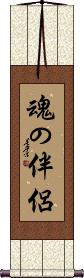
魂の伴侶 is a Japanese-only title for soulmates.
魂 means soul, spirit, immortal soul (the part of you that lives beyond your physical body), or the conscious mind. In the Buddhist context, this is vijñāna or viññāṇa (consciousness, life force, or mind).
の is a possessive article that connects everything here.
伴侶 means mates, companions, partners, and spouses.
Energy Sword Body in Concert
Spirit, Sword & Body as One
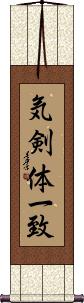
气剑体一致 often gets translated as “Mind Sword Body,” or “Spirit, Sword, and Body as One.” But I think these translations don't tell you enough about what this is really saying.
In this context, 気, which is the modern Japanese version of 氣, means spiritual and unseen energy or “life energy.” In some cases, 気 can be translated as spirit, feeling, or nature. If defined as the mind, it's more about the invisible or intangible parts of one's mind (or soul).
剣 is the Japanese version of 劍 meaning sword.
体 is the modern Japanese version of 體 meaning body.
The Kanji 一 means one, and in this case, suggests “all in one.”
The Kanji 到 means to send, deliver, or convey. But together, 一到 suggests all these things in agreement, union cooperation, or in concert.
Note: Arguments exist as to whether this should be romanized as Kikentaiitchi, Kikentaiicchi, or kikentaiichi. Technically, if you drop the last character, you get 気剣体一 and kikentaiichi (ki ken tai ichi), which is also a valid phrase.
Soul / Spirit
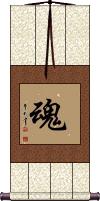
魂 means soul or spirit as in the immortal soul that can be detached from the body.
This can also refer to one's Yang energy or spirit.
In the Buddhist context, this can be the soul, conscious mind, or vijñāna.
This in-stock artwork might be what you are looking for, and ships right away...
Gallery Price: $200.00
Your Price: $90.88

Gallery Price: $72.00
Your Price: $39.88
Gallery Price: $200.00
Your Price: $118.88

Gallery Price: $202.00
Your Price: $111.88

Gallery Price: $106.00
Your Price: $58.88

Gallery Price: $268.00
Your Price: $148.77
Gallery Price: $198.00
Your Price: $109.88

Gallery Price: $61.00
Your Price: $33.88

Gallery Price: $61.00
Your Price: $33.88
Not the results for one body mind and soul that you were looking for?
Below are some entries from our dictionary that may match your one body mind and soul search...
| Characters If shown, 2nd row is Simp. Chinese |
Pronunciation Romanization |
Simple Dictionary Definition |
禪 禅 see styles |
shàn shan4 shan yuzuri ゆずり |
More info & calligraphy: Zen / Chan / Meditation(out-dated kanji) (1) (Buddhist term) dhyana (profound meditation); (2) (abbreviation) Zen (Buddhism); (surname) Yuzuri To level a place for an altar, to sacrifice to the hills and fountains; to abdicate. Adopted by Buddhists for dhyāna, 禪 or 禪那, i.e. meditation, abstraction, trance. dhyāna is 'meditation, thought, reflection, especially profound and abstract religious contemplation'. M.W. It was intp. as 'getting rid of evil', etc., later as 靜慮 quiet meditation. It is a form of 定, but that word is more closely allied with samādhi, cf. 禪定. The term also connotes Buddhism and Buddhist things in general, but has special application to the 禪宗 q.v. It is one of the six pāramitās, cf. 波. There are numerous methods and subjects of meditation. The eighteen brahmalokas are divided into four dhyāna regions 'corresponding to certain frames of mind where individuals might be reborn in strict accordance with their spiritual state'. The first three are the first dhyāna, the second three the second dhyāna, the third three the third dhyāna, and the remaining nine the fourth dhyāna. See Eitel. According to Childers' Pali Dictionary, 'The four jhānas are four stages of mystic meditation, whereby the believer's mind is purged from all earthly emotions, and detached as it were from his body, which remains plunged in a profound trance.' Seated cross-legged, the practiser 'concentrates his mind upon a single thought. Gradually his soul becomes filled with a supernatural ecstasy and serenity', his mind still reasoning: this is the first jhāna. Concentrating his mind on the same subject, he frees it from reasoning, the ecstasy and serenity remaining, which is the second jhāna. Then he divests himself of ecstasy, reaching the third stage of serenity. Lastly, in the fourth stage the mind becomes indifferent to all emotions, being exalted above them and purified. There are differences in the Mahāyāna methods, but similarity of aim. |
三身 see styles |
sān shēn san1 shen1 san shen sanmi さんみ |
{Buddh} trikaya (three bodies of the Buddha); (surname) Sanmi trikāya. 三寶身 The threefold body or nature of a Buddha, i.e. the 法, 報, and 化身, or dharmakāya, sambhogakāya, and nirmāṇakāya. The three are defined as 自性, 受用, and 變化, the Buddha-body per se, or in its essential nature; his body of bliss, which he "receives" for his own "use" and enjoyment; and his body of transformation, by which he can appear in any form; i.e. spiritual, or essential; glorified; revealed. While the doctrine of the trikāya is a Mahāyāna concept, it partly results from the Hīnayāna idealization of the earthly Buddha with his thirty-two signs, eighty physical marks, clairvoyance, clairaudience, holiness, purity, wisdom, pity, etc. Mahāyāna, however, proceeded to conceive of Buddha as the Universal, the All, with infinity of forms, yet above all our concepts of unity or diversity. To every Buddha Mahāyāna attributed a three-fold body: that of essential Buddha; that of joy or enjoyment of the fruits of his past saving labours; that of power to transform himself at will to any shape for omnipresent salvation of those who need him. The trinity finds different methods of expression, e.g. Vairocana is entitled 法身, the embodiment of the Law, shining everywhere, enlightening all; Locana is 報身; c.f. 三賓, the embodiment of purity and bliss; Śākyamuni is 化身 or Buddha revealed. In the esoteric sect they are 法 Vairocana, 報 Amitābha, and 化 Śākyamuni. The 三賓 are also 法 dharma, 報 saṅgha, 化 buddha. Nevertheless, the three are considered as a trinity, the three being essentially one, each in the other. (1) 法身 Dharmakāya in its earliest conception was that of the body of the dharma, or truth, as preached by Śākyamuni; later it became his mind or soul in contrast with his material body. In Mādhyamika, the dharmakāya was the only reality, i.e. the void, or the immateria1, the ground of all phenomena; in other words, the 眞如 the tathāgatagarbha, the bhūtatathatā. According to the Huayan (Kegon) School it is the 理or noumenon, while the other two are氣or phenomenal aspects. "For the Vijñānavāda... the body of the law as highest reality is the void intelligence, whose infection (saṃkleҫa) results in the process of birth and death, whilst its purification brings about Nirvāṇa, or its restoration to its primitive transparence" (Keith). The "body of the law is the true reality of everything". Nevertheless, in Mahāyāna every Buddha has his own 法身; e.g. in the dharmakāya aspect we have the designation Amitābha, who in his saṃbhogakāya aspect is styled Amitāyus. (2) 報身Sambhogakāya, a Buddha's reward body, or body of enjoyment of the merits he attained as a bodhisattva; in other words, a Buddha in glory in his heaven. This is the form of Buddha as an object of worship. It is defined in two aspects, (a) 自受用身 for his own bliss, and (b) 他受用身 for the sake of others, revealing himself in his glory to bodhisattvas, enlightening and inspiring them. By wisdom a Buddha's dharmakāya is attained, by bodhisattva-merits his saṃbhogakāya. Not only has every Buddha all the three bodies or aspects, but as all men are of the same essence, or nature, as Buddhas, they are therefore potential Buddhas and are in and of the trikāya. Moreover, trikāya is not divided, for a Buddha in his 化身 is still one with his 法身 and 報身, all three bodies being co-existent. (3) 化身; 應身; 應化身 nirmāṇakāya, a Buddha's transformation, or miraculous body, in which he appears at will and in any form outside his heaven, e.g. as Śākyamuni among men. |
心骨 see styles |
shinkotsu しんこつ |
(1) body and soul; mind and body; (2) bottom of one's heart; depth of one's heart |
The following table may be helpful for those studying Chinese or Japanese...
| Title | Characters | Romaji (Romanized Japanese) | Various forms of Romanized Chinese | |
| Spiritual Soul Mates | 魂の伴侶 | tamashii no han ryo tamashiinohanryo tamashi no han ryo | ||
| Energy Sword Body in Concert | 気剣体一致 / 氣劍體一致 气剑体一致 | ki ken tai icchi kikentaiicchi ki ken tai ichi | ||
| Soul Spirit | 魂 | tamashi / kon | hún / hun2 / hun | |
| In some entries above you will see that characters have different versions above and below a line. In these cases, the characters above the line are Traditional Chinese, while the ones below are Simplified Chinese. | ||||

Successful Chinese Character and Japanese Kanji calligraphy searches within the last few hours...



