Many custom options...


And formats...



Orin in Chinese / Japanese...
Buy an Orin calligraphy wall scroll here!
Personalize your custom “Orin” project by clicking the button next to your favorite “Orin” title below...
Switched to secondary search mode due to lack of results using primary.
These secondary results may not be very accurate. Try a different but similar meaning word or phrase for better results. Or...
Look up Orin in my Japanese Kanji & Chinese Character Dictionary(My dictionary is a different system then the calligraphy search you just tried)
If you want a special phrase, word, title, name, or proverb, feel free to contact me, and I will translate your custom calligraphy idea for you.
4. Adoring Love
5. Boring
6. Mark the boat to find the lost sword / Ignoring the changing circumstances of the world
7. Corin
8. Corina
9. Corine
10. Corinn
11. Corinna
12. Corinne
13. Corinthians 13:4
14. Dorine
15. Florin
16. Florine
17. Korin
18. Lorin
19. Lorine
20. Loring
22. Morin
27. Shorin Ji Ryu
28. Shorin-Ryu
30. Torino
31. Ueshiro Shorin-Ryu / Ueshiro Matsubayashi-Ryu
32. Victorino
1 Corinthians 13:4-8
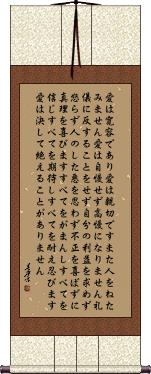
Here is 1st Corinthians 13:4-8 (just the first sentence of verse 8) in Japanese.
In the familiar NIV, this would read:
Love is patient, love is kind. It does not envy, it does not boast, it is not proud.
It does not dishonor others, it is not self-seeking, it is not easily angered, it keeps no record of wrongs.
Love does not delight in evil but rejoices with the truth.
It always protects, always trusts, always hopes, always perseveres.
Love never fails...
The Japanese text is from the 新改訳聖書 (Shinkaiyaku) or New Japanese Bible. Popular among most Protestant denominations in modern Japan.
Note: Because this selection contains some special Japanese Hiragana characters, it should be written by a Japanese calligrapher.
1 Corinthians 13:5
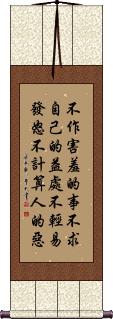
Here is 1 Corinthians 13:5 in Chinese.
The text with punctuation:
不作害羞的事。不求自己的益处。不轻易发怒。不计算人的恶。
Hand-painted calligraphy does not retain punctuation.
This translation is from the Chinese Union Bible.
You may know it from the KJV as:
Doth not behave itself unseemly, seeketh not her own, is not easily provoked, thinketh no evil.
1 Corinthians 14:22
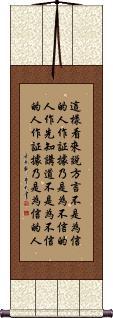
Here is 1 Corinthians 14:22 in Chinese.
The text with punctuation:
这样看来,说方言,不是为信的人作证据,乃是为不信的人。作先知讲道,不是为不信的人作证据,乃是为信的人。
Hand-painted calligraphy does not retain punctuation.
This translation is from the Chinese Union Bible.
You may know it from the KJV as:
Wherefore tongues are for a sign, not to them that believe, but to them that believe not: but prophesying serveth not for them that believe not, but for them which believe.
Adoring Love
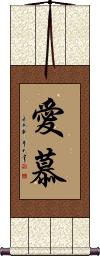
愛慕 means “adoring love” in Chinese, Japanese, and Korean.
I suppose this is the best kind of love to have. 愛慕 has the common character for love. But the second character modifies and reinforces the meaning to become adore, adoring love, or to love and adore.
Ancient Chinese warning:
Adoring someone is fine until you are in the shoes of the Prince of the Kingdom of Wu. This Prince adored a certain beautiful woman (Xi Shi) so much that he neglected his duties and soon let the kingdom fall into ruins.
Boring

博林 is the name Boring in Chinese (Mandarin).
Boring

ボーリング is the name Boring in Japanese Katakana.
Note: Because this title is entirely Japanese Katakana, it should be written by a Japanese calligrapher.
Mark the boat to find the lost sword / Ignoring the changing circumstances of the world
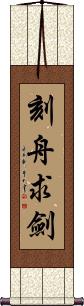
刻舟求劍 is an originally-Chinese proverb that serves as a warning to people that things are always in a state of change.
Thus, you must consider that and not depend on the old ways or a way that may have worked in the past but is no longer valid.
This idiom/proverb comes from the following story:
A man was traveling in a ferry boat across a river. With him, he carried a treasured sword. Along the way, the man became overwhelmed and intoxicated by the beautiful view and accidentally dropped his prized sword into the river. Thinking quickly, he pulled out a knife and marked on the rail of the boat where exactly he had lost his sword.
When the boat arrived on the other side of the river, the man jumped out of the boat and searched for his sword right under where he'd made the mark. Of course, the boat had moved a great distance since he made the mark, and thus, he could not find the sword.
While this man may seem foolhardy, we must take a great lesson from this parable: Circumstances change, so one should use methods to handle the change. In modern China, this is used in business to mean that one should not depend on old business models for a changing market.
This proverb dates back to the Spring and Autumn period (770–476 BC) of the territory now known as China. It has spread and is somewhat known in Japan and Korea.
Corin
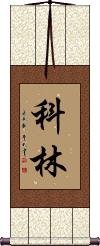
科林 is the name Corin in Chinese (Mandarin).
Corin

コリン is the name Corin in Japanese.
Note: Because this title is entirely Japanese Katakana, it should be written by a Japanese calligrapher.
Corina
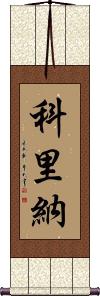
科里納 is the name Corina in Chinese (Mandarin).
Corina
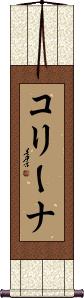
コリーナ is the name Corina in Japanese.
Note: Because this title is entirely Japanese Katakana, it should be written by a Japanese calligrapher.
Corina
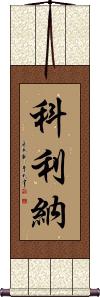
科利納 is the transliteration to Mandarin Chinese for the Latin / Spanish name Corina.
Corine
科林 is the name Corine in Chinese (Mandarin).
Corine
コリン is the name Corine in Japanese Katakana.
Note: Because this title is entirely Japanese Katakana, it should be written by a Japanese calligrapher.
Corinn
科林 is the name Corinn in Chinese (Mandarin).
Corinn
コリン is the name Corinn in Japanese Katakana.
Note: Because this title is entirely Japanese Katakana, it should be written by a Japanese calligrapher.
Corinna
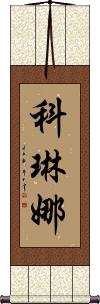
科琳娜 is the name Corinna in Chinese (Mandarin).
Corinna
コリーナ is the name Corinna in Japanese (Katakana).
Note: Because this title is entirely Japanese Katakana, it should be written by a Japanese calligrapher.
Corinne
科琳娜 is the name Corinne in Chinese (Mandarin).
Corinne

コリーン is the name Corinne in Japanese (Katakana).
Note: Because this title is entirely Japanese Katakana, it should be written by a Japanese calligrapher.
Corinthians 13:4
All you need to know about LOVE
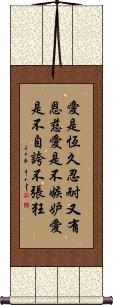
愛是恆久忍耐又有恩慈愛是不嫉妒愛是不自誇不張狂 is 1st Corinthians 13:4 in Chinese.
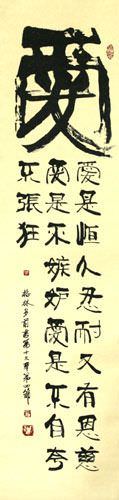
With large “love” character added.
In English, this reads:
1st Corinthians 13:4 (KJV) Charity suffereth long, and is kind; charity envieth not; charity vaunteth not itself, is not puffed up...
1st Corinthians 13:4 (NIV) Love is patient, love is kind. It does not envy, it does not boast, it is not proud.
1st Corinthians 13:4 (Basic English) Love is never tired of waiting; love is kind; love has no envy; love has no high opinion of itself, love has no pride.
The Chinese translation follows the love meaning, rather than the King James' use of “charity.” I was a little confused when writing this description with the significant differences between the NIV vs. KJV translations. After speaking to a Greek scholar about this, it would seem that the KJV has an almost errant translation with the use of “charity” in place of “love.”
We used the most popular Christian Chinese Bible, which is the Chinese Union Version (CUV). The CUV was first published in 1919. We use this so that the Chinese translation would be as accurate and standard as possible. Any Chinese Christian worth their salt will easily be able to identify this verse when they see these characters.
If you want a big “love” character written above the verse on your artwork, just make a note in the “special instructions” tab when you are customizing your artwork. There is no extra charge for that service on this special verse.
Corinthians 13:4

愛は忍耐強い。愛は情け深い。ねたまない。愛は自慢せず、高ぶらない。is 1st Corinthians 13:4 in Japanese.
In English, this reads:
1st Corinthians 13:4 (KJV) Charity suffereth long, and is kind; charity envieth not; charity vaunteth not itself, is not puffed up...
1st Corinthians 13:4 (NIV) Love is patient, love is kind. It does not envy, it does not boast, it is not proud.
1st Corinthians 13:4 (Basic English) Love is never tired of waiting; love is kind; love has no envy; love has no high opinion of itself, love has no pride.
If you want a big “love” character written above the verse on your artwork, just make a note in the “special instructions” tab when you are customizing your artwork. There is no extra charge for that service on this special verse.
Note: Because this selection contains some special Japanese Hiragana characters, it should be written by a Japanese calligrapher.
Dorine
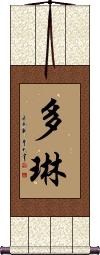
This is a common Mandarin Chinese transliteration for the female French name Dorine.
Dorine

ドリーン is the name Dorine in Japanese (Katakana).
Note: Because this title is entirely Japanese Katakana, it should be written by a Japanese calligrapher.
Florin
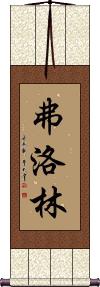
弗洛林 is the name Florin in Chinese (Mandarin).
Florin

フローリン is the name Florin in Japanese Katakana.
Note: Because this title is entirely Japanese Katakana, it should be written by a Japanese calligrapher.
Florine
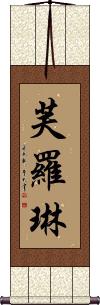
This is a common Mandarin Chinese transliteration for the female French name Florine.
Florine

フロリン is the name Florine in Japanese (Katakana).
Note: Because this title is entirely Japanese Katakana, it should be written by a Japanese calligrapher.
Korin
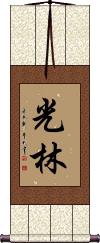
光林 is the name Korin in Chinese (Mandarin).
Korin
コリン is the name Korin in Japanese Katakana.
Note: Because this title is entirely Japanese Katakana, it should be written by a Japanese calligrapher.
Lorin
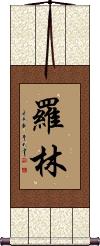
This is a common Mandarin Chinese transliteration for the male name Lorin.
Lorin

ロリン is the name Lorin in Japanese (Katakana).
Note: Because this title is entirely Japanese Katakana, it should be written by a Japanese calligrapher.
Lorine
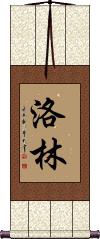
This is the most common way to write the name Lorine in Chinese (Mandarin).
Lorine
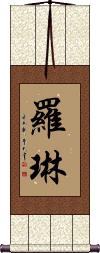
羅琳 is a common Mandarin Chinese transliteration for the female French name Lorine.
Lorine
ロリン is the name Lorine in Japanese Katakana.
Note: Because this title is entirely Japanese Katakana, it should be written by a Japanese calligrapher.
Loring
洛林 is the name Loring in Chinese (Mandarin).
Loring

ローリング is the name Loring in Japanese Katakana.
Note: Because this title is entirely Japanese Katakana, it should be written by a Japanese calligrapher.
Matsumura Shorin-Ryu
Matsumura Sōkon's Shaolin Style
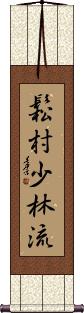
松村少林流 is the Japanese martial arts title “Matsumura Shorin-ryu.”
Morin
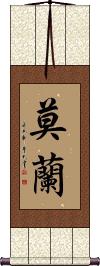
莫蘭 is the name Morin in Chinese (Mandarin).
Morin

モーリン is the name Morin in Japanese Katakana.
Note: Because this title is entirely Japanese Katakana, it should be written by a Japanese calligrapher.
Nippon Shorin-Ryu
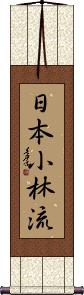
日本小林流 is the Japanese title Nippon Shorin-ryu.
Shobayashi Shorin-Ryu

小林少林流 is the title Shobayashi Shorin-Ryu in Japanese Kanji.
Shōbayashi Shōrin-Ryū is of real Okinawan karate lineage, but the romanization causes confusion.
小林 = Shōbayashi (can also be read Kobayashi)
少林流 = Shōrin-Ryū (Shaolin style) which means “Small-forest Shaolin School.”
This reflects the lineage that uses 小林 (small forest) instead of 松林 (pine forest) or 少林 (Shaolin) as the branch identifier of the Okinawan martial arts style.
You should use this, 小林流 (Shōbayashi/Kobayashi-Ryū) or “Small-forest style” for the Chibana lineage.
You should use 松林流 (Matsubayashi-Ryū) or “Pine-forest style” for the Nagamine lineage.
Shorin-Ryu Shidokan
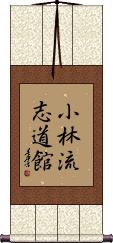
小林流志道館 is the Japanese title Shorin-ryu Shidōkan.
Shorinji Kempo / Kenpo
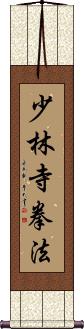
少林寺拳法 is a specific type of martial art in Japan that claims origins in the Kung Fu practiced in the original Shaolin Monastery of China.
The first three characters mean “Shaolin Monastery,” and you might notice the Japanese is pronounced in a very similar way. The reason is, many words were “borrowed” from the original Chinese when Japan did not have a written language and simply absorbed Chinese characters into their language around the 5th century. When a Japanese word did not exist, the Chinese pronunciation was often absorbed as well as the written form.
The last two characters mean “fist law” or “method of the fist.” It has long been argued as to whether the Japanese for these characters should be Romanized as “kempo” or “kenpo.” The official method should be “kenpou” but it's common to drop the “u” that comes after the “o.”
I imagine if you are looking for this title, you already know what it means, so the above is simply extra information that a student of Shorinji Kempo might want to know.
Shorin Ji Ryu
Shaolin Temple Style
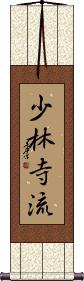
少林寺流 is the Japanese martial arts title “Shorin-ji-ryu.”
Though the first part of the title comes from the Shaolin temple in China. In Japan, this refers to an Okinawa school of karate.
Note: Sometimes, this title is written without the “ji” or “temple” Kanji.
Shorin-Ryu
Shaolin Style
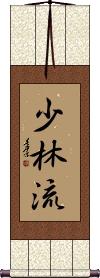
少林流 is the Japanese martial arts title “Shorin-ryu.”
Though the first part of the title comes from the Shaolin (small forest) monks of China.
In Japan, this refers to the Okinawa School of Karate.
 Note that often in Japanese, the first Kanji of this title was changed to the version shown to the right. If you prefer this version, please click on the Kanji to the right instead of the button above.
Shorin-Ryu Shobukan
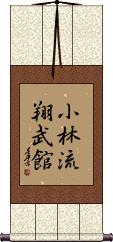
小林流翔武館 is the title, Shorin-Ryu Shobukan meaning “Little Forest Style - Soaring Warrior House” in Japanese.
There is more than one version of Shorin-Ryu and Shobukan, so make sure the characters here match the ones used at your dojo.
Torino
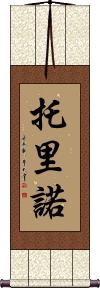
托里諾 is the name Torino in Chinese (Mandarin).
Torino
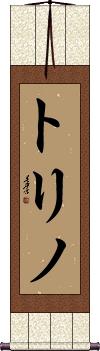
トリノ is the name Torino in Japanese (Katakana).
Note: Because this title is entirely Japanese Katakana, it should be written by a Japanese calligrapher.
Ueshiro Shorin-Ryu / Ueshiro Matsubayashi-Ryu

ウエシロ鬆林流 is the title Ueshiro Shorin-Ryu or Ueshiro Matsubayashi-Ryu in Japanese Katakana and Kanji.
Ueshiro's name is Okinawan, so there is no standard Japanese Kanji transliteration; therefore, a Katakana version (ウエシロ) is appropriate.
松林 can be romanized/pronounced as shorin or matsubayashi thus the two title variations.
Note: Because this selection contains some special Japanese Katakana characters, it should be written by a Japanese calligrapher.
Victorino
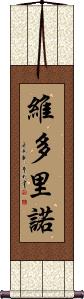
維多里諾 is the transliteration to Mandarin Chinese for the Latin / Spanish name Victorino.
Victorino
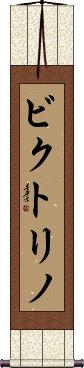
ビクトリノ is the name Victorino in Japanese (Katakana).
Note: Because this title is entirely Japanese Katakana, it should be written by a Japanese calligrapher.
The following table may be helpful for those studying Chinese or Japanese...
| Title | Characters | Romaji (Romanized Japanese) | Various forms of Romanized Chinese | |
| 1 Corinthians 13:4-8 | 愛は寛容であり愛は親切ですまた人をねたみません愛は自慢せず高慢になりません礼儀に反することをせず自分の利益を求めず怒らず人のした悪を思わず不正を喜ばずに真理を喜びますすべてをがまんしすべてを信じすべてを期待しすべてを耐え忍びます愛は決して絶えることがありません | ai wa kan youdeari ai wa shinsetsudesu mata hito o netamimasen ai wa jiman sezu kouman ni narimasen reigi ni hansuru koto o sezu jibun no rieki o motomezu okorazu hito no shita aku o omowazu fusei o yorokobazu ni shinri o yorokobimasu subete o gaman shi s ai wa kan yodeari ai wa shinsetsudesu mata hito o netamimasen ai wa jiman sezu koman ni narimasen reigi ni hansuru koto o sezu jibun no rieki o motomezu okorazu hito no shita aku o omowazu fusei o yorokobazu ni shinri o yorokobimasu subete o gaman shi s | ||
| 1 Corinthians 13:5 | 不作害羞的事不求自己的益處不輕易發怒不計算人的惡 不作害羞的事不求自己的益处不轻易发怒不计算人的恶 | bù zuò hài xiū de shì bù qiú zì jǐ de yì chu bù qīng yì fā nù bù jì suàn rén de è bu4 zuo4 hai4 xiu1 de shi4 bu4 qiu2 zi4 ji3 de yi4 chu bu4 qing1 yi4 fa1 nu4 bu4 ji4 suan4 ren2 de e4 bu zuo hai xiu de shi bu qiu zi ji de yi chu bu qing yi fa nu bu ji suan ren de e | pu tso hai hsiu te shih pu ch`iu tzu chi te i ch`u pu ch`ing i fa nu pu chi suan jen te o pu tso hai hsiu te shih pu chiu tzu chi te i chu pu ching i fa nu pu chi suan jen te o |
|
| 1 Corinthians 14:22 | 這樣看來說方言不是為信的人作証據乃是為不信的人作先知講道不是為不信的人作証據乃是為信的人 这样看来说方言不是为信的人作证据乃是为不信的人作先知讲道不是为不信的人作证据乃是为信的人 | zhè yàng kàn lái shuō fāng yán bù shì wéi xìn de rén zuò zhèng jù nǎi shì wéi bù xìn de rén zuò xiān zhī jiǎng dào bù shì wéi bù xìn de rén zuò zhèng jù nǎi shì wéi xìn de rén zhe4 yang4 kan4 lai2 shuo1 fang1 yan2 bu4 shi4 wei2 xin4 de ren2 zuo4 zheng4 ju4 nai3 shi4 wei2 bu4 xin4 de ren2 zuo4 xian1 zhi1 jiang3 dao4 bu4 shi4 wei2 bu4 xin4 de ren2 zuo4 zheng4 ju4 nai3 shi4 wei2 xin4 de ren2 zhe yang kan lai shuo fang yan bu shi wei xin de ren zuo zheng ju nai shi wei bu xin de ren zuo xian zhi jiang dao bu shi wei bu xin de ren zuo zheng ju nai shi wei xin de ren | che yang k`an lai shuo fang yen pu shih wei hsin te jen tso cheng chü nai shih wei pu hsin te jen tso hsien chih chiang tao pu shih wei pu hsin te jen tso cheng chü nai shih wei hsin te jen che yang kan lai shuo fang yen pu shih wei hsin te jen tso cheng chü nai shih wei pu hsin te jen tso hsien chih chiang tao pu shih wei pu hsin te jen tso cheng chü nai shih wei hsin te jen |
|
| Adoring Love | 愛慕 爱慕 | ai bou / aibou / ai bo | ài mù / ai4 mu4 / ai mu / aimu | |
| Boring | 博林 | bó lín / bo2 lin2 / bo lin / bolin | po lin / polin | |
| Boring | ボーリング | booringu / boringu | ||
| Mark the boat to find the lost sword Ignoring the changing circumstances of the world | 刻舟求劍 刻舟求剑 | kokushuukyuuken kokushukyuken | kè zhōu qiú jiàn ke4 zhou1 qiu2 jian4 ke zhou qiu jian kezhouqiujian | k`o chou ch`iu chien kochouchiuchien ko chou chiu chien |
| Corin | 科林 | kē lín / ke1 lin2 / ke lin / kelin | k`o lin / kolin / ko lin | |
| Corin | コリン | korin | ||
| Corina | 科里納 科里纳 | kē lǐ nà ke1 li3 na4 ke li na kelina | k`o li na kolina ko li na |
|
| Corina | コリーナ | koriina / korina | ||
| Corina | 科利納 科利纳 | kē lì nà ke1 li4 na4 ke li na kelina | k`o li na kolina ko li na |
|
| Corine | 科林 | kē lín / ke1 lin2 / ke lin / kelin | k`o lin / kolin / ko lin | |
| Corine | コリン | korin | ||
| Corinn | 科林 | kē lín / ke1 lin2 / ke lin / kelin | k`o lin / kolin / ko lin | |
| Corinn | コリン | korin | ||
| Corinna | 科琳娜 | kē lín nà ke1 lin2 na4 ke lin na kelinna | k`o lin na kolinna ko lin na |
|
| Corinna | コリーナ | koriina / korina | ||
| Corinne | 科琳娜 | kē lín nà ke1 lin2 na4 ke lin na kelinna | k`o lin na kolinna ko lin na |
|
| Corinne | コリーン | koriin / korin | ||
| Corinthians 13:4 | 愛是恆久忍耐又有恩慈愛是不嫉妒愛是不自誇不張狂 爱是恒久忍耐又有恩慈爱是不嫉妒爱是不自夸不张狂 | ài shì héng jiǔ rěn nài yòu yǒu én cí ài shì bú jì dù ài shì bú zì kuā bù zhāng kuáng ai4 shi4 heng2 jiu3 ren3 nai4 you4 you3 en2 ci2 ai4 shi4 bu2 ji4 du4 ai4 shi4 bu2 zi4 kua1 bu4 zhang1 kuang2 ai shi heng jiu ren nai you you en ci ai shi bu ji du ai shi bu zi kua bu zhang kuang | ai shih heng chiu jen nai yu yu en tz`u ai shih pu chi tu ai shih pu tzu k`ua pu chang k`uang ai shih heng chiu jen nai yu yu en tzu ai shih pu chi tu ai shih pu tzu kua pu chang kuang |
|
| Corinthians 13:4 | 愛は忍耐強い。愛は情け深い。ねたまない。愛は自慢せず、高ぶらない。 | ai ha nintai tsuyoi. ai ha nasakebukai. netama nai. ai ha jiman se zu, takabura nai. | ||
| Dorine | 多琳 | duō lín / duo1 lin2 / duo lin / duolin | to lin / tolin | |
| Dorine | ドリーン | doriin / dorin | ||
| Florin | 弗洛林 | fú luò lín fu2 luo4 lin2 fu luo lin fuluolin | fu lo lin fulolin |
|
| Florin | フローリン | furoorin / furorin | ||
| Florine | 芙羅琳 芙罗琳 | fú luó lín fu2 luo2 lin2 fu luo lin fuluolin | fu lo lin fulolin |
|
| Florine | フロリン | furorin | ||
| Korin | 光林 | guāng lín guang1 lin2 guang lin guanglin | kuang lin kuanglin |
|
| Korin | コリン | korin | ||
| Lorin | 羅林 罗林 | luó lín / luo2 lin2 / luo lin / luolin | lo lin / lolin | |
| Lorin | ロリン | rorin | ||
| Lorine | 洛林 | luò lín / luo4 lin2 / luo lin / luolin | lo lin / lolin | |
| Lorine | 羅琳 罗琳 | luó lín / luo2 lin2 / luo lin / luolin | lo lin / lolin | |
| Lorine | ロリン | rorin | ||
| Loring | 洛林 | luò lín / luo4 lin2 / luo lin / luolin | lo lin / lolin | |
| Loring | ローリング | rooringu / roringu | ||
| Matsumura Shorin-Ryu | 鬆村少林流 松村少林流 | matsu mura shou rin ryuu matsumurashourinryuu matsu mura sho rin ryu | ||
| Morin | 莫蘭 莫兰 | mò lán / mo4 lan2 / mo lan / molan | ||
| Morin | モーリン | moorin / morin | ||
| Nippon Shorin-Ryu | 日本小林流 | nippon shou rin ryuu nipponshourinryuu nipon sho rin ryu | ||
| Shobayashi Shorin-Ryu | 小林少林流 | shou baya shi shou rin ryuu shoubayashishourinryuu sho baya shi sho rin ryu | ||
| Shorin-Ryu Shidokan | 小林流志道館 | sho rin ryu shi dou kan shorinryushidoukan sho rin ryu shi do kan | ||
| Shorinji Kempo Kenpo | 少林寺拳法 | shourinji kenpou shourinjikenpou shorinji kenpo | shào lín sì quán fǎ shao4 lin2 si4 quan2 fa3 shao lin si quan fa shaolinsiquanfa | shao lin ssu ch`üan fa shaolinssuchüanfa shao lin ssu chüan fa |
| Shorin Ji Ryu | 少林寺流 | shou rin ji ryuu shourinjiryuu sho rin ji ryu | ||
| Shorin-Ryu | 少林流 | shou rin ryuu shourinryuu sho rin ryu | ||
| Shorin-Ryu Shobukan | 小林流翔武館 | sho rin ryuu sho bu kan shorinryuushobukan sho rin ryu sho bu kan | ||
| Torino | 托里諾 托里诺 | tuō lǐ nuò tuo1 li3 nuo4 tuo li nuo tuolinuo | t`o li no tolino to li no |
|
| Torino | トリノ | torino | ||
| Ueshiro Shorin-Ryu Ueshiro Matsubayashi-Ryu | ウエシロ鬆林流 ウエシロ松林流 | u e shi ro matsu bayashi ryuu / u e shi ro shou rin ryuu u e shi ro matsu bayashi ryu / u e shi ro sho rin ryu | ||
| Victorino | 維多里諾 维多里诺 | wéi duō lǐ nuò wei2 duo1 li3 nuo4 wei duo li nuo weiduolinuo | wei to li no weitolino |
|
| Victorino | ビクトリノ | bikutorino | ||
| In some entries above you will see that characters have different versions above and below a line. In these cases, the characters above the line are Traditional Chinese, while the ones below are Simplified Chinese. | ||||

Successful Chinese Character and Japanese Kanji calligraphy searches within the last few hours...



