Many custom options...


And formats...



Not what you want?
Try other similar-meaning words, fewer words, or just one word.
Pi Ji Tai Li in Chinese / Japanese...
Buy a Pi Ji Tai Li calligraphy wall scroll here!
Personalize your custom “Pi Ji Tai Li” project by clicking the button next to your favorite “Pi Ji Tai Li” title below...
Switched to secondary search mode due to lack of results using primary.
These secondary results may not be very accurate. Try a different but similar meaning word or phrase for better results. Or...
Look up Pi Ji Tai Li in my Japanese Kanji & Chinese Character Dictionary(My dictionary is a different system then the calligraphy search you just tried)
If you want a special phrase, word, title, name, or proverb, feel free to contact me, and I will translate your custom calligraphy idea for you.
1. Ba Ji Quan
2. Beautiful
4. Bruce Lee
6. Choy Li Fut
7. Da Ji Da Li
8. Benevolent and Skilled Doctor
9. Drain the pond to get all the fish
10. Earth
11. Five Elements Tai Chi Fist
12. Five Elements
13. Five Families / Tsoi Li Hoi Fut Hung
14. A Bright Future
16. Gee
17. Hero
18. Jin Ji Du Li
19. A Journey of 1000 Miles Begins with a Single Step
20. Ki Ken-Tai Icchi
21. Hunt Foxes with Stealth, Hunt Wolves in the Open
22. Le
23. Lee
24. Lianne / Li-Anne
25. Li
26. Lianne
27. Life Energy / Spiritual Energy
28. Lili
29. Energy Sword Body in Concert
30. Muay Thai
32. Nashi
35. Read 10,000 Books, Travel 10,000 Miles
36. Sariputra
37. Shaolin Temple
39. Shintai
40. Shorin Ji Ryu
41. Sword
42. Taekwondo
44. Tai Chi Chuan / Tai Ji Quan
45. Tai Chi Chuan Dao / Tai Ji Quan Dao
46. Tai Chi Chuan Fa / Tai Ji Quan Fa
47. Fundamental Principles of Tai Chi Chuan
48. Tai Chi / Tai Ji
49. Tai Chi Ball
50. Tai Jutsu
51. Tarzan
52. A Journey of 1000 Miles Feels Like One
53. Better to Travel 10,000 Miles than Read 10,000 Books
54. Work Unselfishly for the Common Good
55. Wu Chi / Wuji
56. Yangshuo
Ba Ji Quan
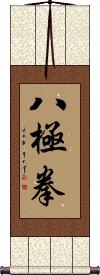
八極拳 is “Ba Ji Quan” or “Eight Extremes Fist.”
Some also translate this as “Eight Extremities Fist,” though I don't feel that's accurate.
八極拳 (Bājíquán) is a Chinese martial art that features explosive, short-range power and is famous for its elbow strikes. It originated in the Hebei Province in Northern China but spread to Taiwan and other places.
The full title is 開門八極拳 (Kāimén Bājíquán), which means Open-Door Bajiquan.
Other romanizations include: BaJiQuan, Pa Chi Ch`üan, or Pa Chi Chuan.
In Japan, this is known as Hakkyokuken.
Beautiful
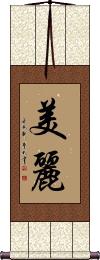
美麗 is a two-character word used often in Chinese, old Korean, and ancient Japanese to express beauty.
I've had a few requests for a “two-character beautiful,” and this is by far the best word. This is not a common word for an Asian person to want on a wall scroll. However, you will see it commonly used as an adjective in phrases, stories, and titles throughout magazines and signage in China.
美麗 can also be translated as gorgeous or lovely.
Note: 美麗 is not commonly used in modern Japan.
Body / Karada
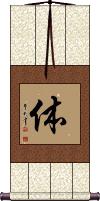
体 is used in Japanese to mean “body.”
体 can also refer to the form, style, corporeal existence, appearance, identity, or state of something or someone. 體 is also used in Buddhism in regard to the corporeal existence of someone (their earthy vessel). It's kind of a broad term that can be used in a lot of different ways.
As a single character, it's usually pronounced “karada” but it can also be pronounced “tai” or “te” (Japanese pronunciation borrowed from the original Chinese).
體 is not a common Kanji to use for a wall scroll. Only select this if you have a personal and meaningful reason to do so. Also, consider this version to be “Japanese only” - see below...
 In Chinese and old Korean Hanja, this character is written in the traditional form shown to the right. If you want this version, click on the character to the right instead of the button above.
Bruce Lee
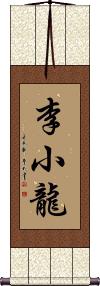
李小龍 is the real full name of Bruce Lee.
 Many people have no idea that Bruce Lee had a “real” Chinese name. In Mandarin and Cantonese, he is known as “Lǐ XiǎoLóng” and “Léi SíuLùng” respectively.
He kept his family name pronunciation (Li = Lee). 李 is a common family name that also means “plum.”
His given name 小龍 (Xiao-Long), literally means “little dragon.” 李小龍 is why you often see the character for dragon associated with Bruce Lee on various posters etc.
For a pronunciation lesson, the “X” in Romanized Mandarin is pronounced like a “sh” sound but with your tongue at the bottom of your mouth. The vowel sound in “Long” is like the English “oh,” not like the “ah” sound in the English word “long.”
If you are a big Bruce Lee fan, you should know this information, and you should have this wall scroll hanging in your room or martial arts studio.
Note: Japanese use these same Chinese characters / Kanji to write Bruce Lee's real name (with different pronunciation - which is a bit like how the name “Bruce Lee” sounds in English).
See Also: Kung Fu | Martial Arts
Chop Wood, Carry Water
Before enlightenment or after, chores remain.
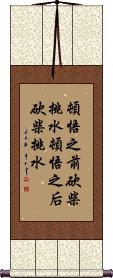
頓悟之前砍柴挑水; 頓悟之後砍柴挑水 means “Before enlightenment, chop wood, carry water; After enlightenment, chop wood, carry water.
This is a Chinese proverb that is attributed to 吴力 (Wú Lì) who lived between 1632 and 1718 - living part of his life as a devout Buddhist, and many years as a Catholic Jesuit Priest in China - what an interesting life!
This has been explained many times in many ways. I am a Buddhist, and here is my brief take on this proverb...
Before enlightenment, one may find daily chores mundane, tedious, and boring. However, upon reaching enlightenment one is not relieved of the details of daily life. An enlightened person will, however, see such chores as a joy, and do them mindfully.
There is another version floating around, which is 在你領悟之前砍柴、運水。在你領悟之後,砍柴、運水。
If you want this other version, just contact me. The meaning is the same, just different phrasing.
Choy Li Fut

蔡李彿 is Choy Li Fut, a Chinese martial arts that combines Northern and Southern Kung Fu styles.
Choy Li Fut is also known as Choy Lay Fut, Choy Lee Fut, Tsai Li Fo and Cai Li Fo, Choy Li Fut, Choi Lei Fut, Choy Lai Fut, Choy Ley Fut, Choi Lei Faht, Choi Leih Faht. These all come from the same 蔡李彿 characters, but different dialects have different pronunciations and romanization schemes for Chinese vary.
Some will write the third character 佛, others will write 彿 (note subtle extra stoke on left side). If you have a preference, place make a note when you place your order.
Da Ji Da Li
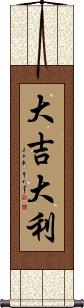
大吉大利 or “Da Ji Da Li” is a Chinese proverb that means great luck, great profit, or everything is thriving.
Benevolent and Skilled Doctor
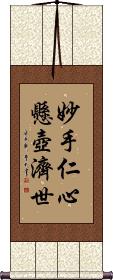
妙手仁心悬壶济世 is a phrase that celebrates the benevolence, skill, and service to his/her patients.
Here's a breakdown of the characters:
妙手 miào shǒu admirable skill in curing disease (when used in reference to doctors).
仁心 rén xīn kindheartedness, charity, benevolent heart.
悬壶济世 xuán hú jì shì practice medicine or pharmacy to help the people or the public.
Drain the pond to get all the fish
Kill the goose that lays the golden eggs
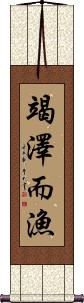
In 632 BC, Duke Wen of the Kingdom of Jin was about to lead an army against the forces of the Kingdom of Chu.
The Duke asked one of his advisers, Jiu Fan, how they could win the impending battle, as they were drastically outnumbered.
Jiu Fan said, “All is fair in war,” and suggested a plan of dishonorable tactics (cheating).
The Duke was unsure of this advice, so he asked another adviser, Yong Ji, who replied, “If you catch fish by draining the pond, you can certainly get all the fish. But there will be no fish the following year. You can cheat this one time in battle, but such tactics can only be used once, as the enemy will be wise in future encounters.”
The Duke heard the words of his wiser adviser but cheated to gain victory in the battle. However, he rewarded Yong Ji more than Jiu Fan at the victory celebration, stating that while Jiu Fan's advice gained one victory, the wise words of Yong Ji would last forever.
This Chinese idiom/proverb is still used, over 2600 years later to remind people not to burn bridges, cheat, or dishonor themselves in exchange for a short-term gain while sacrificing the future.
竭澤而漁 is very similar to the meaning of the English phrase, “Kill the goose that lays the golden eggs.”
Earth
(Used in Japanese version of five elements)
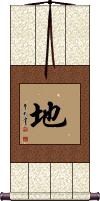
地 is the single-character element and title of the planet Earth in Chinese, old Korean Hanja, and Japanese Kanji.
Because this is a single character, the definition is a little ambiguous and can have many meanings depending on the context in which it is used. These meanings include: earth, ground, land, soil, dirt, place, territory, bottom (of a package, book, etc.), earth (one of the Japanese five elements), the region in question, the local area, skin, texture, fabric, material, weave, base, background, one's true nature, narrative (i.e. descriptive part of a story), real life, actuality, etc.
In Japanese, this Kanji can be pronounced several ways, including chi, ji, tsushi, or tsuchi.
地 is also an element of the Japanese version of the five elements (the original Chinese version uses a different version of earth).
Five Elements Tai Chi Fist
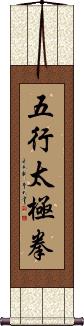
五行太極拳 is a certain school or style of Tai Chi (Taiji).
The characters literally mean “Five Elements Tai Chi Fist.”
Notes:
In Taiwan, it would be Romanized as “Wu Hsing Tai Chi Chuan” - see the standard Mandarin method above in the gray box (used in mainland China and the official Romanization used by the Library of Congress).
The last three characters are sometimes translated as “Grand Ultimate Fist,” so the whole thing can be “Five Elements Grand Ultimate Fist” if you wish.
I have not confirmed the use of this title in Korean but if it is used, it's probably only by martial arts enthusiasts. The pronunciation is correct, as shown above for Korean.
Five Elements
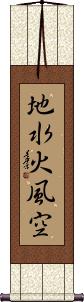
地水火風空 is the specifically-Japanese version of the five elements.
This is a little different than the ancient or original Chinese version.
The elements are written in this order:
1. Earth / Terra / Ground
2. Water
3. Fire
4. Wind / Air
5. Sky / Emptiness / Void / Ether
Note: This set of Kanji can also be romanized as “ji sui ka fuu kuu,” “jisuikafuukuu,” or “jisuikafuku.”
These can also be written in the order 地火風水空 (chi ka sui fuu kuu). Let me know when you place your order if you want the Kanji to be in this character order.
Five Families / Tsoi Li Hoi Fut Hung
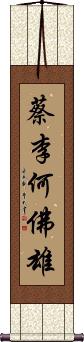
蔡李何佛雄 is the five families associated with San Soo Kung Fu.
The characters are always the same, but there are several ways these are romanized from Cantonese, Mandarin, and other dialects. Some common ones include Tsoi Li Hoi Fut Hung and Choi Li Ho Fut Hung.
If you are using a different romanization, that does not mean it's wrong. It might just be that your school is using a different dialect or romanization scheme.
A Bright Future
Incredible 10,000-Mile Flight of the Peng
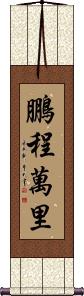
鵬程萬里 is an ancient Chinese proverb used in modern times to wish someone a long and successful career.
It's really about the 10,000 Flight of the Peng (Peng, also known as Roc is a mythical fish that can turn into a bird and take flight).
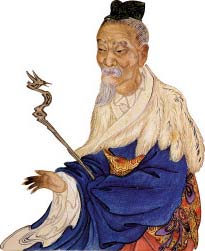
莊子
Zhuangzi or Chuang Tzu
Breaking down each character:
1. Peng or Roc (a kind of bird).
2. Journey (in this case, a flight).
3. 10,000 (Ten Thousand).
4. Li is a unit of distance often referred to as a “Chinese Mile,” though the real distance is about half a kilometer.
Direct Translation: “Peng's Journey [of] 10,000 Li.”
Literal meaning: “The 10,000-Li Flying Range Of The Roc.”
Perceived meaning: “To have a bright future” or “To go far.”
This proverb/idiom comes from the book of Zhuangzi or Chuang Tzu. It tells the tale of a huge fish that could turn into a gigantic bird. This bird was called a “peng” and was many miles long. This legendary size allowed the Peng to fly from the Northern Sea to the Southern Sea in a single bound.
Wishing someone “a Peng's Journey of 10,000 Li” will imply that they can travel far without stopping and will have great success, a long career, and a prosperous future.
Forgive and Forget
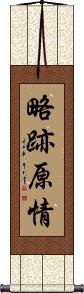
略跡原情 is a Chinese proverb that means “to overlook past faults,” or “forgive and forget.”
It's more literally, “Abridge or make small the scars from your past emotions.” You should let it go.
The character breakdown:
略 (lüè) abbreviation; omission; abridge.
跡 (jī) ruins; scar; traces.
原 (yuán) former.
情 (qíng) feeling; emotion.
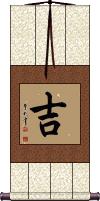
吉 is a surname sometimes romanized as Gee from Chinese.
There are several characters that can also be romanizations or transliterations of Gee, including 紀 (Ji), 季 (Ji), 葛 (Ge), 朱 (Zhu - meaning vermilion/cinnabar), 余 (Yu), 俞 (Yu), and 倪 (Ni).
Hero
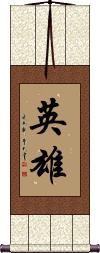
英雄 is the best way to write hero in Chinese and Japanese - especially for calligraphy.
英雄 is also the name of the Chinese movie titled Hero starring Jet Li.
The first character means brave (it can also mean British or English but not in this case).
The second character means heroic but also suggests a male person.
My Japanese dictionary also defines this as “a great man.”
Jin Ji Du Li
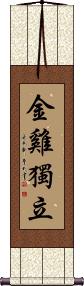
金雞獨立 or “Jin Ji Du Li,” means “golden rooster stands on one leg.”
This is also called “crane stance” in English. This is used in wushu, karate, and other forms of martial arts.
This can be pronounced, “kinkei dokuritsu” in Japanese but it's rarely a title used in Japanese.
A Journey of 1000 Miles Begins with a Single Step
senri no michi mo ippo kara
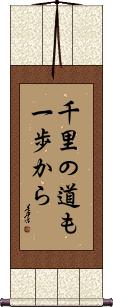
千里の道も一歩から is the Japanese version of an ancient Chinese proverb that means “a journey of a thousand miles begins with a single step.”
Some will also translate this as a 1000-mile road starts with one brick (a small amount).
In this case, the real measurement is an ancient Chinese “li” or 里, which is romanized as “ri” in Japanese. It's about half a kilometer, so three 里 would be a western mile. A journey of 333 miles begins with a single step, just doesn't sound as natural.
Note: Because this selection contains some special Japanese Hiragana characters, it should be written by a Japanese calligrapher.
Ki Ken-Tai Icchi
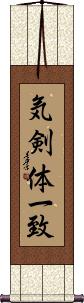
気剣体一致 is the title Ki Ken-Tai Icchi.
気 = energy, 剣 = sword, 体 = body, 一致 = synchronization/unity. So, “energy, sword, and body in unison” would be one way to translate this. Sometimes written with the possessive article, の, making it 気剣体の一致 or “Ki Ken-Tai no Icchi.” Let me know in the special instructions if you want that の character added by the calligrapher.
Hunt Foxes with Stealth, Hunt Wolves in the Open
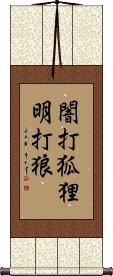
闇打狐狸明打狼 is a Chinese proverb that translates as: Hunt foxes stealthily, [and] hunt wolves openly [just as they do].
Figuratively, this means:
Different opponents require different appropriate strategies.
This is a suggestion that you should know your enemy and know that each enemy is different, therefore requires a specialized approach (attack).
See Also: Art of War Military
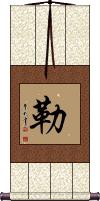
勒 is a Chinese surname that romanizes as Le or Lè and comes from ancient place names (Shu-Le) or ethnic groups like the Huns.
Use caution: There are other surnames in Asia that romanize as Le; here are a few:
Vietnamese (Lê): Most common usage, from Chinese 黎 (Lí), signifying a major royal family like the Lê Dynasty (1428–1788).
Chinese (樂 - Lè): Means "happiness" or "joy," from historical figures or noble lineages.
Korean: Can be a variant of Li or Lee, representing different Chinese characters (e.g., 黎, 呂).
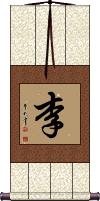
This is the most common Chinese character which sounds like “Lee” or “Li” and is used as a surname / family name in China.
李 actually means “Plum.” So it's really Mr. Plum and Mrs. Plum if you translated the name instead of romanizing.
This is not the only character in Chinese that can be romanized as “Lee” or “Li.” If your family name is “Lee” or “Li” please be sure this is the correct character before you order this scroll (look at your grandparents' Chinese passports or other documents if you are an ABC and are trying to create a heritage wall scroll).
Famous people with this surname include Bruce Lee (Li Xiao-Long), Minister Li Peng, and famous Tang Dynasty poet Li Bai.
In Korea, this is the original character for a surname that romanizes as “Yi.”
Note: This also one version of Lee that is a common Korean surname. However, it’s often romanized as "Yi" and sometimes as "Ri" or "Rhee."
Lianne / Li-Anne
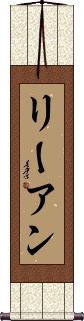
リーアン is the name Lianne or Li-Anne in Japanese (Katakana).
Note: Because this title is entirely Japanese Katakana, it should be written by a Japanese calligrapher.
This is the surname Li in Chinese (Mandarin).
The meaning of this character is Plum.
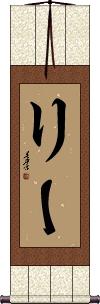
リー is the name Li in Japanese Katakana.
Note: Because this title is entirely Japanese Katakana, it should be written by a Japanese calligrapher.
Lianne
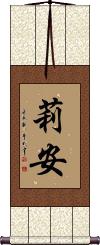
莉安 is the name Lianne or Li-Anne in Chinese (Mandarin).
Life Energy / Spiritual Energy
Chi Energy: Essence of Life / Energy Flow
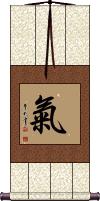
This 氣 energy flow is a fundamental concept of traditional Asian culture.
氣 is romanized as “Qi” or “Chi” in Chinese, “Gi” in Korean, and “Ki” in Japanese.
Chi is believed to be part of everything that exists, as in “life force” or “spiritual energy.” It is most often translated as “energy flow” or literally as “air” or “breath.” Some people will simply translate this as “spirit,” but you must consider the kind of spirit we're talking about. I think this is weighted more toward energy than spirit.
The character itself is a representation of steam (or breath) rising from rice. To clarify, the character for rice looks like this: 
Steam was apparently seen as visual evidence of the release of “life energy” when this concept was first developed. The Qi / Chi / Ki character is still used in compound words to mean steam or vapor.
The etymology of this character is a bit complicated. It's suggested that the first form of this character from bronze script (about 2500 years ago) looked like these samples: 

However, it was easy to confuse this with the character for the number three. So the rice radical was added by 221 B.C. (the exact time of this change is debated). This first version with the rice radical looks like this: 
The idea of Qi / Chi / Ki is really a philosophical concept. It's often used to refer to the “flow” of metaphysical energy that sustains living beings. Yet there is much debate that has continued for thousands of years as to whether Qi / Chi / Ki is pure energy or consists partially or fully of matter.
You can also see the character for Qi / Chi / Ki in common compound words such as Tai Chi / Tai Qi, Aikido, Reiki, and Qi Gong / Chi Kung.
In the modern Japanese Kanji, the rice radical has been changed into two strokes that form an X.
 The original and traditional Chinese form is still understood in Japanese, but we can also offer that modern Kanji form in our custom calligraphy. If you want this Japanese Kanji, please click on the character to the right instead of the “Select and Customize” button above.
More language notes: This is pronounced like “chee” in Mandarin Chinese, and like “key” in Japanese.
This is also the same way to write this in Korean Hanja where it is Romanized as “gi” and pronounced like “gee” but with a real G-sound, not a J-sound.
Though Vietnamese no longer use Chinese characters in their daily language, this character is still widely known in Vietnam.
See Also: Energy | Life Force | Vitality | Life | Birth | Soul
Lili
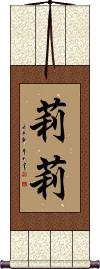
莉莉 is a common way to transliterate the name Lili into Mandarin Chinese.
Energy Sword Body in Concert
Spirit, Sword & Body as One
气剑体一致 often gets translated as “Mind Sword Body,” or “Spirit, Sword, and Body as One.” But I think these translations don't tell you enough about what this is really saying.
In this context, 気, which is the modern Japanese version of 氣, means spiritual and unseen energy or “life energy.” In some cases, 気 can be translated as spirit, feeling, or nature. If defined as the mind, it's more about the invisible or intangible parts of one's mind (or soul).
剣 is the Japanese version of 劍 meaning sword.
体 is the modern Japanese version of 體 meaning body.
The Kanji 一 means one, and in this case, suggests “all in one.”
The Kanji 到 means to send, deliver, or convey. But together, 一到 suggests all these things in agreement, union cooperation, or in concert.
Note: Arguments exist as to whether this should be romanized as Kikentaiitchi, Kikentaiicchi, or kikentaiichi. Technically, if you drop the last character, you get 気剣体一 and kikentaiichi (ki ken tai ichi), which is also a valid phrase.
Muay Thai
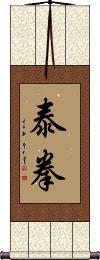
泰拳 is the Chinese title for “Muay Thai.”
This literally means “Thai Fist” and is pronounced like “Tai Chuan” in Chinese.
Muay Thai Netherlands

荷兰泰拳 is the Chinese title for “Muay Thai Netherlands.”
This literally means “Netherlands Thai Fist” or “Holland Thai Fist” and is pronounced like “Hollan[d] Tai Chuan” in Chinese.
The word in Chinese for Netherlands is a transliteration of Holland. I know Holland includes the southern provinces of the Netherlands only, but in Chinese, this is the only name for the whole country.
Nashi
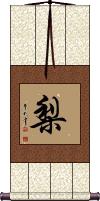
This Japanese Kanji means pear.
This refers specifically to the Pyrus pyrifolia and more specifically the culta variety. This is also known as the Japanese pear, Asian pear, sand pear, or apple pear.
梨 is also a female given name or surname in Japan that beyond Nashi, can be romanized as Rin, Rika, Ri, Nashisaki, or Shina.
In Chinese, this is pronounced like lee or li and just means pear.
Pushing Hands / Tui Sau
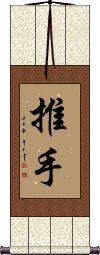
推手 is the martial arts title “Pushing Hands.”
推手 is the title for two-person training routines practiced in internal Chinese martial arts such as Baguazhang, Xingyiquan, Tai Chi Chuan (Taijiquan), Liuhebafa, Chuan Fa, and Yiquan.
The first character means “pushing.”
The second character means “hand” (or “hands”).
This term can be romanized as “Tui Sau,” “Tui Sao,” or from Mandarin, “Tui Shou.”
If you are looking for this term, chances are, you already know the meaning within the context of Tai Chi and other martial arts.
Qi Gong / Chi Kung
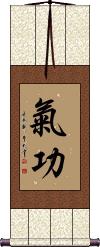
氣功 or Qigong is the title of a technique that is somewhere between medical practice, meditation, and in some cases, religion.
The definition is blurred depending on which school of Qigong you are following. In some cases, it is even incorporated with martial arts.
Some people (even Chinese people) mix this title with Tai Chi (Tai Qi) exercises.
Lately, in China, people will claim to practice Tai Chi rather than Qigong because the Qigong title was recently used as a cover for an illegal pseudo-religious movement in China with the initials F.G. or F.D. (I can not write those names here for fear of our website being banned in China).
You can learn those names and more here: Further info about Qigong
If you are wondering why I wrote “Qi Gong” and “Chi Kung” as the title of this calligraphy entry, I should teach you a little about the various ways in which Chinese can be Romanized. One form writes this as “Chi Kung” or “Chikung” (Taiwan). In the mainland and elsewhere, it is Romanized as “Qi Gong” or “Qigong.” The pronunciation is the same in Taiwan, mainland, and Singapore Mandarin. Neither Romanization is exactly like English. If you want to know how to say this with English rules, it would be something like “Chee Gong” (but the “gong” has a vowel sound like the “O” in “go”).
Romanization is a really confusing topic and has caused many Chinese words to be mispronounced in the west. One example is “Kung Pao Chicken,” which should actually be more like “Gong Bao” with the “O” sounding like “oh” for both characters. Neither the Romanization system in Taiwan nor the Mainland is perfect, in my opinion, and leads to many misunderstandings.
In modern Japan, you may see this written as 気功, but the original 氣功 is still recognized. If you need the Japanese version, please contact me.
Read 10,000 Books, Travel 10,000 Miles
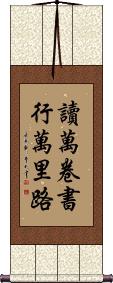
讀萬卷書行萬里路 is a lifelong suggestion for expanding your horizons by gaining knowledge, experience, and seeing the world.
Of course, this was written long ago when it was hard to travel 10,000 miles (at least 1000 years before the invention of the airplane).
With air travel and the business I'm in, I often achieve that lifetime goal on a monthly basis.
However, I am a little behind in the book count.
Note: An ancient Chinese mile (里 or lǐ) referred to in this proverb is about a third of a British/American mile. However, at that time, this was a great distance to travel.
Sariputra
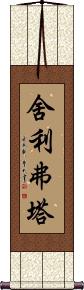
舍利弗塔 is the name Sariputra or Śāriputra in Chinese (Mandarin).
Often written in a shorter form as 舍利弗 (shě lì fú). This name comes from the Sanskrit शारिपुत्र or Śāriputra, and from Pali as Sāriputta.
This name comes from the closest disciple of the Buddha, Śāriputra, who helped establish the legacy of the Sangha (community of monks).
Shaolin Temple
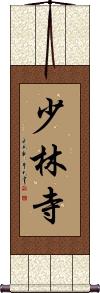
少林寺 is the full title of the Shaolin Temple.
This refers to the Buddhist monastery famous for its kung fu monks.
少林寺 is also known in Japanese, where they use the same characters but romanize them as Shourinji or Shōrinji.
Some believe this monastery and temple represent where Bodhidharma sat with his face to a wall for nine years, leading to his discovery of enlightenment and the establishment of Buddhism in China.
Shingitai / Shin Gi Tai
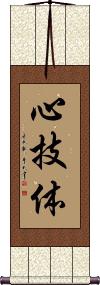
心技体 is the Japanese title “shin gi tai” or “shingitai.”
This can refer to the three elements of Sumo wrestlers or martial artists, “heart-technique-physique.”
Here is what each character represents:
心 (shin) mind, heart, and spirit.
技 (gi) skill, knowledge, and experience.
体 (tai) body and physical effort.
心技体 have the same meanings in Chinese, though this title is used much more often in Japanese.
Shintai
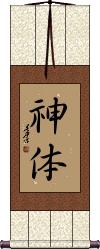
In the context of the Japanese Shinto religion, shintai/shin-tai or 神体 is an object of worship believed to contain the spirit of a deity, typically housed in a shrine.
This may not the the Shintai that you are looking for. This is NOT the Shintai massage technique.
身体 (body/health) and 心体 (heart/mind body) also romanize as Shintai. But I don't know what Saul Goodman is referring to as "light body" though the second character should be 体 which means body.
Shorin Ji Ryu
Shaolin Temple Style
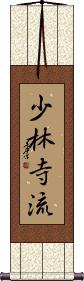
少林寺流 is the Japanese martial arts title “Shorin-ji-ryu.”
Though the first part of the title comes from the Shaolin temple in China. In Japan, this refers to an Okinawa school of karate.
Note: Sometimes, this title is written without the “ji” or “temple” Kanji.
Sword
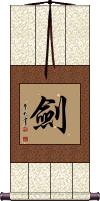
劍 is pronounced “jian” in Chinese. When you say it, imagine that you are making the sound of a sword as it clashes with a metal shield. This might get you closer to the correct pronunciation in Chinese.
I actually wonder if this word came from the metallic ringing sounds of a sword in battle - but such knowledge is lost in history.
The sword is a symbol of a warrior. The one thing that a soldier in ancient China lived and died by. A warrior with his skills and sword proves himself of great value. A warrior who losses his sword instantly becomes worthless.
劍 is an excellent scroll for someone in the military (especially officers of all services - as well as enlisted NCO Marines since they still carry swords even if mainly for ceremonial purposes). Or perhaps someone who practices variations of kung fu or tai chi that involve weapons.
Please note that while this character is understood with the sword meaning in Japanese, you might be looking for the word “katana” which also means sword in Japanese but means “knife” in Chinese.
There are other ways to write sword, and here are a few...


If you are particular about the version you receive, please let me know when you place your order (Note: Special styles are only available from one of our master calligraphers).
Taekwondo
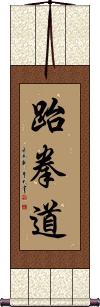
跆拳道 is one of the most widespread types of martial arts in the world as well as being an Olympic sport. Taekwondo was born in Korea with influences of Chinese and Japanese styles combined with traditional Korean combat skills. Some will define it as the “Korean art of empty-handed self-defense.”
In the simplest translation, the first character means “kick,” the second character can mean either “fist” or “punching,” and the third means “way” or “method.” Altogether, you could say this is the “Kick Punch Method.” When heard or read in various Asian languages, all will automatically think of this famous Korean martial art. It is written the same in Japanese Kanji, Chinese, and Korean Hanja characters - so the appearance of the characters is universal. However, you should note that there is another way to write this in modern Korean Hangul characters, which looks like the image to the right. 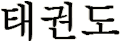
We suggest the original Korean Hanja (Chinese characters) for a wall scroll, but if you need the Hangul version, you must use master calligrapher Cao Bin: Order Taekwondo in Korean Hangul
Note: Taekwondo is sometimes Romanized as Tae-Kwondo, Tae Kwon Do, Taekwon-do, Taegwondo, Tae Gweon Do, Tai Kwon Do, Taikwondo, Taekwando, Tae Kwan Do and in Chinese Taiquandao, Tai Quan Dao, Taichuando, or Tai Chuan Tao.
Tai Chi Wing Chun Kung Fu
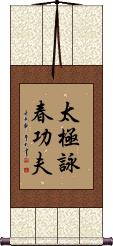
太極詠春功夫 is the title Tai Chi Wing Chun Kung Fu.
Please note that it can be romanized in a variety of ways such as:
Tai Chi Ving Tsun Kung Fu
Tai Qi Yong Chun Gong Fu
Taai Gik Wing Ceon Gung Fu
Be sure this is the right title for what you are looking for before you order.
Tai Chi Chuan / Tai Ji Quan
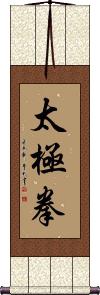
太極拳 is the famous Taoist meditation and martial art exercise. The direct translation of these characters would be something like “grand ultimate fist,” but that does not quite hit the mark for what this title really means.
An early-morning walk through any city in China near a park or an open area will yield a view of Chinese people practicing this ancient technique.
A typical scene is an old man of no less than 80 years on this earth, with a wispy white beard and perhaps a sword in one hand. He makes slow moves that are impossibly smooth. He is steady-footed and always in balance. For him, time is meaningless and proper form, and technique is far more important than speed.
For the younger generation, faster moves may look impressive and seem smooth to the casual observer. But more discipline and mental strength are needed to create perfectly smooth moves in virtual slow motion.
Note: There are two ways to Romanize these Chinese characters, as seen in the title above. The pronunciation and actual characters are the same in Chinese. If you really used English sounds/words to pronounce this, it would be something like “tie jee chew-on” (make the “chew-on” one flowing syllable).
Tai Chi Chuan Dao / Tai Ji Quan Dao
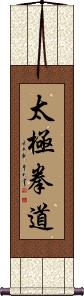
太極拳道 is the common Tai Chi Chuan title with “Dao” (the Way) added to the end.
If you're not sure, I suggest shorter titles such as “Tai Chi Chuan,” or just “Tai Chi.”
Tai Chi Chuan Fa / Tai Ji Quan Fa
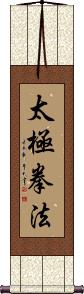
太极拳法 literally translates as “Tai Chi Fist Law” though 拳法 is also known in Japanese as “Kempo” which is sometimes read as “boxing” depending on context.
Fundamental Principles of Tai Chi Chuan
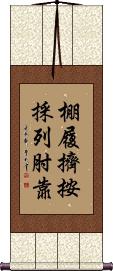
Peng, Lu, Ji, An, Cai, Lie, Zhou, and Kao are the eight fundamentals or forces of Tai Chi Chuan or Taiqiquan.
棚 (Peng) refers to the outward (or upward) expansion of energy.
履 (Lu) is often referred to as “rollback.” Lu is the ability to absorb, yield/deflect incoming force.
擠 (Ji) is often thought of as a “forward press.” However, it is also best described as a “squeezing out of space.”
按 (An) is a downward movement of energy, best translated as “(relaxed) sinking.”
採 (Cai or Tsai) translated as “downward pluck.” Cai is a combination of Lu and An.
列 (Lie or Lieh) is “Split” and is a combination of Peng and Ji.
肘 (Zhou) Elbowing.
靠 (Kao) Shouldering (for when the arms are bound/distance is too close to punch).
Source: https://combativecorner.wordpress.com/2015/12/03/the-8-energies-and-5-movements-of-taijiquan/
Tai Chi / Tai Ji
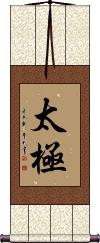
太極 is the shortened title for Tai Chi Chuan or Tai Ji Quan that is sometimes used in Western countries.
Basically just removing the last character which means fist. I don't recommend this two-character selection because it's not really a word without the third character in Japanese and Chinese.
Tai Chi Ball
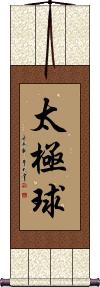
太極球 is the title “Tai Chi Ball.”
This may refer to any number of variations of exercise balls, some with yin-yang themes, others strictly for taichi/taiji or qigong exercises.
Tai Jutsu
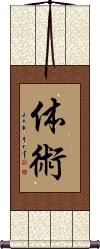
体術 is the martial arts term Tai Jutsu in Japanese Kanji.
Taijutsu is a general term referring to virtually all Japanese martial arts styles that involve the use of the body (perhaps not weapons). The literal meaning of 体術 is “body technique” or “body skill.”
I included the Chinese pronunciation, but this is rarely used in Chinese.
Tarzan
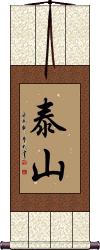
泰山 is Tarzan (a fictional character reared by apes in the jungle) in Mandarin Chinese.
The meaning of 泰山 is large mountain.
泰山 can also represent Taishan township in New Taipei City, Taiwan.
This can also be Mt. Taishan (or Tai Shan) in Shandong, the eastern sacred mountain of China.
In Japanese, this can be the surname Yasuyama or that same Mt. Taishan in China.
A Journey of 1000 Miles Feels Like One
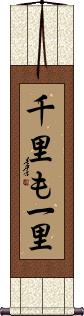
千里も一里 is a Japanese proverb that states “A journey of a thousand miles feels like only one mile.” It is understood that in the proverb, this applies when going to see the one you love.
Note that the “mile” or 里 used in this proverb is an old Chinese “li” (pronounced “ri” in Japanese). It's not actually a mile, as the measurement is really closer to 500 meters (it would take 3 of these to get close to a western mile). Still, 1000里 (333 miles) is a long way.
Better to Travel 10,000 Miles than Read 10,000 Books
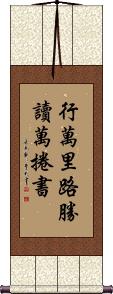
行万里路胜读万卷书 translates a few ways:
To travel ten thousand miles beats reading ten-thousand books.
Better to travel ten thousand li than to read ten thousand books. (a “li” is an ancient Chinese mile)
Traveling thousands of miles is better than reading thousands of books.
No matter how you slice it, this Chinese proverb is claiming that experience is more profound and meaningful than what you can get from a book. Go do it! Don't just read about it.
Work Unselfishly for the Common Good
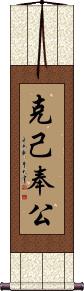
克己奉公 is a Chinese proverb that is often used to express how one should act as a government official. Most of us wish our public officials would hold themselves to higher standards. I wish I could send this scroll, along with the meaning to every member of Congress, and the President (or if I was from the UK, all the members of Parliament, and the PM)
This can also mean: “Place Strict Standards on Oneself in Public Service.”
The story behind this ancient Chinese idiom:
Cai Zun was born in China a little over 2000 years ago. In 24 AD, he joined an uprising led by Liu Xiu, who later became the emperor of the Eastern Han Dynasty.
Later, the new emperor put Cai Zun in charge of the military court. Cai Zun exercised his power in strict accordance with military law, regardless of the offender's rank or background. He even ordered the execution of one of the emperor's close servants after the servant committed a serious crime.
Cai Zun led a simple life but put great demands on himself to do all things honorably. The emperor rewarded him for his honest character and honorable nature by promoting him to the rank of General and granting him the title of Marquis.
Whenever Cai Zun would receive an award, he would give credit to his men and share the reward with them.
Cai Zun was always praised by historians who found many examples of his selfless acts that served the public interest.
Sometime long ago in history, people began to refer to Cai Zun as “ke ji feng gong.”
See Also: Unselfish | Selflessness | Altruism
Wu Chi / Wuji
Without Limit
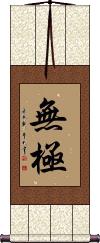
This is Wu Chi or Wuji in Chinese characters.
Wu Chi as a philosophy is often associated with Tai Chi (Taiji).
Yangshuo
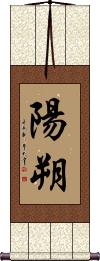
陽朔 is Yangshuo, a famous place not far from Guilin (桂林), Guangxi.
Yangshuo is your destination after a trip down the Li River from Guilin city.
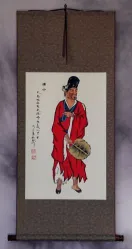
This in-stock artwork might be what you are looking for, and ships right away...
Gallery Price: $63.00
Your Price: $35.00
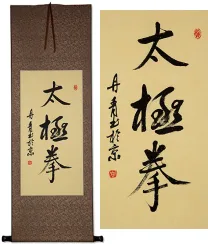
Gallery Price: $87.00
Your Price: $47.88
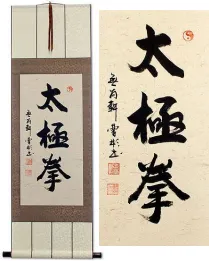
Gallery Price: $200.00
Your Price: $98.88

Gallery Price: $71.00
Your Price: $39.00
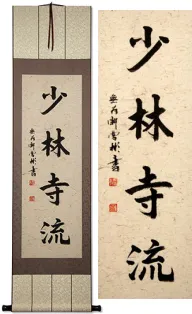
Gallery Price: $180.00
Your Price: $99.88
Gallery Price: $200.00
Your Price: $79.88
Gallery Price: $63.00
Your Price: $35.00
The following table may be helpful for those studying Chinese or Japanese...
| Title | Characters | Romaji (Romanized Japanese) | Various forms of Romanized Chinese | |
| Ba Ji Quan | 八極拳 八极拳 | hakkyo ku ken hakkyokuken hakyo ku ken | bā jí quán ba1 ji2 quan2 ba ji quan bajiquan | pa chi ch`üan pachichüan pa chi chüan |
| Beautiful | 美麗 美丽 | birei | měi lí / mei3 li2 / mei li / meili | |
| Body Karada | 體 体 | karada / tai / te | tǐ / ti3 / ti | t`i / ti |
| Bruce Lee | 李小龍 李小龙 | bu ruu su ri buruusuri bu ru su ri | lǐ xiǎo lóng li3 xiao3 long2 li xiao long lixiaolong | li hsiao lung lihsiaolung |
| Chop Wood, Carry Water | 頓悟之前砍柴挑水頓悟之后砍柴挑水 顿悟之前砍柴挑水顿悟之后砍柴挑水 | dùn wù zhī qián kǎn chái tiāo shuǐ dùn wù zhī hòu kǎn chái tiāo shuǐ dun4 wu4 zhi1 qian2 kan3 chai2 tiao1 shui3 dun4 wu4 zhi1 hou4 kan3 chai2 tiao1 shui3 dun wu zhi qian kan chai tiao shui dun wu zhi hou kan chai tiao shui | tun wu chih ch`ien k`an ch`ai t`iao shui tun wu chih hou k`an ch`ai t`iao shui tun wu chih chien kan chai tiao shui tun wu chih hou kan chai tiao shui |
|
| Choy Li Fut | 蔡李彿 蔡李佛 | cài lǐ fó cai4 li3 fo2 cai li fo cailifo | ts`ai li fo tsailifo tsai li fo |
|
| Da Ji Da Li | 大吉大利 | dà jí dà lì da4 ji2 da4 li4 da ji da li dajidali | ta chi ta li tachitali |
|
| Benevolent and Skilled Doctor | 妙手仁心懸壺濟世 妙手仁心悬壶济世 | miào shǒu rén xīn xuán hú jì shì miao4 shou3 ren2 xin1 xuan2 hu2 ji4 shi4 miao shou ren xin xuan hu ji shi | miao shou jen hsin hsüan hu chi shih | |
| Drain the pond to get all the fish | 竭澤而漁 竭泽而渔 | jié zé ér yú jie2 ze2 er2 yu2 jie ze er yu jiezeeryu | chieh tse erh yü chiehtseerhyü |
|
| Earth | 地 | chi / ji / tsushi / tsuchi | dì / di4 / di | ti |
| Five Elements Tai Chi Fist | 五行太極拳 五行太极拳 | go gyou tai kyoku ken gogyoutaikyokuken go gyo tai kyoku ken | wǔ xíng tài jí quán wu3 xing2 tai4 ji2 quan2 wu xing tai ji quan wuxingtaijiquan | wu hsing t`ai chi ch`üan wuhsingtaichichüan wu hsing tai chi chüan |
| Five Elements | 地水火風空 地水火风空 | chi sui ka fuu kuu chisuikafuukuu chi sui ka fu ku | ||
| Five Families Tsoi Li Hoi Fut Hung | 蔡李何佛雄 | cài lǐ hé fú xióng cai4 li3 he2 fu2 xiong2 cai li he fu xiong cailihefuxiong | ts`ai li ho fu hsiung tsailihofuhsiung tsai li ho fu hsiung |
|
| A Bright Future | 鵬程萬里 鹏程万里 | péng chéng wàn lǐ peng2 cheng2 wan4 li3 peng cheng wan li pengchengwanli | p`eng ch`eng wan li pengchengwanli peng cheng wan li |
|
| Forgive and Forget | 略跡原情 略迹原情 | lüè jì yuán qíng lve4 ji4 yuan2 qing2 lve ji yuan qing lvejiyuanqing | chi yüan ch`ing chiyüanching chi yüan ching |
|
| Gee | 吉 | jí / ji2 / ji | chi | |
| Hero | 英雄 | ei yuu / eiyuu / ei yu | yīng xióng ying1 xiong2 ying xiong yingxiong | ying hsiung yinghsiung |
| Jin Ji Du Li | 金雞獨立 金鸡独立 | kin kei doku ritsu kinkeidokuritsu | jīn jī dú lì jin1 ji1 du2 li4 jin ji du li jinjiduli | chin chi tu li chinchituli |
| A Journey of 1000 Miles Begins with a Single Step | 千里の道も一歩から | sen ri no michi mo i-ppo ka ra senrinomichimoi-ppokara sen ri no michi mo i-po ka ra | ||
| Ki Ken-Tai Icchi | 気剣体一致 | ki ken tai icchi kikentaiicchi ki ken tai ichi | ||
| Hunt Foxes with Stealth, Hunt Wolves in the Open | 闇打狐狸明打狼 暗打狐狸明打狼 | àn dǎ hú li míng dǎ láng an4 da3 hu2 li ming2 da3 lang2 an da hu li ming da lang andahulimingdalang | an ta hu li ming ta lang antahulimingtalang |
|
| Le | 勒 | lè / le4 / le | ||
| Lee | 李 | ri / sumomo | lǐ / li3 / li | |
| Lianne Li-Anne | リーアン | rii an / riian / ri an | ||
| Li | 李 | lǐ / li3 / li | ||
| Li | リー | rii / ri | ||
| Lianne | 莉安 | lì ān / li4 an1 / li an / lian | ||
| Life Energy Spiritual Energy | 氣 气 / 気 | ki | qì / qi4 / qi | ch`i / chi |
| Lili | 莉莉 | lì li / li4 li / li li / lili | ||
| Energy Sword Body in Concert | 気剣体一致 / 氣劍體一致 气剑体一致 | ki ken tai icchi kikentaiicchi ki ken tai ichi | ||
| Muay Thai | 泰拳 | tài quán / tai4 quan2 / tai quan / taiquan | t`ai ch`üan / taichüan / tai chüan | |
| Muay Thai Netherlands | 荷蘭泰拳 荷兰泰拳 | hé lán tài quán he2 lan2 tai4 quan2 he lan tai quan helantaiquan | ho lan t`ai ch`üan holantaichüan ho lan tai chüan |
|
| Nashi | 梨 | nashi | lí / li2 / li | |
| Pushing Hands Tui Sau | 推手 | tuī shǒu / tui1 shou3 / tui shou / tuishou | t`ui shou / tuishou / tui shou | |
| Qi Gong Chi Kung | 氣功 气功 | ki kou / kikou / ki ko | qì gōng / qi4 gong1 / qi gong / qigong | ch`i kung / chikung / chi kung |
| Read 10,000 Books, Travel 10,000 Miles | 讀萬卷書行萬里路 读万卷书行万里路 | dú wàn juǎn shū, xíng wàn lǐ lù du2 wan4 juan3 shu1 xing2 wan4 li3 lu4 du wan juan shu xing wan li lu duwanjuanshuxingwanlilu | tu wan chüan shu hsing wan li lu | |
| Sariputra | 舍利弗塔 | shě lì fú tǎ she3 li4 fu2 ta3 she li fu ta shelifuta | she li fu t`a shelifuta she li fu ta |
|
| Shaolin Temple | 少林寺 | shou rin ji shourinji sho rin ji | shào lín sì shao4 lin2 si4 shao lin si shaolinsi | shao lin ssu shaolinssu |
| Shingitai Shin Gi Tai | 心技体 | shin gi tai shingitai | xīn jì tǐ xin1 ji4 ti3 xin ji ti xinjiti | hsin chi t`i hsinchiti hsin chi ti |
| Shintai | 神体 | shin tai / shintai | ||
| Shorin Ji Ryu | 少林寺流 | shou rin ji ryuu shourinjiryuu sho rin ji ryu | ||
| Sword | 劍 剑 | ken / tsurugi | jiàn / jian4 / jian | chien |
| Taekwondo | 跆拳道 | te kon do / tekondo | tái quán dào tai2 quan2 dao4 tai quan dao taiquandao | t`ai ch`üan tao taichüantao tai chüan tao |
| Tai Chi Wing Chun Kung Fu | 太極詠春功夫 太极咏春功夫 | tài jí yǒng chūn gōng fu tai4 ji2 yong3 chun1 gong1 fu tai ji yong chun gong fu taijiyongchungongfu | t`ai chi yung ch`un kung fu taichiyungchunkungfu tai chi yung chun kung fu |
|
| Tai Chi Chuan Tai Ji Quan | 太極拳 太极拳 | tai kyoku ken taikyokuken | tài jí quán tai4 ji2 quan2 tai ji quan taijiquan | t`ai chi ch`üan taichichüan tai chi chüan |
| Tai Chi Chuan Dao Tai Ji Quan Dao | 太極拳道 太极拳道 | tài jí quán dào tai4 ji2 quan2 dao4 tai ji quan dao taijiquandao | t`ai chi ch`üan tao taichichüantao tai chi chüan tao |
|
| Tai Chi Chuan Fa Tai Ji Quan Fa | 太極拳法 太极拳法 | tài jí quán fǎ tai4 ji2 quan2 fa3 tai ji quan fa taijiquanfa | t`ai chi ch`üan fa taichichüanfa tai chi chüan fa |
|
| Fundamental Principles of Tai Chi Chuan | 棚履擠按採列肘靠 棚履挤按采列肘靠 | péng lǚ jǐ àn cǎi liè zhǒu kào peng2 lv3 ji3 an4 cai3 lie4 zhou3 kao4 peng lv ji an cai lie zhou kao penglvjiancailiezhoukao | p`eng lü chi an ts`ai lieh chou k`ao peng lü chi an tsai lieh chou kao |
|
| Tai Chi Tai Ji | 太極 太极 | taikyoku | tài jí / tai4 ji2 / tai ji / taiji | t`ai chi / taichi / tai chi |
| Tai Chi Ball | 太極球 太极球 | tai kyoku kyuu taikyokukyuu tai kyoku kyu | tài jí qiú tai4 ji2 qiu2 tai ji qiu taijiqiu | t`ai chi ch`iu taichichiu tai chi chiu |
| Tai Jutsu | 體術 体術 | tai jutsu / taijutsu | tǐ shù / / | |
| Tarzan | 泰山 | yasuyama | tài shān / tai4 shan1 / tai shan / taishan | t`ai shan / taishan / tai shan |
| A Journey of 1000 Miles Feels Like One | 千里も一里 | sen ri mo ichi ri senrimoichiri | ||
| Better to Travel 10,000 Miles than Read 10,000 Books | 行萬里路勝讀萬捲書 行万里路胜读万卷书 | xíng wàn lǐ lù shèng dú wàn juǎn shū xing2 wan4 li3 lu4 sheng4 du2 wan4 juan3 shu1 xing wan li lu sheng du wan juan shu | hsing wan li lu sheng tu wan chüan shu | |
| Work Unselfishly for the Common Good | 克己奉公 | kè jǐ fèng gōng ke4 ji3 feng4 gong1 ke ji feng gong kejifenggong | k`o chi feng kung kochifengkung ko chi feng kung |
|
| Wu Chi Wuji | 無極 无极 | wú jí / wu2 ji2 / wu ji / wuji | wu chi / wuchi | |
| Yangshuo | 陽朔 阳朔 | yáng shuò yang2 shuo4 yang shuo yangshuo | ||
| In some entries above you will see that characters have different versions above and below a line. In these cases, the characters above the line are Traditional Chinese, while the ones below are Simplified Chinese. | ||||

Successful Chinese Character and Japanese Kanji calligraphy searches within the last few hours...



